From collection Creating Acadia National Park: The George B. Dorr Research Archive of Ronald H. Epp


Page 1
Page 2
Page 3
Page 4
Page 5
Page 6
Page 7
Page 8
Page 9
Page 10
Page 11
Page 12
Page 13
Page 14
Page 15
Page 16
Page 17
Page 18
Page 19
Page 20
Page 21
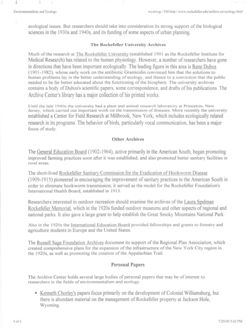
Page 22
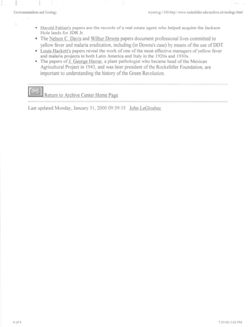
Page 23
Search
results in pages
[Series II] Rockefeller Archive Center
Rock filler Archive Center
PCT Library
Establishing Foundation Archives:
A Reader and Guide to First Steps
Edited by
Kenneth W. Rose
and
Darwin H. Stapleton
Council on Foundations
1991
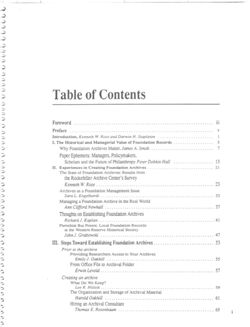
Table of Contents
Foreword
iii
Preface
V
Introduction, Kenneth W. Rose and Darwin H. Stapleton
1
I. The Historical and Managerial Value of Foundation Records
5
Why Foundation Archives Matter, James A. Smith
7
Paper Ephemera: Managers, Policymakers,
Scholars and the Future of Philanthropy Peter Dobkin Hall
13
II. Experiences in Creating Foundation Archives
21
The State of Foundation Archives: Results from
the Rockefeller Archive Center's Survey
Kenneth W. Rose
23
Archives as a Foundation Management Issue
Sara L. Engelhardt
33
Managing a Foundation Archive in the Real World
Ann Clifford Newhall
37
Thoughts on Establishing Foundation Archives
Richard J. Kaplan
41
Parochial But Potent: Local Foundation Records
at the Western Reserve Historical Society
John J. Grabowski
47
III. Steps Toward Establishing Foundation Archives
53
Prior to the archive
Providing Researchers Access to Your Archives
Emily J. Oakhill
55
From Office File to Archival Folder
Erwin Levold
57
Creating an archive
What Do We Keep?
Lee R. Hiltzik
59
The Organization and Storage of Archival Material
Harold Oakhill
61
Hiring an Archival Consultant
Thomas E. Rosenbaum
65
i
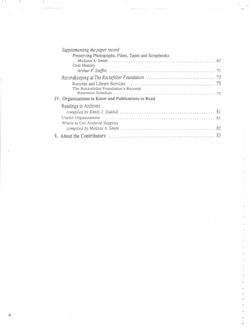
Supplementing the paper record
Preserving Photographs, Films, Tapes and Scrapbooks
Melissa A. Smith
67
Oral History
Arthur F. Sniffin
71
Recordkeeping at The Rockefeller Foundation
73
Records and Library Services
73
The Rockefeller Foundation's Records
Retention Schedule
75
IV. Organizations to Know and Publications to Read
Readings in Archives
compiled by Emily J. Oakhill
81
Useful Organizations
81
Where to Get Archival Supplies
compiled by Melissa A. Smith
82
V. About the Contributors
83
ii
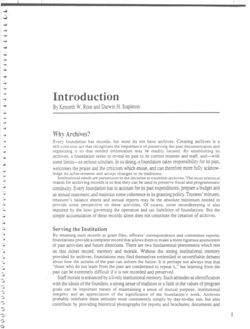
Introduction
By Kenneth W. Rose and Darwin H. Stapleton
Why Archives?
Every foundation has records, but most do not have archives. Creating archives is a
self-concious act that recognizes the importance of preserving the past documentation and
organizing it so that needed information may be readily located. By establishing its
archives, a foundation seeks to reveal its past to its current trustees and staff, and-with
some limits-to serious scholars. In so doing, a foundation takes responsibility for its past,
welcomes the praise and the criticism which ensue, and can therefore more fully acknow-
ledge its achievements and accept changes in its traditions.
Institutional needs are paramount in the decision to establish archives. The most practical
reason for archiving records is so that they can be used to preserve fiscal and programmatic
continuity. Every foundation has to account for its past expenditures, prepare a budget and
an annual statement, and maintain some coherence in its granting policy. Trustees' minutes,
treasurer's balance sheets and annual reports may be the absolute minimum needed to
provide some perspective on these activities. Of course, some recordkeeping is also
required by the laws governing the operation and tax liabilities of foundations. But the
simple accumulation of these records alone does not constitute the creation of archives.
Serving the Institution
By retaining such records as grant files, officers' correspondence and committee reports,
foundations provide a complete record that allows them to make a more rigorous assessment
of past activities and future directions. There are two fundamental phenomena which rest
on this richer record: memory and morale. Without the strong institutional memory
provided by archives, foundations may find themselves embroiled in unverifiable debates
about how the actions of the past can inform the future. It is perhaps not always true that
"those who do not learn from the past are condemned to repeat it," but learning from the
past can be extremely difficult if it is not recorded and preserved.
Staff morale is enhanced by a lively institutional memory. Such attitudes as identification
with the ideals of the founders, a strong sense of tradition or a faith in the values of program
goals can be important means of maintaining a sense of mutual purpose, institutional
integrity and an appreciation of the significance of the foundation's work. Archives
probably reinforce these attitudes most consistently simply by day-to-day use, but also
contribute by providing historical photographs for reports and brochures, documents and
1
other materials for exhibits and a safe repository for critical records which trustees and staff
have committed precious time and effort to produce. There are few things more discourag-
ing than discovering that valuable ideas and data have been lost.
Serving the Public
Beyond these internal reasons for maintaining archives stands the broader issue of social
responsibility. With the privilege of nonprofit incorporation comes certain expectations,
among them a deeper level of accountability to the public than profit-making enterprises.
An archives that routinely provides some public access to a foundation's historical record
(for example, to grant files which are more than 20 years old) demonstrates a positive regard
for the public's legitimate interest in its activities.
Scholarly Research
In all likelihood, the segment of the public most interested in foundation records is the
scholarly community. The majority of researchers who visit the Rockefeller Archive Center
to use foundation records are scholarly users-university and college professors conducting
research for articles and books, and doctoral candidates at work on dissertations. In 1989,
129 of these academic researchers visited the Archive Center, comprising 64 percent of the
199 researchers through the Archive Center's doors that year. By comparison, 35 (17
percent) of the Center's 1989 researchers were nonacademic researchers (independent,
unaffiliated researchers, journalists, film producers, etc.), another 15 (7 percent) were
undergraduate or high school students and 20 others (10 percent) were representatives of
institutions whose records are housed at the Center.
In several papers in this volume, academic users of foundation archives echo Jim Smith's
argument in the 1989 Rockefeller Archive Center Newsletter, that foundation archives are
valuable resources because they often contain the only detailed record documenting the
work of some of "the most fragile and ephemeral organizations that comprise [the]
nonprofit sector." For scholarly researchers, a foundation's archives is as potentially rich
in resources as the number and variety of institutions, individuals and program areas it has
funded. Scholars are rarely interested in the history of philanthropy or specific foundations
per se; of the more than 1,500 researchers who have visited the Rockefeller Archive Center
in the 15 years it has been open, fewer than 50 have been interested in the history of
philanthropy or foundations as such. What usually interests them most is a foundation's
role in the history of some other institution or set of institutions (a school, college,
university, hospital, museum, research institute, etc.) or subject area (agricultural develop-
ment, the arts, black education, child welfare, Latin American fiction, medical education,
molecular biology, the natural sciences, public health, race relations, the social sciences,
etc.), or support for a particular individual artist, author, composer, educator, historian,
medical researcher or scientist. In other words, it is what a foundation does outside its
offices that is of most significance to academic researchers, and that record is usually best
preserved in the correspondence, letters of recommendation, evaluations, reports and
memoranda located in the grant files. Annual reportsprarely are sufficient for their purposes;
the value of the archives for these users rests with the details contained within well-pre-
served grant files. The project files of the various philanthropies housed at the Rockefeller
Archive Center have served as source material for at least 118 books and dissertations and
175 scholarly articles since the Center opened in 1975. (We estimate that the Center has
learned of only about two-thirds of the publications that cite its collections.)
2
The State of Foundation Archives:
Results From the Rockefeller
Archive Center's Survey
By Kenneth W. Rose
D
uring the past fifteen years, both scholars and people working in what has become
known as the "third sector" have become increasingly interested in the role and history of
philanthropy and nonprofit institutions in American life. This interest is manifest in the
growing number of publications in the field; in the development of centers for the study of
philanthropy at such academic institutions as the City University of New York, Indiana
University, Case Western Reserve University and Duke University; and by the appearance
of The Chronicle of Philanthropy, inewspaper serving the philanthropic community. Along
with this growing interest in the history of philanthropy has developed, albeit more slowly,
an interest and concern with preserving foundation records, necessary for accurately
documenting the role and impact of philanthropy.
The Historical Value of Foundation Records
Foundations are a unique part of the nonprofit world, providing the money needed to
maintain and support many institutions, including research centers in science and public
policy, organizational advocates for particular causes and issues, social service agencies,
hospitals, symphony orchestras, universities, libraries, museums, and, on occasion, ar-
chives. Foundation records often contain not only information about the internal workings
of the foundation itself, but also important and often difficult to find information about a
variety of other institutions and organizations, many of which wither away in a few year's
time without leaving any paper trail of their own. Since applicants for financial support
have to explain their backgrounds and needs to funders, foundation records are often rich
in the details of the histories of other organizations.
James A. Smith, a leading historian of the nonprofit sector and public policy, recently
described three areas in which he finds foundation records to be of value. First, foundation
archives "are virtually the only repository of material about the most fragile and ephemeral
organizations that comprise the nation's nonprofit sector, the movements and causes that
have not succeeded or that once flourished briefly and have faded from the scene."
Secondly, the exchanges between nonprofit organizations and foundation staff collected in
foundation archives document "how strategies for effecting social change have evolved."
23
Thirdly, "to the extent that foundations have encouraged research and professional training,
their records are also a place where policy ideas and initiatives (and the people who will
bring them about) can often first be glimpsed."
Dr. Smith's categories illustrate the usefulness of the records of foundations active at the
national level. Yet most foundations operate more regionally or locally, and at this level
philanthropy and foundations play perhaps an even greater role in policy development and
institutional support. As an editor of the Encyclopedia of Cleveland History (1987) and the
author of a doctoral dissertation about race relations and social reform in Cleveland after
World War II, I have found philanthropic records of double value in studying the history
of the Cleveland community. First, both local and national foundations have made grants
to Cleveland-area organizations, and the records of these grants in these foundations'
archives provided documentation of the development of particular institutions, many of
which we often take for granted, such as nursing homes and cultural organizations, and for
which other documentation was scant. Secondly, the internal correspondence, reports and
meeting notes in these foundations' archives greatly enhanced my understanding of how
local civic leaders and foundation officials used philanthropy to try to cope with social
changes during the 1950s and 1960s. 2
The Rockefeller Archive Center Survey
The largest and richest single gathering of foundation records is located at the Rockefeller
Archive Center in North Tarrytown, New York, which was founded as a division of The
Rockefeller University in 1974 to bring together the archives of the Rockefeller family, the
Rockefeller Foundation, the Rockefeller Brothers Fund and The Rockefeller University. In
recent years the records of two notable non-Rockefeller philanthropies have been donated
to the Archive Center, giving the Center the archives of seven of the nation's leading
foundations. In addition to the archives of its founding institutions-the Rockefeller
Foundation and the Rockefeller Brothers Fund-the Archive Center now houses the
archives of the Commonwealth Fund, the China Medical Board of New York, the Russell
Sage Foundation, Jackson Hole Preserve, Inc. and the Rockefeller Family Fund.
Because of its position as the major repository of foundation records and the presence
on its Governing Council of historians and foundation officials who are leaders in the
promotion of philanthropic history, the Archive Center has sought to encourage other
foundations to preserve their records and make them available to researchers. In 1987-
1988, the Center undertook a survey of the thousand largest American foundations to assess
to what extent foundations were preserving their records and granting access to scholars. 3
The survey revealed the not-so-surprising fact that only a limited number of foundations
have deposited their records in archives or have established on-site archives, as the Ford
Foundation and the MacArthur Foundation have done. More surprising, however, given all
that we had been told prior to our survey about how secretive foundations are, many
foundations expressed a willingness to make material available to researchers.
Survey Methods and Results
In early 1988, the Archive Center sent a five-page questionnaire to the thousand largest
foundations according to the Foundation Center's 1987 ranking by assets. This group
included private foundations active nationally and internationally, corporate foundations,
community foundations, and small foundations active in restricted local communities. The
largest foundation surveyed was the nation's largest, the Ford Foundation, with $4.76
billion in assets and total giving in 1986 of $169.7 million. The smallest foundations
24
included in our survey had assets of $10.7 million. For purposes of comparison, the
foundations in the middle of the Foundation Center's 1987 ranking had assets of about
$23.2 million.4
The first mailing, sent out in January 1988, produced 256 responses, and a second mailing
to nonrespondents in July 1988 eventually increased the total number of responses to the
survey to 394, or 39.4 percent. As one might expect, the largest foundations responded in
greater numbers than did those with small or no staff. Of the top 500 foundations, 225
responded (45 percent rate of return; 57.1 percent of all respondents), and 169 of the second
tier of 500 responded (33.8 percent rate of return; 42.9 percent of all respondents). (See
Table 1 for a summary of the results of the survey, and Table 2 for a tabulation of responses
by foundation size.)
Not all respondents completed the survey, however; some chose to reply with letters,
which we culled for applicable information and have included in the totals that follow.
These letters sometimes were form letters declining to participate in the survey, but others
were more substantive. Indeed, many of the letters offered insight into and explanations of
the kinds of responses we received to survey questions, revealing the ideas, attitudes and
practices of foundation officials who have responsibility for their organization's records.
The survey questionnaire first asked respondents to tell us a little about the foundation's
history-its founding date, its historical areas of funding, its geographic service area and
any particularly important funding restrictions-which we thought would be important to
researchers using The Availability of Foundation Records: A Guide for Researchers, which
includes the responses we were granted permission to publish. 5 These questions were
followed by the heart of the survey, a series of questions about the records and researcher
access.
Archival Issues
Of the 394 respondents, only 43 (10.9 percent) had deposited their records in a library or
archives or had established their own archives on site. By far the largest number of
these-32 (74.4 percent)-were among the largest 500 foundations and 14 of them were
among the top 100. Twenty-three foundations reported that they were considering a future
deposit of their materials. In terms of managing their records, however, the responses were
somewhat more encouraging. More than a third of the respondents (140, or 35.5 percent)
reported that they had archival or records management policies and procedures in place,
and another 42 (10.6 percent) had such measures under consideration. Again, more than
half (84, or 60 percent) of the foundations with formal policies for handling their records
were among the top 500 foundations. But only 50 foundations employed someone who was
trained in archival practice, records management or library science. By and large then, the
fate of these records is in the hands of staff who lack professional training in this area.
Despite the lack of professional records management or archival training by foundation
staff, an encouragingly significant number of foundations were able to describe clearly the
types of records maintained by the foundation. More than 300 of the 394 responding
foundations completed a table indicating what records existed in the office files, indicating
an awareness of the variety of records maintained and an ability to gain access to them (See
Table 3). Not surprisingly, some foundations were able to complete the table in more detail
than were others.
Alarming Reports on Preservation
While the figures themselves on records management and archival policies might be
encouraging, the correspondence from foundation officials describing their policies and
practices was most alarming. It often revealed an emphasis on the most negative side of
25
records management: the wholesale destruction of files according to perceived current
needs, the requirements of law and IRS regulations, with an eye always on the budget. "We
only keep subject files for three years," wrote the executive director of one of the top 100
foundations. "We strive to keep paperwork to a minimum at all times," wrote the leader of
a foundation ranked in the 500s, "and we review and strip our files annually following the
Internal Revenue Service Records Retention Guidelines. Our goal is to concentrate on the
current operation and support worthy grant requests as we are able." Another foundation
distinguished between "significant long term grantees," whose files are kept "for an
indefinite period," and other grantees, whose "detailed" files are "consolidat[ed], cull[ed],
and eliminat[ed] four years after the termination of the most recent grant." The president
of a mid-size corporate foundation noted that his organization does "not keep detailed data
beyond the three years required and many of the requests are never filed if we do not expect
to need the data at a later time."
Most revealing was a letter from the president of a 40 year old family foundation active
in funding environmental projects, who reported:
We keep our financial records for whatever length of time the regulatory
authorities require, at which point we dispose of them. Other records are kept
for three or four years and then are disposed of.
On those odd occasions when we may want to refer to something further
back than that, we will go to one of our grant recipients to see if they have the
material we are looking for in their files and if not, we just forget it.
I can't honestly say that this has ever inconvenienced us or those that we
have supported.
If this operating procedure and the attitudes behind it are widespread in the foundation
community, a precious record of philanthropic activity is being irretrievably lost. Those of
us concerned with promoting the orderly preservation of philanthropic records clearly
have
a great deal to do to educate major segments of the foundation world about the value and
importance of archives.
Researcher Access
The survey results demonstrate that policies for researcher access to foundation records
vary widely. Materials at the Rockefeller Archive Center are generally open to qualified
scholars, although some limitations have been defined by the donors. Rockefeller Founda-
tion records are open after twenty years, for example, and Rockefeller Brothers Fund grant
files are open after ten years. Our survey showed that only 46 foundations (11.7 percent),
including those whose records are at the Archive Center, reported that their records are
open to researchers. Nearly twice as many-86 (21.8 percent)-reported that their records
are closed to researchers. Significantly, more than half of the respondents-203 (51.5
percent)-said they would be willing to make material available to researchers on a
case-by-case basis. While this admittedly gives foundations a great deal of latitude in
deciding who gets access and who does not, this was one of the surprises of the survey.
Taken together with those foundations with open records, it means that nearly two-thirds
of the respondents (249 or 63.2 percent) will provide some access to researchers. Along
similar lines, when we asked whether the foundation staff was willing to help researchers
answer questions about the foundation, 289 (73.3 percent) said they were.
26
C
Reasons for Restricted Access
In explaining refusals or reluctance to grant access to researchers, foundation officials
repeated several themes. One was the small size of the staff and the necessary limitations
this imposed on the foundation's ability to provide assistance and access to researchers.
One foundation ranked in the 600s noted that, "to preserve the maximum dollars for
charity," it operated without a fulltime staff, and the two trustees who handle its grantmak-
ing and administration "feel under a heavy duty to focus [their] time
for charitable
purposes." Many foundations cited the small size of staffs-if, in fact, there is any staff at
all-as the reason why material was not available to scholars. Even foundations willing to
provide access on a case-by-case basis argued that the amount of staff time required to help
the researcher would determine which researchers would be given access.
Another reason given for not providing access regarded the youthful age of the founda-
tion. "We are only a four-year-old community foundation" with small assets, wrote one
official. "Our information is not very extensive as of yet" and "we have yet to develop a
policy on preservation of our records." Indeed, there is reason to believe that there is a
natural evolution that occurs within some foundations that gradually promotes the develop-
ment of records management policies and, perhaps ultimately, archival policies. One of the
ten largest foundations maintains good "working files," according to one official, but these
have not yet "taken on the majesty of an archives." This official indicated that the
"archivization" of its records was a step that would be taken at some future date. Wrote
another foundation president, "We would prefer to reach at least our twenty-fifth year before
opening what archival material is now in the file."
Other foundations deny access to researchers because of their desire to avoid publicity.
"Our trustees prefer that we do not publicize or discuss the foundation methods or practices
in grantmaking," wrote the executive director of one the nation's top 100 foundations. This
inclination to work behind the scenes with little or no publicity is probably representative
of many of the foundations that did not respond to our survey.
Some foundations have a reasoned argument for denying access, believing their records
to be confidential contracts with individual recipients of aid. Many foundations that provide
fellowships to researchers or scholarships to students consider material related to this
support to be confidential. The president of a foundation devoted to providing scholarships
for women mentioned "the confidentiality of our case files," but recognized that this was
only one aspect-albeit a major one-of the organization's records. One of the top 200
foundations, whose grants consist solely of fellowships, considers all of its material
confidential, but will permit scholars to look at particular files "if they obtain permission
from the persons involved (or their heirs or executors)."
A Perception of Insignificance
The responses which indicated a perception that the foundation's records are insignifi-
cant present more of a problem for both historians and archivists to address. Some
foundation officials were rather disparaging toward the value of their records, and, ap-
parently, of the importance of their own work. "I do not believe the foundation's records
would be sufficiently noteworthy for your purposes," wrote an official of a foundation in
the top 900. The phrase "sufficiently noteworthy" was repeated in several letters. An official
of a foundation ranked among the top 200 argued that his foundation's records "are
so
limited as to be of little interest or use to researchers." Occasionally this perception
of
insignificance stemmed from the fact that files are routinely discarded. The executive
director of one of the top 100 foundations noted that his organization keeps its subject files
27
for only three years, and understandably added, "I doubt that historians would find much
here of interest."
Waiting for Clio
While a significant number of foundation officials indicated their own view that their
records were not important, responses to our survey also showed that the foundation
community for the most part has yet to receive any indication from the scholarly community
that these materials are important, useful or valuable. When asked about policies on
researcher access, many foundations responded that they had never received an inquiry
about access to their records and had not established a policy relative to this issue. "We've
never been asked," was a common response. "In the 21 years I have been handling the
foundation's records," wrote the president of one corporate foundation ranked in the 400s,
"the only requests for access have been from the IRS and they were not scholarly." This
lack of scholarly interest in these records is most dangerous at the local and regional level,
where limited staff for administrative recordkeeping and the present-mindedness of foun-
dation officials are most likely to lead to the destruction of records. Where financial
resources for administration and staff are viewed as extremely limited, scholarly interest
could serve as a countervailing force to prevent destruction of records.
Conclusion
Various pressures on larger, national foundations, including requests from scholars and the
concerns of historically-minded colleagues in the philanthropic community, will help
promote systematic recordkeeping and preservation of records. But it is with those
foundations closely tied to a corporation, a family or a single individual, active in one
locality or a region, that historians, archivists and members of the foundation community
interested in preserving the rich history of American philanthropy must be most active to
promote preservation. For these foundations, especially in their early years when the
institutional memory is not an item of concern, we should undertake educational and
promotional efforts so that future executive directors will not report, as one did to us, "our
records of past grants are spotty at best and in a great many cases nonexistent."
Since 1987, when planning began for the Archive Center's survey, there have seen signs
that such educational and promotional efforts are beginning, especially within the founda-
tion community among such organizations as the Council on Foundations and the Founda-
tion Center. Indeed, an increasing number of foundations have expressed an interest in
depositing their records in archives. When the Field Foundation went out of existence, for
example, its records went to the University of Texas at Austin, and the Carnegie Corporation
of New York recently deposited its archives at Columbia University. One result of our
survey has been that several foundations have consulted the Archive Center staff for advice
about the deposition of their records, and several more have asked for information about
the records management practices of other foundations. We hope that the results of our
survey will promote a larger and more systematic campaign within the foundation commu-
nity and among historians to promote the orderly maintenance, preservation and use of
foundation records.
28
What Do We Keep?
By Lee R. Hiltzik
T
he central question in establishing an archives is, "What do we save?" Matters of
organization, storage, conservation and researcher access all hinge upon the answer to this
question.
The decision to keep records has to be based on an estimation of the material's
significance. In archival terms, this process of evaluating records is called "appraisal,"
although the monetary value of material is not an issue (and is usually negligible). Instead,
the appraisal process weighs both the uniqueness of the material and the needs of the
institution against the limitations of the archival storage area and the institution's budgetary
and personnel constraints.
Generally, records should be placed in an archives because: (1) they will be used in the
future operation of the foundation; (2) they need to be preserved for legal protection of the
institution; or (3) they have historical value because they contain the only detailed
information about the beginnings of the foundation, its officers and staff and its programs.
The following list includes the most commonly retained records in foundation archives.
(Asterisked sub-categories contain the most vital information.)
(1) Records of administrative significance: Materials that document many of the daily
activities of the foundation and its decisionmakers, including:
Minutes of the board of trustees*
Decisions recorded in office memoranda*
Policy papers*
Outgoing and incoming correspondence*
Grant-related files*
Reports generated from committee work
Minutes of staff meetings
Office subject files
(2) Materials preserved for legal protection: These include:
Personnel files*
Employee health office files*
Grant declinations
(3) Materials of historical value: Other historically significant material that documents
the activities of the foundation and its officers include:
Annual reports*
Personal papers of key officers of the foundation*
59
Photographs
Audio/visual material
These categories are not mutually exclusive. Indeed, many records kept initially for legal
purposes or administrative use will be historically significant in the long term.
At first glance, the above list of material to preserve appears quite comprehensive and
may seem to argue that everything should be kept. Yet a good records management policy
helps identify material that can be safely discarded. Materials that are not unique to a
particular organization often are not necessary to retain. Many foundations hold materials
which are not unique to their operation, such as files of magazines or newspapers, or files
of clippings and reprints, all of which probably can be found at major research libraries and
therefore may not be worth retaining. Also, duplicate files may be discarded. It is not
necessary, for example, to keep unannotated copies of the same committee reports, public
relations brochures and staff memoranda in the archival files of every foundation officer.
Deciding what should be saved in an archive is not an easy task, but everything produced
by a foundation cannot be saved. In these days of massive photocopying and word processor
output, even an archive with large storage capacity can be quickly overwhelmed. At the
other extreme, without an archive, many institutions are destroying the records of their
activities and accomplishments and cannot learn and build from their mistakes.
60
The Organization and Storage
of Archival Material
By Harold Oakhill
P
roper organization and storage of archival material are crucial to the success of any
archival program. The former provides ready access to the information that the material
holds, while the latter ensures that the material is preserved for as long as possible.
Organization
The organization of archival material is maintained on two levels, the intellectual and the
physical. The intellectual organization, or control, involves recording and describing the
type and range of information included in the material, such as names, subjects, dates, type
of record (financial, correspondence, reports) and type of document (photographs, com-
puter tapes, video tapes). Physical control involves recording the storage location of each
group of records and the box number of each file SO that they may be easily retrieved. As
we will see, the intellectual control eventually merges with the physical control. When the
archive has been properly organized, a user will be able to determine that a particular piece
of information exists in a particular file (intellectual control) and that that file can be found
in a particular box on a particular shelf (physical control).
Arrangement
Archivists adhere to two standards when developing intellectual control over a body of
material: Respect des fonds and maintain original order. Respect des fonds refers to the
respect given to the office of origin, or provenance, of a group of records. The records of
one institution, division or office should not be intermingled with those of another. The
original order in which the documents are arranged should also be maintained. The filing
system by which the records were organized should be left intact and the names of files
and folders titles left unchanged. In general, the organization of the material should be
altered as little as possible.
There are two reasons for following these principles. One is purely practical: "if it ain't
broke, don't fix it." Each body of records will show some degree of organization and some
sense of a filing system. If such a system already exists, there is no need to develop another
one. This is especially true in developing an archive for an existing institution. The
arrangement of records in the archives should be essentially identical to their arrangement
in the filing department. There will be a continuous flow of older, inactive records from
61
the filing department to the archive, and having identical filing systems will make this
transfer easier.
The second reason for leaving the original order of records intact is to preserve the
evidential information it bears. Much can be learned about an organization simply by
looking at the manner in which its records were preserved and organized. By reading a list
of file titles and by noting what was saved and what was not saved, a researcher can quickly
learn what the staff of the organization thought was important, what the fields of interest
were, what projects or activities were supported, what the perceived purpose or mandate
of the organization was, what the organization's goals were and how it achieved (or
attempted to achieve) those goals. If the records of the organization were drastically
rearranged, these insights would be lost.
To gain further control over the material and to facilitate the merging of the intellectual
control with the physical control, a standard archival hierarchy of record groups and series
is developed from the existing organization. All of the records created or collected by an
institution constitute its archive. The archive is made up of record groups, which are
materials of a similar provenance (source) or generic makeup, such as the records from
different departments or offices. Record groups are made up of series, which are groups of
files relating to a particular subject or theme. For example, in the archive of a philanthropy
the Project Files record group would be made up of series which reflect the various
programs or divisions. Remember that the original filing system and organization of the
files should suggest these record groups and series. Series are made up of individual files,
which are collections of documents bearing on a specific subject. Each file is made up of
individual documents, or items, which are the lowest unit of archival control. A document
can be a one-page letter, a one-hundred-page report or a computer tape.
Description
Finding aids, or registers, should be developed next to describe the organization of the
records. There should be a general description of each record group that includes important
themes or issues covered by the material, the types of documents included, the quality of
the documentation, inclusive dates, the physical size of the record group (expressed in shelf
footage or number of boxes) and its provenance. A list of the series in that record group
should also be included. Each series should be described, followed by a list of file titles in
the series, listed in the same order as the material is arranged physically. Archival material
is generally stored in boxes (see below) and the number of the box each file is stored in is
listed here, too. Since the series description also serves as a box list, it is here that the
intellectual and physical control of the material meet. At the least, the series register should
include the full title of each file, the inclusive dates of the material in that file, and its box
number. The most detailed registers also include a description of the contents of each file.
Numbering the folders consecutively and noting the numbers in the register adds another
level of control over the material.
Many institutions have a central index where the names of individuals, institutions,
subjects and dates derived from the incoming and outgoing correspondence are recorded
along with the file title where that piece of correspondence can be found. If such an index
does not exist, the list of file titles becomes even more important, since it is the only access
point to the material. In this case, one of the archivist's first priorities after creating a finding
aid would be to work up a rudimentary index of the most important or most commonly
requested subjects, names and documents.
Once the material has been arranged on shelves the creation of a shelf list index completes
the picture. The index is an alphabetical list of the record groups and series noting the
62
physical location of each.
Storage
A
proper storage area and storage policies are crucial to the long-term survival of archival
material. A secure, clean, climate-controlled area free from the risks of fire, flood, theft and
sunlight must be appropriated or created.
Documents should be stored in boxes, never stacked loosely on shelves. Boxes help keep
the material clean, reduce their exposure to harmful lighting and make handling the material
easier. Record cartons or archive storage cases made of acid-free materials should be used.
Virtually all paper manufactured since the mid-nineteenth century contains acid, some more
than others. Acid causes the paper to become yellow and brittle; newsprint, for example,
is very acidic. Since acid migrates from an area of high acidity to an area of low acidity,
acid-free containers will draw some of the acid out of the documents. Files should also be
refoldered in acid-free folders to further stabilize the material.
Steel shelving with baked enamel paint is best. Wood shelving should be avoided since
it is combustible. Treated lumber, even when painted or stained, gives off formaldehyde
which will discolor and even damage paper over an extended period of time. Archival
material should never be stored on the floor.
Ideally an archive storage vault should be of fire-proof construction such as re-enforced
masonry. There should be no unnecessary pipes, ducts or electrical junction boxes in or
running through the vault. Pipes represent a potential for water damage; junction boxes, a
potential fire source. Moreover, all of these fixtures will require maintenance and repair,
which will in turn bring debris, disruption and security problems.
The temperature and humidity of a storage area should be carefully controlled and
monitored. A temperature of 68°F and 50 percent relative humidity is best, although a
temperature between 60°F and 70°F is acceptable. The most important factor is consistency.
Pick a temperature that can be most easily and efficiently maintained and stick to it.
Constant changes in temperature and humidity are what cause a document to deteriorate.
There should be no windows in the storage area, since prolonged exposure to sunlight
is extremely harmful to all types of documents. Ground floor windows also represent a
security liability. Windows that open can also play havoc with the climate of a vault and
provide access to all sorts of harmful items, including dirt, pollutants, fungi, insects and
other forms of wildlife: I have seen pigeons in other archival stack areas, and another
archivist found a squirrel in improperly stored materials that were being transferred to the
Archive Center.
For fire protection, the storage area should have smoke detectors and fire extinguishers.
A sprinkler or non-toxic gas discharge system is desirable. The system should be capable
of being activated both manually and automatically through heat sensors.
Archival material should be stored in its own secure room with a door and a lock. The
room, or vault, should not be used for any other purpose or activity. Archive staff work
areas and the reading area should be outside the vault. Access to the room should be limited
to the archive staff, if possible, to prevent theft, unauthorized access, and to keep the
material in order. It is standard archival policy not to let users wander through the stacks,
picking out their own material as in a library. Misfiled folders and documents would be
virtually impossible to find again.
Finally, limited access to the vault helps the archivist monitor the use of the archive.
Material should be charged out to users, and the archivist should record the user's name,
the name of the file(s) and the date, to ensure the timely return of the material. The archivist
should also make every effort to record the number of users and requests, the types of
information being sought and the files that were used. Archives which are heavily used are
perceived as being more valuable than those which get little use. Therefore, these statistics
63
C
0
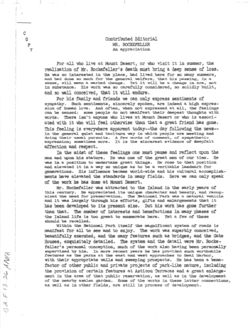
Contributed Editorial
P
MR. ROCKETELLER
Y
An appreciation
For all who live at Mount Desert, or who visit it in summer, the
realization of Mr. Rockefeller's death must bring a deep sense of loss.
He was so interested in the place, had lived here for SO many summers,
and had done so much for the general welfare, that his passing, in a
sense, will mean a marked change. Yet it will be a change in era, not
in substance. His work was so carefully considered, so solidly built,
and so well conceived, that it will endure.
For his family and friends we can only express sentiments of
sympathy. Such sentiments, sincerely spoken, are indeed a high expres-
sion of human love. And often, when not expressed at all, the feelings
can be sensed: some people do not manifest their deepest thoughts with
words. There isn't anyone who lives at Mount Desert or who is associ-
ated with it who will feel otherwise than that a great friend has gone.
This feeling is everywhere apparent today--the day following the news--
in the general quiet and taciturn way in which people are meeting and
doing their usual pursuits. A few words of comment, of sympathetic
expression; sometimes more. It is the sincerest evidence of deepfelt
affection and respect.
In the midst of these feelings one must pause and reflect upon the
man and upon his stature. He was one of the great men of our time, He
was in a position to undertake great things. He rose to that position
and elevated it in a way so unique as to be a veritable landmark for
generations. His influence became world-wide and his cultural accomplish-
ments have elevated the standards in many fields. Here we can only speak
of the work he has done at Mount Desert.
Mr. Rockefeller was attracted to the Island in the early years of
this century. He appreciated its unique character and beauty, and recog-
nized the need for preservation. The National Park was a natural vehicle
and it was largely through his efforts, gifts and enlargements that it
has been developed to its present size. But his work has gone further
than that. The number of interests and benefactions in many phases of
the Island life is too great to emmerate here. Yet a few of these
should be recalled.
Within the National Park itself the magnificent system of roads is
manifest for all to see and to enjoy. The work was superbly conceived,
beautifully executed, and the many features such as bridges, and the Gate
Houses, exquisitely detailed. The system and the detail were Mr. Rocke-
feller's personal conception, much of the work also having been personally
supervised by him. In more recent years he has provided such worthwhile
features as the parks at the east and west approaches to Seal Harbor,
with their appropriate walls and sweeping prospects. He has been a bene-
factor of other public and private projects of park-like nature, including
the provision of certain features at Asticou Terraces and a great enlarge-
ment in the area of that public reservation, as well as in the development
of the nearby azalea garden. Some of the works in these latter connections,
as well as in other fields, are still in process of development.
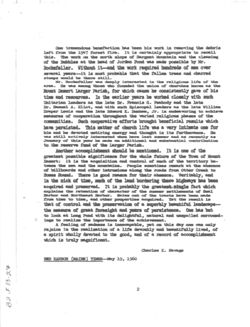
One tremendous benefaction has been his work in removing the debris
left from the 1947 forest fire. It is certainly appropriate to recall
this. The work on the north slope of Sargent Mountain and the cleaning
of the Bubbles at the head of Jorden Pond was made possible by Mr.
Rockefeller. Without it-and the work required hundreds of men over
several years-it is most probable that the fallen trees and charred
stumps would be there still.
Mr. Rockefeller was deeply interested in the religious life of the
area. He was among those who founded the union of churches known as the
Mount Desert Larger Parish, for which cause be consistently gave of his
time and resources. In the earlier years he worked closely with such
Unitarian leaders as the late Dr. Francis G. Pesbody and the late
Dr. Samuel A. Eliot, and with such Episcopal leaders as the late William
Draper Lewis and the late Edward K. Dunism Jr. in endeavoring to achieve
measures of cooperation throughout the varied religious phases of the
commuties. Such cooperative efforts brought beneficial results which
have persisted. This matter of church life was a very intimate one for
him and he devoted untiring energy and thought in its furtherance. He
was still actively interested when here last summer and as recently as
January of this year he made an additional and substantial contribution
to the reserve fund of the Larger Parish.
Another accomplishment should be mentioned. It is one of the
greatest possible significance for the whole future of the Town of Mount
Desert: it is the acquisition and control of much of the territory be-
tween the sea and the mountains. People sometimes remark at the absence
of billboards and other intrusions along the roads from Otter Creek to
Somes Sound. There is good reason for their absence. Veritably, and
in the nick of time, much of the land bordering these highways has been
acquired and preserved. It is probably the greatest single fact which
explains the retention of character of the summer settlements of Seal
Harbor and Northeast Harbor. Sales out of the tracts have been made
from time to time, and other properties acquired. Yet the result is
that of control and the preservation of a superbly beautiful landscape--
the measure of great foresight and years of persistence. One has but
to look at Long Pond with its delightful, natural and unspilled surround-
ings to realize the importance of the achievement.
A feeling of sadness is inescapable, yet on this day one can only
rejoice in the realisation of a life devoutly and beautifully lived, of
a
spirit sholly devoted to the good, and of a record of accomplishment
which is truly mannficent.
Charles K. Savage
BRR HARBOR (MAINE) TIMES-May 19, 1960
2
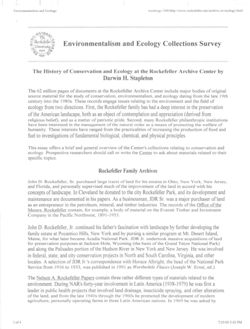
Environmentalism and Ecology
vysiwyg://100/http://www.rockefeller.edu/archive.ctr/ecology.html
The
Rockefeller
University
Environmentalism and Ecology Collections Survey
1901
The History of Conservation and Ecology at the Rockefeller Archive Center by
Darwin H. Stapleton
The 62 million pages of documents at the Rockefeller Archive Center include major bodies of original
source material for the study of conservation, environmentalism, and ecology dating from the late 19th
century into the 1980s. These records engage issues relating to the environment and the field of
ecology from two directions. First, the Rockefeller family has had a deep interest in the preservation
of the American landscape, both as an object of contemplation and appreciation (derived from
religious belief), and as a matter of patriotic pride. Second, many Rockefeller philanthropic institutions
have been interested in the management of the natural order as a means of promoting the welfare of
humanity. These interests have ranged from the practicalities of increasing the production of food and
fuel to investigations of fundamental biological, chemical, and physical principles.
This essay offers a brief and general overview of the Center's collections relating to conservation and
ecology. Prospective researchers should call or write the Center to ask about materials related to their
specific topics.
Rockefeller Family Archives
John D. Rockefeller, Sr. purchased large tracts of land for his estates in Ohio, New York, New Jersey,
and Florida, and personally supervised much of the improvement of the land in accord with his
concepts of landscape. In Cleveland he donated to the city Rockefeller Park, and its development and
maintenance are documented in his papers. As a businessman, JDR Sr. was a major purchaser of land
as an entrepreneur in the petroleum, mineral, and timber industries. The records of the Office of the
Messrs. Rockefeller contain, for example, a body of material on the Everett Timber and Investment
Company in the Pacific Northwest, 1891-1953.
John D. Rockefeller, Jr. continued his father's fascination with landscape by further developing the
family estate at Pocantico Hills, New York and by pursing a similar program at Mt. Desert Island,
Maine, for what later became Acadia National Park JDR Jr. undertook massive acquisitions of land
for preservation purposes at Jackson Hole, Wyoming (the basis of the Grand Teton National Park)
and along the Palisades portion of the Hudson River in New York and New Jersey. He was involved
in federal, state, and city conservation projects in North and South Carolina, Virginia, and other
locales. A selection of JDR Jr.'s correspondence with Horace Albright, the head of the National Park
Service from 1916 to 1933, was published in 1991 as Worthwhile Places (Joseph W. Ernst, ed.).
The Nelson A. Rockefeller Papers contain three rather different types of materials related to the
environment. During NAR's forty-year involvement in Latin America (1938-1979) he was first a
leader in public health projects that involved land drainage, insecticide spraying, and other alterations
of the land; and from the late 1940s through the 1960s he promoted the development of modern
agriculture, personally operating farms in three Latin American nations In 1969 he was asked by
1 of 4
7/25/00 5:42 PM
Environmentalism and Ecology
vysiwyg://100/http://www.rockefeller.edu/archive.ctr/ecology.html
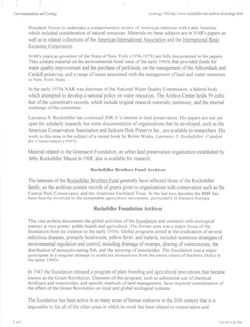
President Nixon to undertake a comprehensive review of American relations with Latin America,
which included consideration of natural resources. Materials on these subjects are in NAR's papers as
well as in related collections of the American International Association and the International Basic
Economy Corporation.
NAR's years as governor of the State of New York (1958-1973) are fully documented in his papers.
They contain material on his environmental bond issue of the early 1960s that provided funds for
water quality improvement and the purchase of parklands, on the management of the Adirondack and
Catskill preserves, and a range of issues associated with the management of land and water resources
in New York State.
In the early 1970s NAR was chairman of the National Water Quality Commission, a federal body
which attempted to develop a national policy on water resources. The Archive Center holds 59 cubic
feet of the committee's records, which include original research materials, testimony, and the internal
workings of the committee.
Laurance S. Rockefeller has continued JDR Jr.'s interest in land preservation. His papers are not yet
open for scholarly research, but some documentation of organizations that he developed, such as the
American Conservation Association and Jackson Hole Preserve Inc., are available to researchers. His
work in this area is the subject of a recent book by Robin Winks, Laurance S. Rockefeller: Catalyst
for Conservation (1997).
Material related to the Greenacre Foundation, an urban land preservation organization established by
Abby Rockefeller Mauze in 1968, also is available for research.
Rockefeller Brothers Fund Archives
The interests of the Rockefeller Brothers Fund generally have reflected those of the Rockefeller
family, SO the archives contain records of grants given to organizations with conservation such as the
Central Park Conservancy and the American Farmland Trust. In the last two decades the RBF has
been heavily involved in the sustainable agriculture movement, particularly in Eastern Europe.
Rockefeller Foundation Archives
This vast archive documents the global activities of the foundation and connects with ecological
matters at two points: public health and agriculture. The former area was a major focus of the
foundation from its creation to the early 1950s. Global programs aimed at the eradication of several
infectious diseases, primarily hookworm, yellow fever, and malaria, included numerous strategies of
environmental regulation and control, including drainage of swamps, altering of watercourses, the
distribution of mosquito-eating fish, and the spraying of insecticides. The foundation was a major
participant in a singular attempt to eradicate mosquitoes from the entire island of Sardinia (Italy) in
the latter 1940s.
In 1943 the foundation initiated a program of plant breeding and agricultural innovations that became
known as the Green Revolution. Elements of this program, such as substantial use of chemical
fertilizers and insecticides, and specific methods of land management, have required consideration of
the effect of the Green Revolution on local and global ecological systems.
The foundation has been active in SO many areas of human endeavor in the 20th century that it is
impossible to list all of the other areas in which its work has been related to conservation and
2 of 4
7/25/00 5:42 PM
Environmentalism and Ecology
siwyg://100/http://www.rockefeller.edu/archive.ctr/ecology.html
ecological issues. But researchers should take into consideration its strong support of the biological
sciences in the 1930s and 1940s, and its funding of some aspects of urban planning.
The Rockefeller University Archives
Much of the research at The Rockefeller University (established 1901 as the Rockefeller Institute for
Medical Research) has related to the human physiology. However, a number of researchers have gone
in directions that have been important ecologically. The leading figure in this area is Rene Dubos
(1901-1982), whose early work on the antibiotic Gramicidin convinced him that the solutions to
human problems lay in the better understanding of ecology, and thence to a conviction that the public
needed to be far better educated about the functioning of the biosphere. The university archives
contains a body of Dubos's scientific papers, some correspondence, and drafts of his publications. The
Archive Center's library has a major collection of his printed works.
Until the late 1940s the university had a plant and animal research laboratory at Princeton, New
Jersey, which carried out important work on the transmission of diseases. More recently the university
established a Center for Field Research at Millbrook, New York, which includes ecologically related
research in its programs. The behavior of birds, particularly vocal communication, has been a major
focus of study.
Other Archives
The General Education Board (1902-1964), active primarily in the American South, began promoting
improved farming practices soon after it was established, and also promoted better sanitary facilities in
rural areas.
The short-lived Rockefeller Sanitary Commission for the Eradication of Hookworm Disease
(1909-1915) pioneered in encouraging the improvement of sanitary practices in the American South in
order to eliminate hookworm transmission; it served as the model for the Rockefeller Foundation's
International Health Board, established in 1913.
Researchers interested in outdoor recreation should examine the archives of the Laura Spelman
Rockefeller Memorial, which in the 1920s funded outdoor museums and other aspects of regional and
national parks. It also gave a large grant to help establish the Great Smoky Mountains National Park.
Also in the 1920s the International Education Board provided fellowships and grants to forestry and
agriculture students in Europe and the United States.
The Russell Sage Foundation Archives document its support of the Regional Plan Association, which
created comprehensive plans for the expansion of the infrastructure of the New York City region in
the 1920s, as well as promoting the creation of the Appalachian Trail.
Personal Papers
The Archive Center holds several large bodies of personal papers that may be of interest to
researchers in the fields of environmentalism and ecology.
Kenneth Chorley's papers focus primarily on the development of Colonial Williamsburg, but
there is abundant material on the management of Rockefeller property at Jackson Hole,
Wyoming.
3 of 4
7/25/00 5:42 PM
Environmentalism and Ecology
vysiwyg://100/http://www.rockefeller.edu/archive.ctr/ecology.html
Harold Fabian's papers are the records of a real estate agent who helped acquire the Jackson
Hole lands for JDR Jr.
The Nelson C. Davis and Wilbur Downs papers document professional lives committed to
yellow fever and malaria eradication, including (in Downs's case) by means of the use of DDT.
Louis Hackett's papers reveal the work of one of the most effective managers of yellow fever
and malaria projects in both Latin America and Italy in the 1920s and 1930s.
The papers of J. George Harrar, a plant pathologist who became head of the Mexican
Agricultural Project in 1943, and was later president of the Rockefeller Foundation, are
important to understanding the history of the Green Revolution.
Return to Archive Center Home Page
Last updated Monday, January 31, 2000 09:39:15 John LeGloahec
4 of 4
7/25/00 5:42 PM
Viewer Controls
Toggle Page Navigator
P
Toggle Hotspots
H
Toggle Readerview
V
Toggle Search Bar
S
Toggle Viewer Info
I
Toggle Metadata
M
Zoom-In
+
Zoom-Out
-
Re-Center Document
Previous Page
←
Next Page
→
[Series II] Rockefeller Archive Center
| Page | Type | Title | Date | Source |
| 1 | File Folder | Rockefeller Archive Center | - | Ronald Epp |
| 2-17 | Archives Guide | Chapters and selected pages from the publication and policy guide, "Establishing Foundation Archives: A Reader and Guide to First Steps," edited by Kenneth W. Rose and Darwin H. Stapleton; Chapters include, "The State of Foundation ARchives: Results from the Rockefeller Archive Center's Survey," "What do we Keep?" and "The Organization and Storage of Archival Material" | 1991 | Rose, Kenneth W. and Stapleton, Darwin H. [eds.] Establishing Foundation Archives. Council on Foundations, 1991. |
| 18-19 | Editorial | Contributed editorial "Mr. Rockefeller: an Appreciation," upon the death of John D. Rockefeller JR, submitted by Charles K. Savage | 05/19/1960 | Original appeared in the Bar Harbor Times, May 19, 1960; copy found in ANPA B2.F13.26 |
| 20-23 | Essay | "The History of Conservation and Ecology at the Rockefeller Archive Center," by Darwin H. Stapleton, an overview of the Rockefeller Archives Center collection | updated January 31, 2000 | Available online at www.rockefeller.edu/archive.ctr |
Details
Series 2