From collection Creating Acadia National Park: The George B. Dorr Research Archive of Ronald H. Epp

Page 1
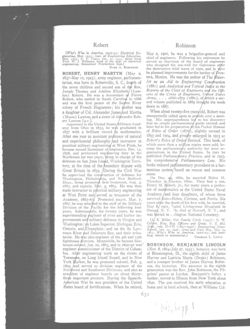
Page 2
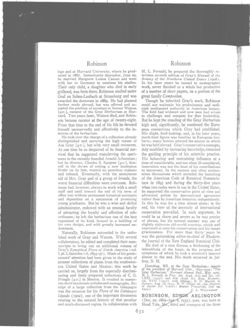
Page 3
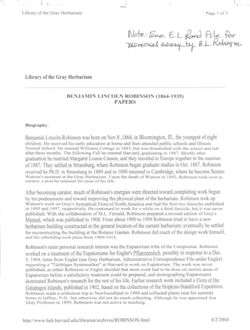
Page 4
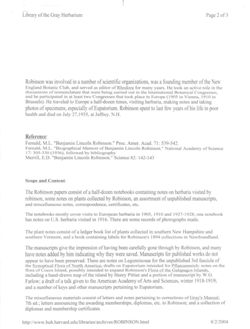
Page 5
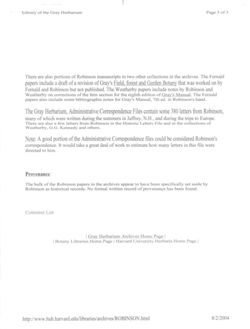
Page 6
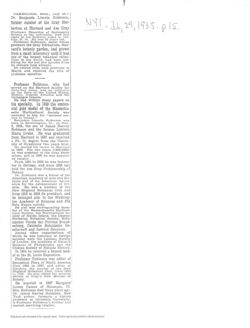
Page 7
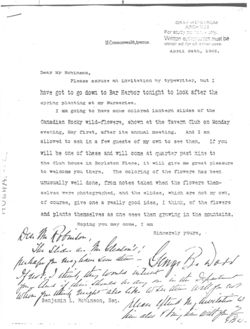
Page 8
Search
results in pages
[Series II] Robinson, B.L. 1864-1935
d
Rohinson, B.L.
1864.
1935.
Robert
Robinson
[Who's Who in America, 1932-33; Electrical En-
gineering, Mar. 1933; Jour. of Engineering Education,
May 2, 190I, he was a brigadier-general and
Mar. 1933 ; N. Y. Times, Jan. 27, 1933 letter from
chief of engineers. Following his retirement he
Prof. W. J. Williams, head of the dept. of electrical
served as chairman of the board of engineers
engineering, Rensselaer Polytechnic Inst.]
who designed the sea-wall for Galveston after
BURR A. ROBINSON
the destructive tidal wave of 1900, and in I9II
ROBERT, HENRY MARTYN (May 2,
he planned improvements for the harbor of Fron-
1837-May II, 1923), army engineer, parliamen-
tera, Mexico. He was the author of The Water-
tarian, was born in Robertville, S. C., fourth of
Jet as an Aid to Engineering Construction
the seven children and second son of the Rev.
(1881) and Analytical and Topical Index to the
Joseph Thomas and Adeline Elizabeth (Law-
Reports of the Chief of Engineers and the Offi-
ton) Robert. He was a descendant of Pierre
cers of the Corps of Engineers, United States
Robert, who settled in South Carolina in 1686
Army,
1866-1879 (1881), of which a sec-
and was the first pastor of the Santee River
ond volume published in 1889 brought the work
colony of French Huguenots; his mother was
down to 1887.
a daughter of Col. Alexander James and Martha
When about twenty-five years old, Robert was
(Mosse) Lawton, and a sister of Alexander Rob-
unexpectedly called upon to preside over a meet-
ert Lawton [q.v.].
ing. His unpreparedness led to his discovery
Appointed to the United States Military Acad-
that no simple parliamentary guide existed, and
emy from Ohio in 1853, he was graduated in
later led to his preparation of the Pocket Manual
1857 with a brilliant record /in mathematics.
of Rules of Order (1876), slightly revised in
After one year as assistant professor of natural
1893 and 1904, and greatly enlarged in 1915 as
and experimental philosophy and instructor in
Robert's Rules of Orden Revised. This book, of
practical military engineering at West Point, he
which more than a million copies were sold, be-
became second lieutenant of engineers, Dec. I3,
came the parliamentary authority for most or-
1858, and performed engineering duty in the
ganizations in the United States. In 1921 he
Northwest for two years, being in charge of the
published Parliamentary Practice, and in 1923,
defenses on San Juan Island, Washington Terri-
his comprehensive Parliamentary Law. His
tory, at the time of the boundary dispute with
books reduced parliamentary procedure to a har-
Great Britain in 1859. During the Civil War
monious system based on reason and common
he supervised the construction of defenses for
sense.
Washington, Philadelphia, and New Bedford,
On Dec. 24, 1860, he married Helen M.
Mass., being promoted first lieutenant, Aug. 3,
Thresher in Dayton, Ohio. They had a son,
1861, and captain, Mar. 3, 1863. He was then
Henry M. Robert, Jr., for many years a profes-
made instructor in practical military engineering
sor of mathematics at the United States Naval
at West Point and served as treasurer of the
Academy, and four daughters, of whom three
Academy, 1865-67 Promoted major, Mar. 7,
survived him-Helen, Corinne, and Portia. Six
1867, he was attached to the staff of the Military
years after the death of his first wife, he married,
Division of the Pacific for the following four
May 8 1901, Tsabel Livingstone Hoagland in
years. Subsequently, for twenty years, he was
Owego, N. Y. He died at Hornell, N. Y., and
superintending engineer of river and harbor im-
was buried in rington National Cemetery.
provements and military defenses in Oregon and
[A, E. Miller, Our Family Circle (1931) G. W.
Washington on Lakes Superior, Michigan, Erie,
Cullum, Biog. Reg. Officers and Grads. U. S. Mil.
Acad., vols. II-VII (1891-1930) Engineering News-
Ontario, and Champlain; and on the St. Law-
Record, Apr. 22, 1920; Army and Navy Reg., May 19,
rence River and Delaware Bay, and their tribu-
1923; Who's Who in America, 1922-23; and auto-
biog. sketch in manuscript.]
taries. He was also engineer of the 4th and 13th
CHARLES L. LEWIS
lighthouse districts. Meanwhile, he became lieu-
tenant-colonel, Jan. IO, 1883, and in 1890-91 was
ROBINSON, BENJAMIN LINCOLN
engineer commissioner of the District of Colum-
(Nov. 8, 1864-July botanist, was born
bia. After engineering work on the rivers of
at Bloomington, Ill., the eighth child of James
Tennessee, on Long Island Sound, and in New
Harvey and Latricia Maria (Drake) Robinson,
York Harbor, he was promoted colonel, Feb. 3,
and a younger brother of James Harvey Robin-
1895, /and served as division engineer of the
son, the historian. His ancestor in the eighth
Northwest and Southwest Divisions, and also as
generation was the Rev. John Robinson, the Pil-
president of engineer boards on about thirty-
grims' pastor at Leyden. Benjamin's father, a
three important projects. During the Spanish-
banker, moved to Illinois from New York about
American War he was president of the United
1840. The son received his early education at
States board of fortifications. When he retired,
home and in local schools, then at Williams Col-
Robinson
Robinson
lege and at Harvard University, where he grad-
M. L. Fernald, he prepared the thoroughly re.
uated in 1887. Immediately thereafter, June 29,
written seventh edition of Gray's Manual of the
he married Margaret Louise Casson and went
Botany of the Northern United States (1908).
with her to Germany to continue his studies.
In his later years he turned to monographic
Their only child, a daughter who died in early
work, never finished as a whole but productive
girlhood, was born there. Robinson studied under
of a number of short papers, on a portion of the
Graf zu Solms-Laubach at Strassburg and was
great family Compositae.
awarded the doctorate in 1889. He had planned
Though he inherited Gray's work, Robinson
further study abroad, but was offered and ac-
could not maintain his preeminence and well-
cepted the position of assistant to Sereno Watson
nigh undisputed authority in American botany.
[q.v.], curator of the Gray Herbarium at Har-
The field had widened and new men had arisen
vard. Two years later, Watson died, and Robin-
to challenge and compete for that leadership.
son became curator at the age of twenty-eight.
But he kept the standing of the Gray Herbarium
From that time to the end of his life he devoted
high and, significantly, he continued the Euro-
himself unreservedly and effectively to the in-
pean connections which Gray had established.
terests of the herbarium.
His slight, frail-looking, and, in his later years,
He took over the charge of a collection already
much-bent figure was familiar in European her-
distinguished and carrying the high repute of
baria many honors attested the esteem in which
Asa Gray [q.v.], but with very small resources.
he was held abroad. Gray's conservative concepts,
At one time he so despaired of its financial sur-
duly modified by increasing knowledge, remained
vival that he suggested transferring the speci-
the guiding principle of his scientific practice.
mens to the recently founded Arnold Arboretum;
His balancing and restraining influence at a
but its director, Charles S. Sargent [q.v.], him-
time of considerable, and too often ill-considered,
self in the throes of setting a new institution
innovation was not the least of his contributions
firmly on its feet, wanted no penniless orphans
to taxonomy. In the earnest and often acrimo-
and refused. Eventually, with the anonymous
nious discussions which attended the launching
aid of Mrs. Gray and of a group of friends, the
of the American Code of Botanical Nomencla-
worst financial difficulties were overcome. Rob-
ture in 1895 and during the thirty-five years
inson had, however, always to work with a small
when two codes were in use in the United States,
staff and until toward the end of his term of
he supported the conservative point of view and
office was without permanent botanical assistants
advocated action by international agreement
and dependent on a succession of promising
rather than by American botanists independently.
young graduates. But he was a wise and skilful
In this he was for a time almost alone; in the
administrator, endowed with an unusual faculty
end, his view of the necessity of international
of attracting the loyalty and affection of sub-
cooperation prevailed. In such argument, he
ordinates; he left the herbarium one of the best
could be as sharp and severe as he was precise
organized of its kind, housed in a building of
of phrase, but his normal manner was one of
his own design, and with greatly increased en-
slightly elaborate old-world courtesy, which well
dowment.
expressed at once his conservatism and his innate
Naturally, Robinson succeeded to the unfin-
graciousness. For more than thirty years he
ished work of Gray and Watson. With several
was the painstaking editor-in-chief of Rhodora,
collaborators, he edited and completed their man-
the journal of the New England Botanical Club.
uscripts to bring out an additional volume of
He died of a rare disease, a thickening of the
Gray's Synoptical Flora of North America (vol.
infundibula of the lungs, in the progress and
pt. I, fascicles i-ii, 1895-97). Much of his prede-
symptoms of which he took a scientist's interest
cessors' attention had been given to the study of
almost to the end. His death occurred in Jaf-
pioneer collections of plants from the southwest-
frey, N. H.
ern United States and Mexico; this work he
[Autobiog. MS. at the Gray Herbarium reports
carried on, largely from the especially discrimi-
of the president of Harvard Univ., 1893-1935; "The
Gray Herbarium," Harvard Alumni Bull., May 1929
nating and finely prepared collections of C. G.
M. L. Fernald, in Proc. Am. Acad. Arts and Sci., vol.
Pringle [q.v.] in Mexico. It resulted in numer-
LXXI (1937), and Nat. Acad. Sci. Biog. Memoirs,
vol. XVII (1937), with bibliog. E. D. Merrill, in
ous short taxonomic articles and monographs. Re-
Science, Aug. 16, 1935; H. W. Odum, ed., Am. Masters
ceipt of a large collection from the Galapagos
of Social Sci. (1927) Boston Transcript, July 29,
1935.]
was the occasion for his Flora of the Galapagos
C. A. WEATHERBY
Islands (1902), one of the important documents
ROBINSON, EDWIN ARLINGTON
relating to the natural history of that peculiar
(Dec. 22, 1869-Apr. 6, 1935), poet, was born at
and much-discussed region. In collaboration with
Head Tide, Me., third and youngest of the three
32
Library of the Gray Herbarium
Page 1 of 3
Note: See E.L. Rand file for
memorial essay by B.L. Robinson
Library of the Gray Herbarium
BENJAMIN LINCOLN ROBINSON (1864-1935)
PAPERS
Biography:
Benjamin Lincoln Robinson was born on Nov.8 1864, in Bloomington, Ill., the youngest of eight
children. He received his early education at home and then attended public schools and Illinois
Normal School. He entered Williams College in 1883, but was dissatisfied with the school and left
after three months. The following Fall he entered Harvard, graduating in 1887. Shortly after
graduation he married Margaret Louise Casson, and they traveled to Europe together in the summer
of 1887. They settled in Strassburg, where Robinson began graduate studies in Oct. 1887. Robinson
received he Ph.D. in Strassburg in 1889 and in 1890 returned to Cambridge, where he become Sereno
Watson's assistant at the Gray Herbarium. Upon the death of Watson in 1892, Robinson took over as
curator, a post he retained for most of his life.
After becoming curator, much of Robinson's energies were directed toward completing work begun
by his predecessors and toward improving the physical plant of the herbarium. Robinson took up
Watson's work on Gray's Synoptical Flora of North America and had the first two fascicles published
in 1895 and 1897, respectively. He continued to work for a while on a third fascicle, but it was never
published. With she collaboration of M.L. Fernald, Robinson prepared a revised edition of Gray's
Manual, which was published in 1908. From about 1900 to 1909 Robinson tried to have a new
herbarium building constructed in the general location of the current herbarium; eventually he settled
for reconstructing the building at the Botanic Garden. Robinson did much of the design work himself,
and the rebuilding took place from 1909-1915.
Robinson's main personal research interest was the Eupatorium tribe of the Compositae. Robinson
worked on a treatment of the Eupatoriums for Engler's Pflanzenreich, possibly in response to a Dec.
5, 1904, letter from Engler (see Gray Herbarium, Administrative Correspondence File under Engler)
requesting a "Tüchtigen Systematiker" at Harvard to work on Eupatorium. The work was never
published, as either Robinson or Engler decided that more work had to be done on certain areas of
Eupatorium before a satisfactory treatment could be prepared, and monographing Eupatoriums
dominated Robinson's research for the rest of his life. Earlier research work included a Flora of the
Galapagos Islands, published in 1902, based on the collections of the Hopkins-Standford Expedition.
Robinson made a collection trip to Newfoundland in 1894 and collected plants near his summer
home in Jaffrey, N.H., but otherwise did not do much collecting. Although he was appointed Asa
Gray Professor in 1899, Robinson was not active in teaching.
http://www.huh.harvard.edu/libraries/archives/ROBINSON.html
8/2/2004
Library of the Gray Herbarium
Page 2 of 3
Robinson was involved in a number of scientific organizations, was a founding member of the New
England Botanic Club, and served as editor of Rhodora for many years. He took an active role in the
discussions of nomenclature that were being carried out in the International Botanical Congresses,
and he participated in at least two Congresses that took place in Europe (1905 in Vienna, 1910 in
Brussels). He traveled to Europe a half-dozen times, visiting herbaria, making notes and taking
photos of specimens, especially of Eupatorium. Robinson spent to last few years of his life in poor
health and died on July 27,1935, at Jaffrey, N.H.
Reference:
Fernald, M.L. "Benjamin Lincoln Robinson." Proc. Amer. Acad. 71: 539-542.
Fernald, M.L. "Biographical Memoir of Benjamin Lincoln Robinson." National Academy of Science
17: 305-330 (1936), followed by bibliography
Merrill, E.D. "Benjamin Lincoln Robinson." Science 82: 142-143
Scope and Content:
The Robinson papers consist of a half-dozen notebooks containing notes on herbaria visited by
robinson, some notes on plants collected by Robinson, an assortment of unpublished manuscripts,
and miscellaneous notes, correspondence, certificates, etc.
The notebooks mostly cover visits to European herbaria in 1905, 1910 and 1927-1928; one notebook
has notes on U.S. herbaria visited in 1916. There are some records of photographs made.
The plant notes consist of a ledger book list of plants collected in southern New Hampshire and
southern Vermont, and a book containing labels for Robinson's 1894 collections in Newfoundland.
The manuscripts give the impression of having been carefully gone through by Robinson, and many
have notes added by him indicating why they were saved. Manuscripts for published works do not
appear to have been preserved. There are notes on Leguminosae for the unpublished 3rd fascicle of
the Synoptical Flora of North America; drafts on Eupatorium intended for Pflanzenreich: notes on the
flora of Cocos Island, possibly intended to expand Robinson's Flora of the Galapagos Islands,
including a hand-drawn map of the island by Henry Pittier and a portion of manuscript by W.G.
Farlow; a draft of a talk given to the American Academy of Arts and Sciences, winter 1918-1919;
and a number of keys and other manuscripts pertaining to Eupatorium.
The miscellaneous materials consist of letters and notes pertaining to corrections of Gray's Manual,
7th ed.; letters announcing the awarding memberships, diplomas, etc. to Robinson; and a collection of
diplomas and membership certificates.
http://www.huh.harvard.edu/libraries/archives/ROBINSON.htm
8/2/2004
Library of the Gray Herbarium
Page 3 of 3
There are also portions of Robinson manuscripts in two other collections in the archives. The Fernald
papers include a draft of a revision of Gray's Field, forest and Garden Botany that was worked on by
Fernald and Robinson but not published. The Weatherby papers include notes by Robinson and
Weatherby on corrections of the fern section for the eighth edition of Gray's Manual. The Fernald
papers also include some bibliographic notes for Gray's Manual, 7th ed. in Robinson's hand.
The Gray Herbarium, Administrative Correspondence Files contain some 380 letters from Robinson,
many of which were written during the summers in Jaffrey, N.H., and during the trips to Europe.
There are also a few letters from Robinson in the Historic Letters File and in the collections of
Weatherby, G.G. Kennedy and others.
Note: A good portion of the Administrative Correspondence files could be considered Robinson's
correspondence. It would take a great deal of work to estimate how many letters in this file were
directed to him.
Provenance:
The bulk of the Robinson papers in the archives appear to have been specifically set aside by
Robinson as historical records. No formal written record of provenance has been found.
Container List
Gray Herbarium Archives Home Page
|
| Botany Libraries Home Page | Harvard University Herbaria Home Page
http://www.huh.harvard.edu/libraries/archives/ROBINSON.html
8/2/2004
CAMBRIDGE, Mass., July 28.-
Dr. Benjamin Lincoln Robinson,
former curator of the Gray Her-
barium at Harvard and Asa Gray
NYT July 29, 1935 p 15,
Professor Emeritus of Systematic
Botany at the university, died last
night at his Summer home in Jaf-
frey, N. H. He was 70 years old.
Professor Robinson, under whose
guidance the Gray Herbarium, Har-
vard's botanic garden, had grown
from a small laboratory until it had
one of the largest botanical collec-
tions in the world, had been suf-
fering for the last few months from
an obscure lung ailment.
He retired from both positions in
March and received the title of
professor emeritus.
Professor Robinson, who had
served on the Harvard faculty for
forty-five years, was an authority
on the flora of the United States,
Mexico, tropical America and the
Galapagos Islands.
He had written many papers on
his specialty. In 1929 the centen-
nial gold medal of the Massachu-
setts Horticultural Society was
awarded to him for "eminent ser-
vice to botany."
Benjamin Lincoln Robinson was
born in Bloomington, Ill., on Nov.
8, 1864, the son of James Harvey
Robinson and the former Latricia
Maria Drake. He was graduated
from Harvard in 1887 and received
a Ph. D. degree from the Univer-
sity of Strasbourg two years later.
He started his career at Harvard
in 1890. For two years (1890-1892)
he was assistant in the Gray Herb-
arium, and in 1892 he was appoint-
ed curator.
From 1891 to 1894 he was instruc-
tor in German, and since 1899 had
held the Asa Gray Professorship of
Botany.
Dr. Robinson was a fellow of the
American Academy of Arts and Sei-
ences and of the American Associ-
ation for the Advancement of Sri-
ence. He was a member of the
New England Botanical Club and
from 1906 to 1908 its president, and
he belonged also to the Washing-
ton Academy of Sciences and Phl
Beta Kappa society.
He also was corresponding mem-
ber of the Massachusetts Horticul-
tural Society, the Horticultural So-
ciety of Rhode Island, the Czecho-
Slovakian Botanical Society, Bota-
nischer Verein der Provinz Brand-
enburg, Deutsche Botanische Ge-
sellschaft and Institut Genévois.
Among other organizations of
which he was honorary or foreign
member were the Linnean Society
of London, the Academy of Natural
Sciences of Philadelphia and the
Chilean Society of Natural History.
In 1904 he received a bronze med-
al at the St. Louis Exposition.
Professor Robinson was editor of
Synoptical Flora of North America
from 1892 to 1897, and editor of
Rhodora, the journal of the New
England Botanical Club, from 1899
to 1928. He also edited the seventh
edition of Gray's New Manual of
Botany.
He married in 1887 Margaret
Louise Casson of Hennepin, Ill.
Mrs. Robinson died three years ago.
Dr. James Harvey Robinson, New
York author, formerly a history
professor at Columbia University,
is Professor Robinson's brother and
nearest surviving relative.
Reproduced with permission of the copyright owner Further reproduction prohibited without permission
GRAY HEREPRIUM
ARCH VES
For study only.
Written author must be
Commonwealth Avenue.
obtait ed for cil other uses.
April 24th, 1905.
Dear Mr Robinson,
Please excuse an invitation by typewriter, but I
have got to go down to Bar Harbor tonight to look after the
spring planting at my Nurseries.
I am going to have scrue colored lantern slides of the
Canadian Rocky wild-flowers, shown at the Tavern Club on Monday
evening, May first, after its annual meeting. And I am
allowed to ask in a faw guests of my own to see them. If you
will be one of these and will come at quarter past nine to
the Club house in Boylston Place, it will give me great pleasure
to welcome you there. The coloring of the flowers has been
unusually well done, from notes taken when the flowers them-
selvas were photographed, and the slides, which are not my own,
of course, give one a really good idea, I think, of the flowers
and plants themselves as one sees them growing in the mountains.
Hoping you may come, I am
Dea the Robindon,
Sincerely yours,
The the
pechales they Seen
If that and I think their this should would he an, In in the Department not
you Slide an have diew interest being R. ward
when you you think if Height also like Wtu item will fr
Benjamin L. Rchinson, Esq.
his also this his will yp GBW- 2
please effend We avilation W
Viewer Controls
Toggle Page Navigator
P
Toggle Hotspots
H
Toggle Readerview
V
Toggle Search Bar
S
Toggle Viewer Info
I
Toggle Metadata
M
Zoom-In
+
Zoom-Out
-
Re-Center Document
Previous Page
←
Next Page
→
[Series II] Robinson, B.L. 1864-1935
| Page | Type | Title | Date | Source | Other notes |
| 1 | File Folder | Robinson, B.L. 1864-1935 | - | Ronald Epp | - |
| 2-3 | Encyclopedia, biographical | Biographical information on Benjamin Lincoln Robinson, curator of the Gray Herbarium at Harvard | - | Dictionary of American Biography. Supp. 1 | - |
| 4-6 | Collection Guide | Guide to the Benjamin Lincoln Robinson Papers; includes biography | - | Library of the Gray Herbarium; available online at www.huh.harvard.edu | Note: See E.L. Rand file for memorial essay by B.L. Robinson [RHE] |
| 7 | Obituary | Obituary of Dr. Benjamin Lincoln Robinson | 07/29/1935 | New York Times. p.15 | - |
| 8 | Letter | Letter to Mr. Robinson from George B. Dorr re: spring planting at his nurseries, lantern slides of Canadian Rocky wildflowers | April 24th, 1905 | Gray Herbarium Archives. | Note: Handwritten addendum by George B. Dorr [MF] |
Details
Series 2