From collection Creating Acadia National Park: The George B. Dorr Research Archive of Ronald H. Epp


Page 1
Page 2
Page 3
Page 4
Page 5
Page 6
Page 7
Page 8
Page 9
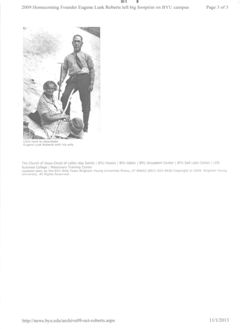
Page 10
Page 11
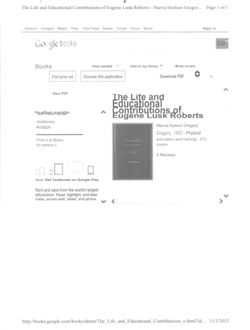
Page 12
Page 13
Page 14
Page 15
Page 16
Search
results in pages
[Series II] Roberts, Eugene 1880-1953
Esbl-ess1
sussez
going
1
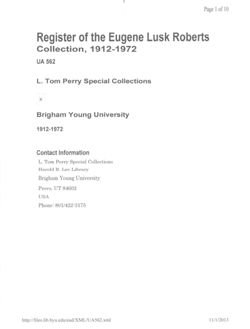
Page 1 of 10
Register of the Eugene Lusk Roberts
Collection, 1912-1972
UA 562
L. Tom Perry Special Collections
X
Brigham Young University
1912-1972
Contact Information
L. Tom Perry Special Collections
Harold B. Lee Library
Brigham Young University
Provo, UT 84602
USA
Phone: 801/422-3175
http://files.lib.byu.edu/ead/XML/UA562.xml
11/1/2013
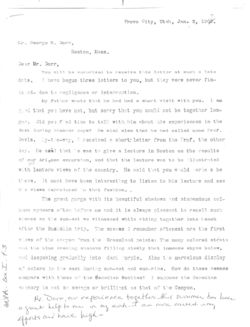
Provo City, Utah, Jan. 2, 1902.
Mr. George B. Dorr,
Boston, Mass.
Dear Mr. Dorr,
You will be surprised to receive this letter at such a late
date. I have begun three letters to you, but they were never fin-
is led- due to negligence or interruption.
My father wrote that he had had a short visit with you. I am
and that you have met, but sorry that you could not be together lon-
ger. Did you find time to talk with him about his experiences in the
Test during pioneer days? He siad also that he had called upon Prof.
Davis. Dy-the-way, I received a short: letter from the Prof. the other
day. He sill that "e was to give a lecture in Boston on the results
of our Arizona excursion, and that the lecture was to be illustrated
with lantern views of the country. He said that you would erha S be
there. It must have been interesting to listen to his lecture and see
the views reproduced in that fashion.
-
The great gorge with its beautiful shadows and stupendous col-
unns appears often before me and it is always pleasant to recall such
seemes as the sun-set we witnessed while riding together into Lanab
alter the Buskskin trip. The scenes I remember oftenest are the first
views of the canyon Crom the Greenland points: The many colored strata
and the blue evening shadows filling slowly that immense abyss below,
and deepening gradually into dark urple. Also the marvelous display
of colors in the east during sun-set and sun-rise. How do these seenes
compare with those or the Ganadian Rockies? I suppose the Canadian
sconery is not so savage or brilliant as that of the Canyon.
Mr Dorr our experience together this summer has been
a great help to me in my work. I am more earnest inney
efforts and have high-
nign-
er ideals in life; for which I am indebted to you, and for which I am
very grateful. Since you were here I have succeeded in attending xxaxx
school by teaching physical culture as a means of paying for the school
ing. I have been kept busy nearly all the time. Besides the regular
course of study I write up the academy colum in the Deseret News, and
take charge of the local department of the college paper. I find, how-
ever that to be thus extremely active is to be more contented and hap- -
pier. This sementer of school has been better for me than has any pre-
ceeding one. I have studied harder and accomplished more in less time.
But I have also, at times, felt more discouraged and in turn more hope-
ful than ever before. The whole school term has been one of - ups "
and IT downs."
*
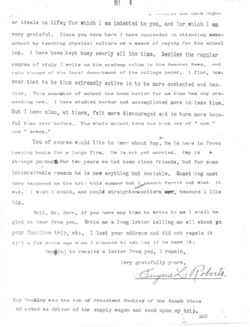
You of course would like to hear about Roy. He is here in Provo
keeping books for a large firm. He is not yet married. Roy is a
strange person. For two years we had been close friends, but for some
inconceivable reason he is now anything but sociable. Something must
have happened on the trip this summer but I cannot ferrit out what it
was. I wish I could, and could straightenmatters
because I like
him.
Fell, Mr. Dorr, if you have any time to write to me I shall be
glad to hear from you. Frite me a long letter telling me all about
your Canadian trip, etc. I lost your address and did not regain it
till a few weeks ago when I chanced to ask Roy if he knew it.
Hopping to receive a letter from you, I remain,
Very gratefully yours,
Engene Lo Roberts.
Roy Woodley was the son of President Woolley of the Kanab State
nd acted as driver of the supply wagon and cook upon my trip.
GBD
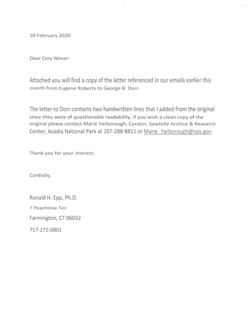
20 February 2020
Dear Cory Nimer:
Attached you will find a copy of the letter referenced in our emails earlier this
month from Eugene Roberts to George B. Dorr.
The letter to Dorr contains two handwritten lines that I added from the original
since they were of questionable readability. If you wish a clean copy of the
original please contact Marie Yarborough, Curator, Sawtelle Archive & Research
Center, Acadia National Park at 207-288-8811 or Marie Yarborough@nps.gov.
Thank you for your interest.
Cordially,
Ronald H. Epp, Ph.D.
7 Peachtree Ter.
Farmington, CT 06032
717-272-0801
2/20/2020
Mail - RONALD EPP - Xfinity Connect
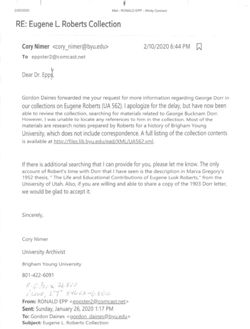
RE: Eugene L. Roberts Collection
Cory Nimer
2/10/2020 6:44 PM
To eppster2@comcast.net
Dear Dr. Epps,
Y
Gordon Daines forwarded me your request for more information regarding George Dorr in
our collections on Eugene Roberts (UA 562). | apologize for the delay, but have now been
able to review the collection, searching for materials related to George Bucknam Dorr.
However, I was unable to locate any references to him in the collection. Most of the
materials are research notes prepared by Roberts for a history of Brigham Young
University, which does not include correspondence. A full listing of the collection contents
is available at http://files.lib.byu.edu/ead/XML/UA562.xml
If there is additional searching that I can provide for you, please let me know. The only
account of Robert's time with Dorr that I have seen is the description in Marva Gregory's
1952 thesis, 11 The Life and Educational Contributions of Eugene Lusk Roberts," from the
University of Utah. Also, if you are willing and able to share a copy of the 1903 Dorr letter,
we would be glad to accept it.
Sincerely,
Cory Nimer
University Archivist
Brigham Young University
801-422-6091
P.O.Box 26 800
Provo, L'T 84602-6800
From: RONALD EPP
Sent: Sunday, January 26, 2020 1:17 PM
To: Gordon Daines
Subject: Eugene L. Roberts Collection
1/26/2020
Xfinity Connect Eugene L_ Roberts Collection Printout
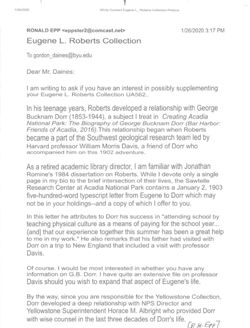
RONALD EPP
1/26/2020 3:17 PM
Eugene L. Roberts Collection
To gordon_daines@byu.edu
Dear Mr. Daines:
I am writing to ask if you have an interest in possibly supplementing
your Eugene L. Roberts Collection UA562..
In his teenage years, Roberts developed a relationship with George
Bucknam Dorr (1853-1944), a subject I treat in Creating Acadia
National Park: The Biography of George Bucknam Dorr (Bar Harbor:
Friends of Acadia, 2016). This relationship began when Roberts
became a part of the Southwest geological research team led by
Harvard professor William Morris Davis, a friend of Dorr who
accompanied him on this 1902 adventure.
As a retired academic library director, | am familiar with Jonathan
Romine's 1984 dissertation on Roberts. While I devote only a single
page in my bio to the brief intersection of their lives, the Sawtelle
Research Center at Acadia National Park contains a January 2, 1903
five-hundred-word typescript letter from Eugene to Dorr which may
not be in your holdings--and a copy of which I offer to you.
In this letter he attributes to Dorr his success in "attending school by
teaching physical culture as a means of paying for the school year.
{and] that our experience together this summer has been a great help
to me in my work." He also remarks that his father had visited with
Dorr on a trip to New England that included a visit with professor
Davis.
Of course. I would be most interested in whether you have any
information on G.B. Dorr. I have quite an extensive file on professor
Davis should you wish to expand that aspect of Eugene's life.
By the way, since you are responsible for the Yellowstone Collection,
Dorr developed a deep relationship with NPS Director and
Yellowstone Superintendent Horace M. Albright who provided Dorr
with wise counsel in the last three decades of Dorr's life.
[R.H.Epp]
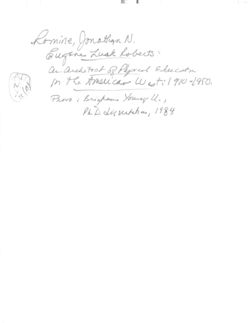
Romine, Jonathan N.
Eugene Lusk Roberts :
an architect of Physical Education
in the American West:1910-1950.
Provo Brigham Young u.,
Ph.D. dissetution, 1984
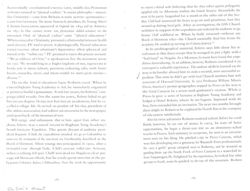
havior initially overshadowed exercise. Later, middle-class Protestant
to marry a third wife (believing that the 1890 edict against polygamy
reformers turned to "physical culture." Its main philosophy-muscu-
applied only to Mormons within the United States). Meanwhile the
lar Christianity-came from Britain; its main activity-gymnastics-
rest of the party languished for a month on the other side of the bor-
came from Germany. The most famous by-product, the Young Men's
der. Cluff had instructed the boys to go out and proselytize, but they
Christian Association, appeared in England in 1844 and in America
wound up dating local girls. After an investigation, the LDS Church
(
in 1851. As the century wore on, physicians added science to the
withdrew its support of the expedition and ordered the students to go
movement. Out of "physical culture" came "physical education."
home. Cluff soldiered on. When he finally returned-without any
Whereasmuscular Christianity presumed a relationship between health
Book of Mormon relics-the Church essentially fired him from the
and character, PE tried to prove it physiologically. Physical educators
academy. He ended up moving to Colonia Juárez. 11
raised concerns about urbanism's degenerative effects (physical and
In his autobiographical material, Roberts says little about his in-
moral) on the "white race." PE promised to turn this process around.
volvement in this fiasco except that he managed to pick a fight with a
We are soldiers of Christ," a spokesperson for the movement wrote
"half-breed" in Nogales. As a Mormon, he must have found the expe-
in 1902. "We would bring in a higher kingdom of man, regenerate in
dition demoralizing. As an athlete, however, Roberts considered it (in
body; make it more stalwart, persistent, enduring, taller, with better
retrospect) a valuable experience. The outdoor skills he learned on the
hearts, stomachs, nerves, and more resistful to man's great enemy-
way to the border allowed him to make a second, more successful ex-
disease." "
pedition. This time he didn't go with local Church members but with
This was the kind of education Eugene Roberts craved. When he
associates of Harvard University. In 1902 Professor William Morris
entered Brigham Young Academy in 1898, he immediately organized
Davis, America's premier geographer, stopped in Provo on his way to
a petition to build a gymnasium. It took four years, but Roberts' cam-
the Grand Canyon for a seven-week gentlemen's vacation. While in
paign yielded results. Over the same four years, Roberts failed to get
Provo he gave a series of lectures at Brigham Young Academy and
his two-year degree. He may not have been academician, but he ex-
lodged at Hotel Roberts, where he met Eugene. Impressed with the
celled at college life. He served as president of his class, president of
boy, Davis extended him an invitation. The next two months brought
the athletics association, lead editor and cartoonist for the newspaper,
sheer delight to Roberts as he explored the North Rim in the company
and quarterback of the intramural team.
of elite eastern intellectuals.
With energy and enthusiasm that set him apart from other stu-
After his twin adventures Roberts reentered school. Before he could
dents, Roberts was a natural recruit for Brigham Young Academy's
finish, however, he ran out of money. In 1903, for want of better
South American Expedition. The quixotic dream of academy presi-
opportunities, he began a three-year stint as an elementary-school
dent Benjamin Cluff, the expedition intended to go to Colombia to
teacher in Provo. Each summer, to recuperate, he went to an environ-
uncover the remains of the ancient city Zarahemla, described in the
ment more to his liking. He pitched a tipi in Provo Canyon, which
Book of Mormon. Fifteen young men participated. In 1900, after a
was then developing into a getaway for Wasatch Front professionals.
triumphal tour through Utah, Cluff's caravan rolled into Arizona,
In 1905 a girls' group camped next to Roberts, and he wound up
where everything fell apart. Cluff went ahead to Nogales to clear pas-
guiding them up the North Fork of Provo Canyon to a waterfall be-
sage with Mexican officials, but he actually spent more time at the po-
low Timpanogos Pk. Delighted by the experience, he looked for other
I ygamist Colonia Juárez, Chihuahua. There he took the opportunity
groups to lead; some he guided to the top of the mountain. Roberts
183
182
On Zion's mount
2009 Homecoming Founder Eugene Lusk Roberts left big footprint on BYU campus
Page 3 of 3
Click here to download
Eugene Lusk Roberts with his wife.
The Church of Jesus Christ of Latter-day Saints I BYU-Hawaii I BYU-Idaho I BYU Jerusalem Center I BYU Salt Lake Center
|
LDS
Business College | Missionary Training Center
Updated daily by the BYU Web Team Brigham Young University Provo, UT 84602 (801) 422-4636 Copyright © 2009. Brigham Young
University. All Rights Reserved.
http://news.byu.edu/archive09-oct-roberts.aspx
11/1/2013
Timp Roberts
Page 1 of 6
BRIGHAM YOUNG UNIVERSITY
BYU
MAGAZINE
ABOUT US
ADVERTISING
BYU TODAY
SEARCH
FALL 1998 > FEATURES > TIMP ROBERTS
ADVA
BRO
MOS
TIMP ROBERTS
e-mail
print
FUN
By Ed Carter
The man and the mountain are after all much alike.
--Harry Davison Kemp
T he event which perhaps most focused the spotlight on Brigham Young University
during the middle decades of this century wasn't conceived in Provo, or even in Utah,
but somewhere near Einsiedeln, Switzerland, as 5,000 worshipers made their way to a
hilltop shrine. In 1908 Eugene Lusk Roberts, an LDS missionary from Provo, watched
those Swiss pilgrims and envisioned for his hometown a similar tradition--the
Timpanogos Hike.
For Roberts, the annual hike to the summit of Utah County's 11,750-foot "Wonder
Mountain," as he called it, always had religious underpinnings. Roberts' purpose in
starting the community climb, which brought thousands to the mountain from 1912 to
1971, was nothing less than helping others worship at the great outdoor shrine.
"Roberts felt the Lord reveals himself to man powerfully in nature and that a stern
climb in utter beauty would be spiritually good for anyone," wrote a Sports Illustrated
correspondent in a 1957 article.
A pioneer of athletic education and a dynamic Renaissance man, Roberts did more than
climb mountains. He coached two world-class high jumpers and laid the foundation for
today's athletic program at BYU. He mingled with early 20th-century luminaries such
as boxing champ Jack Dempsey, actor Douglas Fairbanks, and football coach Knute
Rockne. Roberts brawled in bars but also wrote poetry. His legacy is a range and
degree of excellence rarely achieved. Yet "Timp" Roberts, as he was called by
contemporaries, is destined to be remembered best for his connection with the
mountain he loved.
But, good Brethren, every man is BIGGER than his faults, and as the Soil is
blameless if it gives forth WEEDS, so is the man without Reprobation should he
breed mistakes.
--Laon McDuff
No one could have predicted Roberts' success from the start he got in life. Roberts
described his father as "long-haired and restless." William D. Roberts mined and
farmed in California, battled American Indians in Utah, and transported freight across
the continent. He and his wife. Julia M. Lusk. finally settled in Provo in the 1860s.
http://magazine.byu.edu/?act=view&a=304
11/1/2013
The Life and Educational Contributions of Eugene Lusk Roberts - Marva Hodson Gregor
Page 1 of 1
Search Images Maps Play YouTube News Gmail Drive More
Sign in
Google books
Subm
Books
View sample
Add to my library
Write review
Find prior art
Discuss this application
Download PDF
View PDF
The Life and
Educational
NeeBoRka available
Contributions of
Eugene Lusk Roberts
AbeBooks
Amazon
Marva Hodson Gregory
Gregory, 1952 - Physical
Find in a library
education and training - 370
All sellers >>
pages
0 Reviews
New! Get Textbooks on Google Play
Rent and save from the world's largest
eBookstore. Read, highlight, and take
notes, across web, tablet, and phone.
http://books.google.com/books/about/The_Life_and_Educational_Contributions_o.html?id..
11/1/2013
Timp Roberts
Page 2 of 6
Their 10th child, Gene, was born in 1880.
The family operated Hotel Roberts, located at 200 South and University Avenue. This
setting afforded young Gene some negative experiences. When he was about eight
years old and working as a bellhop, the hotel housed for a time a group of U.S.
marshals charged with capturing Mormon polygamists. After the marshals finished
their work each day, they met in the lobby to swap vulgar stories and photographs--to
which they subjected a naive Gene while his parents attended to other hotel duties.
Roberts experienced other grim aspects of late 19th-century life in a frontier town. As a
boy he saw the bodies of four suicide victims, watched a bloody gun battle, was swept
up by a mob threatening to hang a local saloon keeper, and regularly had his face
bloodied and bruised in fights.
In addition, Roberts suffered at various times from an inferiority complex, depression,
and a slew of physical ills. As an adolescent he considered himself scrawny and ugly,
SO he avoided removing his shirt in front of peers. He began to take quack medicines in
hopes of bulking up his slight frame, but the drugs only increased his anxiety while
doing nothing for his physique. He was accident prone and carried scars and aches
from various mishaps. Failure and disappointment accompanied him constantly.
The self-doubting boy, however, became a flamboyant showman, and the weakling
evolved into a man of physical prowess. As he matured Roberts joined a gymnastics
club and trained as a boxer. He learned to twirl a baton and marched at the front of
parades. Gene developed skill and stamina by dedicating himself to athletics and
exploring the mountains around his Provo home. Those early alpine adventures would
prove to be the basis for a lifelong hobby of serving as a mountain guide.
By the time Roberts entered Brigham Young Academy in 1898, now 100 fall seasons
ago, he was a popular leader among his peers. As a student he spearheaded a drive to
construct a new gymnasium, captained an outlaw football team, and elected senior
class president. He wrote articles and drew cartoons for the campus newspaper, and to
finance his education, he taught children at Franklin Elementary School.
Roberts and his wife, Sytha Brown, left for an LDS mission in Europe just days after
they were married in 1906. While there, Gene became an unofficial guide for American
tourists and had many opportunities to trek the Swiss and Italian Alps. His visit to the
shrine near Einsiedeln came on one of these excursions. The scene of a long line of
worshipers carrying candles and chanting as they climbed the hill impressed Roberts
deeply. As he watched, a vision of the Timpanogos Hike unfolded in his mind. It
included dramatic performances, fireworks displays, music, bonfires, stunts to surprise
hikers along the trail, and instruction about geology, flora, fauna, and history. Within a
few short years, Roberts' vision would take the form of one of the most prominent
community mountain climbs in the United States.
Oh Lord, this day I am to walk through all The matchless beauty of Thy garden.
--Eugene Lusk Roberts
In 1912, Roberts--having spent a year at Yale University after returning from Europe--
was BYU's only trained physical education instructor. That year, he organized a
vigorous program of hiking. dancing, and athletics for summer school students: the
http://magazine.byu.edu/?act=view&a=304
11/1/2013
Timp Roberts
Page 3 of 6
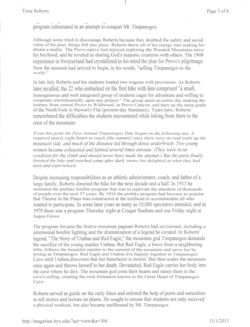
program culminated in an attempt to conquer Mt. Timpanogos.
Although some tried to discourage Roberts because they doubted the safety and social
value of his plan, things fell into place. Roberts threw all of his energy into making his
dream a reality. The Provo native had enjoyed exploring the Wasatch Mountains since
his boyhood, and he reveled in sharing God's majestic creations with others. The 1908
experience in Switzerland had crystallized in his mind the plan for Provo's pilgrimage.
Now the moment had arrived to begin, in his words, "selling Timpanogos to the
world."
In late July Roberts and his students loaded two wagons with provisions. As Roberts
later recalled, the 22 who embarked on the first hike with him comprised "a small,
homogeneous and well integrated group of students eager for adventure and willing to
cooperate wholeheartedly upon any project." The group spent an entire day making the
journey from central Provo to Wildwood, in Provo Canyon, and then up the steep grade
of the North Fork to Stewart's Flat (present-day Sundance). Years later, Roberts
remembered the difficulties the students encountered while hiking from there to the
crest of the mountain:
From this point the First Annual Timpanogos Hike began on the following day. It
required nearly eight hours to reach [the summit] since there were no real trails up the
mountain side, and much of the distance led through dense underbrush. Two young
women became exhausted and fainted several times enroute. (They were in no
condition for the climb and should never have made the attempt.) But the party finally
finished the hike and reached camp after dark, weary but delighted at what they had
seen and experienced.
Despite increasing responsibilities as an athletic administrator, coach, and father of a
large family, Roberts directed the hike for the next decade and a half. In 1913 he
instituted the prehike bonfire program that was to captivate the attention of thousands
of people over the next 57 years. By 1926 the prehike program had become SO popular
that Theater in the Pines was constructed at the trailhead to accommodate all who
wanted to participate. In some later years as many as 10,000 spectators attended, and in
1970 there was a program Thursday night at Cougar Stadium and one Friday night at
Aspen Grove.
The program became the festive mountain pageant Roberts had envisioned, including a
ceremonial bonfire lighting and the dramatization of a legend he created. In Roberts'
legend, "The Story of Utahna and Red Eagle," the mountain god Timpanogos demands
the sacrifice of the young maiden Utahna. But Red Eagle, a brave from a neighboring
tribe, follows the beautiful maiden to the summit of the mountain and saves her by
posing as Timpanogos. Red Eagle and Utahna live happily together in Timpanogos
Cave until Utahna discovers that her benefactor is mortal. She then scales the mountain
once again and throws herself to her death. Devastated, Red Eagle carries her body into
the cave where he dies. The mountain god joins their hearts and raises them to the
cave's ceiling, creating the rock formation known as the Great Heart of Timpanogos
Cave.
Roberts served as guide on the early hikes and enlisted the help of poets and naturalists
to tell stories and lecture on plants. He sought to ensure that students not only received
a physical workout, but also became spellbound by Mt. Timpanogos.
http://magazine.byu.edu/?act=view&a=304
11/1/2013
Timp Roberts
Page 4 of 6
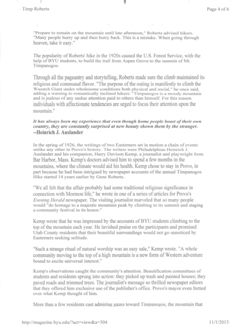
"Prepare to remain on the mountain until late afternoon," Roberts advised hikers.
"Many people hurry up and then hurry back. This is a mistake. When going through
heaven, take it easy."
The popularity of Roberts' hike in the 1920s caused the U.S. Forest Service, with the
help of BYU students, to build the trail from Aspen Grove to the summit of Mt.
Timpanogos.
Through all the pageantry and storytelling, Roberts made sure the climb maintained its
religious and communal flavor. "The purpose of the outing is manifestly to climb the
Wasatch Giant under wholesome conditions both physical and social," he once said,
adding a warning to romantically inclined hikers: "Timpanogos is a moody mountain
and is jealous of any undue attention paid to others than himself. For this reason
individuals with affectionate tendencies are urged to focus their attention upon the
mountain."
It has always been my experience that even though home people boast of their own
country, they are constantly surprised at new beauty shown them by the stranger.
--Heinrich J. Auslander
In the spring of 1926, the writings of two Easterners set in motion a chain of events
unlike any other in Provo's history. The writers were Philadelphian Heinrich J.
Auslander and his companion, Harry Davison Kemp, a journalist and playwright from
Bar Harbor, Mass. Kemp's doctors advised him to spend a few months in the
mountains, where the climate would aid his health. Kemp chose to stay in Provo, in
part because he had been intrigued by newspaper accounts of the annual Timpanogos
Hike started 14 years earlier by Gene Roberts.
"We all felt that the affair probably had some traditional religious significance in
connection with Mormon life," he wrote in one of a series of articles for Provo's
Evening Herald newspaper. The visiting journalist marveled that SO many people
would "do homage to a majestic mountain peak by climbing to its summit and staging
a community festival in its honor."
Kemp wrote that he was impressed by the accounts of BYU students climbing to the
top of the mountain each year. He lavished praise on the participants and promised
Utah County residents that their beautiful surroundings would not go unnoticed by
Easterners seeking solitude.
"Such a strange ritual of natural worship was an easy sale," Kemp wrote. "A whole
community moving to the top of a high mountain is a new form of Western adventure
bound to excite universal interest."
Kemp's observations caught the community's attention. Beautification committees of
students and residents sprung into action: they picked up trash and painted houses; they
paved roads and trimmed trees. The journalist's message SO thrilled newspaper editors
that they offered him exclusive use of the publisher's office. Provo's mayor even fretted
over what Kemp thought of him.
More than a few residents cast admiring gazes toward Timpanogos, the mountain that
http://magazine.byu.edu/?act=view&a=304
11/1/2013
Timp Roberts
Page 5 of 6
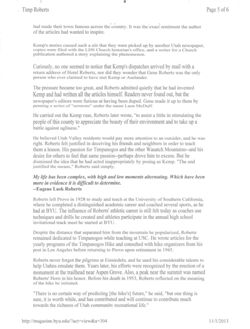
had made their town famous across the country. It was the exact sentiment the author
of the articles had wanted to inspire.
Kemp's stories caused such a stir that they were picked up by another Utah newspaper,
copies were filed with the LDS Church historian's office, and a writer for a Church
publication authored a story explaining the phenomenon.
Curiously, no one seemed to notice that Kemp's dispatches arrived by mail with a
return address of Hotel Roberts, nor did they wonder that Gene Roberts was the only
person who ever claimed to have met Kemp or Auslander.
The pressure became too great, and Roberts admitted quietly that he had invented
Kemp and had written all the articles himself. Readers never found out, but the
newspaper's editors were furious at having been duped. Gene made it up to them by
penning a series of "sermons" under the name Laon McDuff.
He carried out the Kemp ruse, Roberts later wrote, "to assist a little in stimulating the
people of this county to appreciate the beauty of their environment and to take up a
battle against ugliness."
He believed Utah Valley residents would pay more attention to an outsider, and he was
right. Roberts felt justified in deceiving his friends and neighbors in order to teach
them a lesson. His passion for Timpanogos and the other Wasatch Mountains--and his
desire for others to feel that same passion--perhaps drove him to excess. But he
dismissed the idea that he had acted inappropriately by posing as Kemp. "The end
justified the means," Roberts said simply.
My life has been complex, with high and low moments alternating. Which have been
more in evidence it is difficult to determine.
--Eugene Lusk Roberts
Roberts left Provo in 1928 to study and teach at the University of Southern California,
where he completed a distinguished academic career and coached several sports, as he
had at BYU. The influence of Roberts' athletic career is still felt today as coaches use
techniques and drills he created and athletes participate in the annual high school
invitational track meet he started at BYU.
Despite the distance that separated him from the mountain he popularized, Roberts
remained dedicated to Timpanogos while teaching at USC. He wrote articles for the
yearly programs of the Timpanogos Hike and consulted with hike organizers from his
post in Los Angeles before returning to Provo upon retirement in 1945.
Roberts never forgot the pilgrims at Einsiedeln, and he used his considerable talents to
help Utahns emulate them. Years later, his efforts were recognized by the erection of a
monument at the trailhead near Aspen Grove. Also, a peak near the summit was named
Roberts' Horn in his honor. Before his death in 1953, Roberts reflected on the meaning
of the hike he initiated.
"There is no certain way of predicting [the hike's] future," he said, "but one thing is
sure, it is worth while, and has contributed and will continue to contribute much
towards the richness of Utah community recreational life."
http://magazine.byu.edu/?act=view&a=304
11/1/2013
Viewer Controls
Toggle Page Navigator
P
Toggle Hotspots
H
Toggle Readerview
V
Toggle Search Bar
S
Toggle Viewer Info
I
Toggle Metadata
M
Zoom-In
+
Zoom-Out
-
Re-Center Document
Previous Page
←
Next Page
→
[Series II] Roberts, Eugene 1880-1953
| Page | Type | Title | Date | Source | Other notes |
| 1 | File Folder | Robert, Eugene 1880-1953 | - | Ronald Epp | - |
| 2 | Collection Guide | First page (of 10) of the "Register of the Eugene Lusk Roberts Collection, 1912-1972," located in Special Collections of Brigham Young University | - | Available online at htttp://files.lib.byu/edu/ead | - |
| 3-4 | Letter | Letter to Mr. Dorr from Eugene L. Roberts re: reminiscences of shared experiences on western trips | 01/02/1902 | ANPA. Box I.f.3 | - |
| 5 | Letter | Letter to Cory Nimer from Ronald Epp re: letters exchanged between Eugene Roberts and George B. Dorr | 02/20/2020 | Personal correspondence of Ronald Epp | - |
| 6 | Email to Dr. Epp from Cory Nimer re: review of the Eugene Roberts collection and no reference to George B. Dorr | 02/10/2020 | Personal correspondence of Ronald Epp | - | |
| 7 | Email to Gordon Daines (BYU) from Ronald Epp re: offering the letter from Eugene Roberts to George B. Dorr now in Sawtelle Collection, ANP | 01/26/2020 | Personal correspondence of Ronald Epp | Note: Eugene Roberts and Dorr were part of the geological research team led by Harvard professor William Morris Davis, 1902 [MF] | |
| 8 | Bibliographic Citation | Citation, "Eugene Lusk Roberts: An Architect of Physical Eudation in the American West" | 1984 | Romine, Jonathan N. Eugene Lusk Roberts. Provo: Brigham Young Ul, PhD. dissertation, 1984. | - |
| 9 | Textbook Excerpt | Selected pages mentioning 1902 geographic research done, headed by William Morris Davis | - | No source cited; possibly PhD. dissertation by Romine, Jonathan N. Eugene Lusk Roberts, Brigham Young University, 1984. [MF] | - |
| 10 | Image | Photographic image of Eugene Lusk Roberts with his wife. | copyright 2009 | Available online at http://news.byu.edu | - |
| 11 | Magazine Article, online | Online article, "TIMP Roberts," by Ed Carter | Fall 1998 | BYU Magazine; available online at http://magazine. byu.edu | - |
| 12 | Book Title, online | Google book record of "The Life and Educational Contributions of Eugene Lusk Roberts" | 1952 | Gregory, Marva Hodson. The Life and Educational Contributions of Eugene Lusk Roberts. 1952 | - |
| 13-16 | Magazine Article, online | Continuation of the magazine article, "TIMP Roberts" | Fall 1998 | BYU Magazine; available online at http://magazine. byu.edu | Continuation of article started in Item #10 [MF] |
Details
Series 2