From collection Creating Acadia National Park: The George B. Dorr Research Archive of Ronald H. Epp


Page 1
Page 2
Page 3
Page 4
Page 5
Page 6
Page 7
Page 8
Page 9
Page 10
Page 11
Page 12
Page 13
Page 14
Page 15
Page 16
Page 17
Page 18
Page 19
Page 20
Page 21
Search
results in pages
[Series II] Russell, Jack (1943 - ?)
Russelli Jack (1943- 2
Sea also feles,
Series IX on publication of
C.A.N.P.
Living in Acadia
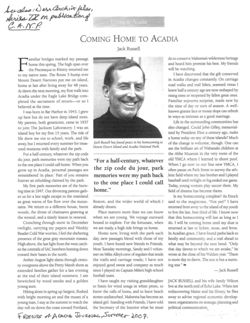
COMING HOME TO ACADIA
Jack Russell
F
amiliar bridges marked my passage
do to conserve Makenna's wilderness heritage
home this spring. The high span over
and heard him promise his best. My friends
the Piscataqua to Kittery returned me
will be watching.
to my native state. The Route 3 hump over
I have discovered that the gift conserved
Mount Desert Narrows put me on island,
in Acadia changes constantly. On carriage
home at last after living away for 48 years.
road walks and trail hikes, seaward vistas I
At dawn the next morning, my first walk into
knew half a century ago are now reshaped by
Acadia under the Eagle Lake Bridge com-
rising trees or reopened by fallen great ones.
pleted the sacrament of return-or SO I
Familiar sojourns surprise, made new by
believed at the time.
the time of day or turn of season. A well-
I was born in Bar Harbor in 1943. I grew
known granite face or mossy slope can refresh
up here but do not have deep island roots.
in ways as intimate as a good marriage.
My parents, both geneticists, came in 1937
Life in the surrounding communities has
to join The Jackson Laboratory. I was an
also changed. Could John Gilley, memorial-
island boy for my first 15 years. The tide of
ized by President Eliot a century ago, make
life drew me out to school, work, and life
a home today on any of these islands? Much
away, but I returned every summer for treas-
Jack Russell has found peace in his homecoming to
of the change is welcome, though. One can
Mount Desert Island and Acadia National Park.
ured reunions with family and the park.
see the brilliant art of Wabanaki children at
For a half-century, whatever the zip code
the Abbe Museum in the very room of the
du jour, park memories were my path back
"For a half-century, whatever
old YMCA where I learned to shoot pool.
to the one place I could call home. When you
When I go now to our fine new YMCA, I
grow up in Acadia, personal passages are
the zip code du jour, park
often pause on Park Street to survey the ath-
remembered 'in place.' Part of you remains
memories were my path back
letic field where my late brother and I played
forever an inholding claimed by the park.
to the one place I could call
baseball until twilight or fog ended our game.
My first park memories are of the burn-
Today, young women play soccer there. My
ing time in 1947. Our divorcing parents gath-
home."
field of dreams has become theirs.
er us for a late night escape to the mainland
Is my homecoming complete? As Enoch
as great waves of fire flow over the moun-
Boston, and the wider world of which I
said to the magistrate, "Not yet!" I have
tains. We return to a different house, burnt
already dream.
returned from away to the island of my youth
woods, the drone of chainsaws gnawing at
Place matters more than we can know
to live the last, best third of life. I know now
the wound, and a timely lesson in renewal.
when we are young. We voyage outward
that this homecoming will last as long as I
Crunching through snow in December
bound to explore. For the fortunate, when
do. I will be coming home until my dust is
twilight, carrying my papers and Weekly
we are ready, a high tide brings us home.
returned at last to lichen, moss, and ferns.
Reader Cold War worries, I feel the sheltering
Home now, living with the park each
In Acadian grace, I have found paths back to
presence of the great gray mountain masses.
day, new passages blend with those of my
family and community, and a trail ahead to
High above, the last light from the west catch-
youth. I have found new friends in Friends.
what may be beyond the next bend. "Only
es the contrails of SAC bombers homing down
Most Tuesday mornings, Sandy and I volun-
that day dawns to which we are awake," he
toward their bases in the north.
teer on Mike Alley's crew of regulars that tends
wrote at the close of his Walden year. "There
Amber August light slants through centu-
the trails and carriage roads; I have not
is more day to dawn. The sun is but a morn-
ry evergreens above the Pretty Marsh shore as
enjoyed good sweat and company as much
ing star." is
extended families gather for a last evening
since I played on Captain Mike's high school
Jack Russell
at the end of their island summers. I am
football team.
bewitched by wood smoke and a golden
I have taught my visiting granddaughter
JACK RUSSELL and his wife Sandy Wilcox
young aunt.
to listen for wind songs in white pines, to
live at the north end of Echo Lake. When not
Hiking alone in spring up Sargent, flushed
know the calls of loons, and to leave beach
rediscovering Maine and his library, he flies
with bright morning air and the muses of a
stones undisturbed. Makenna has become an
away to advise regional economic develop-
young man, I stay at the summit to watch the
island girl. Standing with Friends, have told
ment organizations on strategic planning and
day roll on down the coast toward Portland,
the Secretary of the Interior what he must
political communication.
FRIENDS of ACADIA RNAL,,Summer 2007.
Special Person
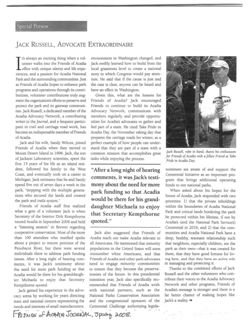
JACK RUSSELL, ADVOCATE EXTRAORDINAIRE
I
t's always an exciting thing when a vol-
environment in Washington changed, and
unteer walks into the Friends of Acadia
Jack swiftly learned how to build from the
office with unique talents and life expe-
local grassroots level to create a national
riences, and a passion for Acadia National
story to which Congress would pay atten-
Park and the surrounding communities. Just
tion. He said that if the cause is just and
as Friends of Acadia hopes to enhance park
the case is clear, anyone can be heard and
programs and operations through its contri-
have an effect in Washington.
butions, volunteer contributions truly aug-
Given this, what are the lessons for
ment the organization's efforts to preserve and
Friends of Acadia? Jack encouraged
AC
DAY
protect the park and its gateway communi-
Friends to continue to build its Acadia
ties. Jack Russell, a dedicated member of the
Advocacy Network, communicate with
Acadia Advocacy Network, a contributing
members regularly, and provide opportu-
writer to the Journal, and a frequent partici-
nities for Acadia's advocates to gather and
pant in trail and carriage road work, has
feel part of a team. He cited Take Pride in
become an indispensable member of Friends
Acadia Day, the November raking day that
of Acadia.
prepares the carriage roads for winter, as a
Jack and his wife, Sandy Wilcox, joined
perfect example of how people can under-
Friends of Acadia when they moved to
stand that they are part of a team with a
Mount Desert Island in 1996. Jack, the son
common mission that accomplishes great
Jack Russell, rake in hand, shares his enthusiasm
for Friends of Acadia with a fellow Friend at Take
of Jackson Laboratory scientists, spent the
tasks while enjoying the process.
Pride in Acadia Day.
first 15 years of his life as an island resi-
dent, followed his family to the West
"After a long night of hearing
nominees are aware of and support the
Coast, and eventually took on a career in
comments, it was Jack's testi-
Centennial Initiative as an important pro-
Michigan. Jack estimates that he and Sandy
gram that brings additional operating
spend five out of seven days a week in the
mony about the need for more
funds to our national parks.
park, "stepping with the multiple genera-
park funding so that Acadia
When asked about his hopes for the
tions who secured the lands and created
future of Acadia, Jack responded with two
the park and trails system."
would be there for his grand-
priorities: 1) that the private inholdings
Friends of Acadia staff first realized
daughter Michaela to enjoy
within the boundaries of Acadia National
what a gem of a volunteer Jack is when
that Secretary Kempthorne
Park and critical lands bordering the park
Secretary of the Interior Dirk Kempthorne
be protected within his lifetime, if not by
toured Acadia in September 2006 and held
quoted."
Acadia's (and the National Park Service's)
a "listening session" in Brewer regarding
Centennial in 2016; and 2) that the com-
cooperative conservation. Most of the more
Jack also suggested that Friends of
munities and Acadia National Park have a
than 100 attendees who testified spoke
Acadia reach out make Acadia relevant to
deep, healthy, resonant relationship such
about a project to restore portions of the
all Americans. He mentioned that minority
that neighbors, especially children, see the
Penobscot River, but there were several
populations in the United States will soon
park as their own-that it was created for
individuals there to address park funding
outnumber white Americans, and that
them, that they have good fortune for liv-
issues. After a long night of hearing com-
Friends of Acadia and other park advocates
ing here, and that they have an active role
ments, it was Jack's testimony about
need to engage minority communities
in managing and protecting it.
the need for more park funding SO that
to ensure that they become the preserva-
Thanks to the combined efforts of Jack
Acadia would be there for his granddaugh-
tionists of the future. In this presidential
Russell and the other volunteers who con-
ter Michaela to enjoy that Secretary
transition year, Jack also specifically rec-
tribute their voices to the Acadia Advocacy
Kempthorne quoted.
ommended that Friends of Acadia work
Network and other programs, Friends of
Jack gained his experience in the advo-
with national partners, such as the
Acadia's message is stronger and there is a
cacy arena by working for years directing
National Parks Conservation Association
far better chance of making hopes like
state and national centers representing the
and the congressional sponsors of the
Jack's a reality.
needs and interests of small manufacturers.
Centennial Challenge authorizing legisla-
FRIENDS of ACADIA JOURNAL, spring 2008.
History
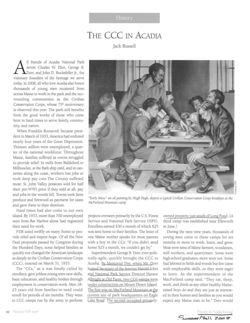
THE CCC IN ACADIA
Jack Russell
ll friends of Acadia National Park
A
revere Charles W. Eliot, George B.
Dorr, and John D. Rockefeller Jr., the
visionary founders of the heritage we serve
today. In 2008, all who love Acadia also honor
thousands of young men mustered from
across Maine to work in the park and the sur-
rounding communities as the Civilian
Conservation Corps, whose 75th anniversary
is observed this year. The park still benefits
from the good works of those who came
here in hard times to serve family, commu-
nity, and nation.
When Franklin Roosevelt became presi-
dent in March of 1933, America had endured
nearly four years of the Great Depression.
Thirteen million were unemployed, a quar-
ter of the national workforce. Throughout
Maine, families suffered as towns struggled
to provide relief. In mills from Biddeford to
Millinocket, at the Bath ship yard, and in can-
neries along the coast, workers lost jobs or
took deep pay cuts. The County suffered
most: St. John Valley potatoes sold for half
their pre-WWI price if they sold at all; pay
and jobs in the woods fell. Towns took farm
produce and firewood as payment for taxes
"Early Mess," an oil painting by Hugh Hegh, depicts a typical Civilian Conservation Corps breakfast at the
McFarland Mountain camp.
and gave them to their destitute.
Hard times had also come to our own
island. By 1933, more than 700 unemployed
projects overseen primarily by the U.S. Forest
owned property just south of Long Pond. (A
men from Bar Harbor alone had registered
Service and National Park Service (NPS).
third camp was established near Ellsworth
their need for work.
Enrollees earned $30 a month of which $25
in June.)
FDR acted swiftly on many fronts to pro-
was sent home to their families. The letter of
During the next nine years, thousands of
vide relief and inspire hope. Of all the New
one Maine mother speaks for most parents
young men came to these camps for six
Deal proposals passed by Congress during
with a boy in the CCs: "If you didn't send
months or more to work, learn, and grow.
the Hundred Days, none helped families as
home $25 a month, we couldn't get by."
Most were sons of Maine farmers, woodsmen,
quickly nor changed the American landscape
Superintendent George B. Dorr, ever polit-
mill workers, and quarrymen. Some were
as deeply as the Civilian Conservation Corps
ically-agile, quickly brought the CCC to
high school graduates, more were not. Some
(CCC), enacted on March 31, 1933.
Acadia. By Memorial Day, when Mr. Dorr
had labored in fields and woods but few came
The "CCs," as it was fondly called by
hosted Secretary of the Interior Harold Ickes
with employable skills, SO they were eager
enrollees, gave jobless young men new skills,
and National Park Service Director Horace
to learn. As the superintendent of the
basic education, and healthy bodies through
Albright at Old Farm, two CCC camps were
MacFarland camp said, "They eat, sleep,
employment in conservation work. Men 18-
under construction on Mount Desert Island.
work, and think as any other healthy Maine-
25 years old from families in need could
The first was on MacFarland Mountain at the
raised boys do and they are just as interest-
enroll for periods of six months. They went
current site of park headquarters on Eagle
ed in their homes and families as you would
to CCC camps run by the army to perform
Lake Road. The second occupied privately-
expect any Maine man to be." Dorr would
12
Summer Fall 2008
Friends of Acadia Journal
portion of the plan? What is the logic behind
ing-that they would present as an option
destroying natural habitats for the purpose
the possibility of a purchase of the property
of building ecological centers to interpret
by conservation buyers, and that they would
RESOURCE
what naturally existed in the first place?
deliver Friends' request to meet directly with
VALUES OF THE
Through opinion editorial pieces in local
the landowners. Friends believes that the con-
SCHOODIC PENINSULA
and regional newspapers, public listening ses-
sultants followed through with both prom-
sions, and kitchen meetings, Friends began
ises, but to date has not been able to meet
the process of engaging community members
with the landowners and does not know if
Adapted from information provided by
in discussions about the proposal and their
the "eco-resort" plan will be pursued, aban-
the National Park Service
desires for the future of their peninsula com-
doned, or revised.
munities. On May 14, the landowners' con-
Friends continues to reach out to com-
The following resource values have
sultants held a public meeting on the
munity members in partnership with con-
been identified on the Schoodic
Schoodic Peninsula to present the "eco-
servation colleagues 10 understand commu-
Peninsula:
resort" concept to residents and to solicit feed-
nity ideas for economic development, to lis-
back. Friends encouraged Gouldsboro and
ten to their concerns or support for the "eco-
Habitat connection between the
Winter Harbor residents to attend the meet-
resort," and to share the important conser-
park and interior lands, which
ing, ask questions, and decide for themselves
vation and park values associated with the
helps prevent the isolation of
whether this large-scale development fit the
3,200 acres adjacent to the park. Friends
vegetative communities and
values of their communities and was appro-
maintains an open and respectful relation-
wildlife populations
priate for the boundaries of a national
ship with the project consultants and con-
resource like Acadia National Park.
tinues/ to hope for a direct meeting with the
Approximately 1.1 mile of
The May 14 public meeting was attended
landowners.
shoreline is state-mapped wildlife
by approximately 250 people. The consult-
Friends recognizes that the large-scale
habitat of significance for
ants discussed the elements of the proposed
development being explored at Schoodic has
waterfowl and wading birds
development that they viewed to be environ-
national implications because of its location
mentally-friendly but did not address specif-
on the boundary of one of America's most
Bald eagle nesting territory
ic details about when the development would
popular national parks. This proposal mer-
be built, how much and what type of hous-
its regional and national scrutiny, SO Friends
Possible archeological sites,
ing would be provided, nor the market they
is partnering with state and national organi-
as well as other cultural resources
looked to for such an ambitious development.
zations, such as the National Parks
Some residents expressed interest in the
Conservation Association, the Sierra Club,
Undeveloped entire islands:
short-term economic benefits presented by
Downeast Audubon, and the Natural
Sargents (15 acres) and
construction of the resort, but Marge num-
Resources Council of Maine, to raise the pro-
Thrumbcap (2 acres)
ber of attendees that spoke expressed skep-
file of this proposal and to engage a larger
ticism and concern about the feasibility and
audience in the analysis of the proposal.
Undeveloped gateway corridor
ecological-soundness of the plan. Many res-
If and when the consultants submit appli-
along Moore Road from the village
idents commented that the educational pur-
cations, or pre-applications, for review before
of Winter Harbor to the park
poses of the environmental centers included
the planning boards in Winter Harbor and
in the plan seem to duplicate the efforts of
Gouldsboro and before Maine's Department
Undeveloped landscape that
the existing Schoodic Education and Research
of Environmental Protection, Friends of
dominates the middle ground
Center at Acadia.
Acadia will review the plans and take fur-
viewshed from points on the
Acadia National/ and Friends of Acadia
ther appropriate action in an effort to pre-
peninsula and Mount Desert Island
have identified this proposal as the single
serve the precious conservation values of
biggest threat to the park. The consultants
the Schoodic Peninsula.
presented the public feedback on the pro-
posed "eco-resort" to the landowners in late
ERIN HITCHCOCK FOGG is the former
May. Friends secured two promises from the
communications coordinator and editor at
developers' consultants prior to this meet-
Friends of Acadia.
Friends of Acadia Journal
Summer Fall 2008 11
write that they "furnished the park with all
baseball, hockey, basketball, boxing, plays,
the labor it has had, road construction apart
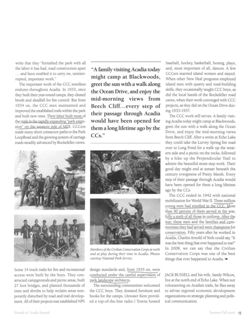
"A family visiting Acadia today
and, most important of all, dances. A few
and have enabled it to carry on, uninter-
CCCers married island women and stayed.
rupted, important work."
might camp at Blackwoods,
When other New Deal programs employed
The important work of the CCC enrollees
greet the sun with a walk along
island men with quarry and road-building
endures throughout Acadia. In 1933, once
the Ocean Drive, and enjoy the
skills, they occasionally taught CCC boys, as
they built their year-round camps, they cleared
did the local hands of the Rockefeller road
brush and deadfall for fire control. But from
mid-morning views from
crews, when their work converged with CCC
1934 on, the CCC men maintained and
Beech Cliff every step of
projects, as they did on the Ocean Drive dur-
improved the established trails within the park
their passage through Acadia
ing 1933-1937.
and built new ones. Their labor built most of
The CCC work still serves. A family visit-
the trails in the rapidly expanding "park exten-
would have been opened for
ing Acadia today might camp at Blackwoods,
sion" on the western side of MDI. CCCers
them a long lifetime ago by the
greet the sun with a walk along the Ocean
made many short connector paths to the Park
Drive, and enjoy the mid-morning views
LoopRoad and the growing system of carriage
CCs."
from Beech Cliff. After a swim at Echo Lake
roads steadily advanced by Rockefeller crews.
they could take the Lurvey Spring fire road
over to Long Pond for a walk up the west-
ern side and a picnic on the rocks, followed
by a hike up the Perpendicular Trail to
admire the beautiful stone step work. Their
good day might end at sunset beneath the
century evergreens of Pretty Marsh. Every
step of their passage through Acadia would
have been opened for them a long lifetime
ago by the CCs.
The CCC ended in 1942 with national
mobilization for World War II. Three million
young men had enrolled in the CCC. More
than 90 percent of them served in the war,
fully a sixth of all those in uniform. After the
war, these men and the families and com-
20
12
munities they had served were champions for
conservation. Fifty years after he worked in
Acadia, Charles Arnold of York could say, "It
was the best thing that ever happened to me!"
Members of the Civilian Conservation Corps at work
In 2008, we can say that the Civilian
and at play during their time in Acadia. Photos
Conservation Corps was one of the best
courtesy National Park Service.
things that ever happened to Acadia.
Some 14 truck trails for fire and recreational
design standards and, from 1935 on, were
access were built by the boys. They con-
conducted under the careful supervision of
JACK RUSSELL and his wife, Sandy Wilcox,
structed campgrounds and picnic areas, built
park landscape architects.
live at the north end of Echo Lake. When not
27 foot bridges, and planted thousands of
The surrounding communities welcomed
volunteering on Acadia's trails, he flies away
trees and shrubs to help reclaim areas tem-
the CCC boys. They donated furniture and
to advise regional economic development
porarily disturbed by road and trail develop-
books for the camps. (Atwater Kent provid-
organizations on strategic planning and polit-
ment. All of their projects met established NPS
ed a top-of-the-line radio.) Towns hosted
ical communication.
Friends of Acadia Journal
Summer Fall 2008
13
New Members
We are pleased to welcome our newest friends:
Bar Harbor Bank
Mark and Lynn Adams
Lorraine Loeper
William Alberino
Trust salutes
M&M Painting
Mr. and Mrs. Oral Applegate
Judith Maines-Lamarre
Friends of Acadia for
AT&T United Way Employee Giving Campaign
Janet Marcimak
David Avery
Donna Marincas
helping preserve the
Kyle and Lelania Avila
Patricia Matulaitis
Bruce and Sharon Beckley
Susan McKinnon
Park for future
Leonard and Jean Berkowitz
Robert and Debra Milotte
generations.
John P. Bobiak
David and Elizabeth Morgan
William and Shirley Bossenberger
Kevin O'Reilly
Vincent and Brenda Bristow
Irvin and Cindy Paradis
Michael Camilleri
Roberta Parritt
Mr. and Mrs. Terry Chambers
Charles and Linda Pasquariello
BAR HARBOR
Charles Clement
Raab Collection LLC
BANK & TRUST
Merle and Allie Cousins
TD Bank Financial Group
MEMBER
Ruta Dzenis
Zachary Reissman
FDIC
What's on your horizon?
Elizabeth Stone Mills Revocable Trust
John Sagaser
For the cyclist looking
Donna Elliott
John and Joanne Salmon
for a difference.
Darci Fredricks
SRA International, Inc.
Nicholas and Rita Hall
Karen Stray-Gundersen
BAR
HARBOP
Patrick Helsel
George and Betty Tassara
Virginia James
Paul and Theresa Waldron
BICYSHOP
Jensen Baird Gardner and Henry
Chrysandra Walter
Steve and Pat Jewell
Ira Weissman and Sally Healey
Locally owned and operated
Anandhi Johri
Kimberly Whitney
for over 25 years
Beatrice Jordan
Eileen Wukitch
141 Cottage Street, Bar Harbor
Tel. (207) 288-3886
Barb, Andy, and Kevin Kalish
Karen and Chris Zimmerman
www.barharborbike.com
Catherine Kashanski and Eric Sorenson
Kathie Krieg
Steve Levitt
March 1 - May 31, 2008
Birch Bay
Retirement Village
Bar Harbor
birchbayinfo.com 207 288-8014
BRUCE JOHN RIDDELL
LANDSCAPE ARCHITECTURE
27 PINE STREET
BAR HARBOR, MAINE 04609
207.288.9668
Creative & Innovative Landscape Architecture
for Residential & Estate Gardens
14
Summer Fall 2008
Friends of Acadia Journal
History
BOB PATTERSON'S FIRST WORK ON MDI
Jack Russell
atrons of the Jordan Pond House will
P
projects, many within the expanding park
know the photograph: A gentleman in
where the young designer's skills were a
his sixties surveys the dining room,
welcome resource for Benjamin Breeze, the
hands at rest on lapels in the manner of
park's landscape architect.
18th-century portraits. Those who knew him
One of Patterson's first assignments was
can imagine this composed man offering
to conceive an expansion and integration of
advice in a calm voice on the right moss for
the Beech Cliff and Beech Mountain trail sys-
a garden recess, how to feather a paddle
tem, building on the achievements of the
stroke in wilderness waters, a fresh way for
Southwest Harbor Village Improvement
morning light to flood a room-to-be, or a
Association. A parking lot and short trail up
path to compose the needs of town and park.
to the cliffs were roughed in by island men
The man is Robert Whiteley Patterson,
employed by the New Deal CWA program
known to many as a leading architect of
late in 1933, but heavy snows had halted
20th-century coastal Maine. Less known is
them. In the spring of 1934. Bob Patterson's
his earlier contribution-to composing
CCC lads finished this work and built the
nature and design in our park.
trail loop around the cliffs. working to his
Patterson was enabled by the Acadian
design that "one of the most important
visionaries. Born in 1905, he was just four
requirements in stone work here is that it
years younger than the conserving collabo-
looks harmonious and unobtrusive in its sur-
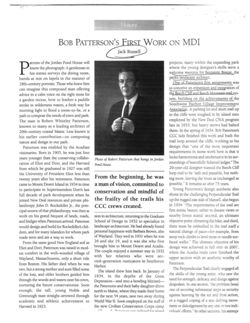
Photo of Robert Patterson that hangs in Jordan
ration of Eliot and Dorr, and the Harvard
Pond House.
roundings of beautifully lichened ledges." The
from which he graduated in 1927 was still
29-year old designer wanted the Beech Cliff
the University of President Eliot less than
loop trail to be "safe and passable, but noth-
twenty years after his retirement. Patterson
From the beginning, he was
ing more, leaving the route as unchanged as
came to Mount Desert Island in 1934 in time
a man of vision, committed to
possible. It remains so after 75 years.
to participate in Superintendent Dorr's last
conservation and mindful of
Young Patterson's design aesthetic also
full decade of park development when he
shone in the challenging Perpendicular Trail
joined New Deal resources and private phi-
the frailty of the trails his
up the rugged east side of Mansell, also begun
lanthropy. John D. Rockefeller Jr., the prin-
CCC crews created.
in 1934. "The requirements of the trail are
cipal source of that philanthropy, was then at
first scenic beauty. either in distant views or
work on his grand bequest of lands, roads,
sion in architecture, returning to the Graduate
nearby forest stand: second, an ultimate
and bridges when Patterson arrived. Patterson
School of Design in 1932 to specialize in
objective point climaxing the hike; and third,
would design and build for Rockefeller's chil-
landscape architecture. He had already found
there must be embodied in the trail itself a
dren, and for many islanders for whom park
personal happiness with Barbara Brown, also
natural change of pace-for example, from
roads were and are a way to work.
of Wayland. They wed in 1931 when he was
steep rock climbs to level moss or needle sur-
From the same good New England soil as
26 and she 19, and it was she who first
faced walks. The ultimate objective of his
Eliot and Dorr, Patterson was raised in mod-
brought him to Mount Desert and Acadia.
design was achieved in full only in 2007,
est comfort in the well-wooded village of
The couple enjoyed a summer stay in 1932
when the Acadia trails crew finished the
with her relatives who were sec-
Wayland, Massachusetts, only a short ride
upper section with an aesthetic worthy of
ond-generation rusticators in Southwest
from Boston. His father died when he was
Patterson.
Harbor.
two, but a strong mother and aunt filled some
The Perpendicular Trail clearly engaged all
The island drew him back. In January of
of the loss, and older brothers guided him
1934, in the depths of the Great
the skills of the young artist. who saw the
through the woods and waters near his town,
Depression-and into a howling blizzard-
need for strength, delicacy, and design against
nurturing the future conservationist. Soon
the Pattersons and their baby daughter drove
despoilers. In one section, the problem [was]
enough, the tall, young Noble and
north to Maine, where they made their home
one of securing substantial steps as security
Greenough man straight-arrowed through
for the next 54 years, save two away during
against heaving by the ice and frost action,
academic and athletic achievement to
World War II. Soon employed on the staff of
or a rugged coping of a size defying move-
Harvard in 1923.
the new Civilian Conservation Corps camp
ment or dislodgement by any one or two indi-
viduals' efforts." In other sections. his attempt
sould be to "soften and naturalize [the] rocky
the old Park Headquarters at Park and Lower
frugal townsmen, as well as Astors and
by clothing ragged and bare surfaces
Main, it seems likely that the vigorous octo-
Rockefellers. The public service he began in
moss and mats of rock fern, such as
genarian enjoyed good talks with this young
the park would lead to many of our ameni-
grow for the most part throughout the talus
park employee, a Harvard man and proper
ties, from wading pools and wharfs to land-
slope." As the authors of Pathmakers would
Bostonian who shared Dorr's passion for
scaping for schools and churches. The
observe more than 70 years later, in a telling
plants and lived just a few steps away.
thoughtful young park designer would
break from their usually austere style, "The
Robert W. Patterson's future, however, was
become a wise counsel for both park and
trail is one of the most highly constructed
only a few steps more in another direction,
towns on the long path to recovery after the
on the island
[the] views are grand to the
toward the shore at Reef Point Gardens, and
1947 fire. The lover of things wild, drawn to
southeast, but the stonework steals the show."
into history. His long professional association
Acadia in his twenties, would found the
By 1935, Bob Patterson had become the
with Beatrix Farrand and commitment to her
Maine Natural Resources Council, and fur-
full-time assistant to Ben Breeze at Acadia
vision led to many commissions, and to his
ther conservation of our northern wilderness.
National Park. From the beginning, he was
essential roles in honoring the decisions of
Friends of the Acadia that Bob Patterson
a man of vision, committed to conservation
Farrand's final years, and saving the plants
cherished might pause at his portrait on their
and mindful of the frailty of the trails his CCC
of Reef Point for their lasting life at the Asticou
next visit to the Jordan Pond House, to reflect
crews created. As he would soon advise his
Azalea and Thuya Gardens, created by his
on the unsigned works that the young artist
supervisors, there is a "fundamental princi-
good friend Charles K. Savage.
contributed at the beginning of his career on
ple [that] areas used by the public (unless
The young Bob Patterson who came to
our island. is
most carefully planned for several decades of
the portal of that future had already found an
time), tend to destroy themselves for the par-
island aesthetic while high on Acadian slopes,
JACK RUSSELL and his wife, Sandy Wilcox,
ticular park purpose for which they are used."
directing young CCC men from across Maine.
live at the north end of Echo Lake. He thanks
Did George B. Dorr hear the distinctive
Lessons learned working on the Beech Cliff
his neighbor Robert Whiteley Patterson Jr.
voice of his designer? Documentation does
and Mansell trails as he began his decades
(Lee) for generous guidance on this essay.
not confirm this, but since the Pattersons
here helped guide the hand that gave us more
They are now, as once their fathers were, good
rented a home on Livingston Road very near
than 40 MDI houses, grand and modest, for
friends.
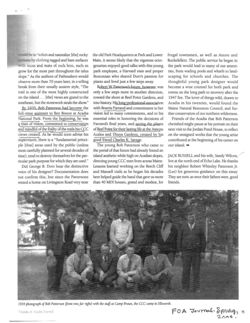
1934 photograph of Bob Patterson (front row, far right) with the staff at Camp Braun, the CCC camp in Ellsworth.
Friends of Acadia Journal
FOA Journal Spring,
15
2009.
Cultural Resources
ACADIAN PASSAGES
Jack Russell
illions who come to Acadia
M
admire two special features of
our park. Every visitor to the
summit of Cadillac sees mountains rise
from the Atlantic for seaward vistas like no
others on Earth. Most also enjoy some part
of our network of trails, carriage roads, and
motor roads. These passages through
Acadia afford visitors of all ages an easy
and intimate access to nature that is unique
in our national park system. As we move
toward the 2016 centennial of Acadia, we
should celebrate the historic artistic
achievement-requiring time, vision, and
community-that opens our park to the
world.
Time
Humankind has walked these hills from
ancient times. Wabanaki forebears moved
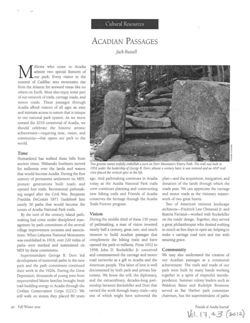
Two granite stones artfully embellish a turn on Dorr Mountain's Emery Path. The trail was built in
for millennia over the lands and waters
1916 under the leadership of George B. Dorr; almost a century later, it was restored and an ANP trail
that would become Acadia. During the first
crew placed the vertical spire at the left.
century of permanent settlement on MDI,
ago. And pathmaking continues in Acadia
plan-and the acquisition, integration, and
pioneer generations built roads and
today as the Acadia National Park trails
donation of the lands through which the
opened foot trails. Recreational pathmak-
crew continues planning and constructing
roads pass. We can appreciate the carriage
ing surged after the Civil War. Benjamin
new hiking trails and Friends of Acadia
and motor roads as the visionary master-
Franklin DeCosta's 1871 Guidebook lists
conserves the heritage through the Acadia
work of two great hearts.
nearly 30 paths that would become the
Trails Forever program.
Two of America's eminent landscape
routes of Acadia National Park trails.
architects-Fredrick Law Olmstead Jr. and
By the turn of the century, island path-
Vision
Beatrix Farrand-worked with Rockefeller
making had come under disciplined man-
During the middle third of these 150 years
on the roads' design. Together, they served
agement by path committees of the several
of pathmaking, a man of vision invested
a great philanthropist who desired nothing
village improvement societies and associa-
nearly half a century, great care, and much
SO much as free days in open air, helping to
tions. When Lafayette National Monument
treasure to build Acadian passages that
make a carriage road turn and rise with
was established in 1916, over 220 miles of
complement the hiking trails and have
amazing grace.
paths were marked and maintained on
opened the park to millions. From 1912 to
MDI by these committees.
1958, John D. Rockefeller Jr. conceived
Community
Superintendant George B. Dorr led
and commissioned the carriage and motor
We may also understand the creation of
development of memorial paths in the new
road networks as a gift to Acadia and the
our Acadian passages as a communal
park and the path committees continued
American people. This labor of love is well
achievement. The trails and roads of our
their work in the 1920s. During the Great
documented by both park and private his-
park were built by many hands working
Depression, thousands of young men from
torians. We know the will, the diplomacy,
together in a spirit of respectful interde-
impoverished Maine families brought fresh
and the extraordinary, decades-long part-
pendence. Summer colony leaders such as
trail-building energy to Acadia through the
nership between Rockefeller and Dorr that
Waldron Bates and Rudolph Brunnow
Civilian Conservation Corps (CCC). We
carried the work through many trials-any
served as Bar Harbor path committee
still walk on stones they placed 80 years
one of which might have subverted the
chairmen, but the superintendent of paths
10 Fall/Winter 2012
Friends of Acadia Journal
Vol.17,*3 (2012)
from 1892 to 1931 was Andrew Liscomb,
the son of a Bar Harbor farmer. Liscomb
and his path workmen, some who served
for decades, built many of the iconic trails
we enjoy today. George B. Dorr credited
Liscomb with the design of the Sieur de
Monts complex.
By the 1920s, with carriage road con-
struction booming and the motor roads
begun, hundreds of island men provided
back labor for good pay and operated
machines that opened the way. Their work
continued through the Great Depression,
when they were joined from 1933 through
1942 by over three thousand Maine CCC
lads. Charles Simpson, a self-taught engi-
neer from Sullivan, and then his son, Paul,
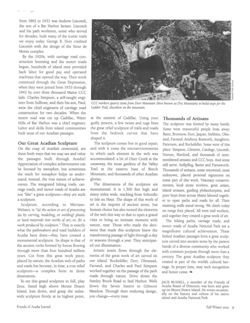
CCC workers quarry stone from Dorr Mountain (then known as Dry Mountain) to build steps for the
were the chief engineers of carriage road
Ladder Trail, elsewhere on the mountain.
construction for two decades. When the
motor road was cut up Cadillac, Water
at the summit of Cadillac. Using your
Thousands of Artisans
Hills of Bar Harbor was a chief engineer.
godly powers, a few twists and tugs frees
The sculpture was formed by many hands.
Labor and skills from island communities
the great relief sculpture of trails and roads
Some were resourceful people from away:
built most of our Acadian passages.
from the bedrock curves that have
Bates, Brunnow, Dorr, Jaques, Stebbins, Olm-
shaped it.
sted, Farrand, Attebury, Bosworth, Staughton,
Our Great Acadian Sculpture
The sculpture comes free in good repair,
Patterson, and Rockefeller. Some were of this
On the cusp of Acadia's centennial, are
and with it come the microenvironments
place: Simpson, Clement, Candage, Liscomb,
there fresh ways that we may see and value
to which each element in the web was
Norton, Hartford, and thousands of unre-
the passages built through Acadia?
accommodated: a bit of Otter Creek at the
membered artisans and CCC boys. And some
Appreciation of complex achievements can
causeway, the moss gardens of the Valley
still serve: Stellpflug, Barter and Farnsworth.
be focused by metaphor, but sometimes
Trail at the eastern base of Beech
Thousands of artisans, some renowned, most
the reach for metaphor helps us under-
Mountain, and thousands of other Acadian
unknown, placed personal signatures on
stand, instead, the true nature of achieve-
glories.
some part of this work. Visionary conserva-
ments. The integrated hiking trails, car-
The dimensions of the sculpture are
tionists, local stone workers, great artists,
riage roads, and motor roads of Acadia are
monumental. It is 1,500 feet high and
island artisans, guiding philanthropists, and
not "like" a great sculpture-they are such
many miles wide, reaching from Schoodic
poor boys from across Maine labored togeth-
a sculpture.
to Isle au Haut. The shape of this work of
er to open paths and roads for all. Their
Sculpture, according to Mirriam-
art is the imprint of ancient stone, but
retaining walls stand strong. We climb today
Webster, is "(a) the action or art of processing
human choice has also turned the elements
on rungs they placed. All were trail workers,
(as by carving, modeling, or welding) plastic
of the web this way or that to open a grand
and together they created a great work of art.
or hard materials into works of art; or, (b) a
vista or bring an intimate moment with
The hiking paths, carriage roads, and
work produced by sculpture." That is exactly
nature, near. Those who made the deci-
motor roads of Acadia National Park are a
what the pathmakers and road builders of
sions that made this sculpture knew the
magnificent cultural achievement. These
Acadia have done-they have created a
transforming passage of light through a day
linked Acadian passages form a great sculp-
monumental sculpture. Its shape is that of
or seasons through a year. They anticipat-
ture carved into ancient stone by the patient
the ancient rocks formed by forces flowing
ed our illumination.
hands of a diverse community who worked
through more than four hundred million
Artistic intent flows through the ele-
with common purpose through more than a
years. Cut from this great work piece,
ments of the great work of art carved on
century. The great Acadian sculpture they
placed by nature, the Acadian web of paths
our island. Rockefeller, Dorr, Olmstead,
created is part of the world's cultural her-
and roads has become, in time, a true relief
Farrand, and Charles and Paul Simpson
itage. In proper time, may such recognition
sculpture-a complex form in three
worked together on the passage of the park
and honor come.
dimensions.
roads through nature. Drive down the
To see this grand sculpture in full, play
Stanley Brook Road to Seal Harbor. Walk
JACK RUSSELL, a member of the Friends of
Zeus. Stand high above Mount Desert
down the Seven Sisters to Gilmore
Acadia Board of Directors, was born and grew
Island, lean down, and grasp the miles-
Meadow. Through their enduring design,
up on Mount Desert Island. He writes occasion-
ally on the history and culture of his native
wide sculpture firmly at its highest point,
you change-every time.
island and Acadia National Park.
Friends of Acadia Journal
Fall/Winter 2012
II
12/13/19
Notes for a Three-Course Sequence of
Acadia Senior College Courses on
"Our Place Through Time"
Passages in the History of
Mount Desert Island and Acadia National Park
To Be Offered in 2011
Course One: Provenance (January-February 2011)
Class 1: Perspective: Ways of Seeing Local History
We would begin with an introduction and orientation in which / offer
perspectives on the entire three-course 18-class sequence, suggest multiple
ways of learning, seeing, and sharing local history, and lead a discussion of
these themes among the co-learners. (I would allow at least 30 minutes for true
self-introductions in which co-learners are encouraged to talk about their own
lives and families in relation to the island, our communities, and park.)
Class 2: Fire, Ice and Life
/ would offer a natural history of our "place" from the Singularity (Big Bang)
through the evolution of the cosmos to the formation of our solar system and
Earth, in whose cooling crust plate tectonic forces create, over many millions of
years, the sixteen distinct bedrocks of MDI and bring them to this place. That is
the Fire. Then the last great glacier does the finish work on our mountains and
valleys. This is the Ice. And finally the return of robust animal and lush plant life
to our island, to create the place first beheld by human eyes perhaps 10,500
years ago. Life. This may sound like an ambitious ramble, but / could bring it off!
(Perhaps / could involve the Night Skies guy, Peter Lord, for some cool visuals
and dialogue on cosmology. / have several serious geologist friends with island
expertise. And as an amateur archaeologist acquainted with the Maine record, /
could do the reconstruction of life credibly, / think.)
Class 3: Dawnland People
Here we would review the full history of Native Peoples in our region from
first appearance to King Philip's War (1676). / would summarize what is known
--
and how -- by anthropologists about the stages of human lifeways here and near
here from the Paleo-Indians to first contact with Europeans. This would end with
an appreciation of Wabanaki culture on the eve of first contact. Then we would
try to reconstruct the Wabanaki perspective on the first eight decades of that
contact, from first encounters through the Great Dying to the increasing pressure
on the tribes, trying to appreciate the distinct modes of tribal response to the
ways of the English and French, and follow the initial devolution into the long
conflict in which the Wabanaki homeland was lost. To the maximum extent
possible, the story would be organized from the Wabanaki point of view. (I would
draw on Abbe Museum resources, personal and physical, and perhaps a tribal
representative.)
Class 4: Contests for Dominion
This class would follow the long contest for supremacy in mid-coastal Maine
among the English, French and Wabanaki from first contact to the British defeat of
the French in 1759/61 and the dire consequences for that defeat for the Wabanaki.
We would assess the motivations and modes of English and French colonialism
and the Wabanaki coping responses from the early seventeenth to mid-eighteenth
century. Co-learners would piece together early accounts of our region. The class
might end with a sorting out who got what between English and French claimants -
to he extent that this mattered on the ground, to the squatters on island.
Class 5: Settlement, Independence and Enterprise Down East
Here we would follow the drama of MDI settlement, from the arrival of
Abraham Somes in 1761 to the outbreak of the Civil War, by which time there
were 4,000 souls, many churches, 22 grade schools, several enterprises, and
five towns founded on this Rock. Through contemporary accounts and
documents and good monographic histories, we would comprehend the
pioneering settlement of the outer islands, listen to island people in Revolutionary
times, chart the growth of the Somesville economic hub, envision subsistence
farming from flinty soils, and mark the service of coastal markets and the growth
of wider trade on the seas. As a decent social historian, / would provide some
sense of daily life on early nineteenth century MDI and some offer some life
stories. We would try to see MDI in the wider world as Maine became a state
and look at mid-coastal Maine as American society and economy rapidly
developed in the first half of the nineteenth century. Finally, we would look for
island voices as the nation tried and failed to cope with the burden of slavery.
Class 6: For the Union Dead
Perhaps / would open with Robert Lowell's poem, a favorite. This class
would bring forth what we know about island men who became soldiers and how
the communities here fared during the Civil War. We might ask how the island of
the 1850s responded to the national turmoil about slavery and the coming of the
war, how volunteers and substitutes were mustered from island towns, and share
what is known of their experience, contribution, and fate. / would seek letters to
and from the home front and explore the record of service from each town, as we
have it. It seems natural to conclude with a look at the enduring significance of the
GAR and its memorialization. / would end with homage to John. M. Gilley, a
Bartlett island-born carpenter, who fell at the Second Battle of the Wilderness and
rests now in the Wasgatt Cemetery up on Beech Hill.
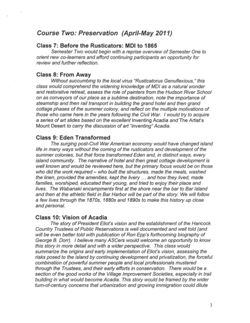
2
Course Two: Preservation (April-May 2011)
Class 7: Before the Rusticators: MDI to 1865
Semester Two would begin with a reprise overview of Semester One to
orient new co-learners and afford continuing participants an opportunity for
review and further reflection.
Class 8: From Away
Without succumbing to the local virus "Rusticatorus Genuflexious," this
class would comprehend the widening knowledge of MDI as a natural wonder
and restorative retreat, assess the role of painters from the Hudson River School
on as conveyors of our place as a sublime destination, note the importance of
steamship and then rail transport in building the grand hotel and then grand
cottage phases of the summer colony, and reflect on the multiple motivations of
those who came here in the years following the Civil War. / would try to acquire
a series of art slides based on the excellent Inventing Acadia and The Artist's
Mount Desert to carry the discussion of art "inventing" Acadia.
Class 9: Eden Transformed
The surging post-Civil War American economy would have changed island
life in many ways without the coming of the rusticators and development of the
summer colonies, but that force transformed Eden and, in distinct ways, every
island community. The narrative of hotel and then great cottage development is
well known and would be reviewed here, but the primary focus would be on those
who did the work required - who built the structures, made the meals, washed
the linen, provided the amenities, kept the livery and how they lived, made
families, worshiped, educated their young, and tried to enjoy their place and
lives. The Wabanaki encampments first at the shore near the bar to Bar Island
and then at the athletic field in Bar Harbor will be part of the story. We will follow
a few lives through the 1870s, 1880s and 1890s to make this history up close
and personal.
Class 10: Vision of Acadia
The story of President Eliot's vision and the establishment of the Hancock
Country Trustees of Public Reservations is well documented and well told (and
will be even better told with publication of Ron Epp's forthcoming biography of
George B. Dorr). / believe many ASCers would welcome an opportunity to know
this story in more detail and with a wider perspective. This class would
summarize the origins and early implementation of Eliot's vision, assessing the
risks posed to the island by continuing development and privatization, the forceful
combination of powerful summer people and local professionals mustered
through the Trustees, and their early efforts in conservation. There would be a
section of the good works of the Village Improvement Societies, especially in trail
building in what would become Acadia. This story would be framed by the wider
turn-of-century concerns that urbanization and growing immigration could dilute
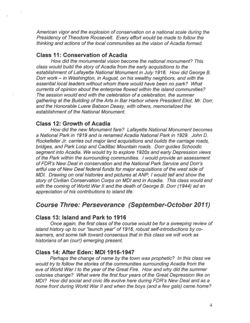
3
American vigor and the explosion of conservation on a national scale during the
Presidency of Theodore Roosevelt. Every effort would be made to follow the
thinking and actions of the local communities as the vision of Acadia formed.
Class 11: Conservation of Acadia
How did the monumental vision become the national monument? This
class would build the story of Acadia from the early acquisitions to the
establishment of Lafayette National Monument in July 1916. How did George B.
Dorr work - in Washington, in August, on his wealthy neighbors, and with the
essential local leaders without whom there would have been no park? What
currents of opinion about the enterprise flowed within the island communities?
The session would end with the celebration of a celebration, the summer
gathering at the Building of the Arts in Bar Harbor where President Eliot, Mr. Dorr,
and the Honorable Luere Babson Deasy, with others, memorialized the
establishment of the National Monument.
Class 12: Growth of Acadia
How did the new Monument fare? Lafayette National Monument becomes
a National Park in 1919 and is renamed Acadia National Park in 1929. John D.
Rockefeller Jr. carries out major land acquisitions and builds the carriage roads,
bridges, and Park Loop and Cadillac Mountain roads. Dorr guides Schoodic
segment into Acadia. We would try to explore 1920s and early Depression views
of the Park within the surrounding communities. / would provide an assessment
of FDR's New Deal in conservation and the National Park Service and Dorr's
artful use of New Deal federal funds for major acquisitions of the west side of
MDI. Drawing on oral histories and pictures at ANP, / would tell and show the
story of Civilian Conservation Corps on MDI and in Acadia. This class would end
with the coming of World War // and the death of George B. Dorr (1944) ad an
appreciation of his contributions to island life.
Course Three: Perseverance (September-October 2011)
Class 13: Island and Park to 1916
Once again, the first class of the course would be for a sweeping review of
island history up to our "launch year" of 1916, robust self-introductions by co-
learners, and some talk toward consensus that in this class we will work as
historians of an (our!) emerging present.
Class 14: After Eden: MDI 1916-1947
Perhaps the change of name by the town was prophetic? In this class we
would try to follow the stories of the communities surrounding Acadia from the
eve of World War / to the year of the Great Fire. How and why did the summer
colonies change? What were the first four years of the Great Depression like on
MDI? How did social and civic life evolve here during FDR's New Deal and as
a
home front during World War // and when the boys (and a few gals) came home?
4
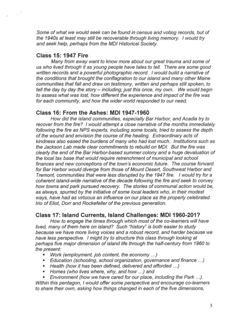
Some of what we would seek can be found in census and voting records, but of
the 1940s at least may still be recoverable through living memory. / would try
and seek help, perhaps from the MDI Historical Society.
Class 15: 1947 Fire
Many from away want to know more about our great trauma and some of
us who lived through it as young people have tales to tell. There are some good
written records and a powerful photographic record. / would build a narrative of
the conditions that brought the conflagration to our island and many other Maine
communities that fall and draw on testimony, written and perhaps still spoken, to
tell the day by day the story - including, just this once, my own. We would begin
to assess what was lost, how different the experience and impact of the fire was
for each community, and how the wider world responded to our need.
Class 16: From the Ashes: MDI 1947-1960
How did the island communities, especially Bar Harbor, and Acadia try to
recover from the fire? / would attempt a close narrative of the months immediately
following the fire as NPS experts, including some locals, tried to assess the depth
of the wound and envision the course of the healing. Extraordinary acts of
kindness also eased the burdens of many who had lost much. Institutions such as
the Jackson Lab made clear commitments to rebuild on MDI. But the fire was
clearly the end of the Bar Harbor-based summer colony and a huge devaluation of
the local tax base that would require retrenchment of municipal and school
finances and new conceptions of the town's economic future. The course forward
for Bar Harbor would diverge from those of Mount Desert, Southwest Harbor and
Tremont, communities that were less disrupted by the 1947 fire. / would try for a
coherent island-wide narrative of the decade following the fire and seek to convey
how towns and park pursued recovery. The stories of communal action would be,
as always, spurred by the initiative of some local leaders who, in their modest
ways, have had as virtuous an influence on our place as the properly celebrated
trio of Eliot, Dorr and Rockefeller of the previous generation.
Class 17: Island Currents, Island Challenges: MDI 1960-201?
How to engage the times through which most of the co-learners will have
lived, many of them here on island? Such "history" is both easier to study
because we have more living voices and a robust record, and harder because we
have less perspective. / might try to structure this class through looking at
perhaps five major dimension of island life through the half-century from 1960 to
the present:
Work (employment, job content, the economy
)
Education (schooling, school organization, governance and finance
Health (how it has been defined, delivered and afforded )
Homes (who lives where, why, and how ...) and
Environment (how we have cared for our place, including the Park ...).
Within this pentagon, / would offer some perspective and encourage co-learners
to share their own, asking how things changed in each of the five dimensions,
5
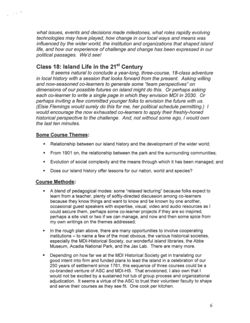
what issues, events and decisions made milestones, what roles rapidly evolving
technologies may have played, how change in our local ways and means was
influenced by the wider world, the institution and organizations that shaped island
life, and how our experience of challenge and change has been expressed in our
political passages. We'd see!
Class 18: Island Life in the 21 st Century
It seems natural to conclude a year-long, three-course, 18-class adventure
in local history with a session that looks forward from the present. Asking willing
and now-seasoned co-learners to generate some "team perspectives" on
dimensions of our possible futures on island might do this. Or perhaps asking
each co-learner to write a single page in which they envision MDI in 2030. Or
perhaps inviting a few committed younger folks to envision the future with us.
(Elsie Flemings would surely do this for me, her political schedule permitting.) /
would encourage the now exhausted co-learners to apply their freshly-honed
historical perspective to the challenge. And, not without some ego, / would own
the last ten minutes.
Some Course Themes:
Relationship between our island history and the development of the wider world;
From 1901 on, the relationship between the park and the surrounding communities;
Evolution of social complexity and the means through which it has been managed; and
Does our island history offer lessons for our nation, world and species?
Course Methods:
A blend of pedagogical modes: some "relaxed lecturing" because folks expect to
learn from a teacher, plenty of softly-directed discussion among co-learners
because they know things and want to know and be known by one another,
occasional guest speakers with expertise, visual, video and audio resources as
I
could secure them, perhaps some co-learner projects if they are so inspired,
perhaps a site visit or two if we can manage, and now and then some spice from
my own writings on the themes addressed;
In the rough plan above, there are many opportunities to involve cooperating
institutions - to name a few of the most obvious, the various historical societies,
especially the MDI-Historical Society, our wonderful island libraries, the Abbe
Museum, Acadia National Park, and the Jax Lab. There are many more.
Depending on how far we at the MDI Historical Society get in translating our
good intent into firm and funded plans to lead the island in a celebration of our
250 years of settlement since 1761, this sequence of three courses could be a
co-branded venture of ASC and MDI-HS. That envisioned, I also own that I
would not be excited by a sustained hot tub of group process and organizational
adjudication. It seems a virtue of the ASC to trust their volunteer faculty to shape
and serve their courses as they see fit. One cook per kitchen.
6
2/21/2016
The call of Acadia brings organizer Jack Russell home
Acadia National Park on My Mind
Musings about the Maine National Park
The call of Acadia brings organizer Jack Russell
home
One in a series of Acadia Centennial features
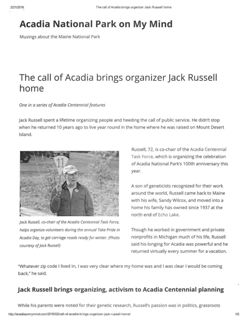
Jack Russell spent a lifetime organizing people and heeding the call of public service. He didn't stop
when he returned 10 years ago to live year round in the home where he was raised on Mount Desert
Island.
Russell, 72, is co-chair of the Acadia Centennial
Task Force, which is organizing the celebration
11
of Acadia National Park's 100th anniversary this
year.
A son of geneticists recognized for their work
around the world, Russell came back to Maine
with his wife, Sandy Wilcox, and moved into a
home his family has owned since 1937 at the
north end of Echo Lake.
Jack Russell, co-chair of the Acadia Centennial Task Force,
helps organize volunteers during the annual Take Pride in
Though he worked in government and private
Acadia Day, to get carriage roads ready for winter. (Photo
nonprofits in Michigan much of his life, Russell
courtesy of Jack Russell)
said his longing for Acadia was powerful and he
returned virtually every summer for a vacation.
"Whatever zip code I lived in, I was very clear where my home was and I was clear I would be coming
back," he said.
Jack Russell brings organizing, activism to Acadia Centennial planning
While his parents were noted for their genetic research, Russell's passion was in politics, grassroots
http://acadiaonmymind.com/2016/02/call-of-acadia-brings-organizer-jack-russell-hom
1/5
2/21/2016
The call of Acadia brings organizer Jack Russell home
activism and later economic development in rust belt Michigan.
After getting his bachelor's degree from
Marlboro College in Brattleboro, Vt. and his
master's from Brown University, he traveled
30,000 miles in a Volkswagen Bus in 1970-71 as
an organizer with the New University
Conference, a group of mostly students and
faculty that led protests and events in support of
causes such as ending the war in Vietnam and
racial equality.
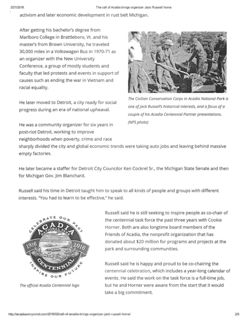
The Civilian Conservation Corps in Acadia National Park is
He later moved to Detroit, a city ready for social
one of Jack Russell's historical interests, and a focus of a
progress during an era of national upheaval.
couple of his Acadia Centennial Partner presentations.
(NPS photo)
He was a community organizer for six years in
post-riot Detroit, working to improve
neighborhoods when poverty, crime and race
sharply divided the city and global economic trends were taking auto jobs and leaving behind massive
empty factories.
He later became a staffer for Detroit City Councilor Ken Cockrel Sr., the Michigan State Senate and then
for Michigan Gov. Jim Blanchard.
Russell said his time in Detroit taught him to speak to all kinds of people and groups with different
interests. "You had to learn to be effective," he said.
Russell said he is still seeking to inspire people as co-chair of
the centennial task force the past three years with Cookie
Horner. Both are also longtime board members of the
Friends of Acadia, the nonprofit organization that has
1916
donated about $20 million for programs and projects at the
2016
park and surrounding communities.
Russell said he is happy and proud to be co-chairing the
centennial celebration, which includes a year-long calendar of
events. He said the work on the task force is a full-time job,
The official Acadia Centennial logo
but he and Horner were aware from the start that it would
take a big commitment.
http://acadiaonmymind.com/2016/02/call-of-acadia-brings-organizer-jack-russell-hom
2/5
2/21/2016
The call of Acadia brings organizer Jack Russell home
"The park is central in our lives and in our community," he said. "If we get significant support, it is worth
doing."
Lessons learned as a boy growing up on Mount Desert Island
Russell's deep connections with the park began as a young boy when his mother gave him free range to
hike anywhere he wished. He said he remembers hiking to the peak of Sargent Mountain, the park's
second highest peak, looking out over the Atlantic Ocean and believing there were mountains all the
way to Florida.
Russell said he was "a lab brat" because of his parents, William L. Russell and Elizabeth S. Russell, had
both been scientists at the Jackson Laboratory in Bar Harbor.
His parents divorced and the father spent most of his career at Oak Ridge National Laboratory in
Tennessee, where his trials on mice led to standards for the effects of radiation on humans. His mother
did her genetic work at Jackson and was known for discoveries in pigmentation, blood-forming cells,
and germ cells.
Both parents were so accomplished that they were elected members of the National Academy of
Sciences, one of the highest honors in science.
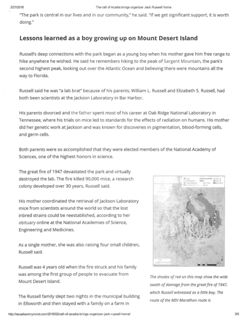
The great fire of 1947 devastated the park and virtually
destroyed the lab. The fire killed 90,000 mice, a research
Sear
Guardian Fire 1947
a
The
Cvt. 25
- 20.2
Our 1PM
ou 24:25
colony developed over 30 years, Russell said.
Go &
His mother coordinated the retrieval of Jackson Laboratory
mice from scientists around the world so that the lost
inbred strains could be reestablished, according to her
obituary online at the National Academies of Science,
Engineering and Medicines.
As a single mother, she was also raising four small children,
Russell said.
Users
Russell was 4 years old when the fire struck and his family
was among the first group of people to evacuate from
The shades of red on this map show the wide
Mount Desert Island.
swath of damage from the great fire of 1947,
which Russell witnessed as a little boy. The
The Russell family slept two nights in the municipal building
route of the MDI Marathon route is
in Ellsworth and then stayed with a family on a farm in
http://acadiaonmymind.com/2016/02/call-of-acadia-brings-organizer-jack-russell-home
3/5
2/21/2016
The call of Acadia brings organizer Jack Russell home
Ellsworth for a week. He said it was astonishing how people
superimposed. (Photo courtesy of College of
pulled together and helped each other out in the wake of
the Atlantic GIS Lab)
the fire.
"You learn what community means pretty quickly," he said. Maybe that is partly the reason that
prompted Russell to work to improve communities during most of his life.
After years in city and state government in Michigan, he was also vice president of the Industrial
Technology Institute in Ann Arbor and then founder of the Modernization Forum.
Now, his challenge, along with Horner, is to lead the effort to mark the centennial of the Maine National
Park.
Russell said one key to involving people from throughout the region was establishing the "centennial
partners." Under the program, people define their bond to the park by helping to plan events, make
donations or design and sell products connected to the celebration.
As a partner, Russell, among other volunteer
tasks, is teaching an eight-week course on the
history of the park and organizing a reprise of
the 1916 celebration of the founding of the Sieur
de Monts National Monument, a forerunner to
the park, and dedication of a time capsule for
organizers of the 2116 bicentennial.
Not long after he returned to Mount Desert
Island, Russell buttonholed then Secretary of
Interior Dirk Kempthorne during an event in
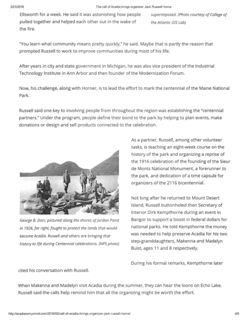
George B. Dorr, pictured along the shores of Jordan Pond
Bangor to support a boost in federal dollars for
in 1926, far right, fought to protect the lands that would
national parks. He told Kempthorne the money
become Acadia. Russell and others are bringing that
was needed to help preserve Acadia for his two
step-granddaughters, Makenna and Madelyn
history to life during Centennial celebrations. (NPS photo)
Buist, ages 11 and 8 respectively.
During his formal remarks, Kempthorne later
cited his conversation with Russell.
When Makenna and Madelyn visit Acadia during the summer, they can hear the loons on Echo Lake.
Russell said the calls help remind him that all the organizing might be worth the effort.
http://acadiaonmymind.com/2016/02/call-of-acadia-brings-organizer-jack-russell-hor
4/5
Viewer Controls
Toggle Page Navigator
P
Toggle Hotspots
H
Toggle Readerview
V
Toggle Search Bar
S
Toggle Viewer Info
I
Toggle Metadata
M
Zoom-In
+
Zoom-Out
-
Re-Center Document
Previous Page
←
Next Page
→
[Series II] Russell, Jack (1943 - ?)
| Page | Type | Title | Date | Source | Other notes |
| 1 | File Folder | Russell, Jack. (1943 - ?) | - | Ronald Epp | - |
| 2 | Journal Article | "Coming Home to Acadia," by Jack Russell | Summer 2007 | Friends of Acadia Journal, Summer 2007 | Note: See also Dorr Archive files, Serix IX on publication of C.A.N.P. [RHE] |
| 3 | Journal Article | "Jack Russell, Advocate Extraordinaire" | Spring 2008 | Friends of Acadia Journal, Spring 2008 | - |
| 4-7 | Journal Article | "The CCC in Acadia," by Jack Russell | Summer/Fall 2008 | Friends of Acadia Journal, Summer/Fall 2008 | Annotated by Ronald Epp |
| 8-9 | Journal Article | "Bob Patterson's First Work on MDI," by Jack Russell | Spring 2009 | Friends of Acadia Journal, Spring 2009 | - |
| 10-11 | Journal Article | "Acadian Passages," by Jack Russell | Fall/Winter 2012 | Friends of Acadia Journal, Fall/Winter 2012 | - |
| 12-17 | Syllabus | Syllabus and course description for Acadia Senior College Courses on "Our Place Through Time: Passages in the History of Mount Desert Island and Acadia National Park," by Jack Russell | 2011 | Acadia Senior College. Mount Desert Island. | - |
| 18-21 | Blog | Blog feature, "The Call of Acadia Brings Organizer Jack Russell Home," one in a series of Acadia Centennial features | 2016 | Acadia on My Mind blog; available at http://acadiaonmymind.com | - |
Details
Series 2