From collection Creating Acadia National Park: The George B. Dorr Research Archive of Ronald H. Epp


Page 1
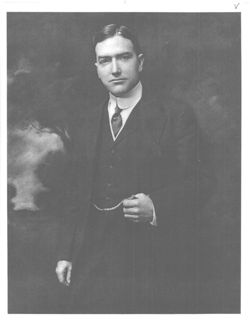
Page 2
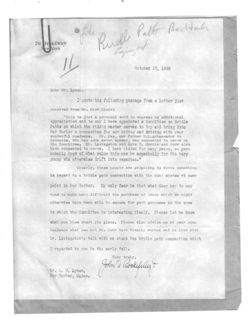
Page 3
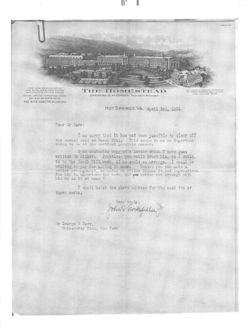
Page 4
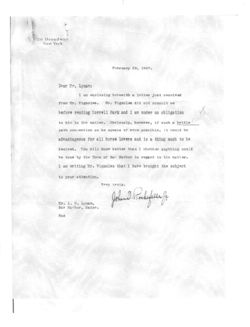
Page 5
Page 6
Page 7
Page 8
Page 9
Page 10
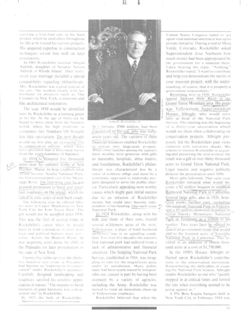
Page 11
Page 12
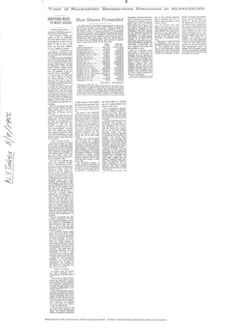
Page 13
Page 14
Page 15
Page 16
Page 17
Page 18
Page 19
Page 20
Page 21
Page 22
Page 23
Page 24
Page 25
Page 26
Page 27
Page 28
Page 29
Page 30
Page 31
Page 32
Page 33
Page 34
Page 35
Page 36
Page 37
Page 38
Page 39
Page 40
Page 41
Page 42
Page 43
Page 44
Page 45
Page 46

Page 47

Page 48
Page 49

Page 50
Search
results in pages
[Series II] Rockefeller, J.D. Jr 1874-1960
Rockefeller J.D.Jr
1874-1960
V
U
shide
26 Breadway
Rude
Palto Basttail
New York
faying out
October 18, 1928
Dear Mr. Lynam:
I quote the following passage from a letter just
received from Mr. Gist Blair:
"This is just a personal word to express my additional
appreciation and to say I have appointed a Committee on Bridle
Paths on which the riding master serves to try and bring into
Bar Harbor a connection for our riding and driving with your
wonderful roadways. Mr. Jay, our former U.S.Ambassador to
Roumania, who has some seven horses, has consented to serve on
the Committee. Mr. Livingston and Dave H. Morris and Dorr also
have consented to serve. I have ridden for many years, 80 per-
sonally know of what value this can be especially for the very
young who otherwise drift into vagaries."
Clearly, these people are proposing to force something
in regard to a bridle path connection with the road system at some
point in Bar Harbor. My only fear is that what they may do may
tend to make more difficult the purchase of lands which we might
otherwise have been able to secure for park purposes in the area
in which the Committee is interesting itself. Please let me know
what you kbow about its plans. Please also advise me at your con-
venience what you and Mr. Dorr have finally worked out in line with
Mr. Livingston's talk with me about the bridle path connection which
I reported to you in the early fall.
Very truly,
Mr. A. H. Lynam,
John D Cockifillist
Bar Harbor, Maine.
NEW YORK BOOKING OFFICE
THE RITZ-CARLTON HOTEL
STREET & MADISON AVENUE
THE HOME STEAD
BATH HOUSE is UNDER THE DIRECTION OF
OR FRANK HOPKINS Medical Dinectors
OPEN ALL THE YEAR
ROOMS FOR THE HOMESTEAD HOTEL
CHRISTIAN S.ANDERSEN, RESIDENT MANAGER
MAY ALSO BE RESERVED AT
THE RITZ-CARLTON PHILADELPHIA
HOT SPRINGS VA. April 3rd, 1931
Dear Mr Dorr:
I am sorry that it has not been possible to clear off
the burned wood on Beach Hill. This SOOKIE to the an important
thing to do st the earliest possible moment.
I am enclosing copy of a letter which I have just
written Mr Miller. Doubtles you would trust him, as I would,
to 10 the Basch Hill work, if he could 80 arrange. I would be
willing to pay for huring it done. Unless you can make a
bettor arrangement, assuming Mr Millar thinks it not impractical
for him to undertake the work, his you better not arrange with
his to do it at once ?
I shall be at the above address for the next two or
three weeks.
Very truly,
goland
Mr George 3 Dorr,
University Club, New York
26 Broadway
New York
February 23, 1927.
Dear Mr. Lynam:
I am enclosing herewith a letter just received
from Mr. Vignoles. Mr. Vignoles did not consult me
before renting Morrell Park and I am under no obligation
to him in the matter. Obviously, however, if such a bridle
path connection as he speaks of were possible, it would be
advantageous for all horse lovers and is a thing much to be
desired. You will know better than I whether anything could
be done by the Town of Bar Harbor in regard to the matter.
I am writing Mr. Vignoles that I have brought the subject
to your attention.
Very truly,
Mr. A. H. Lynam,
Bar Harbor, Maine.
Enc
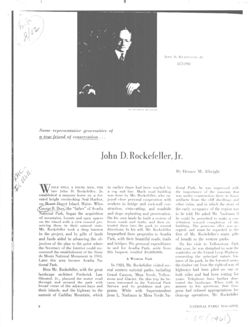
JOHN D. ROCKETTEER JR
1871-1960
An Elvenford photograph
Some representative generosities of
a true friend of conservation
John D. Rockefeller, Jr.
By Horace M. Albright
W
HILE STILL A YOUNG MAN, THE
in earlier times had been reached by
tional Park. he was impressed with
late John D. Rockefeller, Jr.
a cog rail line. Much road building
the importance of the museum that
established a summer home on a for.
was done by Mr. Rockefeller. who en-
was under construction there to house
ested height overlooking Seal Harbor,
joyed close personal cooperation with
artifacts from the cliff dwellings and
on Mount Desert Island. Maine. When
workers in bridge and rock-wall con-
other ruins, and in which the story of
George B. Dorr, the "father" of Acadia
struction. vista-cutting and roadside
the early occupancy of the region was
National Park, began the acquisition
and slope replanting and preservation.
to be told. He asked Mr. Nushaum if
of mountains, forests and open spaces
On his own lands he built a system of
he could be permitted to make a con.
on the island with a view toward pre-
horse roads and trails. and then ex-
tribution toward completion of the
serving them in their natural state,
tended them into the park in several
building. The generous offer was ac-
Mr. Rockefeller took a deep interest
directions. In his will. Mr. Rockefeller
cepted. and must be regarded as the
in the project, and by gifts of lands
bequeathed these properties to Acadia
first of Mr. Rockefeller's many gifts
and funds aided in advancing the oh-
Park, with their beautiful roads, trails
of benefit to the western parks.
jectives of the plan to the point where
and bridges. His personal expenditures
On his visit to Yellowstone Park
the Secretary of the Interior could rec-
in and for Acadia Park, aside from
that year. he was disturbed to note the
ommend the establishment of the Sieur
this bequest. totalled $3.600,000.
roadsides on the Grand Loop Highway
de Monts National Monument in 1916.
connecting the principal nature fea-
Later this area became Acadia Na-
A Western Visit
tures of the park. In the forested areas.
tional Park.
In 1924, Mr. Rockefeller visited sev-
the timber cut from the right-of-way of
Here Mr. Rockefeller, with the great
eral western national parks, including
highways had been piled on one or
landscape architect Frederick Law
Grand Canyon, Mesa Verde, Yellow-
both sides and had been rotting for
Olmsted, Jr., planned the motor road
stone and Glacier. On this trip he be-
years. Telephone lines further dese-
through and around the park with
came interested in the National Park
crated the landscape. When told. in
broad vistas of the adjacent bays and
Service and its problems and pro-
answer to his questions, that Con-
their islands, and the highway to the
grams. While with Superintendent
gress had refused appropriations for
summit of Cadillac Mountain, which
Jesse L. Nusbaum in Mesa Verde Na-
clean-up operations, Mr. Rockefeller
8
NATIONAL PARKS MAGAZINE
(1961)
offered to do the work. Before the
Director of the National Park Service
forests, $2,800,000 of State funds was
Yellowstone roadside work was done,
from 1929 to 1933, Horace M. Albright
needed. Mr. Rockefeller made the con-
also served for thirty-five years as an
clean-up had been adopted as an essen-
tribution of $1,000,000 that completed
advisor to John D. Rockefeller, Jr. in
tial item in road improvement almost
the conservation and preservation fields.
this fund. The Calaveras Groves-
everywhere in the country.
north and south-are now in a State
In 1926, Mr. and Mrs. Rockefeller
park.
visited many of the national parks. On
In 1925, a movement to establish
a second visit to Yellowstone, Mr.
redwood belt in northern California.
national parks in the east received of-
was
Rockefeller became interested in the
At that time he authorized the acquisi-
ficial recognition, and a Federal com-
6bl
Teton Mountains and the northern
tion-through the Save-the-Redwoods
mission was appointed to recommend
part of Jackson Hole, where a national
League-of the Bull Creek Grove of
areas for possible national park status.
park officer and a group of local citi-
coast redwoods, one of the finest
Two outstanding mountain regions
zens had worked on a plan to acquire
stands of trees in the world. Some
were selected after extensive studies.
large tracts of private lands to make
twenty-five years later, he reluctantly
These were in the Great Smoky Moun-
possible the restoration of one of the
gave his consent to a proposal of the
tains, on the boundary line between
most beautiful mountain regions of
California Park Commission to name
Tennessee and North Carolina, and in
the world.
this State park the Rockefeller Red-
the Blue Ridge Mountains of Virginia.
The next year he undertook to carry
wood Forest.
Congress authorized the parks but pro-
out this program, and in the next few
vided that all lands for them had to be
Yosemite Pines Saved
years purchased nearly 35,000 acres
acquired by the States in which the
of lands at a cost of upwards of
In 1928, after reading a New York
designated potential parks lay. The
$1,500,000. In 1950, after many years
Times editorial deploring the cutting
Great Smoky Mountain project in-
of political interference and obstruc-
of sugar- and yellow-pine forests within
volved an outlay of $10,000,000, which
tion. Grand Teton National Park (orig-
Yosemite National Park on private
the States could not afford at the time.
inally created in 1929 to embrace only
lands, Mr. Rockefeller proposed to pro-
Mr. Rockefeller offered to make $5,-
a high mountain area and some lakes)
vide one-half the funds to buy these
000,000 available from the Laura
was extended across Jackson Hole. and
timber holdings if the Government
Spelman Rockefeller Memorial Fund,
the Rockefeller lands were deeded to
would make available an equal amount.
provided the States of Tennessee and
the United States for park purposes. In
Thus there were acquired, in 1931,
North Carolina would match this grant
recent years, Mr. Rockefeller granted
nearly 16,000 acres of superb timber
dollar for dollar, the grant to be in
funds to erect the Jackson Hole Lodge
for Yosemite at a cost of $3,300,000,
memory of his mother. The lands were
and to provide fine tourist facilities at
one-half of which was Mr. Rockefel-
acquired and the park established.
Jenny Lake and Coulter Bay in this
ler's gift.
In the case of the Blue Ridge area,
national park. Well over $10,000,000
A few years ago, the South Cala-
Mr. Rockefeller contributed $164,000
was made available for land purchase
veras Grove of Big Trees-the moun-
toward the acquisition of lands for
and construction of facilities for visi-
tain redwoods, Sequoia gigantea-
Shenandoah National Park, embracing
tors.
were threatened with destruction, along
nearly 200,000 acres and stretching
It was during his 1926 trip to the
with another outstanding area of sugar-
ninety miles along the summit of the
West that Mr. Rockefeller visited the
pine forest. To save these priceless
mountains.
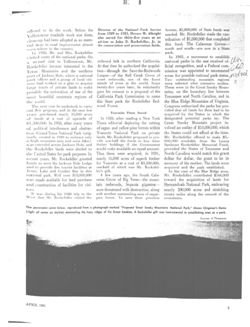
The panoramic scene below, reproduced from a photograph marked "Proposed Great Smoky Mountains National Park," shows Clingman's Dome
(right of center on skyline) dominating the hazy ridges of the Great Smokies. A Rockefeller gift was instrumental in establishing area as a park.
Courtesy of Thompsons
APRIL
1961
9
ample encouraging others to undertake
Croton River. a fine colonial structure
important resource conservation proj.
of the late 1600's; the Philipse prop-
ects. I have not touched on the large
erty, just north of Tarrytown in the
grants for museums in Yellowstone,
Sleepy Hollow section; and Washing.
Yosemite and Grand Canyon, and for
ton Irving's home south of Tarrytown.
interpretative studies which ran to a
These three projects have cost several
total of a quarter of a million dollars.
million dollars, and. except for the
Van Cortlandt House. are not vet com-
Colonial Williamsburg Restored
pleted. although the Irving House
In the field of restoration of his-
(Sunnyside) can and should be visited
toric sites and structures, Mr. Rocke-
by all National Parks Association
feller's greatest work has been at Wil-
members who find themselves near it.
liamsburg, Virginia, where since 1926
On the opposite shore of the Hudson
he had extensive archeological studies
River is the Palisades Interstate Park.
Metropolitan Museum of Art
undertaken. He also instigated long
At the turn of the century. the face
The Cloisters, a branch of New York City's
research in the architectural and land-
of the Palisades and the land at their
Metropolitan Museum of Art, is located in
scape features of the program, and
base along the river were acquired by
Fort Tryon Park. Bo:h the building and the
restoration of the public buildings and
New York philanthropists; but Mr.
park were contributions of Mr. Rockefeller.
most of the business and residential
Rockefeller. over a long period of
structures of the old city. The cost of
years, patiently and at a cost of $19.-
The Park Service is completing the
this extraordinary program thus far
868,000. bought most of the land on
Blue Ridge Parkway, 477 miles in
has been $68.500.000. Mr. Rockefeller
top of the Palisades and presented it
length, connecting these two great na-
maintained a home in Williamsburg
to the States of New York and New
tional parks. In North Carolina. in the
Bassell Hall-and spent two months a
Jersev. This handsome grant made
Grandfather Mountain region. the
year there, actively participating in the
possible the construction of the superb
beautiful Linville Gorge and Falls ad.
solution of problems arising out of the
Interstate Parkway that has been ex-
jacent to the Parkway were threatened
restoration program.
tended to Bear Mountain.
with destruction. Mr. Rockefeller again
He also acquired more than 250
And finally, there is Fort Tryon
stepped in, and at a cost of nearly
acres of the farm, Wakefield, where
Park and the Cloisters in New York
$100,000 bought the threatened terri-
George Washington was born, and
City, near the east end of the George
tory and gave it to the Government.
gave the tract to the government. It is
Washington Bridge, two more of Mr.
This is only a brief recital of some
now a part of the George Washington
Rockefeller's contributions that are
of the outstanding contributions by
Birthplace National Monument.
deeply appreciated by all who see
Mr. Rockefeller toward preserving our
Along the Hudson River. Mr. Rocke-
them. The Cloisters are administered
native landscape, in creating new na-
feller acquired and restored the Van
as a branch of the Metropolitan Mu-
tional and State parks, and by his ex-
Cortlandt House near the mouth of the
seum of Art.
Horace Marden Albright Medal
Awarded Justice Douglas
E
ACH YEAR SINCE 1929, the Ameri-
Check
can Scenic and Historic Preserva-
tion Society, incorporated in 1895 as
an organization dedicated to the pro-
tection of natural scenery, preserva-
tion of historic landmarks, and city
improvement, has made a number of
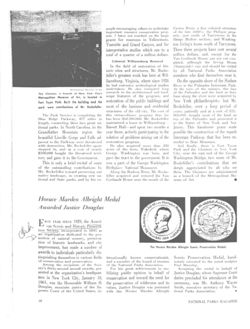
The Horace Marden Albright Scenic Preservation Medal.
awards to individuals particularly dis-
tinguishing themselves in various fields
ternationally known conservationist,
Scenic Preservation Medal, hand-
of conservation and preservation.
and a member of the board of trustees
somely executed by the noted sculptor
Among the recipients of the Soci-
of the National Parks Association.
Paul Manship.
ety's thirty-second annual awards, pre-
For his great achievements in mo-
Accepting the medal in behalf of
sented at the organization's headquar-
bilizing public opinion in behalf of
Justice Douglas, whose Supreme Court
ters in New York City, January 18,
conservation and toward the need for
duties precluded his attendance at the
1961, was the Honorable William O.
the preservation of wilderness and its
ceremony, was Mr. Anthony Wayne
Douglas, associate justice of the Su-
values, Justice Douglas was presented
Smith, executive secretary of the Na-
preme Court of the United States, in-
with the Horace Marden Albright
tional Parks Association.
10
NATIONAL PARKS MAGAZINE
BRIDGEWATER
STATE UNIVERSITY
Bridgewater Review
Volume 7 | Issue 1
Article 8
Sep-1989
John D. Rockefeller, Jr.'s Contributions to American
Conservation and Historic Preservation
Janet Rocap
Recommended Citation
Rocap, Janet (1989) John D. Rockefeller, Jr.'s Contributions to American Conservation and Historic Preservation. Bridgewater Review,
7(1), 12-14.
Available at: http://vc.bridgew.edu/br_rev/vol7/iss1/8
This item is available as part of Virtual Commons, the open-access institutional repository of Bridgewater State University, Bridgewater, Massachusetts.
ESSAY
John D. Rockefeller, Jr. S
Contributions to
American Conservation and
Historic Preservation
Bv Janet Rocap
A
merican environmental his-
landscaping projects on the hundreds
cesses with Standard Oil Company
tory is replete with the contri-
of acres of rolling woodlands. John
Both father and son shared the belief
butions of men and women of
must have been fascinated by watching
that the Rockefeller fortune was the
many vocations: philosophers (like
the building of paths and roads, the
worthy fruit of the work of a Christian
Ralph Waldo Emerson and Henry
planting of trees, and the construction
gentleman. Rockefeller worked hard
David Thoreau). scientists (like George
of a lake because he developed an
throughout his life so that his many
Perkins Marsh and John Wesley
expertise in(groundskeeping which en-
gifts made in the public interest would
Powell). political advocates (like Gif-
abled him. by the age of sixteen, to
overcome the hated specter of "tainted
ford Pinchot and Stewart Udall). and
become responsible for much of such
money." Efficient and well-conceived
crusaders (like John Muir and Rachel
work at Forest Hill. From the age of
giving became Rockefeller's vocation,
Carson) John D. Rockefeller, Jr. was
ten he enjoyed traveling with the family
and his genius for philanthropy earned
none of these, yet he has earned a place
to areas of scenic beauty such as
much praise for the family name.
of distinction as one of the great
Yellowstone National Park. During
His philosophy toward his inherited
benefactors of the twentieth century
the winters, his father's business inter-
wealth was revealed to friend and
movement to conserve national re-
ests brought the family to their New
biographer Raymond B. Fosdick
sources. One of America's greatest
York City home, and led to their
I was born into [wealth]
It
philanthropists. Rockefeller donated
establishing an estate at Pocantico.
was there like air or food or any
$474 million to a variety of interests
New York. which gave John an oppor-
other element
The only
between 1916 and 1959 including
tunity to explore the Hudson River
question with wealth is what
generous gifts to several national parks
Valley The national parks of the west
you do with it. It can be used for
and historic restoration projects, like
as well as numerous sites along the
evil purposes or it can be an
Colonial Williamsburg. Virginia The
Hudson became favorite places for
instrumentality for constructive
wisdom (and) shrewd timing of his
Rockefeller. and he would return to
social living.
funding together with his love of
them many times as an adult. often
Rockfeller studied economics and
beauty and nature, made his contribu-
funding projects.
sociology at Brown University, and
tions important ones, insuring that the
His deep commitment to philanthro-
after graduation in 1897. joined his
Rockefeller legacy will provide to gener-
py was also rooted in childhood. John
father's office in New York City.
ations of Americans the opportunity to
would never know the loose and lazy
Although he showed no great talent for
appreciate this nation's scenic lands
life of a rich man's son. Strict Baptists.
business, he became acquainted with
and unique heritage
the family followed a church-centered
men who would help him further his
Rockefeller's life-long love for the
life which stressed duty to God and fel-
own interests. One such man was
out-of-doors began in his childhood
low man Daily Bible reading was a de-
Frederick T. Gates, a former Baptist
He was born on January 29. 1874 in
vout ritual that Rockefeller would keep
minister who handled various Rocke-
Cleveland Ohio. the fifth child and
throughout his life. Temperance, thrift.
feller charities. Rockefeller would later
only son of wealthy industrialist John
and charity, the forceful opinions of the
credit his influence as having taught
D. Rockefeller, Sr. and Laura Celestia
household. were both preached and
him much about philanthropy
Spelman From the age of four John
lived These virtues remained important
Among Rockefeller's duties for his
enjoyed summers at the family home-
tenets of his adult years.
father's organization was the repair of
stead at Forest Hill. Ohio, which were
Rockefeller's philanthropic endeav-
properties such as the home at Forest
full of country pleasures, including
ors were no doubt motivated in part by
Hill He was a perfectionist. very. con-
boating, swimming horseback riding,
desire to vindicate the Rockefeller
cerned with detail, who liked to deal
hiking. picnicking and bicycling His
name Rockefeller. Sr. was frequently
personally with craftsmen. such as
father was enthusiastically undertaking
maligned for his Robber Baron suc-
carpenters. Rockefeller was fond of
12
carrying a four-foot rule in his back
United States Congress failed to act
pocket. which he used often throughout
upon vital national interests it was up to
his life as he toured his various projects.
private initiative. During a visit to Mesa
His acquired expertise in construction
Verde, Colorado, Rockefeller asked
techniques served him well on later
Superintendent Jesse Nusbaum how
restorations.
much money had been appropriated by
In 1901 Rockefeller married Abigail
the government for a museum there.
Aldrich. daughter of Senator Nelson
Upon hearing the reply, "Nothing,"
Aldrich of Rhode Island Their forty-
Rockefeller stated. "I want to contribute
seven year marriage included a special
and help you demonstrate the merits of
compatibility regarding philanthropy
your museum project, with the under-
Mrs. Rockefeller was a great patron of
standing. of course. that it is properly a
the arts She worked closely with her
government responsibility.`
husband on projects such as The
Returning west in 1926, Rockefeller
Cloisters in New York, a museum and
toured Jackson Hole Basin in the
fine architectural restoration.
Grand Teton Mountain area. His guide
The year 1910 would be identified
Yellowstone Superintendent
later by Rockefeller as a turning point
Horace Albright. who would serve
in his life. At the age of thirty-six he
later as head of the National Park
began to move away from the business
John D. Rockefeller...
Service. This meeting was the beginning
world. where his high positions in
Sr. fortune, $500 million, had been
of a thirty-year association which
companies like Standard Oil brought
transferred to his son. who was forty-
would see them often collaborating on
him little satisfaction. The next decade
seven years old The vastness of these
conservation projects. Albright pur-
would see him play an increasing role
financial resources enabled Rockefeller
posely led the Rockefellers past views
in conservation activity which must
to pursue very large-scale projects
cluttered with run-down shacks His
have provided him a welcomed haven
While other families among the nation's
scheme to interest Rockefeller in acquir-
from the unpleasantness of business
most wealthy were generous with gifts
ing and preserving the area worked: the
In 1916 he donated five thousand
to museums, hospitals, alma maters,
result was a gift of over thirty thousand
acres near his summer home at Seal
and foundations, Rockefeller's philan-
acres to Grand Teton National Park.
Harbor Maine, to help establish what
thropy was characterized less by a
Legal hassles and negative publicity
would become Acadia National Park.
sense of noblesse oblige and more by a
delayed the presentation until 1950.
the first national park cast of the Missis-
systematic approach to undertake pro-
More gifts followed That same year
sippi River The following year be
jects designed to serve the public inter-
Rocketeller initiated what would be-
granted permission to build and main-
est Particularly appealing were worthy
come a $2 million bequest to establish
tain roadways on the island, which re-
causes which might gain initial success
Redwood National Park in California.
sulted in sixty miles of well-built roads.
due to an infusion of Rockefeller
Several large gifts. also in 1926. bene-
The following year he offered fiftv-
money but could later become inde-
fited parks farther east, including
six acres in Upper Manhattan to New
pendent of his funding. One such stone
Shenandoah National Park in Virginia,
York City for Fort Tryon Park The
National Park
and a $5 million memorial donation to
gift would not be accepted until 1930
In 1924 Rockefeller. along with his
Great Smoky Mountains National
This was the first of several times in
wife and three of their sons, toured
Park in Tennessee as a tribute to his
Rockefeller's career when he would
several wilderness areas of the west
mother Two years later he offered to
have to hold a donation in trust until
Yellowstone. a place of fond boyhood
match all government funds that would
legal and political barriers were over
memories was in an appalling condi-
add to the forested acres of Yosemite
come Across the Hudson River. he
tion For over five decades the nation's
National Park in California. This re-
was acquiring acres along the cliffs of
first national park had suffered from a
sulted in an addition of ffiteen thou-
the Palisades for later presentation to
lack of administrative and financial
sand acres at a cost of $1,750,000.
the state of New York
attention. The fledgling National Park
In the 1950's Horace Albright re-
|wenty-five miles up river the thirty~
Service, established in 1916. was strug-
flected upon Rockefeller's contribu-
five hundred acre estate at Pocantico
gling to care for the magnificent areas
tions to the conservation movement
had become an "experiment in conser-
under its jurisdiction. Many public
Remembering the difficulties of creat-
vation" under Rockefeller's guidance
lands had been nearly ruined by irrespon-
ing the National Park System. Albright
Carefully designed landscaping and
sible use. caused in part by having been
credits Rockefeller as one who "quietly
roadways satisfied his sensitive appre-
overseen by a variety of agencies,
stepped in at critical times and turned
ciation of nature. "The impulse to build
including the Army. Rockefeller was
the tide when everything seemed to be
enclaves of quiet harmony was a deep-
moved to fund an immediate clean-up
going against us."
seated one" in Rockefeller
of Yellowstone roadways,
A Phi Beta Kappa banquet held in
By 1921 the bulk of Rockefeller
Rockefeller believed that when the
New York City in February 1924 was
13
ESSAY (continued)
the spark which would revolutionize
mate The price of Colonial Williams
Rockefeller's identification with the
historic preservation in the | nited
burg came to over $100 million. half of
conservation movement was the result
States The address a proposal that the
which was Rockefeller money
of concerns he shared with others in the
Society build a memorial hall at the
The project to restore the colonal
Progressive Era. Since the latter decades
College of William and Mary in Will
capital of Virginia interested Rocke-
of the nineteenth century there had been
hamsburg. Virginia, was delivered by
letter more deeply than any of his other
a growing awareness among scientists
the Reverend Dr. W.A.R. Goodwin
projects. His personal involvement
and others that ever-increasing indus-
rector of the town's Bruton Parish
would last over thirty years. Until his
trialization was a threat to the environ-
Church Goodwin, a charismatic vision-
death in 1960 he spent "twice-yearly
ment. The Progressive Era, which saw
ary had dreams of resening the small
sojourns at Bassett Hall, a fine colonial
the advent of a variety of reform agen-
town from its shabby modern trappings
mansion on the edge of Williamsburg"
cies in an attempt to solve society's ills
and restoring it to its colonial grandeur
in order to oversee the expansion and
with government solutions. also turned
Rockefeller's polite expression of inter
maintenance of the great undertaking
its attention to the stewardship of the
est in Williamsburg spurred Goodwin
The Williamsburg restoration be-
land. debate over what types of policy
to present a restoration proposal to the
came school or historic preservation
to implement split conservationists be-
Rockefeller organization four months
work Rockefeller insisted on perfec-
tween two philosophies One side
later He was turned down X similar
tion in all aspects of the project. which
sought maximum economic utility of
proposal to the Henry Ford organiza-
required an extensive historical re-
resources, as espoused by the politically
tion was also refused
search Authenticity was recreated in
active forester, Gifford Pinchot. The
Goodwin's enthusiasm for his idea
detail, from exact placement of build-
goal of the other. in the tradition of
was matched by his persistence. A 1926
ings on their original sites to use of
naturaliso John Muir, was aesthetic: to
visit brought Rockefeller to Williams-
materials which replicated those of the
prevent human intrusion from spoiling
burg Goodwin made good use of the
colonial period. Rockefeller assembled
nature Rockefeller took a middle view
opportunity to guide his party on a
a large staff of professionals whose
He argued that government should regu-
tour of the town and captured Rocke-
methods would become the standard'in
late designated areas, such as national
feller's imagination To his delight.
historic preservation
parks. in the public interest. This meant
Goodwin soon discovered that Rocke-
The fine work of dozens of archeolo-
providing with sufficient ameni-
teller envisioned a restoration project
gists and architects was integral to the
ties, like museums, to aid in their
on a larger scale than Goodwin had
restoration. and Rockefeller loved to
appreciation and recreational enjoy-
dared hope Rockefeller's interest in
work beside them Among the many
ment of the area. while avoiding un-
restoring a large area of the town (or
accolades bestowed upon Rockefeller
sightly development. such as billboard
none at all) was characteristic of the
for his involvement were honorary
advertisements and tawdry souvenir
man "I'm only interested in ideal
memberships in the American Institute
stands, which would detract from the
projects, he asserted
of Architects in 1936 and the Society of
beauty of nature. His position was
Goodwin was authorized to begin
Landscape Architects in 1938.
attractive to the numbers of tourists
purchasing Williamsburg properties
Rockefeller's funding of the Williams-
who with the advent of Henry Ford's
but was hampered by Rockefeller's
burg restoration led the way for similar
automobile. took to the road in increas-
insistence that his identity as benefactor
projects across the nation. Until Wil-
ing numbers to view the scenic parks
be kept a secret. Not until 1928 was
liamsburg, restorations were done on a
and historic shrines.
Goodwin allowed to announce the
much smaller scale, and the costs were
John D. Rockefeller. Jr.'s role in the
town's patron The names, "Mr and
often borne by the middle class. Besides
conservation and historic preservation
Mrs. John D Rockefeller Jr." were
developing the expertise which would
movements of this century was the
met with enthusiastic applause
be instrumental in other projects. the
result of a keen interest in nature. an
The restoration involved rebuilding
Williamsburg experience was a drama-
appreciation of the cultural heritage of
more than one hundred colonial struc-
tic inspiration which captured public
America, and a sincere desire to serve
tures. forty of which were still standing
terest and helped to gain support for the
the public interest via philanthropy
in 1926. Painstaking care was necessary
growing historic preservation movement.
From the coast of Maine to California's
to accurately reproduce historic build
Rockefeller became involved in other
redwood forests to the cobbled streets
ings which included the House of
restoration projects. He aided Ver-
of Colonial Williamsburg. the United
Burgesses and the famed Raleigh
sailles, Fontainebleau, and Reims in
States has been enriched by his contribu-
Tavern, a meeting place for George
their recovery from damage sustained
tions Historian Roderick Nash has
Washington. George Mason and
during World War 1. Several sites of
written that a country's stewardship of
Patrick Henry. The project required
historic interest along his favorite
its historic monuments tells as much
purchasing some two hundred parcels
stretches of the lower Hudson River
about those who preserved it as it does
of property from private owners The
were restored. including Philipsburg
about the original builders In that
restoration. which opened to the public
Manor, Van Cortlandt Manor, and
case, John D. Rockefeller, Jr. has
in 1936. cost far more than Rocke-
Sunnyside. the former home of writer
earned a hero's legacy within the field
teller's original $4 to $5 million esti-
Washington Irving
of environmental history.
14
LANET ROCAP is a 1988 Graduate of
Bridgewater State College
Total of Rockefeller Benefactions Estimated at $2,500,000,000
DONATIONS MADE
Rockefeller Institute's first drive
idea of help, offering generous
shrewd oll magnate had started
How Shares Pyramided
was to eradicate the hookworm
gifts on condition that the re-
his son, John D Rockefeller Jr.,
TO MANY CAUSES
"the germ of laziness The in-
cipient raise matching or even
carried on The son took over
stitute and other Rockefeller
greater amount
the supervision of all the bene
bodies aided the fight on ane-
In 1909 John D. Rockefeller was prepared to start the
was natural from that
factions
more
than
generat
Rockefeller Foundation with 72,569 shares of Standard
yellow cancer, tu-
They provided funds
point to move to the foun-
ago.
Now
third
generation
of
Continued From Page 1
New Jersey, then having market value of
for research resulting the
an Institution be
Rockefellers taking hold They
$50,000. 000. This is one the rare instances In which
of
penicillin
not
sul-
but an
pri
have contributed their own
Rockefeller benevolent or ganiza
the actual number of shares involved Rockefeller
fanilamide they made possible
affected with inter-
money liberally, not only to the
tions, told Mr. Rockefeller
benefaction is known Since 1909 the Standard Oil empire
the
the California Institute
and, the real sense
family institutions but to new
has been dissolved with Standard of New Jersey stock
public trust. Foundations set
Technology: they helped in the
projects in which the five boys
"Your fortune is rolling up
holders having received shares in more than score of
the Rockefellers were au-
and one daughter have been in.
rolling up like an avalanche!
development
atomic
energy
tonomous and entirely under
subsidiaries This table shows what the 72,569 shares,
and gave to hundred different
terested
The
desire
for
You must keep up with it! You
the control of independent trus-
through stock dividends, splits and increase in market
projects in all parts of the
"chance to of service" as
tees.
must distribute it faster than it
world from agriculture and busi-
strong in the third generation
value, would have grown to by this time:
There were no strings attached
as was in the first second
grows! If you do not, it will
ness administration through the
Number
Closing Price
to Rockefeller gifts and the
What the next thirty years
crush you and your children
Company
Shares
humanities, governmental sci-
Rockefellers always moved slow-
will show in the total of Rocke
Atlantic Refining Co
435,414.00
$17,307,706.50
ence, religious work, peace and
ly New projects were teated
feller benefactions cannot be
and your children's children.
A total in contributions of
Borne Scrymser Co
14,513.80
47,169.85
sex problems to yaws
first by small donations: if they
foretold But the present record
Buckeye Pipe Line Co
103,773.67
2,542,454.92
When Mr. Rockefeller about
proved worth while endowments
of the third generation indicates
$2,500,000,000 la giving at the
Chesebrough
Mfg.
Co
589,623.13
1880 came to realize that the
and grants in large size followed
better
that there will be diminution
rate
day
Gas
Co
301,887.04
10,415,102.88
old methods of giving were
What the self-made careful,
every day since the Christian
Del.)
of interest and activity
5,619,743.36
adequate for rapidly
era
Actually the first Rockefeller
Eureka Pipe Line
and his
ing
ideas
ago. At that time and for
made
100
years
Co
6,418,818.76
anthropy.
National Transit Co
create
base
foun
ly sixty years there
Ohio
Oil
4.833.966,23
factions His first offerings had
was income tax law to en-
Sinclair ou Corp
32,246,216.57
been
mainly
courage contributions through
Mobil Oil Co., Inc
950,653.90
churches missions other
tax exemption Then, too, his
South Penn OIL Co
104,499.36
3,539,915.82
religious projects, with an
Southern Pipe Line Co
7,256.90
36,284.50
casional gift for parks, public
limited personal income would
Standard Oil Co (Calif.
648,766.86
57,821,346.40
buildings hospitals school and
have made the question of in
Standard Oil Co. (Indiana)
1,306,242.00
65,475,380.25
colleges. Later he began to em-
come tax academic to the 16
Standard Oil Co. (Kentucky)
142,960.93
8,077,292.55
phasize those enterprises likely
year-old John D. Rockefeller
Standard Oil Co. (New Jersey)
3.330.191.41
451,240,936.06
to have lasting beneficial et
It was on Sept. 25. 1855, that
Standard Oil Co. (Ohio)
98,693.84
4,910,018.54
fect on community
the youth destined to become
Swan-Finch Oil Corp
145.14
4,245.35
From this he passed on to the
the world's greatest oil man
Union Tank Car Co
174,165.60
5,420,904.30
took his first job. It was as
Washington Oil Co.1
725.69
14,513.80
bookkeeper
for
Hewitt
Tuttle
Cleveland commission merchants
10,171,416.18
$743,130,388.12
and produce shippers
Based on 1955 "hid" price
During the three months and
ndard Oil New 32.7 per cent of the
four
days
that
year
total shares and 60.7 per cent the dollar value
he received $50 in wages,
The
total
number
of
50 cents day. Still out that
statistical including: where fractional shares in
meager pay gava away $5.88
a split or stock dividend represented less than one-half of
pew rent; up to 5 cents
share the (raction was dropped; where it one half
every Sunday to Sunday School
of one share, the amount was computed as a whole share
10 cents month foreign mis
sions: 12 cents to the Five Points
Mission in New York, and sev-
eral personal and assorted con-
in 1903. received total of about
was being sought in Baptist
tributions.
$145,000,000 and spent $317,733.-
plan for great graduate uni-
While he was giving away this
$5.88. he spent $9.09 on clothes
124. The board is being liquidat-
versity in New York.
These
figures
come
from
the
ed. so the funds remaining are
Later, the proposal to rehabili-
celebrated "Ledger A. the
low
tate the University of Chicago
count book he started with his
The scope of the Rockefeller
founded 1856 Stephen
first
1858 1856 his first full year in
benefactions is vast They in
Douglas and others, also
Mr.
refeller
clude the donation the $8,500,
laid before The university
Baptist
$19.31 Each benevo
the the United Nations East River
under debt and an insur-
1860
ance
company
had
$107.35 the next year. $259 97
the
the gift
mortgage
By 1856 his contributions ex.
Fort Tryon Park and The Cloist
interesting contest
ceeded $1,000; in 1869 they were
ers to this city and contribut-
and
principles
Mr
Rockefeller won adherence
$5,489.62: in 1885 they had
ing share in the development of
his doctrine of helping others to
grown to $155,000. and in 1891
the National Park system. They
help themselves, and in May
they reached $500,000. The next
also include unstinted help to
1889, Mr. Gates told conven-
year they passed the million
universities. medical and other
tion of the American Baptist
mark going to $1,353,520 From
scientific institutions, art mu-
Education Society that Mr
then on Mr Rockefeller, who had
seums, the drama, music, the
Rockefeller would give $600,000
started to save by putting away
movies and ever so many other
to re-establish the University of
pennies when years old, gave
things
Chicago if the church raised
in the millions
the national parks
$400,000
The
with
the
name
Rocke-
university
was
of
Gifts to Various Causes
feller linked are: Yosemite
reopened in the fall of 1892 and
since then about $80,000,000
His first contribution to Negro
and the Sequoia groves spared
causes was in 1859; the
through the the
has helped
year he gave Methodist Ger-
campaign in California: Yellow
strengthen and brondo that
stitution's and
stone and the Grand Tetons with
influence and stand
man Roman Catholic and Negro
ing the educations world
churches as well to his own
Jackson
Hole
Vyoming:
the
Great Smokies North Caro-
Gifts $5,000,000 to Brown
Baptist church Catholic charities
University in June were the
were specifically recognized in
lina and Tennessee; the George
most recent of the innumer
1862, Jewish causes in 1865, and
Washington Birthplace National
endowments and grants by the
Monument in Virginia Acadia
his first major lump sum
Rockefellers to universities and
National Park In Maine and the
$558.42 went to Denison Univer-
colleges. Fisk University and
Palisade Interstate Park in New
sity at Granville, Ohio.
other Negro colleges were re
York and New Jersey, to men
cipients of generous help. Har
Just how the avalanche Mr.
tion few.
vard, Yale, Michigan, Stanford
Gates had predicted actually
The Rockefeller support of
Vassar, Columbia-In fact, al
rolled is demonstrated by pro-
higher education dates back to
most all institutions of higher
jecting to current values what a
the 1880's The elder Rockefeller
learning - aided through
Rocket eller pledge in 1909 would
always had made contributions
Rockefeller benefactions in help.
amount
today.
When
Mr
to schools and colleges. but in
ing
mankin
Rockefeller finally agreed
a small way His interest now
In the field of science. the
create the Rockefeller
the promised for
shares Standard ou New
Jersey that had market value
of $50,000,000. What with stock
dividends splits and other
changes, 72,569 shares of 1909
have become 10,171,416 in 1955
and the $50,000,000 value, as of
the close of the market on Fri-
day, has risen to $743,130,388
an increase of 1,386 per cent
Of the 10,171,416 shares.
3,330,192 are of Standard ou of
New Jersey. The remainder is
stock
twenty
two
other
cor-
porations
that
developed
result of the 1911 court order
dissolving the Standard Oil em-
pire the elder Rockefeller
created In addition the stock
gains, the original 72,569 shares
have earned over the years more
than $200,000,000 in cash divi-
dends and received $20,293,848 la
returned capital because of dis-
solutions and relinquishment of
property.
Had the $50,000,000 been left
in 1909 to accumulate at 6 per
cent compound interest it would
have grown to $729,524,669 in
1955 $13,605,719 less than the
gain in stock value and
counting the nearly $225,000.00
cash dividends
and other money
The foregoing figures would
apply only the entire 72,569
shares had been held, but the
lesson the figures just given
lies way money and secur-
ity values multiply. In actual
fact Mr. Rockefeller never ful-
filled this pledge because of
difficulties in obtaining charter
such as he felt would have given
the foundation free play for its
activities Four years later he
started the foundation not with
$50,000,000 but with & total
more than three times as large,
securities valued $182,851,000
Raymond B. Fosdick who was
president of the Rockefeller
Foundation for twelve years
said that by Dec 21. 1950, the
organization
had
$451,528,365 of which $125,773
613. came out of principal and
the rest out of income
Report to Congress
In August, 1954. the founda
tion filed statement with
Congressional committee report
ing
By the end of 1953. the foun-
dation had made 30,572 grants,
totaling $501,749,878 in expended
and authorized appropriations
Its remaining capital funds have
a present market value of ap-
$366,000,000 (as
1954
the Rockefeller Founds
tion has received some addition-
funds, principally in the trans-
moneys
from
other
philan
thropic enterprises being liqui-
dated, the fact remains that as
of about year ago the founda-
tion established with $182,851.
000 in securities, has disposed
of or still held in its treasury
a total of $867,749,878
The same story holds for all
the other trusts, institutes and
funds The General Education
Board, for example, incorporated
Reproduced with permission of the copyright owner. Further reproduction prohibited without permission.
Author ?
File 1915
April 3, 1969
John D. Rockefeller, Jr. and Acadia National Park
From the time that John D. Rockefeller, Jr. first bought property
on Mt. Desert Island in acquiring the Eyrie at Seal Harbor in 1910*, until
his death in 1960, Mr. Rockefeller maintained a most enthusiastic and
active interest in the island and in the developments that led to the
formation of Acadia National Park. His first small gift of $100 in 1911,
to help purchase land as public reservation, led to gifts of land totalling
more than 11,300 acres at a cost of more than $1,000,000. He built some
51 miles of beautifully constructed carriage roads for the Park costing
roughly $2,000,000. He contributed substantially to the Park system of
motor roads; and for buildings, bridges, forestry and planting gave at
least another $1,000,000. After the disastrous fire of 1947, he gave
$500,000 for cleanup and reconstruction.
Mr. Rockefeller's interest was a very strong personal one. "I think
I have always had an eye for nature," he wrote; "because I was brought up
in the woods I have always loved the trees, the rocks, the hills and the
valleys." He believed that National Parks should offer the public "areas
of such outstanding interest in themselves that they tell their own story
if only they are made reasonably accessible." Mr. Rockefeller himself
actually developed the general plan for the present Park, for the land
buying and road building taken together make the basic Park as it is today.
As a summer resident of Mt. Desert Island, Mr. Rockefeller
came to know every part of the island intimately, all of its physical
*Mr. Rockefeller first took his family to Maine in 1908 for the summer,
renting the Sears Cottage in Weymouth Lane in Bar Harbor.
-2-
geography and natural beauty. As he wrote, it is "one of the greatest
views in the world." In a letter to Harold Ickes, Secretary of the
Interior in 1935, he outlined the essence of his vision for the island
and its Park:
"When Acadia National Park was established, it consisted
only of mountain tops of Mount Desert Island (the Monts Deserts mentioned
by Champlain when he saw them in 1604 giving the island its name). Thus
the Park area at the outset was not accessible to any highway and was
traversed only by foot trails. Believing that it should ultimately
extend to the ocean on one side and to Frenchman's Bay on the other, and
that access to it would be desirable not only for pedestrians but, in
carefully chosen areas for lovers of horses as well as automobiles, I
began years ago buying lands on the Island having in mind to make
possible the rounding out of Park boundaries and its extensions and
developments as above outlined."
The actual start toward Acadia National Park began before Mr.
Rockefeller's arrival as a landowner. In 1901 a small group of long
time summer residents of the island met to form a corporation to acquire
and "hold reservations at points of interest on this Island, for the
perpetual use of the public." In 1903 this group, The Hancock County
Trustees of Public Reservations, received its charter from the Maine
Legislature (President-Charles W. Eliot, Vice President-George B. Dorr,
Secretary-L. B. Deasy, Treasurer-George L. Stebbins.)
In 1914 the Hancock Trustees offered their lands to the
Federal Government under the National Monuments Act. Though they had
acquired over 5,000 acres they were not able to meet Government legal
-3-
requirements for acceptance. However, on July 8, 1916, President Wilson
created the Sieur de Monts National Monument, with George Dorr as
Custodian. The Monument, in 1919, became Lafayette National Park, the
first national park in the country east of the Mississippi River and
the first to be acquired by the gift of land to the government.
Finally, in 1929, a Congressional Bill changed the name of
the Park to Acadia and authorized the Secretary of the Interior to accept
gifts of land beyond Mt. Desert Island on the mainland.
The active personal participation by John D. Rockefeller, Jr.
may be dated from 1915. In that year the executive committee of the
Hancock Trustees passed a resolution authorizing Mr. Rockefeller to
begin constructing roads on their lands. In 1915 and 1916 Mr. Rockefeller
made his first substantial contribution, in two pledges, which enabled
the Trustees to complete the Reservation's tract for acceptance by the
Government as a National Monument, a total payment made to George Dorr
of $34,500.
From the Federal Government's acceptance in 1916 Mr. Rockefeller
began to play an important role in almost every aspect of Acadia National
Park's development.
His procedure was to buy property personally, which he then
deeded to the government. His land acquisition was pointed toward
definite objectives-a workable unit at a time in which the boundaries
were studied from the viewpoint that the need for land was to be estab-
lished and then acquisition carried out to meet the objective.
His general practice was to obtain, through the Park super-
-4-
to the Park, thus cooperating with the Park service in its objectives
for land acquisition. He also had very definite plans of his own for
the Park, and in certain cases bought lands to further a specific project
and then offered them to the Park as a package with his plan for their
development.
By 1935 Mr. Rockefeller's gifts to the Park totalled something
over 2,700 acres of land that cost over $250,000. The Park boundaries
on Mt. Desert at that time extended to Frenchman's Bay on the north and
to the Atlantic on the south. By 1946 the total given by Mr. Rockefeller
had risen to approximately 6,950 acres, and by his death in 1960 the
total given, according to a report from Acadia National Park, October 18,
1968, 9,599.08 acres. In his will Mr. Rockefeller bequeathed an
additional 1,701.80 acres to Acadia, making a grand total of 11,300
acres, to which should be added a dozen small parcels willed to the Park,
the acreages of which have not been determined. Taken all in all, this
represents a gift of some 35% to today's total park, more than given by
any other person or group, and probably more than all others taken
together.
A letter of April 26, 1955 from Thomas C. Vint, Chief, Division
of Design and Construction, National Park Service, to Horace M. Albright
gives a very clear picture of Mr. Rockefeller's relationship to the Park,
from one who knew him well:
"April 26, 1955
"Some notes concerning what Mr. Rockefeller had to do about the making
of Acadia National Park:
"He bought and gave to the park more land than any other person
or group. It is probably safe to say more land than all others together--
certainly a greater total in value.
- 5 -
"He built and maintained a carriage road system (motors
prohibited) that give one who travels over it, or one of the loops
that make up the system, a great experience -- an experience that gives
the traveler all that Acadia Park has to offer -- its woods -- its
lakes
the grand views, the intimate views, the ocean, the mountains, etc., etc.
Unfortunately, the public has responded to these much as it has the trail
systems in other parks and uses them much less than anticipated. This
is a motor age which, when it settles down and the automobile less of a
novelty to the general population, the other means of travel will come
back to a reasonable proportion in the scheme of things. The carriage
roads in Acadia National Park will one day get the recognition they
deserve through use by the public, - if not by carriages, by saddle horse,
bicycle, or by afoot. They will be much used and not by the automobile.
"He had much to do about the Park motor road system, which is
separated by overpasses from the carriage roads and the Town roads. He
built part of the Cadillac Mountain road and parts of the main park loop
road. He employed an engineering firm and Frederick Law Olmsted for
the noted landscape architect to make surveys and plans for the motor
road loop. In short he planned the road system, started construction
and later made an agreement with the Government that he would acquire
and donate certain lands to the park if the Government would complete
the road system.
"The above facts are well know in connection with these certain
points concerning Mr. Rockefeller's relationship and are of special
interest:
"There is a lot of himself in what he did for Acadia National
Park. It was no ordinary contribution for the public good.
"He knows intimately the physical geography and the beauties
of Mt. Desert Island. Its hills -- its shoreline -- its streams -- its
woods -- where the fine views are where autumn colors are best, etc.
etc. Few people know the lay of the land and its interesting details
as well as he.
"He likes to build roads. He has a fine sense of location,
fitting a road into the landscape. He made use of construction methods
that reduced scars, many of which by example were used in other national parks.
The road construction, which began as mentioned in 1915, was
of the greatest interest to Mr. Rockefeller. He approached this building
as both an art and a science, studying every mile himself to give the
maximum esthetic experience and the maximum comfort. He himself fitted
the roads into the landscape to cause the least possible scar to the
- 6 -
terrain. While surveys were made at his request, he worked out each unit
on paper himself and oversaw the actual construction. The grades, the
curves, and the fine views were for him a personal creation.
In 1932, Mr. Rockefeller made an agreement with Secretary of the
Interior Wilbur to clarify the conditions of land deeded to the Government:
"For a period of at least twenty-five years from the date of gift,
the horse roads in existence or later constructed will be open only for the
use of horses, horse-drawn vehicles and pedestrians and not for motor
traffic, except by consent of the grantor at the request of the National
Park Service, and except for maintenance, fire fighting, etc."
Mr. Rockefeller resisted the pressure to open the island roads to
motors, and was one of those who opposed their admission to the last. Yet.
when cars were admitted, he did much for the motor road program. In short,
he planned the road system, started its construction, and later made an
agreement with the Government that he would acquire and donate certain lands
to the Park if the Government would complete the road system.
More specifically, Mr. Rockefeller built the Jordan Pond - Eagle
Lake Road from which the present road up Cadillac Mountain makes its ascent,
the Government paying for the rest. In 1934, he finished the construction
of Ocean Drive to Sand Beach. North of this point, he worked with the
Government and offered certain lands to make extension possible.
In the area of forestry, Mr. Rockefeller made an additional important
contribution. While earlier the deep woods had been safe from lumber companies
because transportation costs were too high, the use of the new gasoline sawmill
soon made it profitable to cut any of the island's soft wood growths.
Mr. Rockefeller rescued large tracts of land from the sawmill. It was little
known except to those immediately involved that these acquisitions were made
- 7 -
just in time to save the forests from devastation -- in some cases only a few
hours ahead of the lumbermen and speculators.
Further, Mr. Rockefeller followed a continuous policy of reforestation
along his roads. He cut down dead trees, replaced or added to existing planting,
brought in or transferred top soil where further planting seemed desirable, and
seeded bare banks "in order to more completely restore the natural condition."
The fifty-one miles of carriage roads put in with such care and devotion
by Mr. Rockefeller -- now all on Park land -- proved invaluable during the
tragic Mt. Desert fire of 1947. Not only did the open spaces provided help
check the advance of the fire itself, but the horse roads made it possible for
the fire fighters to move through the mountains quickly. Without them, the
men and equipment could not have reached Seal Harbor and Northeast Harbor,
and they would have burned just as did so much of Bar Harbor.
of the total Park area at that time, some 30,000 acres, at least
one-third was burned over. Consulting with forestry technicians, Mr. Rocke-
feller drew up a plan for cleanup work, and John H. Eisinger was hired to do
the job under a contract with the National Park Service. All responsibility
for the work was undertaken by Mr. Rockefeller since there were no Park funds
at the time to meet the emergency. Fire damage crews worked the year round,
and by 1952 expenditures were close to $500,000. Until his death in 1960,
Mr. Rockefeller continued to contribute to further cleanup, and his widow,
Martha Baird Rockefeller, made additional gifts for this work through 1963.
In addition to the fifty-one miles of carriage roads now within the Park,
to which Mr. Rockefeller gave so much time and enthusiasm, there are another
sixteen miles of such roads on the 2,000 acres still owned by the Rockefeller
family on Mt. Desert. These interconnect with the Park roads, and are all open
to the public, making a unique system of scenic drives some sixty-seven miles in all.
There was, in fact, almost no area in connection with Acadia National Park
- 8 -
and in 1929 sponsored and financed a survey by the New York architect,
Grosvenor Atterbury, of landscape and architectural problems for the Park
Service. He wished to develop a type of architecture appropriate for Acadia.
"I feel," he wrote, "that neither brick nor stucco would be appropriate. It
seems, therefore, as though native stone and wood were the only other materials
available. There are many ways in which these materials can be used. "
In 1931,Mr. Rockefeller had the Brown Mountain and Jordan Pond
Gate Houses built for a cost of about $80,000 -- stone and wood structures
reflecting Norman architecture. The Brown Mountain House was given to the
Park in 1932, the Jordan house in 1940. Also, in 1923, Mr. Rockefeller
purchased the Jordan Pond Tea House for $40,000. He leased it back to the
owners who operated it until 1945. In 1940, Mr. Rockefeller gave both the
house and the surrounding land to the Park.
Last of all, foreseeing the future, in 1934 Mr. Rockefeller became
a stockholder, and subsequently a Director of the Acadia Corporation,
organized to take concessions from the Government for business opportunities
in Acadia, and to operate them. His main interest in these concessions was
their architectural detail, their suitability of location, and attractiveness
of structure. He kept in constant touch with the Corporation architects,
and submitted plans, revisions and suggestions for several of the concession
buildings.
Taken all in all, the contributions of Mr. John D. Rockefeller, Jr.
to Acadia National Park, spread over half a century, were an extraordinary
expression of his devotion to preserving the great natural beauties still
to be seen today in Mount Desert Island.
EnD
C
0
Contributed Editorial
P
MR. ROCKEFELLER
Y
An appreciation
For all who live at Mount Desert, or who visit it in summer, the
realization of Mr. Rockefeller's death must bring a deep sense of loss.
He was so interested in the place, had lived here for so many summers,
and had done so much for the general welfare, that his passing, in a
sense, will mean a marked change. Yet it will be a change in era, not
in substance. His work was so carefully considered, so solidly built,
and so well conceived, that it will endure.
For his family and friends we can only express sentiments of
sympathy. Such sentiments, sincerely spoken, are indeed a high expres-
sion of human love. And often, when not expressed at all, the feelings
can be sensed: some people do not manifest their deepest thoughts with
words. There isn't anyone who lives at Mount Desert or who is associ-
ated with it who will feel otherwise than that a great friend has gone.
This feeling is everywhere apparent today--th day following the news--
in the general quiet and taciturn way in which people are meeting and
doing their usual pursuits. A few words of comment, of sympathetic
expression; sometimes more. It is the sincerest evidence of deepfelt
affection and respect.
In the midst of these feelings one must pause and reflect upon the
man and upon his stature. He was one of the great men of our time. He
was in a position to undertake great things. He rose to that position
and elevated it in a way so unique as to be a veritable landmark for
generations. His influence became world-wide and his cultural accomplish-
ments have elevated the standards in many fields. Here we can only speak
of the work he has done at Mount Desert.
Mr. Rockefeller was attracted to the Island in the early years of
this century. He appreciated its unique character and beauty, and recog-
nized the need for preservation. The National Park was a natural vehicle
and it was largely through his efforts, gifts and enlargements that it
has been developed to its present size. But his work has gone further
than that. The number of interests and benefactions in many phases of
the Island life is too great to emmerate here. Yet a few of these
should be recalled.
Within the National Park itself the magnificent system of roads is
manifest for all to see and to enjoy. The work was superbly conceived,
beautifully executed, and the many features such as bridges, and the Gate
Houses, exquisitely detailed. The system and the detail were Mr. Rocke-
feller's personal conception, much of the work also having been personally
supervised by him. In more recent years he has provided such worthwhile
features as the parks at the east and west approaches to Seal Harbor,
with their appropriate walls and sweeping prospects. He has been a bene-
factor of other public and private projects of park-like nature, including
the provision of certain features at Asticou Terraces and a great enlarge-
ment in the area of that public reservation, as well as in the development
of the nearby azalea garden. Some of the works in these latter connections,
as well as in other fields, are still in process of development.
One tremendous benefaction has been his work in removing the debris
left from the 1947 forest fire. It is certainly appropriate to recall
this. The work on the north slope of Sargent Mountain and the cleaning
of the Bubbles at the head of Jorden Pond was made possible by Mr.
Rockefeller. Without it--and the work required hundreds of men over
several years-it is most probable that the fallen trees and charred
stumps would be there still.
Mr. Rockefeller was deeply interested in the religious life of the
area. He was among those who founded the union of churches known as the
Mount Desert Larger Parish, for which cause he consistently gave of his
time and resources. In the earlier years he worked closely with such
Unitarian leaders as the late Dr. Francis G. Peabody and the late
Dr. Samuel A. Eliot, and with such Episcopal leaders as the late William
Draper Lewis and the late Edward K. Dunham, Jr. in endeavoring to achieve
measures of cooperation throughout the varied religious phases of the
communities. Such cooperative efforts brought beneficial results which
have persisted. This matter of church life was a very intimate one for
him and he devoted untiring energy and thought in its furtherance. He
was still actively interested when here last summer and as recently as
January of this year he made an additional and substantial contribution
to the reserve fund of the Larger Parish.
Another accomplishment should be mentioned. It is one of the
greatest possible significance for the whole future of the Town of Mount
Desert: it is the acquisition and control of much of the territory be-
tween the sea and the mountains. People sometimes remark at the absence
of billboards and other intrusions along the roads from Otter Creek to
Somes Sound. There is good reason for their absence. Veritably, and
in the nick of time, much of the land bordering these highways has been
acquired and preserved. It is probably the greatest single fact which
explains the retention of character of the summer settlements of Seal
Harbor and Northeast Harbor. Sales out of the tracts have been made
from time to time, and other properties acquired. Yet the result is
that of control and the preservation of a superbly beautiful landscape--
the measure of great foresight and years of persistence. One has but
to look at Long Pond with its delightful, natural and unspoiled surround-
ings to realize the importance of the achievement.
A feeling of sadness is inescapable, yet on this day one can only
rejoice in the realization of a life devoutly and beautifully lived, of
a spirit wholly devoted to the good, and of a record of accomplishment
which is truly magnificent.
Charles K. Savage
BRR HARBOR (MAINE) TIMES-May 19, 1960
2
Mount Desert Islander
8/18/2005
SECTION 1 . PAGE 9
Rockefeller generosity built Acadia
Editor's Note: The following
much of their time and money
the third of a four- part series
to make Acadia National Park
about Acadia National Park's
It was
unique and beautiful place. The
founding fathers.
only fitting
trustees began acquiring prop
By Paul S. Richardson
erty that eventually became Aca
dia National Park.
ohn D. Rockefeller, Jr. was
that Mr. Rockefeller was
In 1915, the automobile ban
born Jan, 29, 1874 in Cleveland,
on Mount Desert Island was
Ohio the fifth child and only
able to see the fruition
lifted. This encouraged Mr.
son of Baptist parents. From his
of his dream of
Rockefeller to build a system of
father he learned a love of the
carriage roads away from the
outdoors and the skill of build-
ing roads. He believed that na-
26.2 miles of motor roads
noisy smoking belching autos."
It was Mr. Rockefeller who envi-
ture is evidence of God, He
from mountaintop to the ocean
sioned and built the 57. miles of
loved riding and driving horses
carriage roads between 1913 and
and was reported to be an ac
and 57 miles of
1940. With cars now permitted
complished driver of
on the island, he realized that a
hand
beautiful carriage roads and bridges
system of motor roads would
1908 John D. Rockefeller
his family summered in
before he died in 1960
also be needed. The Jördan Pond
Eagle Lake Road," which he
Bar- Harbor so his wife Abby
at the age of 86.
built, established the standards
(Aldrich) could be near her doc
for road design and quality of
tor, who was summering in Blue
work which have made the
Their third child, Nelson
park's motor roads so beautiful
Aldrich Rockefeller, later to be
In 1947, before all the motor
the second vice-president of the
With the completion of his
training in the West: However,
roads were completed, he saw
United States born in Maine
cottage, and having bought ad
in 1921 Paul Simpson had to
the destruction caused by: the
was delivered on Aug: 8 in Bar
ditional land around Little Long
place his father when the elder
great forest fire and contributed
Harbor. In all, the couple had
Pond, Mr. Rockefeller began
Simpson became ill: Mr. Rocke
funds and crews for the cleanup
six children. Along with Nelson
building carriage roads on his
feller walked all the road sites
and to maintain all the carriage
they had a daughter, Abby, and
property. in 1913. The first car
with the Simpsons and knew all
roads on park lands.
sons John III, Laurance,
riage road began at the entrance
the station points on every plan.
It was only fitting that Mr.
Winthrop and David.
to the Rockefeller property, fol
He greatly influenced the dégree
Rockefeller was able to see the
The Rockefellers returned to
lowed the eastern side of Barr
of the grades, the style of the
fruition of his dreams of 26.2
the island for the next two sum
Hill and continued south along
granite coping stones; the
miles of motor roads from
renting houses Seal
Little Long Pond. The roadwork
ation of views and the natural
mountain top to the ocean
Harbor, quiet village away
was- done by road contractors
appearance of the roads. The
and 57. miles of beautiful
from the many social activities
Alanson E. Clement and
traordinary capabilities he dis
riage roads and bridges before
of Bar Harbor. In 1910 they
Chauncey D. Joy and was com-
played in the design and execu
he died in 1960 at the age of 86.
bought, Samuel Fessenden
pleted in June 1914 at a cost of
tion of the carriage road system
No other man has given so
Clark's house, "The Eyrie," with
$14,321.40 (This amount would
earned him an honorary mem-
much for so many people as this
150 acres on Barr Hill for
be equivalent to $176,440 in
bership in the American Society
quiet man with his love of na-
$26,000. The Eyrie originally
1988, according to the Bureau
of Landscape Architects
ture's beauty.
had 65 rooms; after several years
Labor Statistics.)
In September 1914, Mr. Rock
Reporter LaRue Spiker wrote
of remodeling and expansion, it
In the early days of building
efeller received George B. Dorr's
in The Ellsworth American on
contained 107 rooms, 44 fire
carriage roads, it appears that
letter introducing himself and
July 20, 1978: "The Eyrie, famed
places and 22 bathrooms.
Mr. Rockefeller was in charge of
his activities with the Hancock
summer residence of the late
Also in 1910, John D: Rocke
all the layouts for the roads. As
County Trustees of Public
John D. Rockefeller, Jr. is gone
feller. Jr. made what he called
he began to conceive other
Reservations. He indicated that
from the Seal Harbor scene, but
one of the most important de
roads, hé realized he would need
President Eliot, a mutual friend
the thumbprint of its owner will
cisions of my life." He decided to
help with the design and surveys
had told him of Mr. Rocke-
remain on Mount Desert Island
give his day-to day. business
in order to keep. ahead of the
feller's interest in protecting and
for a long time to come.
management and become phil
road, crews. In 1916 he was for
developing land for public use
anthropist. He realized that his
tunate to hire Charles P. Simp
This was the beginning of a long
Writer Paul S. Richardson is a
great wealth should be directed
son from Sullivan who was an
and lasting relationship between
local historian and resident of
to worthy projects.
expert engineer from years of
two great men who gave so
Otter Creek.
Courant
Rockefeller heir assures parcel's preservation
$4.7M gift will let
donated $4.7 million to a Rocke-
feller-controlled nonprofit group
tract be donated
that owns the 94-acre parcel.
The organization had planned
to state and county
to sell the property, bordered by
Route 117 to the north and Route
Michael Gannon
9A to the east, to a Manhattan
The Journal News
developer to support a planned
agricultural education center on
POCANTICO HILLS Near-
a nearby former Rockefeller cat-
ly 100 acres of the sprawling cen-
tle ranch.
tral Westchester tract once con-
Waletzky's donation to the
trolled by heirs to 19th- and 20th-
Stone Barns Restoration Corp.,
century oil magnate and philan-
founded by her uncle and family
thropist John D. Rockefeller has
patriarch David Rockefeller, will
been spared from development,
allow the nonprofit to instead do-
thanks to a donation by a mem-
nate the parcel to the state and
ber of the family.
county.
Westchester County officials
"I'm proud of what my grand-
and Dr. Lucy Waletzky, a daugh-
father, father, Uncle David and
ter of Laurence Rockefeller and
Uncle John have done in pre-
Matthew Brown/The Journal News
niece of former Vice President
serving open space in the area,
Dr. Lucy R. Waletzky talks with guests yesterday after a ceremo-
Nelson Rockefeller, yesterday
and I'm glad to be doing my lit-
ny in which Westchester County celebrated Waletzky's donation
announced that Waletzky had
Please see ROCKEFELLER, 2B
of $4.7 million to protect 94 acres in Pocantico Hills.
$4.7M gift assures preservation
Mount
ROCKEFELLER, from 1B
for the county's nearby North
The Center for Food and Agri-
Pleasant
117
County Trailway. The site also is
culture, the name of the education
tle thing in protecting this large re-
the possible future headquarters
center being built in several old
gional ecosystem that is so impor-
for the county parks department.
stone farmhouses on the former
tant for wildlife and birds, and also
Yesterday's
announcement
80-acre Bedford Road ranch, is ex-
Rockefeller
people," Waletzky said.
pleased residents of the area who
pected to open in March, said Peg-
State Park
Developer Michael Daly in Feb-
had rallied against the site's devel-
gy Dulany, David Rockefeller's
Preserve
94-acre
Rockefeller
ruary did not renew a $4.7 million
opment. While always careful to
daughter and a Stone Barns board
property
option to buy the property, where
praise the family's efforts at conser-
member.
he had planned to build about 30
vation, Pocantico residents had
The facility, approved by the
homes, Rockefeller associates had
loudly and publicly resisted the plan
Mount Pleasant Town Board in
448
Map
said. Current zoning would have
in the media and public meetings.
September, will include a small,
permitted as many as 55 or 60
"This couldn't be better. I could-
upscale restaurant that would help
Pocantico
Hills
homes.
n't be happier," said author Ben
create revenue for the operation.
Blue Hill at Stone Barns, as it
Pak Nagasing/The Journal News
Instead, 84 acres will be folded
Cheever, a member of a local citi-
into the adjacent 88-acre Rocke-
zens group that organized the
would be called, would feature
tion to the state preserve, The Lau-
feller State Park Preserve. Lau-
meetings earlier this year, who at-
Hudson Valley produce. As part of
rence Rockefeller Fund also sold
rence Rockefeller donated that
tended yesterday's announcement.
the plan, the property was rezoned
172 acres in Tarrytown and Green-
parcel to the state in 1999.
"We're deeply thankful to Lucy
to prevent future development.
burgh to The Hackley School.
The remaining 10 acres, con-
Waletzky We were just a wisp away
The Rockefeller family has his-
sisting of the former Mount Pleas-
from having 20 or 30 homes here. If
torically been active in preserving
Reach Michael Gannon
ant town pool site, will be given to
people hadn't got involved, that
the 3,000 acres it at one time con-
at mgannon@thejournalnews.com
the county for use as a parking lot
would have happened."
trolled around Pocantico. In addi-
or 914-694-5064.
A3823-APR
JORS
Acadia National Park
Bar Harbor, Maine
June 3, 1960
Memorandum
To:
Director
From:
Superintendent, Acadia National Park
Subject: Memorial Services for Mr. John D. Rockefeller, Jr.
The following information is supplied in conjunction with your memorandum
of May 17, 1960, on the above subject. Chief Ranger Bruce made several
contacts locally on the matter.
When Mr. Rockefeller first became interested in Mount Desert Island, one
of his first projects was to form the Union of Churches in the villages
of Seal Harbor, Northeast Harbor, Somesville, Town Hill, Hall Quarry and
Otter Creek. This Union was called "Larger Parish". Contact wasmade
with the President of the Larger Parish and the Pastor of the Seal Harbor
church to determine whether any plans were being made for Memorial Services.
Mr. Charles K. Savage is president of the Parish and Rev. George B.
McDonald is the Pastor of the Seal Harbor Congregational Church. They
outlined the following tentative plans for a Memorial Service which will
be subject to the approval of the Rockefeller family.
The tentative date of the Memorial Service is July 31 at 11:00 a.m. at
Seal Harbor. It would be in a small church which was attended by the
Rockefeller family while in residence at Seal Harbor. The Service would
include a series of short talks by various individuals. The individuals
would talk on benefits derived through Mr. Rockefeller's generosity in
the various fields in which he was interested. A statement would be
made by a National Park Service representative in memory of Mr. Rockefeller's
deep interest in Acadia National Park. We understand that the reason for
postponing the Service until July 31 is to assure that the summer residents
who knew Mr. Rockefeller will have an opportunity to attend.
Mr. Savage was informed that the National Park Service wishes to assist in
every way possible and that possibly Mr. Wirth or Mr. Lee would be able to
attend and take part in this Service. He requested that we convey to Mr.
Wirth his appreciation of our interest and to invite Mr. Wirth to represent
the National Park Service. He assured us that we would be informed of the
desire of the Rockefeller family and of any changes in the plans as regards
the Memorial Services. We also understand that Mr. Savage is planning
to attend the June 8 Service in New York City. We will keep you advised
as to the progress in this matter.
We would like to know who will represent the National Park Service from
either the Washington office or Region offices as soon as can be deter-
mined.
Harold A. Hubler
Superintendent
In duplicate
Copy to: Regional Director, Region Five
TORSH.
A Service In Remembrance And Appreciation
of
JOHN D. ROCKEFELLER, JR.
(1874 . 1960)
at
The Union Congregational Church
Seal Harbor, Maine
Sunday Morning, July 31, 1960
at 11 O'clock
A good man out of the good treasure of his heart
bringeth forth that which is good. Luke 6:45
ORDER OF WORSHIP
ORGAN PRELUDE
Lord God Unlock Now Heaven's Gate - J. G. Walther
Jesus Christ, My Sure Defense - J. S. Bach
Before Thy Throne I Now Appear - J. C. Bach
CALL TO WORSHIP
Minister: He that dwelleth in the secret place of the Most High
shall abide under the shadow of the Almighty.
People:
I will say of the Lord, he is my refuge and mv
fortress, my God in Him will I trust.
HYMN
177
0 God Our Help In Ages Past
INVOCATION (in unison)
Almighty and everlasting Father, giver and preserver of life.
by whose providence we are sustained, be pleased to visit us in this
our simple act of worship. Sanctify us through our reflections on the
life of thy servant, our brother, who having served Thee well in his
day and generation, has been called by Thee to his eternal abode.
Amidst so much of change and confusion and mortality, may we lay
hold on the immortal and the enduring, may we be assured that faith
will never die, that hope will never be put to shame, that love never
faileth; through Jesus Christ, our Lord. Amen.
THE LORD'S PRAYER
ANTHEM
o Lord Most Holy
Cesar Franck
SCRIPTURE LESSON
Selections from the Psalms, Corinthians
and Revelation
HYMN 297 It Singeth Low In Every Heart
OFFERTORY
Air for G String
J. S. Bach
ANTHEM If With All Your Hearts Ye Truly Seek Me
F. Mendelssohn
MEDITATIONS ON A GREAT LIFE
Introductory
Mr. MacDenald
A Great Conservationist
Mr. Hubler
A Blessing to our Island
Mr. Savage
A Guide to the More Excellent Way
Dr. Pusev
MEMORIAL PRAYER
Mr. Manter
HYMN
157
For All the Saints Who From Their Labors Rest
BENEDICTION with Choral Amen
ORGAN POSTLUDE
Up, Bestir Thee Now, My Spirit J. S. Bach
IN MEMORIAM
The life of John D. Rockefeller, Jr. covered so vast a scope that
no brief obituary may deal with it. Many think of him as a man who
gave extensively to innumerable causes out of his abundance. Much
more correct it is, however, to think of him as one who gave himself
deliberately and continually.
From an early age he subjected himself to ever increasing
responsibilities. The leisure which could have been his, and for which
others strive, he exchanged for long hours of hard work in the inter-
est of humanity. It was not for him to make a donation and call it a
day. Whether it was for important conferences or for little meetings
"where two or three are gathered together" he was always ready to
sacrifice personal comfort to bear witness to what he believed was
life giving.
Mr. Rockefeller will long remain a challence and an inspiration
to men of noble outlook. But particularly so to those who knew him
well. They saw:
"The best portion of a good man's life, -
His little nameless unremembered acts
Of kindness and of love."
Beyond all wealth, honors or even health is the attachment
we form to noble souls; because to become one with the
good, generous and true is to become in a measure good,
generous and true ourselves.
Matthew Arnold.
PARTICIPATING IN THE SERVICE
Mr. Harold Hubler, Superintendent, Acadia National Park
Rev. George B. MacDonald, Minister, Mount Desert Larger Parish
Rev. John G. Manter, Minister, Mount Desert Larger Parish
Dr. Nathan Pusey, President, Harvard University
Mr. Charles Savage, Chairman, Mount Desert Larger Parish
MUSIC
Nancy Freeman
Elizabeth Murrell
Mary Hooper
Mary Ann Savage
Barbara Lucas
Ann Treadway
Shirley Merrill
Shirley Wallace
Lucy MacDonald, Organist
USHERS
Ranger Gordon Bruce
Ranger Robert Metherell
Ranger John Riddle
Ranger Charles Stewart
FLORAL DECORATIONS
In loving tribute from the gardens of Seal Harbor,
arranged by Pearl Grindle and Harry Fernald
"The primal duties shine aloft, like stars;
The charities that soothe and heal and bless
Are scattered at the feet of man like flowers."
A3823-APR
Acadia National Park
Bar Harbor, Maine
June 10, 1960
Memorandum
To:
Regional Director, Region Five
From:
Superintendent, Acadia National Park
Subject: Memorial Services for Mr. John D. Rockefeller, Jr.
We wrote the Director on June 3 on the above subject and advising of
the possibility of Memorial Services on July 31st at Seal Harbor for
Mr. John D. Rockefeller, Jr. Rev. George 3. McDonald, Mount Desert
Larger Parish cause into the office today and advised that he had been
in contact with Mrs. Rockefeller regarding the Service. She highly
approves the Services but she cannot be here. David will be here but
it is not known whether any of the other boys will or not. Rev.
McDonald will contact the family in the near future to determine if
any of the other boys will attend the Service.
We have been requested to serve on the committee of arrangements which
will be happy to do. The plans are to have 3 or 4 brief talks by one
National Park Service official and 3 or 4 other local citizens. These
talks are to be between 5 and 10 minutes in length. It is our thought
that Director Wirth may wish to attend and speak for the National Park
Service. Otherwise he may wish to designate someone else. Please
advise as to your reactions and those of the Director on this matter.
Harold A. Hubler
Superintendent
In duplicate
Copy to: The Director
9/24/2019
The Memorials of Acadia National Park
Blog by Don Lenahan.
Dec. 2016.
Library of Congress
JDR, Jr. (c.1915)
No other person is more responsible for the size and overwhelming popularity of
Acadia National Park than John D. Rockefeller, Jr. The fifth smallest national park at
49,000 acres, with 31,000 acres at its main location on Maine's Mount Desert Island,
had an estimated 3.3 million visitors in 2016.
He donated $3,568,000 to the Park and related projects. *3 He gave it over 11,000
acres, helped finance and construct its 27-mile Park Loop Road and built a 53-mile
network of carriage roads. Forty-five miles of those roads are in the Park today and
include 17 unique stone bridges and 2 gatehouses. Locally, he gave Seal Harbor the
land for its village green, after buying the old Glencove Hotel and having it torn
down in 1919. In 1948 he gave 30 acres to the Jackson Memorial Laboratory in Bar
Harbor after the widely devastating 1947 fire had destroyed the facility.
JDR, Jr., the only son of John D. Rockefeller, Sr. (founder and president of Standard
Oil Company) and Laura Spelman Rockefeller, was born in Cleveland, OH in 1874.
He married Abby Greene Aldrich in 1901. They came to Mount Desert Island in
1908 and rented a Bar Harbor cottage called The Briars on the Shore Path off
Wayman Lane. There Abby gave birth to their son, Nelson, later to be New York
governor and U.S. vice president. JDR, Jr. had first come to the island in 1893 while
a student at Brown University. In 1909 he and his family became summer residents
of Seal Harbor and the next year purchased The Eyrie, a 150-acre estate.
He died of pneumonia in Tucson, AZ in 1960 and was buried in the Rockefeller
Family Cemetery in Sleepy Hollow, NY. In his will he left the U.S. Government an
additional 1,500 acres on Mount Desert Island for "the extension or improvement of
Acadia National Park."
*Footnotes:
1 A special thanks goes to Earl Brechlin and the Mount Desert Islander newspaper
for reporting this event.
2 Memorial GPS coordinates: N44° 18.482' W068° 11.345"
3 http://rockarch.org/bio/jdrjr.php
Posted by Don Lenahan at 12:01 PM
2 comments:
Monday December 26. 2016
Atwater Kent
Inventor, Industrialist and Philanthropist
The previous blog post, "Memorial Maintenance," mentioned the recently
NATIONALIVEN ARK SERVICE
JUN 6 1660
A3423-RR
ACADIA NATIONAL PARK
CONTENTS NOTED
INITIAL
Hal 6/6
Aest.
aint. Superv.
Mr. Charles K. Savage
President
Acadia Corporation
Seal Harbor, Maine
Dear Mr. Savage:
Lawrence Hadley, son of former Superintendent Ben Hadley of
Acadia National Park, has shown me the contributed editorial
entitled "Mr. Rockefeller, An Appreciation" which appeared
in the May 19 issue of the Bar Harbor Times.
This is one of the finest statements of appreciation of
Mr. Rockefeller that I have read. I share completely the
sentiments you have expressed so eloquently. Mr. Rockefeller's
lifelong work in behalf of Acadia National Park was indeed a
work of generosity and dedication, an ideal of public service.
Many people who have benefited from Acadia National Park will
be most grateful. to you for your splendid and thoughtful trib-
ute to Mr. Rockefeller.
Sincerely yours,
Conred L. Wirth
Director
Copy to: Regional Director, Region Five)
L
Superintendent, Acadia
With copy of editorial.
Colonial Williamsburg Foundation
http://www.history.org/Foundation/journal/Winter00_01/vision.htm
Colonial
Williamsburg
The Journal of the Colonial Williamsburg Foundation
Winter 2000-2001
"The far-visioned generosity of Mr. Rockefeller"
Editor's Note: The Colonial Williamsburg
Foundation celebrates its seventy-fifth
anniversary in 2001. The journal plans a series
of stories that explore how Williamsburg's
restoration came to pass. Below is the first, a
never-before-published composition by the
Reverend Dr. W. A. R. Goodwin.
Twice rector of Williamsburg's Bruton Parish
Church, it was Goodwin who persuaded
philanthropist John D. Rockefeller Jr. to finance
the return of Virginia's second colonial capital
to its eighteenth-century aspect. This article is
an edited transcription of a phonograph
recording made in Goodwin's second-floor
Wythe House office July 29, 1930.
Colonial Williamsburg
Note: Site visit necessary due to my suspecion
that JDRIr. may have applied experience
and princeple developed at acadia national
Park to his next big project Calovial
Williamsburg "Conservation takes many former
1 of 7
5/23/01 4:21 PM
Colonial Williamsburg Foundation
http://www.history.org/Foundation/journal/Winter00_01/vision.htm
by
As time goes on the American people and
the lovers of liberty all over the world will
appreciate even more deeply than they can
possibly do at present the far-visioned
generosity of Mr. John D. Rockefeller Jr.
in giving to America Williamsburg
Restored as an inspiration, and as a
witness to events that are memorable in
the history of Virginia, of the nation, and
of the world. Our country will surely
always hold Mr. Rockefeller in grateful
remembrance for his generous
philanthropy in assuming the
responsibility of preserving and restoring
Colonial Williamsburg
this ancient capital. We have all been
The Reverend Dr. W.A.R. Goodwin, above right, rector of Bruton Parish
Church, took the idea of Williamsburg's restoration to philanthropist
deeply impressed with the patience and
John D. Rockefeller, above, in 1926.
generous consideration of Mr.
Rockefeller. It has been a constant joy to
be permitted to be associated with him in
this work.
In 1926, it was our privilege to point out to him that Williamsburg was the only city
celebrated in connection with pre-Revolutionary and Revolutionary events that was capable
of restoration. It would be impossible to acquire a territory one mile long and a quarter of a
mile wide in Boston, with Faneuil Hall as its center; or in New York, with Wall Street and
Trinity church as its center; or in Philadelphia with Independence Hall as its center.
Whereas, here, in Williamsburg, equally famous, there remained at least seventy colonial
buildings in a town surrounded by the untouched and unmarked countryside, presenting an
opportunity to create a shrine that would bear witness to the faith and the devotion and the
sacrifice of the nation builders.
Williamsburg was established in 1633 as a palisaded outpost for the protection of the lower
part of Virginia's Lower Peninsula against Indian invasion. The palisade ran across the
Peninsula, from Archers Hope Creek to the tributaries of the York. The place was then
known as Middle Plantation.
A church was established about this time, here at Middle Plantation, and continued to serve
the people until 1678, when a brick church was erected. At the time of the rebellion of
Nathaniel Bacon, Bacon and his councilors met here at Middle Plantation at the home of
Otto Thorpe.
In 1699, because of the prevalence of malaria and mosquitoes at Jamestown, and because,
as an old chronicle states, "clear and crystal springs burst from champagne soil" in and
about Middle Plantation, Jamestown was abandoned as the capital of the colony and the
government moved to Middle Plantation.
Francis Nicholson was at that time governor of the colony. He proposed that a city should
5/23/014.2
Colonial Williamsburg Foundation
http://www.history.org/Foundation/journal/Winter00_01/vision.htm
be laid out in the form of a monogram of W and M in honor of King William and Queen
Mary. The governor must have known from observation that such a plan was impossible as
the tops of the W and the bottoms of the M ran into neighboring ravines. But having made
his gesture of loyalty to his sovereign king and queen, he had the town surveyed by
Theodoric Bland and laid it out as it is at present, naming the main street the Duke of
Gloucester after the eldest son of Queen Anne and the streets on either side Francis and
Nicholson after himself.
Prior to the moving of the capital from Jamestown to Williamsburg, their majesties' College
of William and Mary was established here in 1693. In 1705 the Capitol was started at the
east end of the Duke of Gloucester Street. In 1705, order was given for the building of the
Governor's Mansion, subsequently known as the Palace. The Palace, however, was not
completed until about 1712. In 1715, Alexander Spotswood, then lieutenant governor,
erected the Powder Magazine.
In 1710, Governor Spotswood proposed to the vestry of Bruton Parish Church that a new
church should be erected, and said that if the parish would build the east and the west ends
of the church, he would undertake to prevail upon the government to build the wings and
the intervening part and provide pews for the governor and his council and the members of
the House of Burgesses. This was done by act of the House of Burgesses as recorded in
Hening's Statutes, thus making Bruton Parish the court church of colonial Virginia.
The church as built by Spotswood continued in its then-form until 1840 when a fair was
given and money raised to build a wall across the church at the intersection of the nave and
transept. The west end of the church was turned into a Sunday school room, the tower into a
coal bin, and an entrance door to the church was placed at the east end of the building. The
old pews were taken out from the church along with the old flagstone aisle.
This was the condition in which the church was found in 1902 when we came to
Williamsburg. The walls had begun to disintegrate and were in a dangerous condition. They
were being pressed out by the heavy weight of the roof timbers.
Through the kind cooperation of many interested friends, the parish church was restored
beginning in 1905 and finished in time to have the opening celebration when the General
Convention of the Episcopal Church of America met in Richmond in 1907, and its delegates
could attend.
Dr. W. R. Huntington, rector of Grace Church in New York served as the chairman of our
advisory committee. Mr. J. Stewart Barney of New York gave his services as the architect of
the restoration upon two conditions: first, that he should not receive any compensation for
his work; and, second, that he should be allowed to restore the church exactly as it was in
colonial days.
The high pews were replaced. The pew of the colonial governor was rebuilt, and over it was
hung the velvet canopy emblazoned with the name of Alexander Spotswood. The high
pulpit, with the clerk's desk, was also rebuilt. The flagstone aisle was restored.
During the excavation, thirty-nine graves were found beneath the aisle and chancel of the
church. Nine of these graves were identified by means of brass tacks that had been driven
into the coffin wood.
At the consecration service, a Bible, which had been presented to the parish by His Majesty
King Edward VII, was formally given by the Lord Bishop of London, who on this occasion
paid his first official visit to his ancient Diocese of Virginia. This Bible presented by his
3 of 7
5/23/01 4:21 PM
Colonial Williamsburg Foundation
http://www.history.org/Foundation/journal/Winter00_01/vision.htm
majesty was placed upon a bronze lectern that had been given by President Theodore
Roosevelt.
After having completed the restoration of Bruton Parish Church, we moved to Rochester
and did not return again to Williamsburg for thirteen years.
Colonial Williamsburg
Taken in 1927 by the U.S. Army Air Corps to assist the restoration,
this aerial photograph shows Williamsburg as Rokefeller first saw it.
Upon coming back we found that the old George Wythe House, which adjoins the parish
churchyard, had fallen into decay. Steps were taken by which this building might be
secured, and through the cooperation of kind friends it was purchased and restored. Chapter
III of the Colonial Dames of America assumed the responsibility for the purchase of the
house. It was while this building, the George Wythe House, was in process of restoration,
that Mr. John D. Rockefeller Jr. made his first visit to Williamsburg.
It had been our privilege to meet Mr. Rockefeller on the occasion of a meeting of the Phi
Beta Kappa Society held in New York in the interest of the building of the Phi Beta Kappa
Memorial Hall at the College of William and Mary. We invited Mr. Rockefeller to visit
Williamsburg. He came down with his family, and it was our privilege to show him the City
of Williamsburg, in which he became greatly interested.
He also visited the Wythe House and saw what was being done to preserve and restore this
ancient building. It had been the home of George Wythe-the first professor of law in
America, the teacher of Thomas Jefferson, of James Monroe, of Chief Justice John
Marshall, and of Henry Clay. The Wythe House had also been turned over to Mr. George
Washington as his headquarters during the Yorktown Campaign, and there is every
probability that the Battle of Yorktown, in its final details, was planned by Washington, the
Marquis de Lafayette, the Comte de Rochambeau, and General Thomas Nelson in the
parlor. George Wythe was also a signer of the Declaration of Independence.
The restoration of the Wythe House very strongly appealed to Mr. Rockefeller. It enabled us
to point out to him the great advantage that would result if other old and historic houses in
the city, fast falling into decay, could be rescued, preserved, and restored.
It was our privilege to cooperate with him in the purchase of the property, which was
needed for Williamsburg's restoration during the first eighteen months of the acquisition
program undertaken. As was to be expected, the prices of property advanced as the purchase
program proceeded. It is, however, interesting to remember that no single piece of property
4 of 7
5/23/01 4:21 PM
Colonial Williamsburg Foundation
http://www.history.org/Foundation/journal/Winter00_01/vision.htm
in the City of Williamsburg was purchased by any outsider or by any resident of the city for
the purposes of speculation, the property all having been bought from the original owners.
Colonial Williamsburg
Taken by Colonial Williamsburg during the summer of 2000.
this photograph has at least twenty-one eighteenth-century
buildings in common with the picture above.
Mr. Rockefeller did not in the beginning indicate his purpose of securing all, or of restoring
the whole, colonial area of Williamsburg. He entered upon the work and proceeded with it
gradually, buying certain pieces of property and finally committing himself to the
restoration of the Main Building-or the Christopher Wren Building-at the college, the
rebuilding of the Capitol, the rebuilding of the House of Burgesses, the restoration of the
Duke of Gloucester Street, and the acquisition of Court Green and Palace Green.
We secured the services of the architectural firm of Perry Shaw and Hepburn of Boston, and
also the services of Mr. Arthur A. Shurcliff, the president of the American Institute of
Landscape Architects. My secretary, Miss Elizabeth Hayes, prepared a historical booklet
descriptive of the history of Williamsburg to be shown to Mr. Rockefeller. Preliminary
plans were drawn.
I can well remember the morning when these preliminary plans were presented to Mr.
Rockefeller in a room in the Vanderbilt Hotel in New York. The whole morning from nine
o'clock until half past twelve was spent with Mr. Rockefeller in reviewing these plans. After
lunch, Mr. Rockefeller brought back with him to the Vanderbilt Hotel his principal aide,
Colonel Arthur Woods, and his legal and real estate advisors, Mr. Thomas M. Debevoise
and Mr. Charles Heydt, and spent several hours explaining to them the plans that had been
explained to him in the morning. It was at this time that he authorized us to proceed to buy
the property within the area that has been previously mentioned.
During the first eighteen months of the Restoration it was necessary that all of the work of
the Restoration in Williamsburg should be confined to my office.
The name of the donor was not known-and every possible effort was being made by
newspapers and others to learn from me, and from my secretary, the name of the person
responsible for the purchase of this property.
In order to conceal the identity of the donor, envelopes were often addressed to men of
wealth and left in conspicuous places upon my office desk and table.
In consequence thereof, reports were circulated that the Restoration was being done by Mr.
Henry Ford, by Mr. Cornelius Vanderbilt, by Mr. J. Pierpont Morgan, and by every other
5 of 7
5/23/01 4:21 PM
Colonial Williamsburg Foundation
http://www.history.org/Foundation/journal/Winter00_01/visio
man in American who was supposed to have enough money to buy all of this property.
The name of Mr. Rockefeller was, however, never revealed. His name did not appear at all
within my letter files.
The name of Mr. Rockefeller as the donor of the funds for the Restoration was not made
known until early 1928.
At that time it became necessary to negotiate with the city for the acquisition of the Palace
Green, the Court Green and other property owned by the city. It seemed advisable,
therefore, that the city should know to whom this property was to be turned over, and, with
Mr. Rockefeller's consent, his name was announced at a mass meeting conducted in the
high school building that June when the citizens assembled to vote on the question of
authorizing the proper authorities to turn over the city property to the Restoration.
Colonial Williamsburg
Goodwin and Rockefeller seemed to be gazing into the future when a
Virginia Chamber of Commerce photographer snapped them
behind the Wythe House in 1928.
As the work proceeded, it became more highly organized. The Restoration is deeply
indebted to the fidelity of Mr. Kenneth Chorley who for the past year has been acting as the
representative of President Arthur Woods's office here in Williamsburg.
Mr. Rockefeller was extremely anxious that the work should be done in accordance with
historic verity. To this end research work was organized and research workers were sent to
England and to France to study the records in the British foreign record office, in the
libraries in the universities of England, and in the military offices and historic libraries of
France. As a result of this work, information indispensable to the Restoration was secured.
The work has proceeded with care and with great caution. The work is proceeding slowly.
No time limit has been fixed for its completion. It is believed that it is best not to release for
publication plans or descriptions of the work as anything done is liable to change in the light
of further evidence.
It is fortunate that Williamsburg, which is being restored, will bring to mind, and perpetuate
the simple architectural designs of that period in Virginia and American history before
wealth had become obvious.
6 of 7
5/23/01 4:21 PM
Coloníal Williamsburg Foundation
http://www.history.org/Foundation/journal/Winter00_01/vision.htm
The results of the Restoration will be far reaching in their significance. It is interesting to
think of the significance of:
The restoration of the Christopher Wren Building, the oldest academic
building upon the American continent, over which Washington presided as
chancellor, associated with the school days of Jefferson, of Chief Justice
Marshall, of the Randolphs, the Tylers, the Carters, the Dabneys, the Carrs and
other men famous in Virginia history.
The restoration of the Capitol building where George Mason's bill of rights
was adopted, where the resolution was passed instructing the Virginia delegates
in the Continental Congress to offer there a resolution to declare the colonies
free and independent states, where Patrick Henry delivered his Brutus speech.
The restoration and the furnishing of the colonial Governors Palace and the
preservation and restoration of the historic homes of this city will constitute a
treasure the value of which will increase with the passing years.
The Restoration will be educational. Modern windows will open on vistas stretching
through the distance into the past.
The Restoration will be inspirational, in that it will recall to present and to future
generations the faith and the sacrifice of the nation builders.
Through this Restoration, a shrine will be created that will serve to stimulate patriotism, that
will develop in American citizens a deeper love for their native land as they come to
understand the things that happened here, without which the foundations of the federal
republic could not have been securely laid.
After helping Rockefeller to secure properties in
Williamsburg's Historic Area, Goodwin served as the
Restoration's local agent, as well as rector of Bruton
Parish. He died in 1939 and is buried in the chancel
of the church.
Featured Articles from the Current Issue | Featured Articles from Past Issues
What is the Journal of the Colonial Williamsburg Foundation? | How to Get Printed
Magazine
Colonial Williamsburg Foundation Copyright © 2001.
Privacy Policy
7 of 7
5/23/01 4:21 PM
Colonial Williamsburg Foundation, John D. Rockefeller, Jr.
http://www.history.org/History/jdrlweb/overview/guideintro.htm
John Rookefeller, Library
Overview
Reference
Desk
Exhibits
Collections
Library Catalog
Links
John D. Rockefeller, Jr. Library
Overview
The opening of the John D. Rockefeller,
General Info
Jr. Library in April 1997 represented the
culmination of a forty-year-old dream at
Hours
Colonial Williamsburg: to collect at a
single location all of the foundation's
Staff
various information resources on the
history and culture of the
Directions
eighteenth-century Chesapeake.
Research materials on history,
General Collections and Public
archaeology, architecture, and decorative
Services
arts that were previously housed in
several different libraries have, for the
Special Collections and Services
first time, been gathered under one roof.
This collection, in conjunction with other
Visual Resources Collections
museum resources at Colonial
and Services
Williamsburg, provides an
unprecedented opportunity to conduct
Technical and Automation
in-depth research on colonial Virginia.
Services
Although the primary purpose of the
Administrative Services
Rockefeller Library is to serve the staff of
the Colonial Williamsburg Foundation,
The Abby Aldrich Rockefeller
anyone with a serious interest in the
Folk Art Library
study of the eighteenth-century
Chesapeake is welcome to use the
collection. Patrons can find a wealth of
information in the library's general
collections, Virginia reference materials,
rare books, manuscripts, maps,
microforms, and architectural and
photographic collections. In addition,
online resources, such as CD-ROMs,
databases, and userguides, provide
enhanced, up-to-date finding aids for
hard-to-research materials.
The John D. Rockefeller, Jr. Library is
part of the new Bruton Heights School
Education Center, a 30.6-acre complex
of research departments and collection
storage facilities that serves as a physical
testament to Colonial Williamsburg's
continuing commitment to education and
research.
Home Overview Reference Desk Exhibits
Collections Library Catalog Relevant Links
1 of 1
5/23/01 3:44 PM
Stairway and Second Floor
HILLCREST
The spiral staircase leading to the second floor was the
signature piece of the Hillcrest's architect, Mott Schmitt.
At the top of the stairway is a portrait of William
Rockefeller (1841-1922), younger brother of John D. Rockefeller
and his partner in the oil business. William Rockefeller owned
Rockwood Hall, an estate along the Hudson River which
introduced his brother to the local area and led to his purchase of
land in this area.
On the landing at the top of the stairs is a bust of John D.
Rockefeller.
The display case at the top of the stairs contains a
selection of honors given to Paul Erhlich (1854-1932), the German
Home of the Rockefeller Archive Center
Nobel Laureate whose papers are among the Center's collections.
The portrait at the end of the hallway by the Reading
The Rockefeller Archive Center is located in Hillcrest, a
Room is of Edith Rockefeller McCormick (1872-1932), daughter
home of Westchester field stone built for Martha Baird
of John D. and Laura Spelman Rockefeller, whose portrait hangs
in the Reading Room. Edith's portrait was completed in 1908.
Rockefeller (1895-1971), the second wife of John D. Rockefeller,
Her husband, Howard Fowler McCormick, was the son of Cyrus
Jr. (1874-1960) and a former concert pianist.
McCormick, inventor of the McCormick reaper.
The house was designed by Mott B. Schmitt and was
The Library at the end of the hallway was designed as the
completed in 1963. Mrs. Rockefeller personally planned the
master bedroom. The Reading Room across the hall was to be the
furnishings of the house, but she never used it as her residence,
upstairs sitting room. The adjacent room with card catalogs and
although she maintained a staff here for her periodic visits.
microfilm readers was originally the television room.
Adjacent to the house is a ten-cargarage, above which are
apartments for the resident custodian.
A guided tour of Hillcrest is available upon request.
The house provides work space for both researchers and
staff and includes a few rooms where Rockefeller memorabilia are
on display. The archival storage vaults are closed to researchers.
Researchers who visit the RAC work in the Reading
November, 2003
Room on the second floor of the house and may use the
Researchers' Lounge on the first floor (the former pantry of the
house). About 260 researchers visit the Archive Center each year.
The Staff Lounge and the Researchers' Lounge are located
in the servants' (tiled) wing of the first floor of the house. The
Dining Room
two main meeting rooms, the Dining Room and the Conference
The dining room includes the chandelier chosen by Mrs.
Room, are also located on the first floor, as are several rooms with
Rockefeller, and a portrait of John D. Rockefeller, Jr. (1874-1960).
displays of Rockefeller memorabilia.
Mrs. Rockefeller also chose the wallpaper for this room. It is a
19th-century French mural on canvas.
Foyers and Hallways
The table is from the board room of the Culpeper
The paintings in the foyer and along the walls make the
Foundation and was a gift to the Archive Center from the
entranceway and the halls a museum unto themselves. The foyer
foundation when it merged with the Rockefeller Brothers Fund.
is dominated by a large portrait of John D. Rockefeller by the
The terrace just outside the dining room is the roof of the
noted portrait artist Eastman Johnson. Rockefeller posed for
archival storage vaults.
Johnson in the latter's New York studio in 1895, at age 56, just
about the time he quietly retired from day-to-day management of
The Blue Room
the Standard Oil Company. The painting was exhibited at the St.
Originally the "morning room" for the house, this room
Louis World's Fair in 1900 and belonged to Edith Rockefeller
now holds two notable items belonging to John D. Rockefeller: his
McCormick and later her son, Fowler, who in 1970 gave the
safe from Kykuit and the desk from his Standard Oil Company
portrait to the Rockefeller Foundation for installation in the
office in Manhattan (26 Broadway). The Turkish prayer rug over
Archive Center then under discussion.
the mantle is from the collection of John D. Rockefeller, Jr., who
admired Oriental carpets and porcelains as well as medieval art.
Along the walls in the foyer, the hallways, and in the
Conference Room (originally the main living room) are Marc
The Powder Room
Chagall's sketches for the stained glass windows at the Union
This room now holds the furnishings from Abby Aldrich
Church of Pocantico Hills. The windows were commissioned by
Rockefeller's Powder Room in the Rockefeller's apartment at 740
members of the Rockefeller family, beginning with one (The Good
Park Avenue. It includes a portrait of Queen Victoria, painted ca.
Samaritan window, the large window at the south end of the
1840 by F.X. Winterhalter, and other items from the Victorian era
church) to honor John D. Rockefeller, Jr. David Rockefeller
purchased by Mrs. Rockefeller.
purchased the sketches from Chagall's estate.
John D. Rockefeller Jr.'s Office
The Union Church is located just down the hill from the
Originally designed as the music room, this room has been
entrance to the Archive Center. The stained-glass windows,
refurbished with the oak paneling, mantel and furniture from the
unremarkable from the outside, offer brilliant displays of color
office of John D. Rockefeller, Jr. as it was at 26 Broadway (1924-
when seen from the inside on sunny days. Another Rockefeller-
1933) and Rockefeller Center (1933-1970). The furnishings were
commissioned stained-glass window - a rose window by Matisse,
purchased as a unit from Charles of London. Most of the paneling
his last work - honors Abby Aldrich Rockefeller (Mrs. John D.
was taken from an unknown Tudor house; the highboy is
Rockefeller, Jr.).
Elizabethan, the large tables are Elizabethan and Charles I, and the
chairs are Charles II. The books in the bookcase are ones that
were in Mr. Rockefeller's office in 1960.
7/15/2016
XFINITY Connect
Cc: Maureen Fournier
Subject: Fwd: RAC & Acadia's Cadillac Summit Road
date
An update from the RAC.
Santil 4/8/18
quiz
Ron
From: "Michele Beckerman"
To: "Ronald Epp"
Cc: "Marie""Yarborough" , "Rebecca Cole-Will" , "Web Archive"
Sent: Wednesday, July 13, 2016 5:57:35 PM
Subject: RE: RAC & Acadia's Cadillac Summit Road
Dear Ron-
I am currently on vacation, but will be returning to work on Monday July 18th. When I return, I will look into the status Cadillac Summit Dedication newsreel footage since I do not believe we have
received the films yet from Alex Albanese (but I could be mistaken about that). I will also look into the logistics of having a duplicate made for Acadia National Park's William Otis Sawtelle Collections
& Research Center. I believe arrangements could be made to view the film at the Archive Center.
I am also looking forward to seeing your biography of George Dorr. It will be a great addition to the library at the archive center.
Best wishes,
Michele
Michele Hiltzik Beckerman
Assistant Director- Head of Reference
Rockefeller Archive Center
15 Dayton Avenue
Sleepy Hollow NY 10591
Mbeckerman@rockarch.org
(914)366-6342
Sent with Good (www.good.com)
Original Message-
From: Ronald Epp [eppster2@comcast.net]
Sent: Wednesday, July 13, 2016 04:24 PM Eastern Standard Time
To: Beckerman, Michele
Cc: Yarborough, Marie; Rebecca Cole-Will
Subject: RAC & Acadia's Cadillac Summit Road
https://web.mail.comcast.net/zimbra/h/printmessage?id=380531&tz=America/New_York&xim=1
3/8
7/15/2016
XFINITY Connect
Dear Michele,
I forward to you a series of emails regarding a RAC newsreel project about which you may have
some pull.
Last month Friends of Acadia published an article of mine on the impact of the Cadillac Summit
Road, developed from my April 7, 2016 publication Creating Acadia National Park: The Biography of
George B. Dorr. Can you believe that after all this time, Mr. Dorr's fascinating life is now in the
public record? A copy will shortly find its way into
your hands as it has into the hands of David Rockefeller whom I met last fall. Here is a link:
htp://friendsofacadia.org/news-publications/books/george-dorr-biography/
The point of this contact is to ask whether you have any cataloging information on the Cadillac
Summit Dedication newsreel footage referred to below. Further, whether this singular
documentation might be shared with the William Otis Sawtelle Collections and Research Center. If
access is restricted to the RAC, might I visit and view it when the newsreel is returned
by
Fun
City
Films to you?
All the Best,
Ronald H. Epp
From: funcity@mac.com
To: "Marie Yarborough" k, "Ronald Epp"
https://web.mail.comcast.net/zimbra/h/printmessage?id=380531&tz=America/New_York&xim=
4/8
7/15/2016
XFINITY Connect
Sent: Wednesday, July 13, 2016 1:35:11 PM
Subject: Re: Park Dedication Ceremony
Marie & Roland -
Thank you both so much for the information.
Let me give you a bit more background on this project I am doing the work for the Rockefeller Archive Center.
We are in the middle of scanning / digitally restoring a selection of family films in their collection that date from the teens to the 1940's.
While the bulk of the material is actual home movie footage, there are also some newsreels - it seems these prints were given to the family by the various studios at the time as a courtesy. This
is
not the first time, in trying to track down more information about a newsreel title, that we have discovered the RAC may hold the only surviving copy.
As to the Arcadia image - it is from a Paramount Newsreel, "A Peek at the Peak." There is sync sound, and the runtime is 70 seconds. There certainly could have been Pathe coverage of this
event as well - going by material I've seen on this project, between Paramount, Pathe, Universal and Fox/Movietone two or more studios often covered the same story.
I must say the July date surprised me - the event took place on a misty, rainy day and everyone seems dressed for chilly weather, so I would have guessed April or May. But people dressed much
more formally then, and I've never been to Maine so I don't know what the summers there are like.
Unfortunately I personally can't provide you with a copy - but I will tell the RAC about your assistance and interest in this title. I should be delivering finished clips to them around the end of this year.
Thank you again for the help.
Sincerely,
Alex Albanese
Fun City Films
630 Ninth Ave, suite 202
New York, NY 10036
212-262-0221
On Jul 13, 2016, at 11:17 AM, Ronald Epp wrote:
https://web.mail.comcast.net/zimbra/h/printmessage?id=380531&tz=America/New_York&xim=
5/8
7/15/2016
XFINITY Connect
Dear Alex,
ANP curator Marie Yarborough copied me on her response to your inquiry. I was delighted to find out
that there survived moving film footage of the dedication of the Cadillac Mountain summit road.
In my research several newspapers reported that footage was taken yet after careful research I thought
I had tracked down the last surviving PATHE News footage abroad in a Paris archive. Only later did I
learn that it had not survived WWII.
Would you share with us a couple of details and a high resolution copy for archival research? Besides the frame below, how many seconds or minutes
of footage has survived?
We can also identify individuals in the image provided below.
If I can assist with other details, please contact me.
Sincerely,
Ronald H. Epp, Ph.D.
532 Sassafras Dr.
Lebanon, PA 17042
717-272-0801
From: "Acadia Collections, NPS"
To: funcity@mac.com
Sent: Wednesday, July 13, 2016 9:40:24 AM
Subject: Fwd: Park Dedication Ceremony
Dear Alex, thanks for your inquiry--that is a really amazing picture.
tps://web.mail.comcast.net/zimbra/h/printmessage?id=380531&tz=America/New_York&xim=
6/8
7/15/2016
XFINITY Connect
The official party/dedication for the road was July 23, 1932. Also, if you want the best possible research that exists on this topic, and anything else related to the creation of Acadia
National Park, you should pick up the newly published biography of George B. Dorr, by Dr. Ronald Epp. He has done 20 years of research on Dorr and has uncovered
any
and
everything there is to know about the creation of the park. His book, in fact, is "our" go to reference now. "Creating Acadia National Park" by Ronald H. Epp
He has a section in the book related to both the July 1932 road dedication and the July 1932 dedication of the Stephen Tyng Mather Memorial Plaque on Cadillac.
Is there a chance that we could have a high resolution copy of this image for archives?
Let me know if you have any more questions~
All the best, Marie C. Yarborough
Curator, Acadia National Park
William Otis Sawtelle Collections & Research Center
Acadia National Park, Bar Harbor, Maine
For research questions or appointments visit:
http://go.nps.gov/Acadia_Collections
http://www.nps.gov/acad/learn/historyculture/collections.htm
2 16
FIND YOUR
NationalParkService
PARK
KENNIAL
Forwarded message
From:
Date: Fri, Jul 8, 2016 at 1:24 PM
Subject: Park Dedication Ceremony
To: acadia_information@nps.gov
https://web.mail.comcast.net/zimbra/h/printmessage?id=380531&tz=America/New_York&xim=
7/8
7/15/2016
XFINITY Connect
Hello
I have a historical question about your park. I am trying to date a newsreel from the early 1930's that shows the ribbon cutting for the scenic highway to the summit of Cadillac
Mountain.
George B Dorr and John D Rockefeller 3rd cut the ribbon. Gov. William T. Gardiner & Secretary of the Navy Charles Adams were also in attendance - so this would put the date
of
the ceremony somewhere between 1929 & late 1932.
Would you happen to know what the date was?
Thank you,
Alex Albanese
Fun City Films
630 Ninth Ave, suite 202
New York, NY 10036
212-262-0221
Wanda Moran, Park Ranger
Division of Interpretation
Acadia National Park
207-288-8804
207-288-8813 FAX
https://web.mail.comcast.net/zimbra/h/printmessage?id=380531&tz=America/New_York&xim=
8/8
Viewer Controls
Toggle Page Navigator
P
Toggle Hotspots
H
Toggle Readerview
V
Toggle Search Bar
S
Toggle Viewer Info
I
Toggle Metadata
M
Zoom-In
+
Zoom-Out
-
Re-Center Document
Previous Page
←
Next Page
→
[Series II] Rockefeller, J.D. Jr 1874-1960
| Page | Type | Title | Date | Source | Other notes |
| 1 | File Folder | Rockefeller, J.D. Jr. 1874-1960 | - | Ronald Epp | - |
| 2 | Image | Photographic image of John D. Rockefeller, Jr. | No date. | No source cited. | - |
| 3 | Letter | Letter to Mr. Lynam from John D. Rockefeller, Jr. re: bridle path connection with the road system at some point in Bar Harbor | 10/18/1928 | No source cited. | - |
| 4 | Letter | Letter to Mr. Dorr from John D. Rockefeller, Jr. re: clearing of the burned wood on Beech Hill | April 3rd, 1921 | No source cited. | - |
| 5 | Letter | Letter to Mr. Lynam from John D. Rockefeller, Jr. re: Morrell Park and bridle path connection | 02/23/1927 | No source cited. | - |
| 6-8 | Journal Article | Journal article entitled, "John D. Rockefeller, Jr.," by Horace M. Albright | 1961 | National Parks Magazine. Vol. 35 (1961), pp. 8-10 | - |
| 9-12 | Journal Article | Journal article entitled, "John D. Rockefeller, Jr.'s Contributions to American Conservation and Historic Preservation," by janeet Rocap | 09/01/1989 | Bridgewater Review. Volume 7, Issue 1, Article 8 (1989), 12-14. | - |
| 13 | Newspaper Article | "Total of Rockefeller Benefactions Estimated at $2,5000,000,000" | 08/07/1955 | New York Times. | - |
| 14-21 | Essay | "John D. Rockefeller, Jr. and Acadia National Park;" author unknown | 04/03/1969 | ANPA. B14, f3, Pg.1 | - |
| 22-23 | Editorial | Contributed editorial, "Mr. Rockefeller: An Appreciation," submitted by Charles K. Savage, upon the death of John D. Rockefeller, Jr. | 05/19/1960 | Original appeared in the Bar Harbor Times; copy available at ANPA. B2.F13.26 | - |
| 24 | Newspaper Article | "Rockefeller Generosity Built Acadia" | 08/18/2005 | Mount Desert Islander | - |
| 25 | Newspaper Article | "Rockefeller Heir Assures Parcel's Preservation" | 10/12/2003 | Journal News. www.journalnews.com | - |
| 26-27 | Memorandum | Memorandum to the Director of the NPS from the Superintendent of Acadia National Park re: memorial services for Mr. John D. Rockefeller, Jr. | 06/03/1960 | ANPA. B2.F13.20 | - |
| 28-31 | Brochure | Brochure from the Memorial Service in Remembrance and Appreciation of John D. Rockefeller, Jr. | 07/31/1960 | ANPA. B2.F13.22 | - |
| 32 | Memorandum | Memorandum to the Regional Director of the NPS from the Superintendent of Acadia National Park re: Memorial Services for Mr. John D. Rockefeller, Jr. | 06/10/1960 | ANPA. B2.F13.29 | - |
| 33 | Blog | Blog by Don Lenahan on JDR, Jr. | 12/01/2016 | Lenahan, Don. The Memorials of Acadia National Park. | - |
| 34 | Letter | Letter to Mr. Charles K. Savage from Conrad L. Wirth re: contributed editorial on "John D. Rockefeller Jr, An Appreciation" | 06/06/1960 | ANPA. B2 F13.28 | - |
| 35-42 | Journal Article, online | "The Far-Visioned Generosity of Mr. Rockefeller" | Winter 2000-2001 | Colonial Williamsburg:The Journal of the Colonial Williamsbury Foundation. Winter 2000-2001. Available online at www.history.org/Foundation/journal | Note: Site visit necessary due to my suspicion the JDR Jr. may have applied experience and principles developed at Acadia National Park to his next big project, Colonial Williamsburg. "Conservation takes many forms." [RHE] |
| 43-44 | Pamphlet | Pamphlet, "Hillcrest," home of the Rockefeller Archive Center | 11/01/2003 | Pamphlet provided by the Archive Center | - |
| 45-50 | Email correspondence between Michele Beckerman (Head of Reference, RAC), Marie Yarborough, Alex Albanese (Fun City Films) and Ronald Epp re: a Paramount newsreel entitled, "A Peek at the Peak," the dedication of the Cadillac Mountain Summit Road | 07/13/2016 | Personal correspondence of Ronald Epp | - |
Details
Series 2