From collection Creating Acadia National Park: The George B. Dorr Research Archive of Ronald H. Epp

Page 1
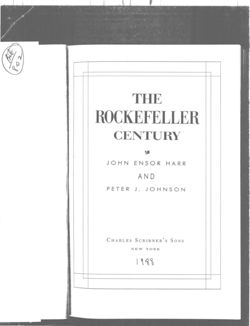
Page 2
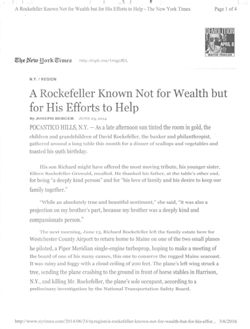
Page 3
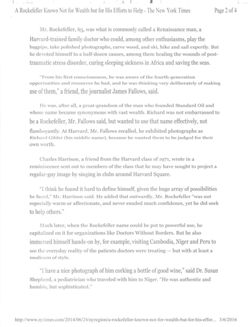
Page 4
Page 5
Page 6
Page 7
Page 8
Page 9
Page 10
Page 11
Page 12
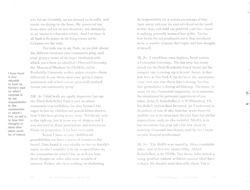
Page 13
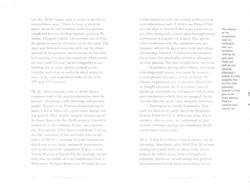
Page 14
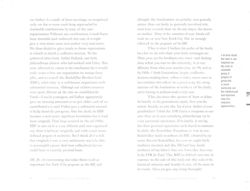
Page 15
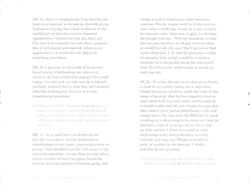
Page 16
Page 17
Page 18
Page 19
Page 20
Page 21
Page 22
Page 23
Page 24
Page 25
Search
results in pages
[Series II] Rockefeller, David
Rockefeller, David
THE
ROCKEFELLER
CENTURY
JOHN ENSOR HARR
AND
PETER J. JOHNSON
CHARLES SCRIBNER'S SONS
NEW YORK
1988
A Rockefeller Known Not for Wealth but for His Efforts to Help - The New York Times
Page 1 of 4
APRIL 8
WATCH TRAILER
The New Dork Times
http://nyti.ms/1mgcfEL
N.Y. / REGION
A Rockefeller Known Not for Wealth but
for His Efforts to Help
By JOSEPH BERGER JUNE 23, 2014
POCANTICO HILLS, N.Y. - As a late afternoon sun tinted the room in gold, the
children and grandchildren of David Rockefeller, the banker and philanthropist,
gathered around a long table this month for a dinner of scallops and vegetables and
toasted his 99th birthday.
His son Richard might have offered the most moving tribute, his younger sister,
Eileen Rockefeller Growald, recalled. He thanked his father, at the table's other end,
for being "a deeply kind person" and for "his love of family and his desire to keep our
family together."
"While an absolutely true and beautiful sentiment," she said, "it was also a
projection on my brother's part, because my brother was a deeply kind and
compassionate person."
The next morning, June 13, Richard Rockefeller left the family estate here for
Westchester County Airport to return home to Maine on one of the two small planes
he piloted, a Piper Meridian single-engine turboprop, hoping to make a meeting of
the board of one of his many causes, this one to conserve the rugged Maine seacoast.
It was rainy and foggy with a cloud ceiling of 200 feet. The plane's left wing struck a
tree, sending the plane crashing to the ground in front of horse stables in Harrison,
N.Y., and killing Mr. Rockefeller, the plane's sole occupant, according to a
preliminary investigation by the National Transportation Safety Board.
hhttp://www.nytimes.com/2014/06/24/nyregion/a-rockefeller-known-not-for-wealth-but-for-his-effor...3/6/2016
A Rockefeller Known Not for Wealth but for His Efforts to Help - The New York Times
Page 2 of 4
Mr. Rockefeller, 65, was what is commonly called a Renaissance man, a
Harvard-trained family doctor who could, among other enthusiasms, play the
bagpipe, take polished photographs, carve wood, and ski, hike and sail expertly. But
he devoted himself to a half-dozen causes, among them healing the wounds of post-
traumatic stress disorder, curing sleeping sickness in Africa and saving the seas.
"From his first consciousness, he was aware of the fourth-generation
opportunities and resources he had, and he was thinking very deliberately of making
use of them," a friend, the journalist James Fallows, said.
He was, after all, a great-grandson of the man who founded Standard Oil and
whose name became synonymous with vast wealth. Richard was not embarrassed to
be a Rockefeller, Mr. Fallows said, but wanted to use that name effectively, not
flamboyantly. At Harvard, Mr. Fallows recalled, he exhibited photographs as
Richard Gilder (his middle name), because he wanted them to be judged for their
own worth.
Charles Harrison, a friend from the Harvard class of 1971, wrote in a
reminiscence sent out to members of the class that he may have sought to project a
regular-guy image by singing in clubs around Harvard Square.
"I think he found it hard to define himself, given the huge array of possibilities
he faced," Mr. Harrison said. He added that outwardly, Mr. Rockefeller "was not
especially warm or affectionate, and never exuded much confidence, yet he did seek
to help others."
Much later, when the Rockefeller name could be put to powerful use, he
capitalized on it for organizations like Doctors Without Borders. But he also
immersed himself hands-on by, for example, visiting Cambodia, Niger and Peru to
see the everyday reality of the patients doctors were treating - but with at least a
modicum of style.
"I have a nice photograph of him corking a bottle of good wine," said Dr. Susan
Shepherd, a pediatrician who traveled with him to Niger. "He was authentic and
humble, but sophisticated."
http://www.nytimes.com/2014/06/24/nyregion/a-rockefeller-known-not-for-wealth-but-for-his-effor...3/6/2016
A Rockefeller Known Not for Wealth but for His Efforts to Help - The New York Times
Page 3 of 4
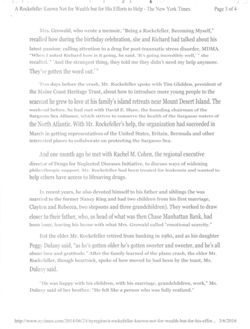
Mrs. Growald, who wrote a memoir, "Being a Rockefeller, Becoming Myself,"
recalled how during the birthday celebration, she and Richard had talked about his
latest passion: calling attention to a drug for post-traumatic stress disorder, MDMA.
"When I asked Richard how is it going, he said, 'It's going incredibly well,'" she
recalled. " And the strangest thing, they told me they didn't need my help anymore.
They've gotten the word out.'"
Two days before the crash, Mr. Rockefeller spoke with Tim Glidden, president of
the Maine Coast Heritage Trust, about how to introduce more young people to the
seacoast he grew to love at his family's island retreats near Mount Desert Island. The
weekend before, he had met with David E. Shaw, the founding chairman of the
Sargasso Sea Alliance, which strives to conserve the health of the Sargasso waters of
the North Atlantic. With Mr. Rockefeller's help, the organization had succeeded in
March in getting representatives of the United States, Britain, Bermuda and other
interested places to collaborate on protecting the Sargasso Sea.
And one month ago he met with Rachel M. Cohen, the regional executive
director of Drugs for Neglected Diseases Initiative, to discuss ways of widening
philanthropic support. Mr. Rockefeller had been treated for leukemia and wanted to
help others have access to lifesaving drugs.
In recent years, he also devoted himself to his father and siblings (he was
married to the former Nancy King and had two children from his first marriage,
Clayton and Rebecca, two stepsons and three grandchildren). They worked to draw
closer to their father, who, as head of what was then Chase Manhattan Bank, had
been busy, leaving his home with what Mrs. Growald called "emotional scarcity."
But the elder Mr. Rockefeller retired from banking in 1980, and as his daughter
Peggy Dulany said, "as he's gotten older he's gotten sweeter and sweeter, and he's all
about love and gratitude." After the family learned of the plane crash, the elder Mr.
Rockefeller, though heartsick, spoke of how moved he had been by the toast, Ms.
Dulany said.
"He was happy with his children, with his marriage, grandchildren, work," Ms.
Dulany said of her brother. "He felt like a person who was fully realized."
http://www.nytimes.com/2014/06/24/nyregion/a-rockefeller-known-not-for-wealth-but-for-his-effor...
3/6/2016
Message
Page 1 of 1
Epp, Ronald
From:
Epp, Ronald
Sent:
Thursday, February 10, 2005 3:10 PM
To:
'pjohnson@rockco.com"
Subject: David Rockefeller & Acadia
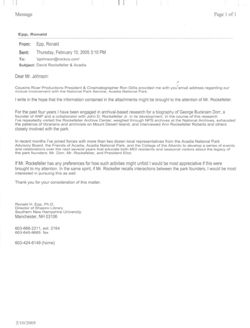
Dear Mr. Johnson:
Cousins River Productions President & Cinematographer Ron Gillis provided me with you email address regarding our
mutual involvement with the National Park Service, Acadia National Park.
I write in the hope that the information contained in the attachments might be brought to the attention of Mr. Rockefeller.
For the past four years I have been engaged in archival-based research for a biography of George Bucknam Dorr, a
founder of ANP and a collaborator with John D. Rockefeller Jr. in its development. In the course of this research
I've repeatedly visited the Rockefeller Archive Center, weighed through NPS archives at the National Archives, exhausted
the patience of librarians and archivists on Mount Desert Island, and interviewed Ann Rockefeller Roberts and others
closely involved with the park.
In recent months I've joined forces with more than two dozen local representatives from the Acadia National Park
Advisory Board, the Friends of Acadia, Acadia National Park, and the College of the Atlantic to develop a series of events
and celebrations over the next several years that educate both MDI residents and seasonal visitors about the legacy of
the park founders: Mr. Dorr, Mr. Rockefeller, and President Eliot.
If Mr. Rockefeller has any preferences for how such activities might unfold | would be most appreciative if this were
brought to my attention. In the same spirit, if Mr. Rockeller recalls interactions between the park founders, I would be most
interested in pursuing this as well.
Thank you for your consideration of this matter.
Ronald H. Epp, Ph.D.
Director of Shapiro Library
Southern New Hampshire University
Manchester, NH 03106
603-668-2211, ext. 2164
603-645-9685 fax
603-424-6149 (home)
2/10/2005
an entrepreneurial spirit:
ABOUT ROCKEFELLER PHILANTHROPY ADVISORS
Rockefeller Philanthropy Advisors is a 501(c)(3) non-profit organization
Three Centuries of
that helps donors to create thoughtful, effective philanthropy throughout
the world. Headquartered in New York City, it traces its antecedents to
John D. Rockefeller, Sr., who in 1891 began to professionally manage
Rockefeller Family
his philanthropy "as if it were a business.' Rockefeller Philanthropy
Advisors provides research and counsel on charitable giving, develops
Philanthropy
philanthropic programs, and offers complete program, administrative
and management services for foundations and trusts. Rockefeller
Philanthropy Advisors currently advises on and manages more than
$100 million in annual giving in more than 20 countries.
437 Madison Avenue
101 Second Street
37th Floor
24th Floor
New York, NY 10022
San Francisco, CA 94105
(212) 812-4330
(415) 543-0733
www.rockpa.org
table of contents
2
Foreword
Melissa A. Berman, President and CEO,
Rockefeller Philanthropy Advisors
4
Preface
Eileen Rockefeller Growald, Founding Chair,
Rockefeller Philanthropy Advisors
5
The Rockefeller Family's Philanthropic Beginnings:
A Brief History
Peter J. Johnson, Historian, Author and Rockefeller
Family Associate
Edited by Donzelina A. Barroso
20 Values, Rituals, and Communication in
Rockefeller Family Philanthropy
Eileen Rockefeller Growald, Founding Chair,
Rockefeller Philanthropy Advisors
31 Learning Philanthropy: Opportunity and
Relationship-Building Among the Younger
Generations
Peter O'Neill
Allison Whipple Rockefeller
Theo Spencer
Penny Fujiko Willgerodt, Vice President & Senior
Philanthropic Advisor, Rockefeller Philanthropy
Advisors
45 Personal Engagement and Passion in Philanthropy:
Two Generations Share their Experiences
David Rockefeller, Sr.
David Rockefeller, Jr.
© 2005. Rockefeller Philanthropy Advisors
64 Biographies
*
This book is printed on paper made from 30% post-consumer content.
This text is adapted from the transcript of "Reflections on the Past, Present
and Future: The Legacy of Rockefeller Family Philanthropy," a public
symposium hosted by Rockefeller Philanthropy Advisors and held on
November 18, 2004 at The Asia Society. New York City.
Q: It occurs to me that you all have done SO many
Personal Engagement and
creative things, as well as keeping up with the
Passion in Philanthropy:
logacy that you have been given. Some of you serve
on boards of places where your parents or
Two Generations Share their
grandparents served. Do you find that what your
Experiences
parents involved you in moves you toward these
other projects such as the Cornerstone Parks. or do
DAVID ROCKEFELLER, SR.
you find that your interests depart from theirs?
DAVID ROCKEFELLER, JR.
AWR: In my case, I was not born a Rockefeller. My
Effective
philanthropy
children were, and they will have to deal with those
avid Rockefeller, Jr: (DR, Jr.): It is a pleasure
is about clear
issues in due time. But I have enjoyed this legacy very
to be here with my father and to share some
and open
much, because all of the passions I had as a young
of our thoughts. Our remarks will focus
communication
in both
person and a young adult, before I ever met my
more on our personal experiences and our
directions.
husband, are SO spot-on in the legacy that this
approaches to philanthropy rather than on
family has given me the privilege to be a part of.
intra-generational issues.
I am extremely interested in New York State, and I am
We have, I am delighted to say, shared some
interested in open space and conservation, and there is
philanthropic activities, beginning with serving on the
not one board meeting that goes by without Nelson
board of the Rockefeller University, on which my
Rockefeller being remembered as the initiator of a
father has now sat for more than 60 years. I had a
directive for clean air and clean water; or Laurance
short tenure there largely because it did not directly
Rockefeller with the Greenway, Central Park and the
relate to my specific passions, a theme I consider very
National Parks; or David for his emphasis on the
important. We have also served on the Museum of
American farmland and the interpretation of
Modern Art (MoMA) board together-my father for
agriculture and seasonal food. I 'hey are all
more than 50 years and I for over 25. We served in
remembered. These things are such a pleasure to
succession on the board of the Rockefeller Brothers
waltz into, having done nothing but enjoyed the ride,
Fund, as well as on the board of a smaller foundation
and I am SO pleased and SO proud to be a part of it.
called the David Rockefeller Fund, which my
father set up in order to engage his children and
grandchildren in philanthropy. In addition, I
3 Some that work is documented Kim Robinson, Colliburative Grant Making:
Lessons Learned from the Rockefeller Family's Experience (Washington, DC:
succeeded my father as the American advisor to the
National Center for Family Philanthropy, 2001.
44
Learning Philmarking
Penant and Passes
45
Praemium Imperiale-an organization that distributes
directives taught me useful lessons-accountability and
international prizes for the arts.
sharing.
To begin the discussion, I would like you,
I also learned from him the importance of
Dads, to reflect on how your own father and
seizing opportunities. I can think of two instances that
grandfather influenced you when you were young.
illustrate this principle. This first occurred on a trip to
First you could address conversations about
Williamsburg, Virginia. Father and Mother used to
philanthropy, and then you could delve into some early
take their children on trips during vacations to
influential trips that I know that you took, where not
different parts of the United States and, later, abroad,
only philanthropy but the potential of philanthropy
SO that we would get an appreciation of what was
was a theme.
going on in the world. We went to Williamsburg
because Father had met the rector of a church there
David Rockefeller, Sr. (DR, Sr.): I was 21 years old when
and thought highly of him. Williamsburg had been the
Grandfather (John D. Rockefeller) died. Growing up, I
seat of the governors of North America before the
saw a lot of him, and was devoted to him, as I think he
American Revolution. Dr. W.A.R. Goodwin, the
was to me. Ivisited him in Florida, in Lakewood, NJ,
pastor of the church, was our guide. He showed Father
and in Tarrytown, NY. We had meals together, and I
a particular building that needed to be restored. After
enjoyed his company immensely. By the time that I
we left, he wrote Father asked him if he would
came to know him, however, he had ceased to be
restore it, which he did. Father became more
involved personally in philanthropy. Although he was
interested, and ended up financing the restoration of
an important influence in my life, his influence was
the entire village of Williamsburg, which I hope many
not directly related to philanthropy.
of you have visited. You still can see the letter that
It can be very
Insofar as Father (John D. Rockefeller, Jr.)
Dr. Goodwin wrote to Father, and the response in
satisfying to
was concerned, I think learned a great deal about
which Father signed the letter "David's Father"
identify a need
philanthropy from him. Philanthropy was important
because he did not want it to known that he was
and seize the
opportunity
to my father in many respects and he felt that it was
buying up the land.
to help
important that his children learn about it at an early
The second such example occurred when we
alleviate it.
age. He gave us an allowance starting around age ten,
visited Versailles, France right after World War II.
and no matter how small the allowance was, it was
The guide pointed out the fact that the chateau was in
given with the understanding that: (1) we would keep
danger of being ruined, because water was coming
a record of how we spent the money; and (2) that we
down through holes in the roofs and destroying walls.
would give ten percent of it to charity. Both of those
Afterward, Father put up the money to replace all the
46
Present and Passion
Personal red Passion
Praemium Imperiale-an organization that distributes
directives taught me useful lessons-accountability and
international prizes for the arts.
sharing.
To begin the discussion, I would like you,
I also learned from him the importance of
Dads, to reflect on how your own father and
seizing opportunities. I can think of two instances that
grandfather influenced you when you were young.
illustrate this principle. This first occurred on a trip to
First you could address conversations about
Williamsburg, Virginia. Father and Mother used to
philanthropy, and then you could delve into some early
take their children on trips during vacations to
influential trips that I know that you took, where not
different parts of the United States and, later, abroad,
only philanthropy but the potential of philanthropy
SO that we would get an appreciation of what was
was a theme.
going on in the world. We went to Williamsburg
because Father had met the rector of a church there
David Rockefeller, Sr. (DR, Sr.): I was 21 years old when
and thought highly of him. Williamsburg had been the
Grandfather (John D. Rockefeller) died. Growing up, I
seat of the governors of North America before the
saw a lot of him, and was devoted to him, as I think he
American Revolution. Dr. W.A.R. Goodwin, the
was to me. I visited him in Florida, in Lakewood, NJ,
pastor of the church, was our guide. He showed Father
and in Tarrytown, NY. We had meals together, and I
a particular building that needed to be restored. After
enjoyed his company immensely. By the time that I
we left, he wrote Father and asked him if he would
came to know him, however, he had ceased to be
restore it, which he did. Father became more
involved personally in philanthropy. Although he was
interested, and ended up financing the restoration of
an important influence in my life, his influence was
the entire village of Williamsburg, which I hope many
not directly related to philanthropy.
of you have visited. You still can see the letter that
It can be very
Insofar as Father (John D. Rockefeller, Jr.)
Dr. Goodwin wrote to Father, and the response in
satisfying to
was concerned, I think I learned a great deal about
which Father signed the letter "David's Father"
identify a need
philanthropy from him. Philanthropy was important
because he did not want it to known that he was
and seize the
opportunity
to my father in many respects and he felt that it was
buying up the land.
to help
important that his children learn about it at an early
The second such example occurred when we
alleviate it.
age. He gave us an allowance starting around age ten,
visited Versailles, France right after World War II.
and no matter how small the allowance was, it was
The guide pointed out the fact that the chateau was in
given with the understanding that: (1) we would keep
danger of being ruined, because water was coming
a record of how we spent the money; and (2) that we
down through holes in the roofs and destroying walls.
would give ten percent of it to charity. Both of those
Afterward, Father put up the money to replace all the
Personal Regagenews and Presson
Per would Elegagement and Process
47
roofs of Versailles. If you have been there, you know it
DR, Sr.: I felt as though I came up through the ranks
is quite a big place, SO it was not
of Chase. Over my 35 years there I think I held every
an inconsiderable thing for him to have done. He took
officer position possible, from assistant manager to
a personal interest in seeing the project through and I
chairman. As I worked my way up I observed that the
remember on one occasion staying at the hotel in
bank's charitable gifts usually reflected the interests of
Versailles and being allowed to ride bicycles through
the senior officers of the bank, and or those of their
the park and to walk on the roofs while they were
wives. But it did not seem to me that there was any
being restored.
logic or cohesiveness to Chase's giving. I persuaded the
I mention these stories because they gave me
officers to spend a weekend together to discuss what
insight into some of the things that Father did and
the bank should be doing and how much it should
For all of us,
how he happened upon them. It has been a great
spend. We developed a program much along the lines,
the question
lesson to me, and I have followed his example. It can
really, of the Rockefeller Brothers Fund, as a result of
of how much
be very satisfying to identify a need and seize the
which the bank had-and I think still has-a rather
strategic
thinking we
opportunity to help alleviate it.
carefully organized corporate philanthropic program.
ought to do as
I think it has been very effective over the years,
individuals, as
DR. Jr.: I know my father follows that rule. If you ever
much more SO than if Chase had continued to give
corporations,
and as
have the opportunity to sit in his office and an idea is
on a purely casual basis.
foundations,
generated about someone who can make something
is an important
happen, it is never his response to say, "I'll get to
DR, In: For all of us, the question of how much
one.
that next week." He says, "Would you get that person
strategic thinking WC ought to do as individuals, as
on the phone, please?" Immediate response in
corporations, and as foundations, is an important one.
philanthropy, and an entrepreneurial nature, is very
With all the choices available, it is very hard to do
important. The renovation of corner gas stations
what our grandfather and great-grandfather did, which
through the Cornerstone Parks Project would be,
is to sprinkle dimes around, as Peter Johnson likes to
I think, a very good example of that entrepreneurial
say. In my own case, my mother (Peggy McGrath
spirit. Could you comment on your experiences at
Rockefeller) was deeply interested in music, and that
Chase Manhattan Bank? You were one of the leaders
had a great early influence on me. She used to play the
in the corporate world when Chase developed its
piano when we were sitting in the evening, either
famous art collection, but you also led Chase to
doing homework or having a martini. (I was not the
become an important vehicle for institutional
one with the martini.) Those evenings formed what
philanthropy.
has become a lifetime of connection to music and the
Personal Engagement and Pleasant
Personal Kugagework and Passion
40
arts for me. Certainly, art was around on the walls, and
the responsibility for a certain percentage of what
music was playing in the house. My passion led me
I give away each year to each individual on the board.
from music and art to arts education, and, ultimately,
In that way, each child or grandchild can have a hand
to an interest in education reform. And Tcan trace it
in making personally some of those gifts. This has
all back to the piano in the living room and the
been both fun and productive, and it has introduced
Cézanne over the sofa.
me to a number of areas that I might not have thought
That leads me to ask, Dads, as you think about
of myself.
the difference between your community giving, and
your giving to some of the larger institutions with
DR. In: I myself have two daughters, both students
which you've been SO identified-Harvard University,
at Columbia University. The older one has already
the Museum of Modern Art (MoMA). and the
served on the David Rockefeller Fund board, and the
I have found
Rockefeller University as three major examples-how
younger one is coming up in the near future. As they
it very
differently do you think about your giving to major
both live in New York City, they have the opportunity
valuable
institutions with which you are personally involved
to see not only what their father is doing, but what
to have my
family's input
versus your community giving?
their grandfather is doing and thinking. The theme, it
on what I
seems to me, of personal engagement. is SO important.
consider to
DR, Sr.: I think both are equally important. I set up
You mentioned the personal engagement of your
be my
responsibilities
the David Rockefeller Fund in part to address
father, John D. Rockefeller, Jr., in Williamsburg, VA.
to the
community responsibilities, but also because I was
You didn't mention that he rejected, as I understand it,
communities
eager to have my children and grandchildren observe
the colors of some of the bricks that were shown for
in which I
live, as well as
how I have been giving money away. Not that my way
possible use in the structures. But you have had similar
to hear their
is the right way, but it is one way of doing so, and I
connections, surely, to the wonderful MoMA. in its
thoughts on
was interested in their participation and involvement.
four iterations. Can you talk a little bit about the
what other
areas would
From my perspective, it has been very useful.
meaning of personal involvement, and by that I mean
be of interest.
Because I have SO many children and
not just financial involvement?
grandchildren, we have a system of rotation on the
board. I have found it very valuable to have my family's
DR, Sr.: The MoMA was inspired by three remarkable
input on what I consider to be my responsibilities to
ladies, one of them my mother (Abby Aldrich
the communities in which I live, as well as to hear
Rockefeller), in the 1920s. These three ladies invited a
their thoughts on what other areas would be of
young graduate student at Harvard named Alfred Barr
interest. We have also been working on distributing
to share his thoughts and advice with them. That is
SD
Personal and Passion
Previously Passion
51
how the MoMA began, and, of course, it has had an
of what turned out to be the winning architect was an
extraordinary career. There has been a lot in the
entire education in itself. I think it was Peter O'Neill
papers about the new building, which has just been
who said that we often feel that we get more than we
The pleasure
completed by a very brilliant Japanese architect, Mr.
give. That feeling really comes about through personal
of the
involvement
Yoshio Taniguchi. I think it has become one of, if not
involvement in programs or projects. The pleasure
with the
the, greatest museum of modern art in the world. The
of the involvement with the institutions sets up a
institutions
space was dedicated yesterday, and I cut the ribbon
resonance whereby the giver gives freely and with joy
sets up a
resonance
assisted by the governor and the mayor of New York.
and learning. Ultimately I believe it is the programs
whereby the
It is exciting to me that this institution, which started
that we have been personally involved in that give us
giver gives
out very small, has now opened a magnificent new
the most pleasure. That has certainly been true for me.
freely and
with joy and
building that is, in my opinion, in itself a very
Nonetheless, giving funds without involvement
learning.
beautiful work of art. as well as the ideal setting for
is also important, because you cannot be involved
Ultimately I
some of the most magnificent works of art of the
in every project if you give, as [ do, to about 100
believe it is the
20th and 21st centuries.
programs that
different organizations, or, as my father does, to 500.
we have been
So, though you cannot do it everywhere, you can
personally
DR, Jr.: Your comments make me think about a
depend on your friends or colleagues to tell you about
involved in that
give us the
comment made in the previous discussion about the
great enterprises in which they are engaged. You can
most pleasure.
pleasure of knowing really interesting and powerful
trust that they have good ideas and good connections.
That has
people. Because of my Praemium Imperiale trips to
Turning now to family foundations: Dads,
certainly been
true for me.
Japan, I was in Tokyo on a regular basis during a ten-
could you describe the early days of the Rockefeller
year period. When Yoshio Taniguchi became one of
Brothers Fund and how it shifted over time from an
the three finalists for the MoMA project, I decided I
enterprise that was more, as I understand it, about
wanted to see his buildings. He gave me a personal
personal community giving, into something that had
tour through four of his Japanese buildings. I can say
a much more strategic cast.
that the consistency of his work from what he did
earlier to MoMA is amazing. He took concepts that
DR, Sr.: I had four brothers, none of whom, sadly, are
played out in very clean, uncluttered environments,
alive today. Immediately after World War II, we began
such as the case of the aquarium in Tokyo or of the
meeting on a regular basis to discuss what we were
Toyota Museum in Toyota City, for example, and put
going to do with our lives, what we thought was
them into the middle of a very complicated block in
important, and how we would manage the properties
Manhattan. Having a chance to see through the eyes
and possessions that had been passed down to us by
Personal and Passion
Person and Passion
53
our father. As a result of those meetings, we recognized
although the beneficiaries are probably not generally
early on that we were each being approached for
entities that our family is personally involved with,
charitable contributions by many of the same
much less certainly than in the early days, the themes
organizations. Without any coordination, it would have
are similar. Many of the members of our family still
been inevitable (and awkward) that one of us might
reside in or near New York City. This is strongly
give a very modest sum and another very much more.
reflected in the program of the RBF.
We thus decided to give jointly to those organizations
This is where I believe that scale of the family
in which we shared a collective interest. We first
has a lot to do with what your family strategies are.
I do think that
gathered advice from Arthur Packard, our family
When you are five brothers and a sister and thinking
the heart is as
philanthropic who had worked with Father. But
about what you want to do collectively, it is very
important as
the mind in
soon afterward we came to the conclusion that it would
different from when you number close to 90, such as
charitable
make sense to have an organization to manage those
the Fifth / Sixth Generation. Imagine collective
giving. A
gifts, and we created the Rockefeller Brothers Fund
decision-making there, where it makes more sense to
program of
(RBF), which today is a well-known organization with
have entities that reflect in a general way the strong
giving that
is based
substantial resources. Although our relative resources
interests of the foundation or members of the family,
exclusively on
were quite different at the time we established the
and to bring in professionals to help out.
the intellectual
Fund-I was the youngest, and Father appropriately
This also raises the question of how to define
and objective
may miss
gave us increasing amounts as we got older-each of us
the family as the generations expand. Are you the
important
contributed to it, and Father gave a substantial amount
nuclear family; are you the line of your father or your
opportunities.
to help launch the program. After his death, the RBF
grandfather? I think the DR Fund is a response to our
became a much more significant foundation than it had
sense that at its most satisfying, philanthropy can be
been originally. That leap occurred in the mid 1960s.
a very personal experience. If the family is too big,
RBF is now run in a very different and more organized
then that personal experience can be hard to maintain.
way than it had been originally, and with a much more
So while the Rockefeller Foundation is run by non-
defined program of activities. But I think all of us felt
Rockefeller family members, the RBF, chaired by my
that originally it was a very satisfactory way to be able
cousin Steven Rockefeller, has seven or eight family
to accomplish a great deal more collectively than we
members involved, and the DR Fund has family
could have on a purely personal basis.
members of my father's line only. Someday there may
be the DR Jr. Fund. The RBF has shifted over time in
DR, Jr.: It is interesting that today there is still an
response to the scale of the family and the scale of the
important New York City program at the RBF, and
historical interests, and frankly the size of the issues in
the room. Have you got any closing thought?
S.4
Personal and Passion
Personal Engagement and Passion
55
DR, Sr.: Just to re-emphasize that I do think that the
I think it would be unfortunate if that were not to
heart is as important as the mind in charitable giving.
continue. What the impact would be if there were no
A program of giving that is based exclusively on the
estate taxes is a challenge, because in a sense you have
intellectual and objective may miss important
less incentive, rather than more, to give. I would hope
opportunities. I learned that from my father, and
that people would say, "Well, how wonderful, we now
I've tried to do it myself. Over and above a program
have no taxes, therefore we will give even more than
that is well-planned and organized, when you see
we would have with the taxes." But I am not sure that
opportunities it is wonderful to be able to do
would always work. I do think the percentage is really
something about them.
the question. In my mind, it would be a mistake to
eliminate the tax altogether, but on the other hand I
DR, Jr.: I guess one would say that if an outcome-
think 70 or 80 percent, which we had at one time, is
based strategy of philanthropy was taken to its
much too high.
extreme, the heart would not be engaged. You would
engage the mind, and you might not do as well and
DR, Jr.: If you look abroad, you see that private charity
probably would not have as much fun, and I certainly
is, even in very weal thy nations, not a major theme.
subscribe to having fun. Let us see if we have
I think the question would be, would the residue of the
stimulated any questions.
stamp of generosity that had been impelled at least to
some extent by the tax code, remain and be sustained,
Q: I hope this will be a hypothetical question. but as
or would we glide into the path of many European and
you know, Congress might eliminate the federal
other nations, where private philanthropy is really not
estate tax In that case what effect do you feel this
a major player? You may know that Bill Gates, Sr. took
will have on the heart the mind. and the quantum
a leading role in advocating for the estate tax. I tried to
of giving?
help him a couple of years ago, and to date we have
not fully prevailed. I think there could be serious
DR, Sr.: In my mind there is no doubt that the
disadvantages to the non-profit sector as a whole,
fact that we are given charitable deductions on
certainly in the long run. Whether it would be as
contributions is a very positive, encouraging factor to
much of a problem in the short run, I think, is
giving. I have intended to give the full amount of my
probably the main question.
charitable deductions ever since that went into effect,
and in a number of cases I have gone beyond the
Q I wonder if you might add another historical note
amount. It is a big stimulus to charitable giving, and
When MK think of the Rockefeller family. we think
56
Personal Engagement and Passion
Passent Engagement and Passion
57
of generations and generations in philanthropy,
branch; we have worked at it and enjoy each other and
but when we think of some of the other great
enjoy working together.
19th-century fortunes-the Carnegies the
Vanderbilts, and the do not think
DR, Sr.: And because of the example that was set by
of philanthropy. Perhaps the only other examples
Grandfather and Father.
I can think of are the Rothschilds and your
various families. Are the Rockefellers unique, or
DR, Jr.: Exactly. So it is very conscious. I have been
are there other families that have succeeded over
working on my daughters, and the proof of those
multiple generations?
puddings is still, I think, to be seen. But we do have
the example of passing these values down, one person
DR, Jr.: I am not a historian of family philanthropy,
to another. I do not know how long it will go on, and
but I think it may be that other families are more
it would be an interesting question, I think, to ask
under the radar and doing as much as five and six
whether, and to what extent, other families have been
generations down the line as our family. We have
successful in keeping these traditions.
tended to retain family names in our foundations, and
without, frankly, any public relations guidance, I think,
(): Chose of us in the field can never drive up the
have kept the Rockefeller philanthropic "brand" out
west side of Manhattan without thinking about
there in the minds of citizens. Some 10 years ago,
the origins of the Palisades Do you feel that there
around the time of the sale of Rockefeller Center,
was 3 sense in your fathers generation that the
a well-known public relations advisor told us that
philanthropic dollar more "pomph," if you will,
philanthropy was really the most distinguishing
in addressing issues and making major changes than
characteristic of the family today, not historically,
it does today?
and that to the extent that we wanted to continue
strongly as a family, we should promote that. And
DR, Sr. I certainly think that Father had resources at
I think, at least informally, we probably have. Why
his disposal that were considerably greater than that of
other families have not persisted in this way, I really
any of the subsequent generations, making it possible
do not know, but it takes a lot of work, especially when
for him to undertake projects such as the restoration of
the family is large. The William branch, John D.
Williamsburg, VA, or Versailles, or the Palisades. Any
Rockefeller's brother, and all his descendants, probably
of these for my generation and beyond would be group
number some 500 or 600 members by today. I do not
efforts. I have to say the Northern Forest Lands
believe they have as much cohesion as the John
Collaboration is a good example of a large-scale
58
Personal Engagement and Parties
Personal of Passion
50
project to which our family has given substantially,
(): With regard to Chase, were you building a good
while also bringing in the contributions of other
Chase, or .) good art collection? What rule should a
donors. I think that may be a tradition that could be
corporate art lection play?
continued not only by our family, but picked up by
others. If one group sets the lead in undertaking a
DR, Sr.: We started the art collection when I was a
project beyond their own financial capacities, they can
senior officer at Chase. I felt that there were several
bring other partners in to support it.
considerations. First, there was the question of a brand
new building that we had built at 1 Chase Plaza that
DR, Jr.: Real estate values certainly are a factor, as is
had a lot of wall space that was going to be pretty bare
the capacity of the family. From a real estate point of
if there was nothing on it. Gordon Bunshaft. the
view the northern forests, which are located in
architect of the buil ding himself, said to me, "I think
northern New York State and New England, are not
you need to consider what you are going to do about
If one group
near any major urban areas that tend to exacerbate
that." So we put gether a committee of five very
sets the lead
property prices. Grandfather had both the capacity and
distinguished heads of museums, including Alfred Barf
in undertaking
the vision in a time where the Palisades were close, but
from the MoMA, to advise us as to how we could go
a project
beyond their
not as close, to the developed New York City as they
about filling that space in a way that would achieve
own financial
are today. Thank heaven he had the vision and the
its objective of covering the walls with something
capacities,
opportunity. The opportunities that are out there are
interesting, while also being able to support living
they can
bring other
not as obvious, and not as close, certainly, to us urban
artists and to acquire beautiful works of art that would
partners in to
dwellers, as they were in the past. Nonetheless, there
be of interest to those who worked in the bank as well
support it.
are opportunities in the natural world. My work with
as those who visited it. We set up an art committee of
the National Park Foundation has caused me to see
distinguished advisors to help us and then proceeded
what amazing advances can be made in some of the
to purchase the works of art. I think the results have
outlying national parks where there are in-holdings or
demonstrated that it was worth doing: many people
adjacent holdings that could be added in order to give
working for and visiting the bank have enjoyed these
integrity to a park. Summer 2005 will be the 25th
works over the years, and, in addition, it certainly has
anniversary, for example, of Jimmy Carter's signing of
helped a lot of living artists. It has also turned out to
the Alaskan National Lands Conservation Act, the
be a rather good investment. because the value of the
land conservation act that essentially doubled the size
collection today, I think is something like five time
of the national parks system in one stroke of the pen.
what it was when we bought it. Many other
corporations followed Chase's example.
60
Personal Employees and Passion
Personal Engagement and Passion
61
3/22/2017
David Rockefeller, generous benefactor to Harvard, former Overseer, dies at 101 I Harvard Gazette
Harvard Gazette
Campus & Community > Obituaries
David Rockefeller dies at 101
Business leader was generous benefactor to Harvard, headed Overseers
March
21, 2017 Editor's Pick Popular
File photo by Justin Ide
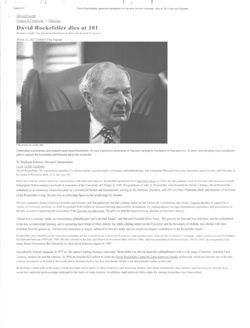
Celebrated businessman and philanthropist David Rockefeller '36 was a generous benefactor of Harvard, serving on the Board of Overseers for 12 years, and donating many substantial
gifts to support the humanities and financial aid at the University.
By Stephanie Schorow, Harvard Correspondent
Email Twitter Facebook
David Rockefeller '36, a prominent member of a storied family, a global leader in business and philanthropy, and a longtime Harvard University benefactor and Overseer. died Monday at
his home in Pocantico Hills, N.Y. He was 101.
Born into a family whose name was synonymous with fame and largesse, Rockefeller graduated from Harvard College in 1936 He did graduate work at Harvard with economist Joseph
Schumpeter before earning a doctorate in economics at the University of Chicago in 1940. The grandson of John D. Rockefeller, who founded the family's fortune, David Rockefeller
embarked on an immensely successful career as a commercial banker and businessman, serving as the chairman, president, and CEO of Chase Manhattan Bank and chairman of the board
of the Rockefeller Group. He also was an influential figure on the world stage for decades.
He was a generous donor to Harvard faculties and Schools, and that generosity has had a lasting impact on the University's institutions and vision. Capping decades of support for
a
variety of University priorities, in 2008 he pledged $100 million to increase learning opportunities dramatically for undergraduates through international experiences and participation in
the arts, as well as supporting the renovation of the Harvard Art Museums. The gift was then the largest from an alumnus in Harvard's history.
"David was a visionary leader, an extraordinary philanthropist, and a devoted friend," said Harvard President Drew Faust. "His passion for Harvard was infectious, and his commitment
to the arts, to experiential learning, and to increasing knowledge of other cultures has made a lasting impact on the University and the thousands of students and scholars who have
benefited from his generosity. The Harvard community is deeply saddened by David's death, and we extend our deepest condolences to the Rockefeller family."
Rockefeller was a member of the executive committee of the Committee on University Resources, and was honorary chair of The University Campaign, which raised a record $2.6 billion
for Harvard between 1994 and 1999. He also served on the Harvard Board of Overseers from 1954 to 1966. and was president of the board from 1966 to 1968. In recognition of his
many forms of service to the University, he received an honorary degree in 1969.
Described by Fortune magazine in 1977 as "the nation's leading business statesman," Rockefeller was also an innovative philanthropist with a wide range of interests, including Latin
America, modern art, and the sciences. In 1994, he donated $25 million to create the David Rockefeller Center for Latin American Studies at Harvard, which has become one of the pre-
eminent institutions of its kind in the world and is distinguished as the first interfaculty initiative for international studies at Harvard
Rockefeller's initial gifts to the center, which provided endowments for three chairs in Latin American Studies, have been emulated by other donors, and Harvard now benefits from
seven new endowed professorships dedicated to the study of Latin America. In addition, eight endowed fellowships for visiting researchers have been added.
3/22/2017
David Rockefeller, generous benefactor to Harvard, former Overseer, dies at 101 Harvard Gazette
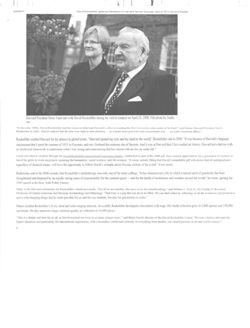
Harvard President Drew Faust met with David Rockefeller during his visit to campus on April 25. 2008. File photo by Justin
Ide
"In the early 1990s, David Rockefeller had the vision to help lead Harvard's effort in creating the first University-wide center of its kind," said former Harvard President Neil L.
Rudenstine in 2008. "David realized that the time was right to turn attention - in a much more powerful and concentrated way - on Latin American affairs."
Rockefeller credited Harvard for his interest in global issues. "Harvard opened my eyes and my mind to the world," Rockefeller said in 2008. "It was because of Harvard's language
requirement that I spent the summer of 1933 in Germany and saw firsthand the ominous rise of fascism. And it was at Harvard that I first studied art history. Harvard provided me with
an intellectual framework to understand what I was seeing and experiencing that has stayed with me for my entire life."
Funds provided to students through the David Rockefeller International Experience Grants, established as part of the 2008 gift, have created opportunities for a generation of students to
travel the globe to work on projects spanning the humanities. social sciences, and life sciences. "It seems entirely fitting that David's remarkable gift will ensure that all undergraduates,
regardless of financial means, will have the opportunity to follow David's example and to become citizens of the world," Faust noted.
Rudenstine said in his 2008 remarks that Rockefeller's philanthropy was only one of his many callings. "It has characterized a life in which a natural spirit of generosity has been
strengthened and deepened by an equally strong sense of responsibility for the common good - and for the health of institutions and societies around the world," he wrote, quoting his
1999 speech at the New York Public Library.
Many in the Harvard community felt Rockefeller's death personally. "For all its inevitability, this news is no less heartbreaking," said William L. Fash Jr., the Charles P. Bowditch
Professor of Central American and Mexican Archaeology and Ethnology. "That truly is a gap that can never be filled. We can find solace by reflecting on all the wondrous and productive
and world-changing things that he made possible for us and for our students, but also for generations to come."
Others recalled Rockefeller's lively mind and wide-ranging interests. As a child, Rockefeller developed a fascination with bugs. His beetle collection grew to 2,000 species and 150,000
specimens. He also amassed a huge, museum-quality art collection of 15,000 pieces.
"This is a deeply sad time for us all, as David touched our lives in so many unique ways," said Brian Farrell, director of the David Rockefeller Center. "He was a tireless advocate for
higher education and particularly for international experiences, with a boundless intellectual curiosity in everything from beetles, our shared passion, to art and world cultures."
3/22/2017
David Rockefeller, University trustee and descendent of UChicago's philanthropic founder, 1915-2017 UChicago News
Service and leadership on a global stage
After completing his graduate work, Rockefeller began in government service, working for New York Mayor Fiorello La Guardia. During World War II, he served as an
intelligence officer in North Africa and the south of France, achieving the rank of captain. With the return of peace, Rockefeller embarked on his career at Chase Manhattan
and worked to continue his family's tradition of philanthropy-what John D. Rockefeller Sr. called "the art of giving.' He was first elected as a trustee of the University of
Chicago on May 8, 1947. He served as a trustee until 1963, became an honorary trustee until 1966, then was a life trustee until 2007 and was a trustee emeritus at the time
of his death.
Rockefeller became chairman and chief executive of Chase, where he focused on global banking and developed important relationships with numerous world leaders. He
was part of a generation of Rockefellers who held a prominent place in American civic life. His brother Nelson Rockefeller was governor of New York and later vice president
of the United States, while his brother Winthrop Rockefeller served as governor of Arkansas.
David Rockefeller's civic work included helping New York City through its financial crisis, serving as a key supporter of New York's Museum of Modern Art, and leading
Rockefeller University as chairman of its board of trustees. His many years of service to educational, civic and cultural institutions earned Rockefeller honors, including the
U.S. Legion of Merit, the French Legion of Honor and the Presidential Medal of Freedom.
Gray said that when Rockefeller retired from Chase, the bank's board decided to honor him by endowing a chair in his honor, rather than through a direct gift - after all,
"what could you give a Rockefeller?"
There was a competition between Harvard and the University of Chicago for the chair, which was to be in international economics. Chicago won, and Rockefeller came for
the announcement and dinner that inaugurated the chair. "He always remained interested in following its progress and learning of its incumbents," Gray said.
The chair is now held by Nobel laureate Lars Hansen, the David Rockefeller Distinguished Service Professor in Economics.
John W. Boyer, dean of the College and author of The University of Chicago: A History, said David Rockefeller valued what his family had begun at the University of Chicago,
and he contributed to its later successes.
"David Rockefeller served with great distinction as an active trustee of the University, as a generous philanthropist in support of the University's academic programs and as a
wise adviser to several of our presidents," Boyer said. "The gifts of his grandfather, John D. Rockefeller Sr., to the early University of Chicago were primarily responsible for
the founding of one of the great new research universities in modern America, setting a model for those who would follow in advancing the well-being of American higher
education and society. David Rockefeller shared with his grandfather and his father a deep conviction about the profound responsibilities that the great American universities
bear in enhancing the intellectual creativity and cultural progress of American civic life."
Rockefeller is survived by five of his children, David Rockefeller Jr. Abigail Rockefeller, Neva Rockefeller Goodwin, Peggy Dulany and Ellen Rockefeller Growald He was
preceded in death by his son Richard Rockefeller.
Tags
David Rockefeller(http://news.uchicago.edu/tag/david-rockefeller) President Robert J. Zimmer
(http://news.uchicago.edu/tag/president-robert-j-zimmer), John W. Boyer (http://news.uchicago.edu/tag/john-
w-boyer), Alumni (http://news.uchicago.edu/tag/alumni), Obituary (http://news.uchicago.edu/tag/obituary),
Board of Trustees (http://news.uchicago.edu/tag/board-trustees)
Munch Madness
OBITUARY
David Rockefeller, business statesman' and
former Chase Manhattan chairman, dies at
101
NEW YORK TIMES
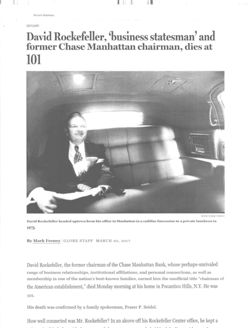
David Rockefeller headed uptown from his office in Manhattan in a cadillac limousine to a private luncheon in
1973.
By Mark Feeney | GLOBE STAFF MARCH 20, 2017
David Rockefeller, the former chairman of the Chase Manhattan Bank, whose perhaps-unrivaled
range of business relationships, institutional affiliations, and personal connections, as well as
membership in one of the nation's best-known families, earned him the unofficial title "chairman of
the American establishment," died Monday morning at his home in Pocantico Hills, N.Y. He was
101.
His death was confirmed by a family spokesman, Fraser P. Seidel.
How well connected was Mr. Rockefeller? In an alcove off his Rockefeller Center office, he kept a
II." It was no hyperbole when Fortune magazine described him in 1977 as "the nation's leading
business statesman."
Mr. Rockefeller's reach extended far beyond business. A nephew, former US Senator Jay
Rockefeller, a West Virginia Democrat, once called him "probably the most powerful man in
America." Mr. Rockefeller scoffed at the title, but the perception that he presided over the
intersection of financial and political influence in this country, if not the world, made him a favorite
target of conspiracy theorists at both ends of the political spectrum.
Get Fast Forward in your inbox:
Forget yesterday's news. Get what you need
Enter email address
Sign Up
today in this early-morning email.
Mr. Rockefeller's vigorous and longstanding advocacy of globalization (he visited 103 countries and
traveled 5 million air miles during his 35 years at Chase, which became JPMorgan Chase, in 2000)
added fuel to the fire. Seeing internationalization in economic rather than political terms, Mr.
Rockefeller never disguised the fact that his interest in making business deals was not limited to
democracies. The accusation "David Rockefeller has never met a dictator he didn't like" was
frequently heard.
While Mr. Rockefeller's reserved, bankerly nature made him an unlikely object of demonization, it
ideally suited him for service on institutional boards. At various times he was chairman of New
York's Museum of Modern Art, the Council on Foreign Relations, Harvard University's board of
overseers, the Japan Society, and the Trilateral Commission. The commission, of which he was
cofounder, was a special bugbear of the far left and right: No fewer than 15 members held positions
of influence in the Carter administration, including the president and vice president, as well as the
secretaries of state, defense, and treasury.
Mr. Rockefeller never ventured out of the private sector. When his brother Nelson was governor of
New York, there was talk of Mr. Rockefeller running for mayor of New York. Richard Nixon twice
asked him to be secretary of the treasury. Jimmy Carter did SO once, also seeking him as chairman
of the Federal Reserve. Mr. Rockefeller declined all four offers, instead preferring, as he put it in his
"Memoirs" (2002), "the fascinating and personally rewarding life of a commercial banker." His
closest brush with politics came in 1979 when Mr. Rockefeller's efforts to gain the exiled shah of
Iran admittance into the United States became a cause celebre.
Only part of Mr. Rockefeller's influence stemmed from his wealth and position. Forbes magazine
stated his worth as being $3.1 billion in 2016. Yet that sum placed him only 214th on its list of the
richest Americans. Mr. Rockefeller owed fame even more to his surname.
So much of the Rockefellers' unique status had to do with its great ongoing commitment to
philanthropy. The list of institutions the Rockefellers either founded or notably assisted includes the
University of Chicago, Rockefeller University, the Memorial Sloan-Kettering Cancer Center, Brown
Calling philanthropy "a tradition in our family," Mr. Rockefeller was brought up to believe that
"with opportunities go obligations," he said in a 2002 Boston Globe interview.
"It seems to me that's a pretty simple but basic lesson for just about anybody," he said. "It would be
a sad waste of one's life if one didn't use those opportunities to do things that are constructive for
society as a whole."
Besides those institutions and causes already noted, Mr. Rockefeller involved himself with
numerous others. He took a great interest in Latin America, one result of which is the David
Rockefeller Center for Latin American Studies at Harvard. As president of Morningside Heights
Inc., he helped build middle-class housing in New York near Columbia University in the late 40s
and '50s. He was instrumental in the redevelopment of lower Manhattan, with the siting of Chase's
60-story headquarters there in the late '50s; and, as chairman of the Downtown-Lower Manhattan
Association, with the building of the World Trade Center.
Famous for his energy, Mr. Rockefeller never let it go to waste. Asked in that 2002 interview why he
waited until he was 87 to publish his autobiography, Mr. Rockefeller replied, "Maybe I was just too
busy."
The son of John D. Rockefeller Jr. and Abby Greene (Aldrich) Rockefeller, he was born on June 12,
1915, in New York City. David Rockefeller was the favorite of his grandfather, the founder of the
family fortune - and the grandchild John D. Rockefeller felt was most like himself.
Mr. Rockefeller had five siblings: John D. III; Abby; Nelson; Laurance, a pioneering venture
capitalist and leading environmentalist; and Winthrop, the two-term governor of Arkansas. All
predeceased him. Mr. Rockefeller was considered the "serious" one among his generation of the
family.
"I don't think I had the typical childhood," he said with characteristic (if also extreme)
understatement in the 2002 interview. The nine-floor Rockefeller home was the largest private
residence in New York; and his father wore black tie to dinner every evening, his mother a gown.
Like many boys, Mr. Rockefeller collected bugs (in his case beetles) - only his collection grew to
2000 species and 150,000 specimens. He was SO serious about the subject that two species are
named for him. The family spent summers at Seal Harbor, Maine. There Mr. Rockefeller developed
a lifelong love of sailing. In celebration of his 100th birthday, he donated 1,000 acres of adjacent
land to the Mount Desert Island & Garden Preserve, as a "gfit to all the people of Maine."
Graduating from Harvard in 1936, Mr. Rockefeller did graduate work there with the economist
Joseph Schumpeter, then studied with the economist Friedrich von Hayek at the London School of
Economics. He earned a doctorate in economics at the University of Chicago in 1940, publishing his
dissertation a year later as "Unused Resources and Economic Waste."
Mr. Rockefeller spent a year and a half as an unpaid aide to New York Mayor Fiorello LaGuardia,
then worked for six months in New York's federal defense preparedness office. Enlisting in the
captain.
Upon leaving the army, Mr. Rockefeller joined what was then the Chase National Bank; his
maternal uncle was chairman. "I didn't want to be given jobs and opportunities because of my
name. I wanted to feel that I had done things on my own," he said in 2002. "I think, to a
considerable extent, getting a PhD was an indication that I had earned something on my own.
Therefore, when I got a job at the bank I didn't have to be embarrassed about it."
Mr. Rockefeller rose from assistant manager in the foreign department (starting at $3,500 a year)
to assistant cashier to second vice president, then vice president. He became vice chairman in 1957,
and chief executive officer and chairman in 1969. He retired in 1981. His first 12 years at the bank
he rode the subway to work. During Mr. Rockefeller's chairmanship, Chase was the nation's third
largest bank. He emphasized its foreign business, greatly raising its global profile.
In 1998, President Clinton awarded Mr. Rockefeller the nation's highest civilian honor, the
Presidential Medal of Freedom.
Asked in 2002 if being a Rockefeller had been more blessing or burden, he answered without
hesitation. "The benefits have far outweighed the disadvantages."
Mark Feeney can be reached at imfeeney@globe.com.
Stay updated, right in your news feed.
Like 463K
Most Popular In Metro
'Ijust wasn't going to go down for something he did,' Hernandez witness says
Alexander Bradley said he would have kept silent about a double murder if only Aaron Hernandez
had not shot him once between the eyes. MORE...
GOP health plan would cost Mass. $2billion, Baker says
Governor Charlie Baker's estimate came in a letter to the state's congressional delegation in which he
shared his administration's analysis of the effects of the bill. MORE...
Boston schools ditch conventional world mapsi in favor ofthisone
Social studies classrooms throughout the Boston public school system are getting an upgrade some
448 years in the making. MORE...
Twosisters, one house, and amystery
Sheryl Waldman lived a reclusive life with her sister, Lynda, in their family's old home on Clinton
Road in Brookling Over the cho faded from view until cho
Viewer Controls
Toggle Page Navigator
P
Toggle Hotspots
H
Toggle Readerview
V
Toggle Search Bar
S
Toggle Viewer Info
I
Toggle Metadata
M
Zoom-In
+
Zoom-Out
-
Re-Center Document
Previous Page
←
Next Page
→
[Series II] Rockefeller, David
| Page | Type | Title | Date | Source | Other notes |
| 1 | File Folder | Rockefeller, David | - | Ronald Epp | - |
| 2 | Title Page | Title page of the book, "The Rockefeller Century," by John Ensor Harr and Peter J. Johnson | 1988 | Harr, John Ensor and Johnson, Peter J. The Rockefeller Century. New York: Charles Scribner's Sons, 1988. | - |
| 3-5 | Newspaper Article | Online copy of the article, "A Rockefeller Known Not for Wealth but for His Efforts to Help" | 06/23/2014 | www.nytimes.com/2014 | - |
| 6 | Email to Mr. Johnson from Ronald Epp re: David Rockefeller and Acadia | 02/10/2005 | Personal correspondence of Ronald Epp | - | |
| 7-18 | Booklet | Booklet of the Rockefeller Philanthropy Advisors entitled, "An Entrepreneurial Spirit: THree Centuries of Rockefeller Family Philanthropy;" includes thoughts and remarks of David Rockefeller, Sr. and Jr. | 2005 | www.rockpa.org | - |
| 19-21 | Newsletter, online | Article from the Harvard Gazette, "David Rockefeller Dies at 101" | 03/21/2017 | Harvard Gazette online. | - |
| 22-25 | Obituary | Obituary from the Boston Globe, "David Rockefeller, 'business statesman' and former Chase Manhattan chairman, dies at 101" | 03/20/2017 | Boston Globe online. | - |
Details
Series 2