From collection Creating Acadia National Park: The George B. Dorr Research Archive of Ronald H. Epp


Page 1
Page 2
Page 3
Page 4
Page 5
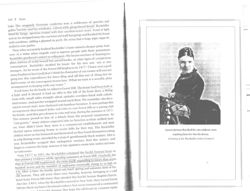
Page 6
Page 7
Page 8
Page 9
Page 10
Page 11
Page 12
Page 13
Page 14
Page 15
Page 16
Page 17
Page 18
Page 19
Page 20
Page 21
Page 22
Page 23
Page 24
Page 25
Page 26
Page 27
Page 28
Page 29
Page 30
Page 31
Page 32
Page 33
Page 34
Page 35
Page 36
Page 37
Page 38
Page 39
Page 40
Page 41
Page 42
Page 43
Page 44
Page 45
Page 46
Page 47
Page 48
Page 49
Page 50
Page 51
Page 52
Page 53
Page 54
Page 55
Page 56
Page 57
Page 58
Page 59
Page 60
Page 61
Page 62
Page 63
Page 64
Page 65
Page 66
Page 67
Page 68
Page 69
Search
results in pages
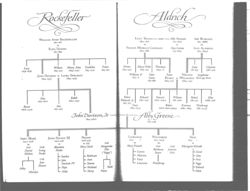
[Series II] Rockefeller Families
Rockefeller Fanilies
wite
TITAN
THE LIFE OF
John D. Rockefeller , Sr.
RON CHERNOW
RANDOM HOUSE
NEW YORK
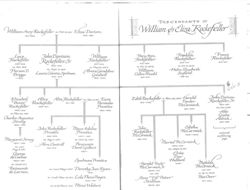
DES CENDANTS OF
William Avery Rockefeller m. Feb 18,1837 Eliza Eliza Davison
William & Eliza Rockefeller
1810-1906
1813-1889
Lucy
JohnDavison
William
Mary Ann
Franklin
Francis
Rockefeller
Rockefeller, Sr.
Rockefeller
Rockefeller
Rockefeller
Rockefeller
1845~1917
1845-1847
1838-1878
1841-1922
1843-1925
1839-1937
m nov. 1856
m. Oct.17, 1872
m. Oct. 12, 1870
m. May25, 1864
PiersonD.
m. Sept.9, 1864
Laura Celestia Spelman
Almira Geraldine
William
Helen Elizabeth
Briggs
1839-1915
Goodsell
Cullen Rudd
Scofield
1845-1915
1848-1932
?~1912
1844-1920
sisks
Elizabeth
Edith Rockefeller m nov. 26,1895 Harold
John Davison
Alice AltaRockeller m.Jan.17,1901 Ezra
"Bessie"
Rockefeller
Parmalee
1872~1932
Fowler
Rockefeller; Jr.
1871-1962
Rockefeller
McCormick
1874-1960
1869-1870
Prentíce
m. Oct.9,1901
1872~1941
1866-1906
1863-1955
m. Mar.22,1889
Abby
Greene
Charles Augustus
Aldrich
Strong
1874-1948
1862-1940
johnRockeler
Mary Adeline
John
Editha
Prentice
Prentice
Rockefeller
McCormick
continued
1907-1981
McCormick
1903~1904
1902-1972
onfollowing
Margaret Strong
m. Aug. 11, 1941
m. Oct. 16,1937
1897-1901
page
1897 -1985
Abra Cantrill
Benjamin
Muriel' McCormick
m. (1st)
1902-1959
1912-1972
Aug. 3, 1927
Davis Gilbert
m. Sept. 10,1931
1907-
George
Elisha
de Cuevas
Dyer
1885-1961
Spelman Prentice
Hubbard
m. (2nd) 1977
1911-
Harold Fowler
1906-
Mathide
Raímundo
Mc Cormick,
McCormick
m (1st) may 1, 1937
de Larrain
Dorothy Jean Ryan
1898~1973
1905~1947
1916-
m.1931
m.Apr.12,1923
m.
(2nd) mar. 16,1953 Lola Piercenoyes
Anne "Fifi" Potter
MaxOser
1926-1967
Stillman
1877-1942
m.(3rd) nov. 6, 1972 Mimi Walters
1879-1969
John Davison
m. (1st)
Rockefeller, Jr.
Oct. 9,1901
Abby Greene Aldrich
1874-1948
1874-1960
m. (2nd) Aug. 15,1951
Martha Baird Allen
FOREWORD
1895-1971
John
Laurance
David
Davison
Spelman
Rockefeller
Rockefeller III
Rockefeller
1915-
1906-1978
1910-
m. Sept. 7, 1940
m. Nov. 11, 1932
m. Aug. 15, 1934
Margaret
Blanchette
Mary French
McGrath
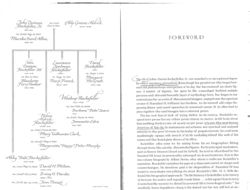
The life of John Davison Rockefeller, Sr., was marked to an exceptional degree
FerryHooker
by silence, mystery, and evasion. Even though he presided over the largest busi-
010-1997
1915-1996
1909-1992
ness and philan thropic enterprises of his day, he has remained an elusive fig-
ure. A master of disguises, he spent his life camouflaged behind multiple
Winthrop Rockefeller
personae and shrouded beneath layers of mythology. Hence, he lingers in our
national psyche as a series of disconnected images, ranging from the rapacious
1912-1973
creator of Standard Oil, brilliant but bloodless, to the wizened old codger dis-
m.(1st) Feb.14,1948
pensing dimes and canned speeches for newsreel cameras. It is often hard to
Barbara "Bobo". Sears
piece together the varied images into a coherent picture.
Nelson
1916-
This has not been for lack of trying. Earlier in the century, Rockefeller in-
Aldrich
m. (2nd) June 11,1956
Rockefeller
Jeannette Edris
spired more prose than any other private citizen in America, with books about
him tumbling forth at arate of nearly one per year. Ashewas the most famous
1918-1997
1908-1979
American of his day, his statements and actions were reported and analyzed
m. (1st) June 23, 1930
minutely in the press. Yet even in his heyday of popular interest, he could seem
Mary Todhunter Clark
maddeningly opaque, with much of his life unfolding behind the walls of his
1907-
estates and the frosted-glass doors of his office.
m. (2nd) may 4, 1963
Rockefeller often seems to be missing from his own biographies, flitting
Margaretta "Happy" "FitlerMurphy
through them like ghostly, disembodied figure. For the principal muckrakers,
1926-
such as Henry Demarest Lloyd and Ida Tarbell, he served as shorthand for the
Abby "Babs"Rockefeller-
Standard Oil trust, his personality submerged in its machinations. Even in the
two-volume biography by Allan Nevins, who strove to vindicate Rockefeller's
1903-1976
reputation. Rockefeller vanishes for pages at a time amid a swirl of charges and
m.(1st) may 14, 1925 David H. Milton
countercharges. The attention paid to the depredátions of Standard Oil has
1900-1976
tended to overshadow everything else about Rockefeller's life. H. G. Wells de-
m.
(2nd) Oct.3,1946 Irving H. Pardee
fended this biographical approach: "The life history of Rockefeller is the history
1892-1949
of the trust; he made it, and equally it made him so that apart from its story
m. (3rd) Apr. 23,1953 Jean Mauzé
it seems hardly necessary to detail his personal life in chron ol logical order." So
1903-1974
A.Karl/.T Kemp
steadfastly have biographers clung to this dated view that we still lack an ac-
182 49 Titan
drews loudly cried foul, Rockefeller sent an emissary to tell Andrews that he
could buy back his stock at the original sale price. Embittered, Andrews
spurned this fair offer and opted to keep the moncy. Had he kept the stock, it
CHAPTE R 1
1
39
would have been worth $900 million by the early 19 930s, by one estimate.
This rash decision, motivated by pure pique and a bruised ego, kept him from
The Holy Family
becoming one of America's richest men.
Irate at Andrews's behavior, Rockefeller lost whatever residual gratitude
he felt for his founding partner and ridiculed his business abilities. Whenever
he feuded with someone, he tended to turn that person into a reprobate, and he
later said of Andrews, "He was ignorant. conceited, lost his head
governed
by the same wicked sort of prejudice accompanying the egotism SO character-
istic of that type of ignorant Englishman. "40 It was one of many times that
Rockefeller singled out the English for special abuse. As for Andrews, he not
only squandered a chance to make a colossal fortune but later poured the
money into an ugly, ornate house on Euclid Avenue where he dreamed of
someday entertaining Queen Victoria. Once described as "the most pretentious
residence ever built in Cleveland," this five-story monstrosity, with one hun-
dred rooms and as many servants, won the well-deserved nickname of "An-
drews's Folly. "41 For the rest of his life, Andrews lambasted Rockefeller in
t a time when America's brand-new millionaires reveled in garish
long-winded diatribes to anyone who would listen. Maurice Clark probably
A
houses that paid queer homage to everything from medieval ro-
caught the truth about Sam Andrews when he said, "Before selling he was sore
mance to the Arabian Nights, Rockefeller preferred to own raw
at John. After selling he was sore at himself. "42 Standard Oil was never kind to
land. In 1873, he invested in seventy-nine scenic acres at Forest
skeptics who doubted its bright future.
Hill, a lovely, thickly wooded spot, crisscrossed by steep ravines and gulleys, just
four miles east of his Euclid Avenue home. Two years later, he assembled a
team of investors who bought the land from him to construct a sanatorium
that would specialize in homeopathic medicine and water cures. As part of the
deal, Rockefeller and Stephen Harkness set up a short railroad to whisk people
out to this suburban resort. When both ventures fell victim to the depression of
the 1870s, Rockefeller repurchased the land, now crowned with an enormous
rambling building. Starting in 1877, he began to use it as a summer home, per-
haps with some therapeutic intention in mind, for the previous year doctors
had diagnosed Cettie as consumptive. At the doctors' urging, Rockefeller and
his family vacationed in the dry, fresh air of Colorado in the summer of 1876.
Perhaps he believed his wife would find relief from the lake breezes at Forest
Hill.
Eager to expose Rockefeller as a tasteless vulgarian, Ida Tarbell mocked the
Forest Hill house as "a monument of cheap ugliness," and other satirical crit-
ics rushed to pile on equally insulting epithets. 1 This much-maligned house
was, in fact, John D.'s favorite hideaway. "Oh, I like Forest Hill much better than
any
other
home!"
he proclaimed. 2 It enjoyed an excellent location, standing on
the brow of a sharply sloping hill, with wonderful views of Lake Erie: it re-
minded Rockefeller of his boyhood home in Moravia, poised above Owasco
184 sel Titan
Lake. This ungainly Victorian confection was a wilderness of porches Rockefeller and
turrets and bay windows, covered with gingerbread detail. of
gables, loved the large, spacious rooms with their unobstructed views. Fond house light
and air, he stripped away the curtains and wall hangings and flooded the in-
with sunshine, adding a glassed-in porch. He even had a huge pipe organ
stalled in one parlor.
Those who accurately faulted Rockefeller's taste missed a deeper point, how-
At a time when moguls vied to impress people with their possessions, tro-
ever: Rockefeller preferred comfort to refinement. His house was bare of hunting
phies, shelves of richly bound but unread books, or other signs of conspicuous to awe
consumption. Rockefeller molded his house for his own use, not good
As he wrote of the Forest Hill fireplaces in 1877: "I have will seen warrant a
strangers. many fireplaces here [and] don't think the character of our rooms of thing that we
into the expenditures for fancy tiling and all that sort
going find in some of the extravagant houses here. What we want is a sensible, plain
arrangement in keeping with our rooms."
It took time for the family to adjust to Forest Hill. The house had been built as
hotel, and it showed: It had an office to the left of the front door, a cubicle- dining
a with small tables straight ahead, upstairs corridors lined with deco-
room sized rooms, and porches wrapped around each floor. The verandas, also this
rated in resort style, were cluttered with bamboo furniture. It was perhaps club
arrangement that tempted John and Cettie to run Forest Hill as a paying of 1877.
for friends, and they got a dozen to come and stay during the summer As
This venture proved no less of a debacle than the proposed sanatorium. host-
"club guests," many visitors expected Cettie to function as their unlikely and were
Some didn't know they were in a commercial establishment
ess. shocked upon returning home to receive bills for their stay. The Rockefeller eating
children were no less bemused and disoriented as they found themselves After
Laura Spelman Rockefeller, who seldom wore
in big dining room, attended by a troop of gentlemanly black waiters. and a
anything fan cier than this dress.
a Rockefeller scrapped this misbegotten venture, fired the waiters, and
(Courtesy of the Rockefeller Archive Center)
year, began to convert the large warren of tiny upstairs rooms into suites mas-
ter bedrooms.
1877 to 1883, the Rockefellers retained the Euclid Avenue house the as
their From primary residence while spending summers at Forest Hill. Gradually, than seven
at Forest Hill lengthened. the estate itself expanding to more
stays hundred acres and the number of employees eventually rising to as high Eu- as
136. After a time, the family spent only brief spring and autumn stints at cold
Avenue. They still went there every Sunday, however, bringing in Church. a
clid lunch from Forest Hill when they attended the Euclid Avenue Baptist Forest
After late 1883. when the Rockefellers moved to New York. they turned
Hill into their exclusive Cleveland residence but never renounced a sentimental repair,
Avenue. They kept the old house in constant
The Holy Family
187
186 34 Titan
always ready to receive family members. even though they never went there
From the start he wasn't made of his father's indestructible stuff. On Janu-
and it slowly lapsed into an honored, deserted monument to bygone days.
ary 29, 1874, in an unusual moment of tearful joy, Rockefeller arrived at the
Plans to turn it into a convalescent home for crippled children or aged couples
Standard Oil office and informed Henry Flagler and Oliver Payne that Cettie
never materialized. "It seemed too sacred for common use, we all loved it so,"
had given birth to their first son. Dr. Myra Herrick delivered the infant in an up-
stairs bedroom at Euclid Avenue while Rockefeller waited expectantly across
Cettie later said.4
Despite its considerable distance from his office, Rockefeller, clad in goggles
the hall. "How glad all were that the baby was a boy-for there had been four
and duster, drove downtown each morning from Forest Hill, seated in a little
girls-and that he was perfectly formed," Cettie wrote.6 She always associated
two-seat surrey behind a pair of fast-trotting horses. He was still passionate
the birth of Junior-as he was known to distinguish him from John Senior-
about trotting horses and now had a dozen of them. He constructed his own
with the launch of the Women's Christian Temperance Union in Ohio. As
a
half-mile racetrack at Forest Hill, shaded by maples planted by his son, and
founding member, she had planned to aid her evangelical sisters with rousing
bought Welsh and Shetland ponies for each child. By the mid-1870s, he often
prayers and biblical hymns in local saloons, and, as she later told Junior, "I
returned home from the office for lunch then spent the rest of the afternoon en
might have joined them, if a wee baby boy had not claimed me. She fired him
famille in a constant flurry of outdoor activity. He dammed a stream to make
with that same crusading, Christian spirit and horror of liquor.
two artificial lakes, one for boating, the other for swimming, and on sultry days
The baby boy was small and sickly, lacking his ather's robust energy and re-
often swam the mile-long circuit. a straw hat perched on his head to guard his
flecting his mother's more delicate constitution; for three years, his parents
fair skin from the sun. After becoming a biking enthusiast, he smoothed out
worried about his health. He had a cloistered childhood, insulated from a world
many dangerously curving paths and rewarded visitors who learned to ride
that might contaminate his values. In later years, he could recall only a single
with free bikes. He took unusual delight in ice skating and frequently as many
male playmate from these early years, Harry Moore, the son of the Forest Hill
as fifty people-many of them strangers from the neighborhood-skate on
housekeeper. "I had a camera and he and I took pictures and played together
the Rockefeller pond on a frosty day. Since he wouldn't allow the pond to be
constantly."8 Nevertheless. Junior found loases of enchantment on the estate
flooded on the Sabbath, Rockefeller sometimes rose after midnight on a freezing
and later cherished idyllic memories of summer afternoons spent rowing,
Sunday night to direct the workmen in preparing for the next day's skating.
swimming, and hiking. As they read aloud to one another, Junior and his sis-
Though he lacked interest in the homely interior of Forest Hill, Rockefeller
ters often lolled on a great beech tree whose limbs dipped over a creek. Even
if
spent hours daily out on the grounds. A tall, angular figure striding about and
his recollections sound highly idealized. with the shadows expunged, his boy-
surveying the property, he planned new vistas, gravel paths, gardens. barns,
hood letters are suffused with the warm glow of a protected childhood, secure
and carriage houses. He created a fair-sized farm with sixteen COWS and thou-
in the love of his doting parents. Perhaps Junior's boyhood wasn't quite as
sands of chickens. Serving as his own engineer and following the natural
lonesone as it seems from afar. Many decades later, his childhood friend Kate
grades, Rockefeller laid out twenty miles of roadway for horse and buggy rides
Strong reminisced to him, "You were quite the nicest boy that ever was in those
through stands of aspen, beech, oak, and maple trees. Supervising fifty or sixty
days, SO all your friends thought
affectionate, considerate, thoughtful and
workmen, he developed a limestone quarry on the property to service his
full of fun as well as wise almost beyond your years. Junior was always
grandiose projects and adorned the roads with picturesque bridges over did
bathed in female love, almost suffocated by it.
streams. To secure striking vistas, he also began to relocate large trees and
Just as Standard Oil workers never remembered a cross word from John Se-
this SO expertly that they weren't damaged in transition. This constant re-
nior, SO Junior couldn't cite a single instance of paternal anger. His father was
arrangement of his domain was more than just a matter of framing pretty
patient and encouraging, if notably stingy with praise. As Junior said, his
views or beautifying a patch of garden. It was Rockefeller's typical way of re-
father was a "beloved companion. He had a genius with children. He never told
making his own miniature universe and working out some vast, never-ending
us what to do or not to do. He was one with us. "10 In contrast to Big Bill's nar-
cissism. John D. had an overdeveloped sense of family responsibility. John and
design.
For the Rockefeller children, life at Forest Hill could seem melancholy as they
Cettie never administered corporal punishment, and they inculcated moral
drifted alone about the huge estate, cut off from worldly temptation by their
principles by instruction and example. Each child was taught to listen to his or
parents. This mood of solitary yearning especially afflicted John Jr., who was ill-
her conscience as a severely infallible guide.
tutored at home until age ten and later described his boyhood self as "shy,
For this boy destined to be the world's greatest heir, money was SO om-
nipresent as to be invisible-something "there, like air or food or any other ele-
188
Titan
The Holy Family
189
ment." he later said-yet it was never easily attainable. 11 As if he were a
poor,
bered Alta as "mischievous, impulsive, the ringleader of the trio," while Edith
rural boy, he earned pocket change by mending vases and broken fountain
was "scrutinizing, calculating," if high-spirited. 18 Because the girls got less at-
pens or by sharpening pencils. Aware of the rich children spoiled by their par-
tention than their brother did, they probably had more freedom to rebel and ex-
ents, Senior seized every opportunity to teach his son the value of money.
plore. As Alta once teased him, "We girls often though John should have been
Once, while Rockefeller was being shaved at Forest Hill. Junior entered with a
a
girl and we the boys of the family. 19 Despite his sex, Junior ended up as his
plan to give away his Sunday-school money in one lumpsum, for a fixed period,
mother's favorite because he was surely the most like her-obedient, crucified
and be done with it. "Let's figure it out first," Rockefeller advised and made Ju-
by duty, and almost too eager to please. The model child would struggle to be-
nior run through calculations that showed he would lose eleven cents interest
come the model adult, with often painful consequences.
while the Sunday school gained nothing in return. Afterward. Rockefeller told
his barber. "I don't about the boy giving his money in that way. I want him
to give it. But I also want him to learn the lesson of being careful of the little
Soon after the Rockefellers had moved to 424 Euclid Avenue, they were fol-
things."
lowed by the Erie Street Baptist Mission Church-soon renamed the Euclid Av-
When Rockefeller was complimented upon his son. he protested truthfully,
enue Baptist Church-thestruggling church that had exerted such a formative
"It was his mother who developed him. "13 Cettie brought up her children in her
influence upon Rockefeller's life. As far as fashion or convenience went, it
own ascetic style and tutored them in the rites of self-abnegation. She imag-
would have behooved the Rockefellers to attend the nearby Saint Paul's Episco-
ined that she presided with a light touch and had no idea that she could be
pal Church. where elegant couples stepped from tony carriages each Sunday
quite overbearing. As she remarked. "I never like to interfere with the children
morning. Instead, they drove back down Euclid Avenue to a plain brownstone
SO long as they make happy noises." A sweet, good-natured woman, Cettie
church with a tall, narrow steeple and a lower-middle-class congregation. As
nevertheless had a strong didactic side that could verge on fanaticism. As she
Junior said. "There weren't half a dozen families that were not of limited
once confessed to a neighbor, "I am SO glad my son has told me what he wants
means. Rockefeller felt no discomfort at being surrounded by humble people
for Christmas, SO now it can be denied him. "15 Dutiful, eager to please
his
and valued this continuity with his roots. He needed the spiritual refreshment
mother. Junior absorbed the full force of her piety. "How good God is to have
of the plain but emotional Baptist style of prayer and probably also wanted to
added to our lovely daughters our only son." Cettie later wrote. "Though the
show that he wasn't being spoiled by wealth.
youngest, he is the strongest in courage, independence and Christian charac-
The Euclid Avenue Baptist Church was celebrated as the Rockefeller church
ter." She hemmed him in with numerous prohibitions. He was told that
and with good reason: By the early 1880s, he was covering half its annual bud-
square dancing was promiscuous and immoral, and by age ten this little
get, even pledging weekly money from his children and stipulating that "the 20
paragon had to sign a solemn oath that he would abstain from "tobacco, pro-
cents from each child will be earned by the sweat of their brows, pulling weeds,
fanity, and the drinking of any intoxicating beverages." "17
Mother wasn't the
etc. "21 Avoiding clubs, theaters, and other such wicked haunts, Rockefeller was
only earnest female drumming him full of morality: Grandma Spelman also
seen publicly only at church, a fixture in his ninth-row pew, his presence gen-
badgered him to attend children's temperance meetings. Thus, an extraordi-
erating a growing army of oglers: curiosity seekers, feature writers, panhan-
nary contradiction lay at the core of Junior's life: While his father was being re-
dlers, and idlers. He loved the bold, joyous, militant spirit of the Baptists and
buked publicly as a corporate criminal, his mother was pumping him brimful of
contributed open handedly to their local charities. His foremost beneficiaries in-
morality and religion. Like his father, Junior developed an upside-down world-
cluded the celebrated one-armed "Brother" D. Jones, who proselytized from a
view in which the righteous Rockefeller household was always under attack by
derelict barge moored to a Cleveland dock; the Ragged School, which taught
a godless, uncomprehending world.
the Bible and trade skills to vagabond teenagers; and the Cleveland Bethel
With three older sisters, John grew up in largely female surroundings as a
Union, which preached temperance and Christianity to hard-drinking sailors
delicate boy spared the rough play and teasing of brothers. He was feminized
and where Rockefeller himself often stopped by at lunchtime to mingle anony-
by the experience, wearing his sisters' cast-off dresses, learning to sew and
mously with the seamen.
knit. and even attending cooking classes, as if he might someday have to keep
Religion was a form of sustenance for Rockefeller, a necessary complement
house and prepare his own sandwiches. Eight years older than Junior, Bessie
to his buttoned-up business life. Praising the ministry's role, he once said he
was warmly attentive to her brother but inhabited a different world. and he
needed "good preaching to wind me up, like an old clock, once or twice every
grew up with the wilder and more willful Alta and Edith. One visitor remem-
week."22 His life records no crises of faith, no agonizing skepticism toward the
624 Titan
Dynastic Succession x 625
ond only to William Henry Gates III, with $40 billion. among the billionaires
decided that 13 West Fifty-fourth Street could not accommodate this growing
listed by Forbes magazine in its 1997 ranking of the richest Americans.11) Be-
tribe, and in 1911 they bought the property at 10 West Fifty-fourth Street.
tween 1917 and 1922. he gave away another $200 million to charity and
Having finished with Kykuit, William Welles Bosworth-the landscape archi-
$475 million to his children, with almost all of the latter going to Junior. A pro-
tect whom John senior found SO infuriatingly extravagant-constructed a
found dichotomy now opened in the Rockefeller family between the dutiful son
nine-story mansion for the younger Rockefellers that resembled a miniature
and the wayward daughters and sons-in-law-a dichotomy SO deep that the
city. Lavishly appointed with a rooftop squash court and playground, an art
world would think of Junior's descendants alone as the real Rockefellers. (Of
gallery, a music room, two drawing rooms, and an infirmary, it was one of New
course, they also had the Rockefeller name.) By keeping the fortune in one
York's largest private residences. The family occupied the new domicile begin-
compact mass, Rockefeller enabled his son to magnify its impact. The poor little
ning in September 1913.
rich boy was now the planet's foremost heir. Within the space of five years. Ju-
To escape the sultry Manhattan summers. Junior and Abby began to spend
nior's net worth soared from $20 million to about $500 million-more than
summers on Mount Desert Island in Maine in 1908. A favorite getaway of the
the $447 million that his father had given to the Rockefeller Institute, the Gen-
rich since the 1880s, it was now colonized by several Rockefeller intimates, in-
eral Education Board. the Rockefeller Foundation. and the Laura Spelman
cluding Charles Eliot, Simon Flexner, and Christian Herter. John and Abby
Rockefeller Memorial combined-and equivalent to $4.4 billion today. Thus,
were SO enchanted by the island's rocky, rugged beauty that in 1910 they
for all their public-spirited generosity. the Rockefellers still retained control over
bought a hilltop house called the Eyrie in Seal Harbor on the quieter southern
a great deal of the fortune, though much of it would be distributed to deserv-
side of the island. Set on a granite bluff overlooking the harbor, the Eyrie was a
ing parties over time. After disbursing SO much, Rockefeller left himself with
heavily gabled, Tudor-style cottage in the same sense that Newport mansions
pocket change-somewhere in the neighborhood of twenty to twenty-five
were cottages-that is, it was a colossal affair. Starting with the original 65
million dollars-for playing the stock market.
rooms, Junior expanded the place to palatial scope until it contained 107
In 1917. Rockefeller formed special trusts at the Equitable Trust for Alta and
rooms, 44 fireplaces, 22 bathrooms, and 2,280 windows.
Edith, depositing twelve million dollars apiece in their accounts 140 million
When Junior and Abby first visited Mount Desert Island, it was a pristine
apiece today) and terminating their allowances. This money, if more than
place that still banned autos, and they could explore any number of wild, un-
enough to make them comfortable for life, seemed a bagatelle beside Junior's
spoiled places on foot or horseback. Junior took special delight in constructing
cache. In defending this blatant imbalance, Junior later argued that his father
carriage roads on his property. During these Maine summers, he developed a
had favored him because he could "carry on his philanthropic and charitable
special feeling for wilderness, which inspired in him feelings of religious awe
work in the same spirit which had activated him, and
anything he gave me
and perhaps memories of the lakes and ravines of his Forest Hill boyhood. For
would be administered with the same sense of duty and stewardship which im-
a man sorely taxed by responsibility, these solitary haunts refreshed an over-
pelled his giving. "12 In a way that would have been impossible for Alta and
burdened mind.
Edith, Junior adopted his father's principles and functioned as his surrogate.
In 1916, President Wilson created the Sieur de Monts National Monument
Rockefeller told his son. "What a providence that your life should have been
on the island, which became Lafayette National Park in 1919-the first na-
spared to take up the responsibilities as I lay them down!" Rockefeller was
in-
tional park created in the East-and then was ren amed Acadia National Park
creasingly buoyed by the admiration of this son who viewed him as a heroic fig-
in 1929. To serve the cause of conservation, Junior not only donated thou-
ure in business and philanthropy. As he told Inglis, "I really think I could not
sands of wilderness acres to the park but personally charted fifty-seven miles of
have had SO good and true a son as he is if I had been half SO bad as the preju-
auto-free carriage roads (engineers calculated the grades), studded with
diced and interested 'historian' [Tarbell] would seek to make me out.' 11 For
charming stone bridges and gatehouses that blended seamlessly into the
Rockefeller, only a good tree brought forth good fruit, and Junior's virtue was
scenery. From his father. he had learned the art of opening vistas and making
therefore incontrovertible proof of his own.
the roads as unobtrusive as possible. While some environmental purists faulted
Junior for tampering with nature, he had democratic vision of how the parks
might be of use to ordinary people. Whereas he often seemed wearily dutiful at
By the time that Junior inherited his golden treasury, he and Abby had brought
philanthropic board meetings, he showed an undisguised zest for scenic preser-
forth a large, energetic family of six children. having added Laurance (1910),
vation. It was an early sign of what became a continuing interest: preserving
Winthrop (1912). and David (1915). After Laurance's birth. Junior and Abby
ancient beauty from the encroachments of modern life. At the same time. he
6
Titan
Dynastic Succession
627
ed, whenever possible, to retreat from the chaos of modern urban life into
easy; people become self-indulgent and selfish and cruel. 21
Abby
once
told
e peace and dignity of an uncorrupted rural past.
Nelson, "I am sure that too much money makes people stupid, dull, unseeing
and
uninteresting. Be careful. 22 During World War Abby directed five hun-
dred workers of the Red Cross auxiliary that operated out of 4 West Fifty-
by Aldrich Rockefeller, unlike her husband, was attuned to the modern, the
fourth Street, which Senior had obligingly vacated to aid the war effort. She
ring, and the spontaneous. "Mother would love to have an idea and say,
stationed her white-uniformed children in the basement to roll bandages and
et's go do it,'" said her son David. "She enjoyed the unexpected very much."
had them tend victory gardens at Pocantico.
e could be satirical or flippant and admired the saucy young flappers of the
In running their various households, Abby oftenchafed at Junior's niggardly
20s. "I love to see the old hypocrisies being shattered," she said. 16 Never fear-
style but submitted for the sake of marital harmony. She waited until the Janu-
or inhibited, she was pleased by impulsive behavior and once said of her
ary white sales to buy new linen, and when the children went off to school, she
andchildren, "I love even their naughtiness, their funny wants and their
had to telephone them clandestinely from the bathroom. since her husband
ots to get them, which I can see lurking in their minds."17 Such an attitude
considered these calls superfluous luxuries. One son obser pointedly, "His
rplexed Junior, who was irritated by the high jinks of small children.
calls were business and therefore justifiable, hers were personal, and possibly
Though she adhered to her father's economic conservatism, Abby helped to
frivolous.
oaden the political spectrum for the Rockefeller family. She was a liberal Re-
If John junior and Abby had a marriage of passionate intensity, it was be-
blican who supported Planned Parenthood, the United Jewish Appeal, and
cause his buttoned-down life required one great release. He beamed in her
e League of Nations. After the Ludlow Massacre, to improve labor relations,
presence, could not take his eyes off her. "I never knew a man more completely
e contributed up to a third of the annual budget of the National Women's
attached to the woman he married," said Tom Pyle, the game warden at Pocan-
ade Union League. In the 1920s, she also teamed up with Standard Oil of
tico. "When they were grandparents, in the latter quarter of their lives, he
ew Jersey to create a community center. the Bayway Community Cottage, for
still treated her with the adoration and devotion of a young lover."24 Many peo-
finery workers in Elizabeth. New Jersey, and frequently stopped by its baby
ple found something unhealthy about his constant need for her, which
one
nic. After one trip. she told her daughter Babs, "I held twenty-five naked,
daughter-in-law later said "seemed almost primitive and uncontrollable."
firming babies today in our new baby clinic at some of them took
Even when traveling, Junior hovered over her with proprietary air, refusing to
e occasion to drench me thoroughly. Most of them were fat, rosy, and cheer-
share her company with others. Once when they were away, Abby wrote to a
I. but once in a while they all began to howl at once. I had a wonderful
son, "Your father is afraid that I shall become intimate with too many people
ne. "18 She was the major benefactor of the Grace Dodge Hotel in Washing-
and will want to talk to them, SO generally we eat in what I call the old people's
n. D.C., a 350-room hotel for professional women operated by the YWCA and
dining room where he feels I am safer."26
affed entirely by women, down to the bellhops and elevator operators.
Even at home, Junior tried to monopolize Abby, and he cast a jealous eye on
Abby was vocal in her passion for social justice, and this had a lasting influ-
his six children as potential competitors for her time. Always warm and nat-
ce on her descendants. While staying with Senior at Ormond Beach in 1923,
ural with the children, Abby did not abandon their upbringi to servants and
e wrote a letter to her three oldest sons that throbbed with outrage at dis-
governesses. She played cards with them, read to them, took afternoon tea with
imination. "It is to the everlasting disgrace of the United States that horrible
them, and tucked them into bed at night. A convivial married to a profes-
chings and brutal race riots frequently occur in our midst. The social os-
sional homebody, she followed the example of countless other women in her
cism of the Jews is less barbaric, but
causes cruel injustice.
I long to
position and tried to shape her sons model husbands, devoid of the faults
ve our family stand firmly for what is best and highest in life. 19 Though Ju-
of her own husband. Junior, perhaps subconsciously, saw her attention to the
or subscribed to many of Abby's views, he was guided more by abstract codes
children as time stolen from him, and this could make him seem to be a
conduct than visceral sympathy with the oppressed.
grouchy, schoolmasterish father. "We grew up realizing that we had to com-
Abby made sure that her children did not flaunt their wealth, and she turned
pete with Father for her time and attention," his son David said. expected
wn one son who wanted extra travel money in college by telling him. "The
her to be available when he needed her and his needs seemed insatiable."2"
ys who cannot afford to go away will feel restless and envious."4 Constantly
Whatever its drawbacks. it was generally a happy marriage. While they
gilant against the disfiguring effects of wealth, she lectured Laurance when
would have bruising quarrels over modern art, they were devoted to each other
was only thirteen on the perils of having too much money: "It makes life too
and shared many pleasures, including theater. concerts. and film as well
676 66 Titan
He had extracted mixed messages from his religious training as well as from his
incongruously matched parents. Not surprisingly, he had served as an emblem
of both corporate greed and philanthropic enlightenment.
Starting in the 1870s, Rockefeller's stewardship of Standard Oil had sig-
naled a new era in American life that had both inspired and alarmed the popu-
ACKNOWLEDGMENTS
lace. His unequaled brilliance and rapacity as a businessman had squarely
confronted the country with troubling questions about the shape of the econ-
omy. the distribution of wealth, and the proper relationship between business
and government. Rockefeller perfected a monopoly that indisputably demon-
strated the efficiency of large-scale business. In creating new corporate forms,
he charted the way for the modern multinational corporations that came to
dominate economic life in the twentieth century. But in SO doing he also ex-
posed the manifold abuses that could accompany untrammeled economic
power, especially in the threat to elected government. As architect of the first
great industrial trust, he proved the ultimately fragile nature of free markets,
It has taken the kindness of many strangers to explore the labyrinth of materials
forcing the government to specify the rules that would ensure competition and
now available on John D. Rockefeller, Sr.
fair play in the future.
Because Rockefeller died in 1937, there are few people today who can provide in-
The fiercest robber baron had turned out to be the foremost philanthropist.
formation from either firsthand experience or hearsay, which made me especially
Rockefeller accelerated the shift from the personal, ad hoc charity that had tra-
grateful to the family members who spoke with me. David Rockefeller not only sat
ditionally been the province of the rich to something both more powerful and
for an interview but graciously offered a sneak preview of the chapter on his
more impersonal. He established the promotion of knowledge, especially scien-
grandfather in his for thcoming memoir. Other descend ants of figures discussed in
tific knowledge, as a task no less important than giving alms to the poor or
this book-including Nelson Aldrich, Jr., Elizabeth de Cuevas. John de Cuevas,
building schools, hospitals, and museums. He showed the value of expert opin-
James T. Flexner, Abby O'Neill, Spelman Prentice, Ann Rockefeller Roberts J. Still-
ion, thorough planning, and competent administration in nonprofit work, set-
man Rockefeller, and O. Stillman Rockefeller-added shading and nuance to many
ting a benchmark for professiona in the emerging foundation field. By the
events. Peter Johnson, the resident historian at the Rockefeller family office, reacted
to all of my requests for information in a fine. collegial spirit.
time Rockefeller died, in fact, SO much good had unexpectedly flowered from SO
My foremost debt is to the staff of the Rockefeller Archive Center, which is situ-
much evil that God might even have greeted him on the other side, as the titan
ated on the family estate in Sleepy Hollow (formerly North Tarrytown) but is oper-
had SO confidently expected all along.
ated by a team of professional archivists under the very able direction of Darwin
Although Junior moved into Kykuit after Rockefeller's death, he knew that
Stapleton. The center, first opened to researchers 1975, is a division of the Rocke-
his father was inimitable, and SO he decided to retain the Jr. after his name. As
feller University. I am especially grateful to Tom Rosenbaum, who expertly guided
he was often heard to say in later years, "There was only one John D. Rocke-
me through the vast trove of documents and mulating things to say about SO
feller."26
many of them. His help was invaluable and always graciously rendered. Ken Rose
was especially adept when it came to Cleveland history, while Valerie Komor wasin-
dispensable in elucidating the mystery of Charles and Bessie Strong. Michele Hiltzik
and Robert Battaly did yeoman's work in helping me with the photos. I salute the
professionalism of the entire staff and the exemplary work it performs each year for
so many scholars.
Among other Samaritans who supplied aid and comfort, I would like to single
out Jean Ashton and the staff of the Rare Book and ManuscriptLibrary at Colum-
bia University, which houses the voluminous collection of Rockefeller material in
the Allan Nevins papers; Meredith Nevins Mayer, who permitted me to quote from
her father's papers; Ronald Grele and the Columbia University Oral History Project;
Barbara T. Zolli, Beth Davidson, and the staff of the Drake Well Museum in Ti-
678 Acknowledgments
Acknowledgments x 679
tusville, Pennsylvania, which contains Ida Tarbell's extensive files on Standard Oil:
The generous Deirdre Bair, now working on a biography of Carl Jung, gave me a
Caroline Tarbell Tupper, who gave permission to quote from the papers of her
road map of Jung scholars who might be of assistance in unearthing the story of
grandaunt Ida Tarbell; Harold Miller and the staff of the State Historical Society of
Edith and Harold McCormick in Switzerland. William McGuire of Princeton Uni-
Wisconsin, which made available the papers of Henry Demarest Lloyd by inter-
versity, the editor of Jung's Collected Works, dipped into his formidable database on
library loan: John Grabowski and the staff of the Western Reserve Historical Soci-
several occasions and came up with splendid discoveries. James Hillman. formerly
ety in Cleveland; William Massa, Jr., of the Manuscripts and Archives Collection at
the director of the Jung Center in Zurich, introduced me to the hilarious memoir of
the Yale University Library, who tracked down some critical letters; Daniel Meyer
Edith's chauffeur, Emile Ammann.
and the Department of Special Collections at the University of Chicago Library: and
James A. Smith and Kathleen McCarthy helped to locate Rockefeller in the broad
Letitia Yeandle and Theresa Helein of the Folger Shakespeare Library in Washing-
stream of philanthropic history. Alan Brinkley provided a timely perspective on the
ton. D.C., who provided Rockefeller's correspondence with Henry Clay Folger.
often-tangled question of business corruption in American political history.
Sir David Simon, the former chairman of British Petroleum, took a special inter-
Goldstein deepened my understanding of John D. Rockefeller. Jr.'s conservation
est in this project and arranged for me to examine the original minute books of
work on Mount Desert Island. Other friends who offered welcome advice, referrals,
Standard Oil of Ohio. which was absorbed by British Petroleum in the 1970s.
stories, and suggestions include Robert Caro, Jonathan Coss, Andrew Delbanco,
Dorothy Jankowski, Barbara Rutigliano, and George Dunn served as gracious hosts
Paula Giddings, Robert C. Kochersberger, Jr., the late J. Anthony Lukas, Vincent
during my Cleveland visit. Robert Craig Brown, the chairman of the University of
McGee, John Rousmaniere, Willie Ruff, Tom Ryley, and Scott Sandage.
Toronto history department, went beyond the call of duty in showering e with in-
Both the research and writing stages of this book proved unexpectedly rich in
formation about William Lyon Mackenzie King. I enjoyed the cheerful, efficient
medical emergencies, and I would like to express special thanks to some superb
help of two delightful people at Spelman College-Tanya Sharpe, the interim direc-
physicians. Dr. Eric Rackow, chief of medicine at Saint Vincent's Hospital, and Dr.
tor of the archives, and undergraduate Darsheika Giles-who sifted through many
Jay Weinstein helped to rescue me from a nasty brush with a blood clot. They con-
unexplored files pertaining to early Rockefeller history. Dr. Deborah Dependahl Wa-
sulted closely with my brother, Dr. Bart Chernow, now a vice dean at the Johns
ters kindly escorted me on a tour of the Rockefeller rooms at the Museum of the
Hopkins Medical School. I would also like to thank Dr. Dennis Fabian of Saint Vin-
City of New York. Richard Warshauer, George Picon. and John Nesimi allowed me
cent's for operating on my knee and Dr. Jonathan Deland of the Hospital for Special
a glimpse of the old Standard Oil offices at 26 Broadway. Cynthia Altman, Carol
Surgery for operating on my foot.
Moberg, and David Lyons were knowledgeable guides on a stroll around Rockefeller
Alberto Vitale, Harold Evans, and the other Random House executives gener-
University, while Vicki Manning filled in blanks about the Judson Memorial
ously supported this project from the outset. I would like to extend special thanks to
Church. Peter Kraus of the New York Public Library provided statistical tables for
Newhouse, Jr., for his early encouragement. My editor, Ann Godoff, found time
converting figures into contemporary dollars. Jennifer Shaw extracted many inter-
in her busy schedule to combine fine, tough, old-fashioned editing with her usual
esting articles for me from local libraries. Susan Sacharski, archivist of the North-
bountiful enthusiasm. I am grateful to her assistant, Enrica Gadler, for many small
western Memorial Hospital in Chicago, and William Beatty, professor of medical
favors performed over the years. Gaby Bordwin created the outstanding cover for
bibliography emeritus at Northwestern University, counseled me in tracking down
the book, while Jim Lambert did his usual fine work on the interior design. Ben-
that phantom, Dr. Charles Johnston. Dr. Josef Jelinek and Alice DeLury provided
jamin Dreyer was the soul of patience in supervising the copyediting process.
some needed guidance on Rockefeller's alopecia.
Melanie Jackson continues to define my notion of the ideal agent. Each year, she
Three people in Lakewood-Deborah Kern, chairwoman of the Lakewood Her-
improves just when thought that she already attained perfection. My parents
itage, her husband. Jerome Kern. and Judith Robinson of the Lakewood Public
were, as usual, unstinting in both their love and supporti The single most impor-
Library-helped to re-create that colorful phase of Rockefeller's life. Laurel
nt figure in the creation of this book was my wife, Valerie, who again endured the
Auchampaugh and Ann Townsend of the Cayuga-Owasco Lakes Historical Society
prolonged periods of insanity that overtook her obsessed husband. More than just
in Moravia, New York, passed along some piquant folklore about Rockefeller's
a
lovely martyr, she was my dinner-table muse, bedtime confidante, and most per-
childhood and secretly initiated me, in a back room, into the mysteries of Joshua: A
ceptive critic. Her editorial contribution to this biography cannot be overstated, for
Man of the Finger Lakes Region. I was delighted to receive unsolicited aid from
she enabled me to find that often elusive voice-neither too sympathetic nor too
George Plimpton, a descendant of General Adelbert Ames, who rounded up back-
sharp-that would best capture the complexities of Rockefeller's character. Cha-
ground materials on a trip to Ormond Beach. Leslie Bottarelli of the Ormond Beach
peau, my dear.
Community Enrichment Center sent additional information. Jean S. Hoefer of the
Stephenson County Genealogical Society and Michael Cline of the Oakland Ceme-
tery in Freeport, Illinois, helped to unravel the mystery of Dr. William Levingston's
last days in that town.
NOTES
ABBR E VIATIONS
AN-Allan - Nevins Papers, Butler Library, Columbia University, New York, New
York
CUOH-ABF-Columbia University Oral History Collection, Abraham B. Flexner
interview
CUOH-PM-Columbia University Oral History Collection, Paul Manship inter-
view
FSL-Folger Shakespeare Library, Washington, D.C.
HDL-Henry Demarest Lloyd Papers, State Historical Society of Wisconsin, Madi-
son, Wisconsin
IMT-Ida Minerva Tarbell Papers, Pennsylvania Historical & Museum Commis-
sion, Drake Well Museum Collection, Titusville, Pennsylvania
RAC-Rockeler Archive Center, Sleepy Hollow, New York. Papers of John D.
Rockefeller, Sr., John D. Rockefeller, Jr., and other family members
RAC-CAS-Rockefeller Archive Center, Charles A. Strong Papers
RAC-FTG-Rockefeller Archive Center, Frederick T. Gates Papers
SOCMB-Standard Oil Company Minute Books, BP America, Cleveland, Ohio
UC-JDR-University of Chicago, John D. Rockefeller Papers
UC-UPP-University of Chicago, University Presidents' Papers
B = Box
F = File
FOREWORD
1. Wells, The Work, Wealth and Happiness of Mankind. p. 454.
PRELUDE: POISON TONGUE
1. RAC, Inglis interview, p. 1062.
2. Ibid., p. 916.
3. Ibid., p. 375.
Rockefeller
Alanch
WILLIAM AVERY ROCKEFELLER
LUCY TRUMAN
-
sister
Abby Truman
ABBY BURGESS
(1810-18??)
(1805-1876)
(1792-1865)
(1810-1888)
m.
m.
m.
m.
ELIZA DAVISON
FRANCIS MORGAN CHAPMAN
Duty Greene
ANAN ALDRICH
(1813-1889)
(1807-1886)
(1793-1864)
(1807-1892)
Lucy
William
Mary Ann
Franklin
Francis
Emma
Mary Willet
Thomas
Louisa
Clarence
(1845-1917)
(1845-1847)
(1829-1903)
(1835-1837)
(1842-?)
(1838-1878)
(1841-1922)
(1843-1925)
(18??-1879)
(18??-1916)
JOHN DAVISON m. LAURA SPELMAN
William F.
Dutee
ABBY
NELSON
Josephine
(1839-1937)
(1839-1915)
(1832-?)
Greene
PEARCE
m.
WILMARTH
(died at age three)
(1838-1888)
(1845-1917)
(1841-1915)
Alice
Edith
Nelson
Edward
Stuart
William
Richard
Elsie
(1869-1870)
(1872-1932)
Wilmarth, Jr.
(1871-1957)
(1876-1960)
(1881-1966)
(1884-1941)
(1888-1968)
(1867-1871)
Bessie
Alta
Lucy
Robert
Emma
Winthrop
(1871-1962)
(1869-1955)
(1866-1906)
(1878-died in infancy)
(1882-1884)
(1886-1974)
John Davison, Jv.
m.
(1874-1960)
AbbyGreene
(1874-1948)
ABBY (BABS)
JOHN DAVISON III
NELSON
LAURANCE
WINTHROP
DAVID
(1903-1976)
(1906-1978)
(1908-1979)
(1910-
)
(1912-1973)
(1915- )
m.
m. (1st)
(2nd)
m.
m.
m.
m.
(1st)
(2nd)
Blanchette
Mary Clark
Margueretta
Mary French
(1st)
(2nd)
Margaret McGrath
David
Irving
Hooker
Fitler
Barbara
Jeannette
("Happy")
Laura
Milton
Pardee
Sears
Edris
David
Sandra
Rodman
Marion
Abby
(3rd)
John
Ann
Lucy
Neva
Jean
Davison IV
Steven
Laurance
Winthrop
Mauze
Peggy
Abby
Hope
Michael
Mark
Richard
Marilyn
Alida
Mary
Nelson
Eileen
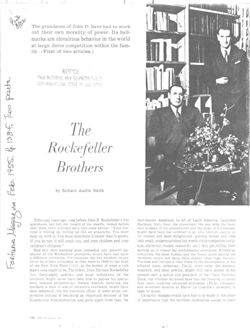
marks are chivalrous behavior in the world
at large, fierce competition within the fam-
ily. (First of two articles.)
NOTICE
THIS MATERIAL MAY SE
COPYRIGHT LAW MTFLE 17 U.S. 0000
The
Rockefeller
Brothers
by Richard Austin Smith
Fifty-odd years ago, long before John D. Rockefeller's five
best-known American in all of Latin America. Laurance
grandsons had felt the weight of his wealth, indeed before
Spelman, forty-four, the shrewdest. the one with the busi-
they were born, a friend gave him some advice: "Your for-
ness acumen of his grandfather and the looks of his mother.
tune is rolling up, rolling up like an avalanche. You must
might have been too confined to go into venture capital at
keep up with it. You must distribute it faster than it grows.
its riskiest and most enlightened putting money and time
If you do not, it will crush you, and your children and your
into small, undernourished but worth-while companies (avia-
children's children."
tion, electronic, rocket, research) until they get rolling, then
Had this chill warning gone unheeded. any present ap-
moving on to repeat the performance elsewhere. Winthrop,
praisal of the Rockefeller grandsons would have had quite
forty-two, the most human and the freest spirit among the
a different coloration. For example, the five brothers might
brothers. would not likely have shaken loose from Socony-
never have been acclaimed, as they were in 1949 by the head
Vacuum and become a vital force in the development of his
of the New York State C.I.O., as the models of what a rich
adopted state, Arkansas. David, thirty-nine, the keenest.
man's sons ought to be. The eldest, John Davison Rockefeller
steadiest, and most precise, might still have landed in his
3rd, forty-eight, gentlest and most withdrawn of the
present spot. a senior vice president of the Chase National
brothers, might never have been free to pursue his special
Bank, but whether he would have had the freedom to spend
bent. venture philanthropy. Nelson Aldrich, forty-six, the
four years studying advanced economics (Ph.D., Chicago )
quickest, a man of almost excessive ebullience, might have
and seventeen months as Mayor La Guardia's secretary is
been cemented into the executive offices of some great cor-
open to doubt.
poration instead of becoming an important member of the
Certainly changes would have had to be made in the order
Eisenhower Administration, and quite apart from that, the
of importance that the brothers themselves assign to their
138
FORTUNE February 1955
STARS, FIREWORKS AND BALLOONS:
Celebrations at Phelps Place
F
or nearly four hundred years, many important events of historical note have occurred at the site
where Phelps Memorial Hospital Center now stands.
Long before any building or specific name was associated with what is now hospital property, Native
Americans claimed that the stars were so bright here at night, reflected by the river, that they "brought the
light of day, even to the older stands of trees."
Tonight, as we celebrate forty years of Phelps' service to our Hudson River Valley region, the stars still
shine brightly, and it is well that we recall one or two other special occasions which also occurred
here.
O
n an early October afternoon in 1909, Abby
river. Observers said it was the most beautiful and spec-
and John D. Rockefeller, Jr. sat on the veranda
tacular exhibition seen to that time.
of Kykuit, their family home in Pocantico. As
they watched, scores of steam and sailing ships as-
Years later, Abby actively supported her husband and
sembled on the Hudson to the west. Hot air balloons
eldest son in their efforts to consolidate the Ossining
rose and hovered over the river banks. It was the begin-
and Tarrytown Hospitals at one centrally located site.
ning of the Hudson-Fulton Celebration, a full week of
After the James Foundation graciously donated the
festivities marking the tercentenary of Henry Hudson's
Phelps Place property, Abby's family contributed more
exploration of the river in
than $1 million toward
1609, as well as the cen-
construction of the new
tenary of the first use of
hospital.
steam navigation on the
But the family wanted to
river by Robert Fulton.
reasonably assure that
the new building would
By day, the Rockefellers
not obscure their view of
and their neighbors saw
the river. So, before con-
a naval procession on the
struction on the hospital
river, and decorated mo-
actually began in 1952,
tor cars paraded up the
four large red-and-white
Albany Post Road. Twenty
balloons were lofted to
horse-drawn historical
the height of the pro-
floats followed, each eighteen feet in height, depicting
posed structure and sightings were taken at Kykuit. For-
scenes from the Legend of Sleepy Hollow, Hudson's ship
tunately, those surrounding stands of older trees screened
the Half Moon, Fulton's Clermont and many other sub-
the hospital's site and no adjustments to the original
jects. In the evenings, the downtown sections of all the
construction plans were ever really needed.
villages between Irvington and Croton were brightly lit
by colored "illuminations" and forty set pieces of fire-
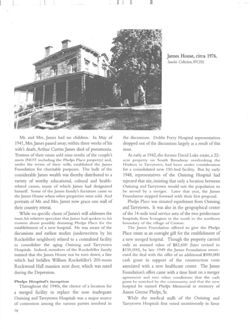
When Phelps Hospital officially opened--on Saturday,
works filled the skies. A Masked Ball was held at the
January 7, 1956--Abby's son, JDR 3rd, and her daugh-
Tarrytown Music Hall that weekend and, late into each
ter-in-law, Blanchette helped cut the ceremonial ribbon,
night, gigantic signal bonfires were set ablaze from ev-
and hundreds of red-and-white balloons once again
ery mountain top and prominence along the river.
filled the air.
All week long, the young couple could hear the boom
Abby was laid to rest in 1948, at a private burial place
of cannon shots rumbling through the valley and, at the
in Pocantico. Though she never lived to see our hospi-
nightime conclusion of the celebration, they could see a
tal built, it is easy to imagine her still, silently watching,
huge "pyrotechnics" display lofted behind Phelps Place,
like a star, over Phelps, its patients, staff and Auxilians,
filling the sky one final time with color and silhouetting
to this very day.
the James House against the intermittently reflecting
PHELPS MEMORIAL HOSPITAL CENTER
AND THE ROCKEFELLER FAMILY
A PARTNERSHIP OF THE HEART
In November of
who reside in the area of the Tarrytowns. with
1891, exactly one hun-
no named memorials to be established for
dred years ago, a small
anyone". It was anonymous generosity to the
group of public-spirited
hospital on a scale unmatched before or since.
citizens opened a single
room, 3-bed hospital in
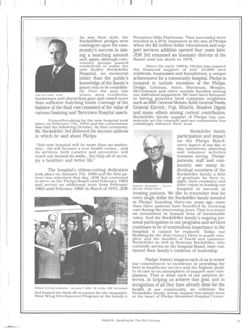
In July of 1935, JDR 3rd joined the Board
Tarrytown, New York, the
of the Tarrytown Hospital and for eight years he
first such facility just
actively participated in hospital affairs, learning
north of New York City.
much about the healthcare business. Then, in
Among the contributors
1943, he was elected Chairman of the Hospital
to the hospital that first
Board, serving for ten years in that post. Among
year were Mr. and Mrs.
numerous accomplishments during his tenure,
William Rockefeller. Two
the hospital greatly expanded its patient care
years later, Mr. and Mrs.
facilities and complement of physicians during
John D. Rockefeller, Sr.
JDR Sr. (1839 1937)
the post World War II years. But, perhaps, no
(William's brother) took possession of their estate
achievement during this period was more impor-
in nearby Pocantico Hills. Mr. Rockefeller, Sr.
tant than his father's and his advocacy of a series
made the first major gift to the fledgling hospital's
of four studies (beginning in 1929) and eventual
"new" building fund in 1908 and thus began a
plans (in 1949) to develop a new consolidated
partnership of the heart between his family and
hospital for the lower mid-Hudson region. The
the local healthcare community which has lasted
merged hospital would combine and further ex-
for four generations and continues at Phelps
pand upon the now insufficient 122 beds of the
Memorial Hospital Center today.
Tarrytown and Ossining Hospitals, adding a
modern recovery room and numerous other pa-
On July 3, 1907, John D. Rockefeller, Jr.
tient and staff conveniences.
was nominated and unanimously elected a
member of the Tarrytown Hospital Association.
In 1952, the James Foundation of New
More importantly that day, it was Abby Aldrich
York generously offered a 66 acre wooded parcel
Rockefeller (Mrs. JDR Jr.) who was proposed and
of land, the former Arthur Curtiss James estate
unanimously elected to the Board of the
known as "Phelps Place", overlooking the Hud-
Tarrytown Hospital. She went on to serve a
son River in North Tarrytown, halfway between
number of active terms guiding the early growth
the old Tarrytown and Ossining Hospitals. The
of the area's first healthcare facility. The Ossin-
property included the James House, summer
ing Hospital was also being organized a few miles
residence of the Phelps family (of Phelps-Dodge
north of Tarrytown at about this time, and the
fame). The land and the Italianate mansion on it
family established a permanent endowment fund
were valued at $100,000 and the James Founda-
there in 1918.
tion added about $500,000 more in cash to the
offer, provided that the new hospital be known as
Between 1910, when 89 patients were
Phelps Memorial and that sufficient additional
seen, and 1923 (587 patients), Mrs. JDR Jr. and
funds be raised for construction and equipment.
like-minded members of the Vanderbilt, Gould,
Newberry, Potter, Biddle and other prominent
In 1945, JDR Jr.
area families greatly expanded the facilities, mov-
had donated $200,000 to
ing the Tarrytown Hospital's location twice, and
the Tarrytown Hospital
adding a nurses' residence. Endowment, equip-
and to this amount he
ment and special purpose funds were establish-
now added $700,000,
ed and, by the early 1930s, John D. Rockefeller,
his initial pledge to the
3rd and his new bride, Blanchette Ferry Hooker,
new facility. With addi-
began their own active participation in local
tional commitments from
hospital affairs.
Mr. & Mrs. JDR 3rd, the
Rockefeller Bros. Fund,
From 1908 to 1940, the families of JDR Jr.
and other relatives, the
and his son, JDR 3rd, were the leading supporters
family's level of participa-
of the Tarrytown Hospital's growth. The condi-
tion ultimately reached
tions under which their financial contributions
$1,225,000 of Phelps'
were made were always the same: that they be
final $5,400,000 cost to
noted as "given on behalf of the family members
be built and equipped.
Mr. & Mrs. JDR Jr.
10
PHELPS Building for The 21st Century
As was their style, the
Pocantico Hills Playhouse. That successful drive
Rockefellers' pledges were
resulted in a 20% expansion in the size of Phelps
contingent upon the com-
when the $2 million dollar educational and sup-
munity's success in rais-
port services addition opened four years later.
ing a matching amount
JDR 3rd remained an honorary director of the
and, again, although com-
Board until his death in 1978.
munity groups passed
resolutions to name the
Since the early 1980s, Phelps has enjoyed
new facility Rockefeller
the financial support of over 10,000 area
Hospital, no memorial
residents, businesses and foundations, a unique
(other than the public's
achievement for a community hospital. Phelps is
knowledge of the family's
honored to include members of the Phelps,
grant) was to be establish-
Dodge, Lehman, Astor, Harriman, Morgan,
ed. Over the next two
McCormack and other notable families among
JDR 3rd (1906 1978)
years, area residents,
our individual supporters. We have been fortunate
businesses and physicians gave and raised more
in having generous local corporate neighbors
than sufficient matching funds. Coverage of the
such as IBM, General Motors, Kraft General Foods,
balance of the final cost consisted of the value of
General Electric, Fuji, Hitachi, Readers Digest
various Ossining and Tarrytown Hospital assets.
and many others among current contributors.
Rockefeller family support of Phelps has con-
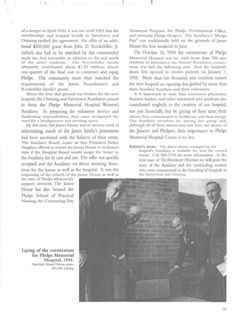
Groundbreaking for the new hospital took
sistently set the example and our community has
place on February 7th, 1954 and the cornerstone
unfailingly followed their lead.
was laid the following October. At that ceremony,
Mr. Rockefeller 3rd delivered the keynote address
Rockefeller family
in which he said about Phelps:
participation and impact
on the Phelps Board,
"this new hospital will be more than an institu-
every aspect of our day to
tion... (it) will become a true health center.. and
day operations, planning
its services, both curative and preventive, will
and volunteer activities
reach out beyond its walls. (to) help all of us en-
remains strong. Phelps'
joy a healthier and better life."
patients, staff and com-
munity owe many in-
The hospital's ribbon-cutting dedication
dividual members of the
took place on January 7th, 1956 and the first pa-
Rockefeller family a debt
tient was admitted that day. JDR 3rd continued
of gratitude for their in-
to serve on the Phelps Board until February 1962
sight, their constancy and
and served an additional term from February
Rodman Rockefeller Current
their vision in leading our
1963 until February 1969. In March of 1970, JDR
Member. Phelps Board
hospital to success in
treating patients. We like to remember that for
every single dollar the Rockefeller family invested
in Phelps' founding thirty-six years ago, more
than three patients have benefited by receiving
care during the intervening years. That is a return
on investment in human lives of inestimable
value. And the Rockefeller family's ongoing per-
sonal participation in our programs and services
continues to be of tremendous importance to the
hospital; it cannot be replaced. Today, our
Building for the 21st Century Drive is nearly com-
plete and the families of David and Laurance
Rockefeller as well as Rodman Rockefeller, who
currently serves on the hospital Board, have con-
tinued their family's tradition of leadership.
Phelps' history inspires each of us to renew
our commitment to excellence in providing the
best in healthcare service and the highest quali-
ty of care in an atmosphere of support and com-
passion. That is what each of our patients de-
serves. In helping us achieve that goal, and in
recognition of all they have already done for the
Ribbon Cutting Dedication - January 7. 1956 - Mr. & Mrs. JDR 3rd (center)
health of our community, we celebrate the
3rd hosted the kick-off reception for the hospital's
Rockefeller family, whose support has always been
West Wing Development Program at the family's
at the heart of Phelps Memorial Hospital Center.
OUR FIRST AUXILIANS
Phelps Memorial Hospital Center, and its predecessor Tarrytown and Ossining Hospitals, were all founded and
initially expanded largely through the efforts of women. The hospitals' Women's Auxiliaries helped raise funds
for new and improved equipment and buildings, provided direct services in support of patients and other hospi-
tal staff members, and lent strong doses of insight and commitment to developing high quality health care for
families and workers in the lower Hudson Valley region--much as Phelps Auxiliary members continue doing to
this day.
Three women in particular--Abby Greene Aldrich Rockefeller (a founder of the Tarrytown Hospital), her daugh-
ter-in-law Blanchette Ferry Hooker Rockefeller (a founder of Phelps Memorial), and Helen Ward Brandreth Potter
(founder of the Ossining Hospital)--may be considered our first Auxilians.
Their stories, and their importance to our community and hospital, are offered on the fortieth anniversary of the
opening of Phelps, in thanks and as a tribute to all our Auxilians, past, present and future. For without them,
surely, the hospital would not exist.
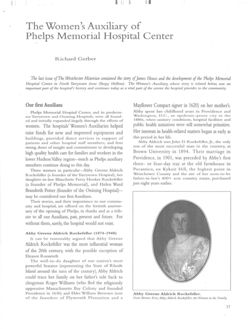
ABBY GREENE ALDRICH ROCKEFELLER (1874-1948)
Tarrytown Hospital Auxiliary
It can be reasonably argued that Abby Greene Aldrich Rockefeller was the most influential woman of the
20th century, with the possible exception of Eleanor Roosevelt.
The well-to-do daughter of our nation's most powerful Senator (repre-
senting the State of Rhode Island around the turn of the century), Abby
Aldrich could trace her family on her father's side back to clergyman
Roger Williams (who fled the religiously oppressive Massachusets Bay
Colony and founded Providence in 1636) and Elder William Brewster (one
of the founders of Plymouth Plantation and a Mayflower Compact signer
in 1620) on her mother's. Abby spent her childhood years in Providence
and Washington, DC, an epidemic-prone city in the 1880's, when sani-
tary conditions, hospital facilities and public health initiatives were still some-
what primitive. Her interests in health-related matters began as early as
this period in her life.
Abby Aldrich met John D. Rockefeller, Jr., the only son of the most SUC-
cessful man in the country, at Brown University in 1894. Their marriage
in Providence, in 1901, was preceded by Abby's first three or four day
stay at the old farmhouse in Pocantico, on Kykuit Hill, the highest point in
Westchester County and the site of her soon-to-be father-in-law's 400+
acre country estate, purchased just eight years earlier.
Abby was instantly taken by the bucolic communities around Pocantico, the farm property surrounded
by groves of trees, and the farmhouse itself, featuring broad and comfortable verandas. From the porch, she
was especially impressed by the unmatched, sweeping and unobstructed panoramic view of the Hudson River
Valley and the Palisades to the west, a vista which included a sighting across the nearby estate then known as
Phelps Place, on the eastern bank of the river, less than two miles away.
In fact, Abby was SO happy at Pocantico, that she agreed to spend her month-long honeymoon there
with JDR Jr. The following summer, she began spending even more time at Pocantico and, as Bernice Kert
reports in her wonderful biography of Abby:
"One of the local Tarrytown doctors
remarked to a neighbor of the Rockefellers
'Pay attention to the filly! She's the
one really worth watching!'
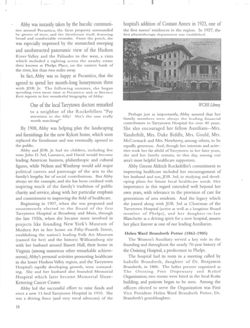
By 1908, Abby was helping plan the landscaping and furnish-
ings for the new Kykuit home, which soon replaced the farm-
ROCKEFELLERS
house and was eventually opened to the public.
John D. Rockefeller, Sr.
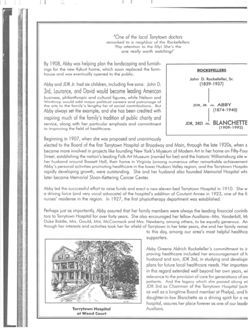
Abby and JDR Jr. had six children, including five sons: John D.
(1839-1937)
3rd, Laurance, and David would become leading American
business, philanthropic and cultural figures, while Nelson and
Winthrop would add major political careers and patronage of
the arts to the family's lengthy list of social contributions. But
JDR, JR. m. ABBY
Abby always set the example, and she has been credited with
(1874-1940)
inspiring much of the family's tradition of public charity and
service, along with her particular emphasis and commitment
JDR, 3RD m.
BLANCHETTE
to improving the field of healthcare.
(1909-1992)
Beginning in 1907, when she was proposed and unanimously
elected to the Board of the first Tarrytown Hospital at Broadway and Main, through the late 1920s, when
S
became
more involved in projects like founding New York's Museum of Modern Art in her home on Fifty-Four
Street, establishing the nation's leading Folk Art Museum (named for her) and the historic Williamsburg
site
W
her husband around Bassett Hall, their home in Virginia (among numerous other remarkable achievement
Abby's personal activities promoting healthcare in the lower Hudson Valley region, and the Tarrytown
Hospita
rapidly developing growth, were outstanding. She and her husband also founded Memorial Hospital
whi
later became Memorial Sloan-Kettering Cancer Center.
Abby led the succcessful effort to raise funds and erect a new eleven-bed Tarrytown Hospital in 1910. She W
a driving force (and very vocal advocate) of the hospital's addition of Coutant Annex in 1923, one of
the
fi
nurses' residense in the region. In 1927, the first physiotherapy department was established.
Perhaps just as importantly, Abby assured that her family members were always the leading financial
contrib
tors to Tarrytown Hospital for over forty years. She also encouraged her fellow Auxilians--Mrs.
Vanderbilt,
Mi
Duke Biddle, Mrs. Gould, Mrs. McCormack and Mrs. Newberry, among others, to be equally generous. An
though her interests and activities took her far afield of Tarrytown in her later years, she and her family remai
to this day, among our area's most helpful healthca
supporters.
Abby Greene Aldrich Rockefeller's committment to ir
proving healthcare included her encouragement of h
husband and son, JDR 3rd, in studying and developir
plans for future local healthcare needs. Her importano
in this regard extended well beyond her own years, wi
relevance to the provision of care for generations of are
patients. And the legacy which she passed along wi
JDR 3rd as Chairman of the Tarrytown Hospital (acti
as well as a longtime Board member at Phelps), and h
daughter-in-law Blanchette as a driving spirit for a ne
hospital, assures her place forever as one of our leadir
Tarrytown Hospital
Auxilians.
at Wood Court
BLANCHETTE FERRY HOOKER ROCKEFELLER (1909-1992)
Phelps Memorial Hospial Auxiliary
When Phelps Memorial Hospital opened on January 7, 1956, Blanchette
Rockefeller stood by her husband, John D. Rockefeller 3rd's side. The opening
ceremony represented for them, as for their neighbors, the realization of a dream,
a dream of a new, centralized and modern healthcare facility for the region.
The Rockefellers had worked hard alongside literally thousands of other area
residents in bringing that dream to fruition. Almost twenty years of area needs
analyses, planning studies, lobbying with physicians, politicians and business lead-
ers, as well as fundraising activities and site development had preceded that day.
And the Rockefellers led much of those efforts, complementing one another through
the process. Their pleasure must have been great on opening day at Phelps, but
the hard work of helping a new hospital begin operations still lay ahead of them.
Blanchette Ferry Hooker Rockefeller was born in New York City. Her father was the founder and president of
the Hooker Chemical Company and her forbears also founded the Ferry Seed Company.
In 1932, at the age of 24, Blanchette married JDR 3rd and then began her civic, cultural and charitable
activities career. Best known as a trustee and two-time president of the Museum of Modern Art (which was
established by her mother-in-law), Blanchette helped expand that institution considerably. She was also involved
with the National Council on the Humanities, New York Council on the Arts, the New York Philharmonic, the Asia
and Japan Societies, among other organizations. Blanchette also raised four children, including John D. Rockefeller
4th, the current United States Senator from West Virginia.
But Blanchette also took a leadership role in health and welfare related institutions. She was the first woman
elected vice chairman of the Community Service Society, one of our country's oldest and largest private family
and health agencies. And, of course, there were her efforts on behalf of Phelps.
In the first few weeks after Phelps opened, Blanchette was to be seen in patient rooms, administrative offices,
even in the boiler room making certain that everything was just right. She took a particular interest in the dietary
department, where she made sure that patients were being fed nutritiously as well as deliciously. But it was to be
in the realm of fundraising that Blanchette was to have her most significant impact for the hospital.
Aside from her encouragement of financial contributions to found and continue support of Phelps from her
family and social contacts, Blanchette hosted numerous gatherings related to hospital business at her home, the
nearby Fieldwood Farm. When the hospital began the successful West Wing Expansion Campaign in 1970, she
helped to host the kick-off reception at the family's Pocantico Hills Playhouse. Even after her husband's untimely
death in 1978, Blanchette continued her annual personal support of Phelps. In fact, over the forty years of
Phelps Memorial Hospital's history, Blanchette and JDR 3rd are, cumulatively, the most generous financial
contributors to our hospital.
At her death, in December of 1992, Blanchette made provision for a significant bequest to benefit the
hospital. Her example, of a lifetime of service and real concern for patients, assures that the memory of Blanchette
Rockefeller remains bright and clear at Phelps.
The westCnester
VOLUME 72
NUMBER 4
Historian
Fall 1996
QUARTERLY OF THE WESTCHESTER COUNTY HISTORICAL SOCIETY
Phelps Place (James House), North Tarrytown
Phelps Place: A Historical Overview
Richard J. Gerber and Arthur James Hoe
This article was written as part of the 40th anniversary celebration in 1995 of Phelps Memorial Hospital in
North Tarrytown, and was previously published in the Hospital's journal for the Ninth Annual Champagne
Ball, held on November 4, 1995.
On
the fortieth anniversary of the opening of
named Tappan Zee (Sea) by the Dutch settlers who fol-
Phelps Memorial Hospital Center, we should remem-
lowed Hudson.
ber some of the rich history connected with our site,
The Dutch bought this land from the local Native
which came to be known as Phelps Place. Any
Americans in 1629 and set up a trading post here, one
complete history of Phelps and its Auxiliary must really
in a series which eventually extended from New
begin with an account of the magnificent 66-acre
Amsterdam (New York City) to Fort Orange (Albany).
estate upon which the hospital and its treasure, the
Otter, mink, bear and deer were to be found here and,
James House, are situated. The following overview can
once they were quickly trapped out, timber, grain and
only begin to suggest the wealth of interesting infor-
flax were culled and cultivated for export from this
mation and stories which connect our hospital today
property. Ironically, the settlers brought contagious dis-
with the people who passed through and the events
eases, like smallpox, cholera, malaria, measles and
which occurred here. But it also helps to further
plague to the area, and these (along with depleted food
explain the way in which Phelps Memorial Hospital
supplies and increasing warfare) ultimately resulted in
Center came into being, how our Auxiliary continues
the emigration and the virtual extinction of the Native
to play such an important role in our existence, and
Americans from this region.
why our tradition of the highest quality healthcare
One of these early Dutch settlers, Frederick Philipse
service is SO firmly rooted in our community.
bought this property and began trading in this area in
1672, establishing the Upper Mills just south of this
The Land
land. He called his estate Philipsburg Manor. Around
The eastern bank of the Hudson River, about 30
1693, England's King William and Queen Mary grant-
miles north of New York City, has been the site of
ed Philipse a Royal Charter, formally recognizing his
numerous events of major historical importance. The
ownership of the land. Philipse built a series of
66-acre wooded parcel of rolling land now occupied by
sawmills and gristmills which, worked by African-
Phelps--bounded on the north by Rockwood Hall
American laborers and patronized by local tenant
Park, on the south by Sleepy Hollow Manor, on the
farmers, soon became an early industrial site for the
east by Route 9, and on the west by the river--has
production of lumber and grains. He also began the
shared much of this notoriety.
nearby Old Dutch Church. By the end of the 1600s,
This land was home, hunting and farming territory
Philipse was the richest man on the continent.
for a branch of the Wappinger Confederacy of Native
For the next 80 years, Philipse's descendants contin-
Americans, whose ancestors left traces here dating as far
ued to own the Manor, parlaying the burgeoning mill
back as 8000 B.C. By the beginning of the fifteenth
business into even more considerable wealth. But,
century A.D., the Wappingers numbered about 5,000
following the Revolutionary War, the loyalist Philipses
and included local subgroups like the Tappans, the Sint-
lost their property, New York State sold this parcel to
Sincks and others.
General Girard Beekman whose family founded North
Our property first surfaces in modern history when
Tarrytown nearby. It would be another 50 years before
Henry Hudson (an English captain employed by the
activity would really begin to occur on the wooded
Dutch East India Company) undertook the first
tract at the north side of the growing village.
recorded voyage up the river on his ship the Half Moon
in 1609. Hudson is said to have landed and met with
The Phelps family
the Native Americans along this shore, near the widest
Back in 1630, a farmer by the name of William
expanse of the river. This section of the river was
Phelps had emigrated from England to the
75
Massachusetts Bay Colony, moving later to
this success, Phelps began investing in New York real
Connecticut; from him descended the line which
estate, banks, insurance, lumber and other raw materials.
eventually took possession of what became known as
His skills and timing were considerable factors, but
Phelps Place.
Phelp's real wealth resulted from his good fortune and
Williams' great-great-great-grandson Thomas
partnerships with family members.
Phelps III (born in 1741) owned grist and sawmills in
Anson Phelps's three eldest children were daughters:
Connecticut before serving as a Lieutenant in the
Elizabeth, Melissa and Caroline. While sons were
Revolutionary War under Generals George Washington
traditionally the business helpmates in assembling and
and Nathaniel Greene. He became SO attached to
inheriting family dynasties, Phelps's partners turned out
General Greene that he named his fourth son, Anson
to be his sons-in-law: Elizabeth married Daniel James,
Greene Phelps, after him in 1781.
Melissa married William E. Dodge, and Caroline
Anson Greene Phelps, for whom our hospital is
married James Stokes, each a member of a socially
named, was a most extraordinary man. With him the
prominent New York family. Together, Phelps and his
story of our hospital begins in earnest.
sons-in-law founded the Phelps-Dodge Partnership in
When Anson was 10, his father died, bankrupt as a
1833.
result of the inflation which followed the Revolution.
Phelps-Dodge diversified early, with major interests
Two years later, his mother died, leaving Anson a
in lumbering, copper and brass manufacturing.
penniless orphan and ward of a minister in Canton,
Banking, railroading and even involvement in the auto-
Connecticut. Anson was soon apprenticed to learn the
mobile business created great wealth for the family. For
tanning and saddlery business in Hartford. He opened
a time, Phelps-Dodge was one of the largest firms in
his own general store and, before long, was exporting
the country.
saddles to South Carolina in trade for cotton, which he
In the New York of the early 1800s, warm weather
then arranged for shipping and sale in England. Thus
periodically brought epidemics of smallpox, cholera
began his expertise as a merchant.
and yellow fever to the city and families of means, like
In 1806, Anson Phelps married Olivia Egleston and
the Phelpses, began sailing north, upriver to places like
they eventually had seven children. Shipping became a
Ossining for the summer, to escape the dreaded illnesses.
particular passion for Phelps, but the War of 1812
The first Phelps summer home was at 66 Beekman
disrupted his business. When war ended, he moved his
Avenue in North Tarrytown.
family to New York City and, using his business
In 1818, Anson Phelps's only son and namesake was
contacts, he established the Charleston Shipping Line,
born. Anson Phelps, J became a partner in his father's
the first regular service out of New York. Following
firm. In 1845, Anson, Jr. married Jane Gibson, daughter
of one of his father's merchant associates. Anson, Jr. and
his bride loved country life, SO they purchased these 66
acres of property overlooking the Hudson from the
Beekman estate in 1848. For the next three years they
supervised the laying out of the land's main roadways
and construction of the 22-room Victorian Gothic
stone building which they at first called the Manor
House. The architect of this summer home was John
Butler Snook, the man who designed the original
Grand Central Station. In 1848, the Hudson River
Railroad was cut along the river side of the property.
Anson Greene Phelps, Sr. died in 1853, so he had
but two years to enjoy his son and daughter-in-law's
summer retreat. At his death, Anson Sr. was a multi-
millionaire, but during his lifetime he had been very
generous to charities. Although not among New York's
very wealthiest, he did provide well for his survivors.
In fact, Anson Sr.'s charitable giving (over $500,000)
was said to be the largest by any American up to that
time. In honor of his father and family, Anson, Jr.
Olivia Egleston Phelps. Courtesy Arthur James Hoe.
named his Hudson River estate Phelps Place. Phelps
76
Block in Hartford, Phelps Memorial Hospital in
Ansonia, Connecticut, and the Ansonia Hotel in New
York City are among additional memorials named in
honor of Anson Greene Phelps, Sr.
Unfortunately, Anson, Jr. died soon thereafter, of
smallpox in 1859. Anson, Jr. and his wife had only six
years to enjoy their Phelps Place summer home together,
and they had no children. Jane Gibson Phelps, Jr.
continued living at the home she had shared with her
husband until her death in 1909. She then bequeathed
the property to her sister, Helen Louise Gibson, who
had lived there with her. At Miss Gibson's death in
1918, she left Phelps Place in her will to the
Presbyterian Mission Board, much to the surprise of
her Phelps family inlaws. That might have been the
end of Phelps Place, but for Anson, Sr.'s great grandson,
Arthur Curtiss James.
The James family
Arthur Curtiss James's youth could not have been
more different from that of his great grandfather's.
Anson Greene Phelps, Sr. Courtesy Arthur James Hoe.
Born in New York City in 1867, Arthur's grandfather,
publicity of his gifts meant immediate cancellation. In
Daniel James, had diversified the family's fortune
fact, according to the New York Times, following World
further by investing in southwest mining ventures.
War I, Arthur Curtiss James "stood to be the richest
Arthur's father, Daniel Willis James, then expanded the
man in the country."
family's interests in railroading.
James always believed that the Phelps Place property
After graduation from Amherst College in 1889
should have remained in his family, as he was a great
(with a Bachelor's and Master's), Arthur began his
admirer of his Phelps family antecedents. So by 1921,
career as a mail clerk in his father's business. For the
within a year of the passing of the Phelps Place
next 20 years, he worked his way up through the
property out of his family, James bought it back from
company on merit. But along the way, when his father
the Presbyterian Mission Board.
died in 1907, Arthur Curtiss James inherited $26
Though James and his wife, Harriet, kept their
million.
primary residence in New York City, they already had
James had become the third partner in Phelps-
a summer home in Newport and a winter home in
Dodge in 1902 and, as the company incorporated in
Florida. An accomplished sailor (sailing was his first
1908, he became a director, a title he retained for the
love), James built his first 130-foot yacht in 1900. In his
rest of his life. James was the principal builder of a rail-
second yacht (the 218-foot Aloha, built in 1909) he
road empire which ultimately included ownership of
personally sailed around the world with his wife and
one-seventh of the entire mileage of all railroads in the
several friends, on one of several globe-wide voyages.
United States, covering a quarter of the country. A
But the Jameses also loved their country retreat at
highlight of his professional career came when James
Phelps Place and they spent a good deal of time enter-
drove the golden spike in a tie that linked the Northern
taining guests here from around the world. They had a
Pacific and Western Pacific railroad systems in
fine boat house constructed on the Hudson behind the
California.
mansion for summer sailing. The property also included
With his enormous railroad, copper, silver and gold
a 12-room superintendent's house, a six-room bunga-
mine holdings, James was cited as one of the 10 or 12
low, a large garage with two four-room apartments
wealthiest men in the nation by the start of the
above it, and a tennis court. Gardens, greenhouses,
twentieth century, but he was also one of the least well
chicken coops and sheds for machinery were also to be
known to the public. His name rarely appeared in the
found on the property when the Jameses owned it.
newspapers, his photograph almost never. He donated
They restored the building and furnished it with
many millions to charity during his lifetime, but most
valuable antiques and period pieces. They also
of it was untraceable because of his strict rule that
renamed it James House.
77
James House, circa 1976.
Sanchis Collection, WCHS.
Mr. and Mrs. James had no children. In May of
the discussions. Dobbs Ferry Hospital representatives
1941, Mrs. James passed away; within three weeks of his
dropped out of the discussions largely as a result of this
wife's death, Arthur Curtiss James died of pneumonia.
issue.
Trustees of their estate sold nine-tenths of the couple's
As early as 1942, the former David Luke estate, a 22-
assets (NOT including the Phelps Place property) and,
acre property on South Broadway overlooking the
under the terms of their wills, established the James
Hudson in Tarrytown, had been under consideration
Foundation for charitable purposes. The bulk of the
for a consolidated new 150-bed facility. But by early
considerable James wealth was thereby distributed to a
1948, representatives of the Ossining Hospital had
variety of worthy educational, cultural and health-
rejected that site, insisting that only a location between
related causes, many of which James had designated
Ossining and Tarrytown would suit the population to
himself. Some of the James family's furniture came to
be served by a merger. Later that year, the James
the James House when other properties were sold. And
Foundation stepped forward with their first proposal.
portraits of Mr. and Mrs. James now grace one wall of
Phelps Place was situated equidistant from Ossining
their country retreat.
and Tarrytown. It was also in the geographical center
While no specific clause of James's will addresses the
of the 14-mile total service area of the two predecessor
issue, his relatives speculate that James had spoken to his
hospitals, from Irvington in the south to the northern
trustees about possibly donating Phelps Place for the
boundary of the village of Croton.
establishment of a new hospital. He was aware of the
The James Foundation offered to give the Phelps
discussions and earliest studies (underwritten by his
Place estate as an outright gift for the establishment of
Rockefeller neighbors) related to a centralized facility
a new merged hospital. Though the property carried
to consolidate the aging Ossining and Tarrytown
only an assessed value of $82,600 (later revised to
Hospitals. Indeed, members of the Rockefeller family
$150,000), by late 1949 the James Foundation sweet-
insisted that the James House not be torn down, a fate
ened the deal with the offer of an additional $500,000
which had befallen William Rockefeller's 205-room
cash grant in support of the construction costs
Rockwood Hall mansion next door, which was razed
associated with a new healthcare center. The James
during the Depression.
Foundation's offers came with a time limit on a merger
agreement and two other conditions: that the cash
Phelps Hospital's inception
grant be matched by the community and that the new
Throughout the 1940s, the choice of a location for
hospital be named Phelps Memorial in memory of
a merged facility to replace the now inadequate
Anson Greene Phelps, Sr.
Ossining and Tarrytown Hospitals was a major source
While the medical staffs of the Ossining and
of contention among the various parties involved in
Tarrytown Hospitals first voted unanimously in favor
78
of a merger in April 1950, it was not until 1952 that the
Treatment Program, the Phelps Development Office,
memberships and hospital boards in Tarrytown and
and currently, Phelps Hospice. The Auxiliary's "Phelps
Ossining ratified the agreement. An offer of an addi-
Fair" was traditionally held on the grounds of James
tional $500,000 grant from John D. Rockefeller, Jr.
House the first weekend in June.
(which also had to be matched by the community)
On October 16, 1954 the cornerstone of Phelps
made the deal inevitable, in addition to the real needs
Memorial Hospital was set, with more than 200 area
of the area's residents. The Rockefeller family
residents in attendance; the Nurses' Residence corner-
ultimately contributed about $1.25 million, almost
stone was laid the following year. And the hospital's
one-quarter of the final cost to construct and equip
doors first opened to receive patients on January 7,
Phelps. The community more than matched the
1956. More than ten thousand area residents toured
requirements of the James Foundation's and
the new hospital on opening day, guided by more than
Rockefeller family's grants.
three hundred Auxilians and their volunteers.
About the time that ground was broken for the new
It is important to note than numerous physicians,
hospital, the Ossining and Tarrytown Auxiliaries joined
business leaders, and other interested area residents also
to form the Phelps Memorial Hospital Women's
contributed mightily to the creation of our hospital,
Auxiliary. In preparing for volunteer service and
not just financially, but by giving of their time, their
fundraising responsibilities, they soon recognized the
talents, their commitment to healthcare, and their energy.
need for a headquarters and meeting space.
Our Auxiliary members are among this group and,
By this time, the James House was in serious need of
although all of their stories may not have the drama of
refurnishing; much of the James family's possessions
the Jameses and Phelpses, their importance to Phelps
had been auctioned with the balance of their estate.
Memorial Hospital Center is no less.
The Auxiliary Board, under its first President Helen
Vaughan, offered to restore the James House to its former
Editor's note: The James House, managed by the
state if the Hospital Board would assign the house to
hospital's Auxiliary, is available for rent for catered
events. Call 366-3170 for more information. In the
the Auxiliary for its care and use. The offer was quickly
next issue of The Westchester Historian we will print the
accepted and the Auxiliary set about securing dona-
story of the Auxiliary and the outstanding women
tions for the house as well as the hospital. It was the
who were instrumental in the founding of hospitals in
beginning of the rebirth of the James House as well as
the Tarrytowns and Ossining.
the start of Phelps Memorial's
support network. The James
House has also housed the
Phelps School of Practical
Nursing, the Continuing Day
Laying of the cornerstone
for Phelps Memorial
Hospital, 1954.
New York Herald Tribune photo,
WCHS Library.
79
The Women's Auxiliary of
Phelps Memorial Hospital Center
Richard Gerber
The last issue of The Westchester Historian contained the story of James House and the development of the Phelps Memorial
Hospital Center in North Tarrytown (now Sleepy Hollow). The Women's Auxiliary, whose story is related below, was an
important part of the hospital's history and continues today as a vital part of the service the hospital provides to the community.
Our first Auxilians
Mayflower Compact signer in 1620) on her mother's.
Phelps Memorial Hospital Center, and its predeces-
Abby spent her childhood years in Providence and
son Tarrytown and Ossining Hospitals, were all found-
Washington, D.C., an epidemic-prone city in the
ed and initially expanded largely through the efforts of
1880s, when sanitary conditions, hospital facilities and
women. The hospitals' Women's Auxiliaries helped
public health initiatives were still somewhat primitive.
raise funds for new and improved equipment and
Her interests in health-related matters began as early as
buildings, provided direct services in support of
this period in her life.
patients and other hospital staff members, and lent
Abby Aldrich met John D. Rockefeller, Jr., the only
strong doses of insight and commitment to developing
son of the most successful man in the country, at
high quality health care for families and workers in the
Brown University in 1894. Their marriage in
lower Hudson Valley region--much as Phelps auxiliary
Providence, in 1901, was preceded by Abby's first
members continue doing to this day.
three- or four-day stay at the old farmhouse in
Three women in particular--Abby Greene Aldrich
Pocantico, on Kykuit Hill, the highest point in
Rockefeller (a founder of the Tarrytown Hospital), her
Westchester County and the site of her soon-to-be
daughter-in-law Blanchette Ferry Hooker Rockefeller
father-in-law's 400+ acre country estate, purchased
(a founder of Phelps Memorial), and Helen Ward
just eight years earlier.
Brandreth Potter (founder of the Ossining Hospital)--
may be considered our first Auxilians.
Their stories, and their importance to our commu-
nity and hospital, are offered on the fortieth anniver-
sary of the opening of Phelps, in thanks and as a trib-
ute to all our Auxilians, past, present and future. For
without them, surely, the hospital would not exist.
Abby Greene Aldrich Rockefeller (1874-1948)
It can be reasonably argued that Abby Greene
Aldrich Rockefeller was the most influential woman
of the 20th century, with the possible exception of
Eleanor Roosevelt.
The well-to-do daughter of our nation's most
powerful Senator (representing the State of Rhode
Island around the turn of the century), Abby Aldrich
could trace her family on her father's side back to
clergyman Roger Williams (who fled the religiously
oppressive Massachusetts Bay Colony and founded
Providence in 1636) and Elder William Brewster (one
Abby Greene Aldrich Rockefeller.
of the founders of Plymouth Plantation and a
From Bernice Kert, Abby Aldrich Rockefeller: the Woman in the Family.
17
Abby was instantly taken by the bucolic communi-
hospital's addition of Coutant Annex in 1923, one of
ties around Pocantico, the farm property surrounded
the first nurses' residences in the region. In 1927, the
by groves of trees, and the farmhouse itself, featuring
first physiotherapy department was established.
broad and comfortable verandas. From the porch, she
was especially impressed by the unmatched sweeping
and unobstructed panoramic view of the Hudson
River Valley and the Palisades to the west, a vista
which included a sighting across the nearby estate
then known as Phelps Place, on the eastern bank of
the river, less than two miles away.
In fact, Abby was SO happy at Pocantico, that she
agreed to spend her month-long honeymoon there
with JDR Jr. The following summer, she began
spending even more time at Pocantico and, as Bernice
Kert reports in her wonderful biography of Abby:
One of the local Tarrytown doctors remarked
WCHS Library.
to a neighbor of the Rockefellers "Pay
attention to the filly! She's the one really
Perhaps just as importantly, Abby assured that her
worth watching!"
family members were always the leading financial
contributors to Tarrytown Hospital for over 40 years.
By 1908, Abby was helping plan the landscaping
She also encouraged her fellow Auxilians--Mrs.
and furnishings for the new Kykuit home, which soon
Vanderbilt, Mrs. Duke Biddle, Mrs. Gould, Mrs.
replaced the farmhouse and was eventually opened to
McCormack and Mrs. Newberry, among others, to be
the public.
equally generous. And, though her interests and activ-
Abby and JDR Jr. had six children, including five
ities took her far afield of Tarrytown in her later years,
sons: John D. 3rd, Laurance, and David would become
she and her family remain, to this day, among our
leading American business, philanthropic and cultural
area's most helpful healthcare supporters.
figures, while Nelson and Winthrop would add major
Abby Greene Aldrich Rockefeller's commitment to
political careers and patronage of the arts to the
improving healthcare included her encouragement of
family's lengthy list of social contributions. But Abby
her husband and son, JDR 3rd, in studying and devel-
always set the example, and she has been credited with
oping plans for future local healthcare needs. Her
inspiring much of the family's tradition of public
importance in this regard extended well beyond her
charity and service, along with her particular emphasis
own years, with relevance to the provision of care for
and commitment to improving the field of healthcare.
generations of area residents. And the legacy which
Beginning in 1907, when she was proposed and
she passed along with JDR 3rd as Chairman of the
unanimously elected to the Board of the first
Tarrytown Hospital (active as well as a longtime Board
Tarrytown Hospital at Broadway and Main, through
member of Phelps), and her daughter-in-law
the late 1920s, when she became more involved in
Blanchette as a driving spirit for a new hospital, assures
projects like founding New York's Museum of
her place forever as one of our leading Auxiliaries.
Modern Art in her home on Fifty-Fourth Street,
establishing the nation's leading Folk Art Museum
Helen Ward Brandreth Potter (1862-1905)
(named for her) and the historic Williamsburg site
The Women's Auxiliary served a key role in the
with her husband around Bassett Hall, their home in
founding and throughout the nearly 70-year history of
Virginia (among numerous other remarkable achieve-
the Ossining Hospital, a predecessor to Phelps.
ments), Abby's personal activities promoting healthcare
The hospital had its roots in a meeting called by
in the lower Hudson Valley region, and the Tarrytown
Isabelle Brandreth, daughter of Dr. Benjamin
Hospital's rapidly developing growth, were outstand-
Brandreth, in 1886. The ladies present organized as
ing. She and her husband also founded Memorial
The Ossining Free Dispensary and Relief
Hospital which later became Memorial Sloan-
Organization, two rooms were hired in the local Rohr
Kettering Cancer Center.
building, and patients began to be seen. Among the
Abby led the successful effort to raise funds and
officers elected to serve the Organization was First
erect a new 11-bed Tarrytown Hospital in 1910. She
Vice President Helen Ward Brandreth Potter, Dr.
was a driving force (and very vocal advocate) of the
Brandreth's granddaughter.
18
On December 4, 1888 the Ossining Hospital
as the Ossining Democratic Register newspaper of April
Association was incorporated, and it succeeded the
29, 1905 reported:
Dispensary Committee in June of the following year
as the hospital moved to a 20-room property at Cedar
Of all the projects in which Mrs. Potter [is]
Glen. In 1891, a building on South Orchard Street
engaged, none perhaps [is] nearer and dearer
to her than that of the Ossining Hospital
It
was purchased for $3,500 and the Ossining Hospital
was her first care and attention. It seems she
began in earnest.
The hospital's Board of Lady Managers (as the
was untiring in her efforts to upbuild and
Auxiliary was then known) was led by Mrs. E.A.
extend the hospital's sphere of usefulness. It
McAlpin. Among her accomplishments, Mrs.
offered her an instrument through which she
McAlpin furnished the Ossining Hospital's first
could ease the pangs of suffering humanity. In
Maternity Ward as a memorial to Mrs. Benjamin
sales and lawn fetes for the Hospital she was
Brandreth. The Ossining Institute for Girls furnished
one of the leading spirits and her financial
a patient room and Mrs. Louis Henop gave the
assistance was unlimited. As one of the Lady
Women's Ward in memory of her daughter, Mrs. Ann
Managers and chairman of the House
Committee, she was ever with her associates
B. Seeley. The first cash donation received in support
of the hospital was $500 from the estate of Mrs. Jane
carrying out some schemes which were
Baker. In 1892, a Training School for Nurses was
intended to put the Hospital on a stronger
and more useful basis. One of her recent acts
established and three years later, an Operating Room
opened as a memorial to Mrs. Pierre Van Cortlandt.
was the re-papering of the dining room
which she furnished with Mission furniture at
The Ossining Hospital was now serving more than
the same time.
500 patients per year; new quarters were needed. In
early 1905, Helen Brandreth Potter took a ride down
Unfortunately, in April 1905, while carrying a cup
Spring Street and was heard to say, "What a lovely spot
of hot water to a sick child, Mrs. Potter accidentally
this would be for a hospital!"
spilled it on herself and was badly scalded. No serious
injury was anticipated, but the burn failed to heal and
The Hospital. Ossining, N.Y.
"blood poisoning" set in. She passed away soon there-
after at the age of 43.
Her untimely death was mourned throughout our
a
region. In fact, the Ossining Village President issued a
proclamation and all business in town was suspended
on the day of her funeral. The papers reported that
Mrs. Potter was "universally beloved."
Her husband, Frederick and his sisters, Blanche and
Martha Potter, recalled Helen's remark on Spring
Street. In 1906, they purchased land overlooking the
Hudson and built a new hospital. On January 7, 1907,
the Potters presented the building (insured for
$75,000) to the hospital association. Five thousand
WCHS Library.
area residents visited the building on opening day.
And at the left side of the main door to the new
Since the founding of the Ossining Free
building, a special tablet was inscribed: "This Property
Dispensary, Helen Potter had been amongst its most
and This Building were given to The Ossining
active supporters. A leading member of the Ossining
Hospital Association in Loving Memory of Helen
social community, Mrs. Potter was described as "strik-
Ward Potter AD 1906." In 1910, Martha Potter
ingly handsome, possessing a rare charm of manner
bequeathed a $25,000 Betterment Fund, the first such
which won all hearts." She was a deeply religious
endowment established for the hospital.
woman as well, active in the local Trinity Episcopal
The Ossining Women's Auxiliary was formally
Church, Christ Child Day Nursery, and the Bethany
established in 1922 and the Board of Lady Managers
Home for Old Ladies. She was President of the
was gradually merged into it. Until 1954, (when they,
Ossining School Society, a member of the D.A.R., and
in turn, merged into the Phelps Auxiliary) the
the Mayflower Society, among many others. However,
Ossining Auxiliary members served the patients and
19
staff of the Ossining Hospital, mounting successful
York Philharmonic, the Asia and Japan Societies,
fund drives and providing for nearly every hospital
among other organizations. Blanchette also raised
related need.
four children, including John D. Rockefeller 4th, the
Throughout its history, the Ossining Hospital's
current United States Senator from West Virginia.
Auxiliary was led by a series of strong, hard-working
But Blanchette also took a leadership role in health
and insightful women, all in the tradition of their
and welfare related institutions. She was the first
founding spirit, Helen Ward Brandreth Potter.
woman elected vice chairman of the Community
Service Society, one of our country's oldest and largest
Blanchette Ferry Hooker Rockefeller (1909-1992)
private family and health agencies. And, of course,
When Phelps Memorial Hospital opened on
there were her efforts on behalf of Phelps.
January 7, 1956, Blanchette Rockefeller stood by her
In the first few weeks after Phelps opened,
husband, John D. Rockefeller 3rd's side. The opening
Blanchette was to be seen in patient rooms, adminis-
ceremony represented for them, as for their neighbors,
trative offices, even in the boiler room making certain
the realization of a dream, a dream of a new, central-
that everything was just right. She took a particular
ized and modern healthcare facility for the region.
interest in the dietary department, where she made
The Rockefellers had worked hard alongside literally
sure that patients were being fed nutritiously as well as
thousands of other area residents in bringing that
deliciously. But it was to be in the realm of fundrais-
dream to fruition. Almost 20 years of area needs analyses,
ing that Blanchette was to have her most significant
planning studies, lobbying with physicians, politicians
impact for the hospital.
and business leaders, as well as fundraising activities
Aside from her encouragement of financial contri-
and site development had preceded that day. And the
butions to found and continue support of Phelps from
Rockefellers led much of those efforts, complement-
her family and social contacts, Blanchette hosted
ing one another through the process. Their pleasure
numerous gatherings related to hospital business at her
must have been great on opening day at Phelps, but
home, the nearby Fieldwood Farm. When the hospital
the hard work of helping a new hospital begin opera-
began the successful West Wing Expansion Campaign
tions still lay ahead of them.
in 1970, she helped to host the kick-off reception at
Blanchette Ferry Hooker Rockefeller was born in
the family's Pocantico Hills Playhouse. Even after her
New York City. Her father was the founder and
husband's untimely death in 1978, Blanchette contin-
president of the Hooker Chemical Company and her
ued her annual personal support of Phelps. In fact,
forbears also founded the Ferry Seed Company.
over the 40 years of Phelps Memorial Hospital's history,
In 1932, at the age of 24, Blanchette married JDR
Blanchette and JDR 3rd are, cumulatively, the most
3rd and then began her civic, cultural and charitable
generous financial contributors to our hospital.
activities career. Best known as a trustee and two-time
At her death in December of 1992, Blanchette made
president of the Museum of Modern Art (which was
provision for a significant bequest to benefit the
established by her mother-in-law), Blanchette helped
hospital. Her example of a lifetime of service and real
expand that institution considerably. She was also
concern for patients assures that the memory of Blanchette
involved with the National Council on the
Rockefeller remains bright and clear at Phelps.
Humanities, New York Council on the Arts, the New
The Westchester
VOLUME 73
NUMBER 1
Historian
Winter 1997
QUARTERLY OF THE WESTCHESTER COUNTY HISTORICAL SOCIETY
Richard Gerber is a resident of Ossining. He has
been associated with Phelps Memorial Hospital
Center in Sleepy Hollow for nine years and currently
is the hospital's Vice President for Development and
Public Relations.
OTHER BOOKS BY
HARRY EMERSON FOSDICK
The Living
e
THE SECOND MILE
of These Days
THE ASSURANCE OF IMMORTALITY
THE MANHOOD OF THE MASTER
THE MEANING OF PRAYER
AN AUTOBIOGRAPHY
THE MEANING OF FAITH
THE MEANING OF SERVICE
CHRISTIANITY AND PROGRESS
TWELVE TESTS OF CHARACTER
by
THE MODERN USE OF THE BIBLE
ADVENTUROUS RELIGION
Harry Emerson Fosdick
A PILGRIMAGE TO PALESTINE
AS I SEE RELIGION
THE HOPE OF THE WORLD
THE SECRET OF VICTORIOUS LIVING
THE POWER TO SEE IT THROUGH
SUCCESSFUL CHRISTIAN LIVING
A GUIDE TO UNDERSTANDING THE BIBLE
LIVING UNDER TENSION
ON BEING A REAL PERSON
A GREAT TIME TO BE ALIVE
ON BEING FIT TO LIVE WITH
THE MAN FROM NAZARETH
RUFUS JONES SPEAKS TO OUR TIMES, AN ANTHOLOGY
GREAT VOICES OF THE REFORMATION, AN ANTHOLOGY
A FAITH FOR TOUGH TIMES
WHAT IS VITAL IN RELIGION
HARP ER & BROTHERS
Publishers: New York
1956
WEEPE TEACHERS
LIPRARY
FrintFriendly.com: Print web pages, create PDFs
Page 1 of 3
David Rockefeller to donate 1,000-plus acres on Mount Desert
Island
p
pressherald.com/2015/05/21/rockefeller-donates-thousands-of-acres-on-mdi/
By Dennis Hoey Staff Writer [email protected]|@DennisHoey 207-791-6365
One of America's wealthiest individuals has decided to celebrate his 100th birthday in style by donating not money,
but more than 1,000 acres of fields, forest, streams and a freshwater pond on Mount Desert Island to a local nonprofit
organization.
Billionaire David Rockefeller will make a formal announcement Friday of his gift of Little Long Pond and surrounding
land to the Land and Garden Preserve of Mount Desert Island.
Search photos available for purchase: Photo Store
The Land and Garden Preserve is a public charity governed by a 25-member board of directors. Its mission is
"preserving, for public enjoyment, the aesthetic and spiritual heritage of certain horticultural and natural landscapes on
Mount Desert Island." The organization also cares for two gardens in nearby Northeast Harbor - the Asticou Azalea
Garden and the Thuya Garden - and manages 140 acres of open space near Eliot Mountain.
Rockefeller, who has homes in Manhattan and Westchester County, New York, is an international banker and
philanthropist. He has summered at his family home in Seal Harbor since he was a child. His parents purchased their
first home in Seal Harbor in 1910.
"This magnificent state and its wonderful residents have been such an integral part of my family's history. It is my
hope that the public should forever benefit from this beloved tract of land. I am delighted to make this gift to all the
people of Maine," Rockefeller said in a statement.
Rockefeller was born June 12, 1915, the son of John D. Rockefeller Jr. and Abby Aldrich Rockefeller. He served as
chairman and chief executive officer of Chase Manhattan Corporation for many years. The philanthropist, whose wife,
Margaret, died in 1996, is the oldest living member of the Rockefeller family He still owns a summer home in Seal
Harbor, on Mount Desert Island, where he spends most of his holidays and the entire month of August, his family
says.
Rockefeller's daughter, Neva R. Goodwin, serves as president of the Land and Garden Preserve. She has a home in
Seal Harbor. The Rockefellers had six children.
"My father's generosity will ensure that Little Long Pond and the beautiful land and trails around it will always be open
to public access for walking, hiking, horseback riding, and the other outdoor activities that are an important part of the
allure of the beautiful state of Maine. What a grand and appropriate way for this wonderful man to celebrate his 100th
birthday," Goodwin said in a statement.
Under the agreement with the Land and Garden Preserve, the Rockefeller property which is situated between
Northeast Harbor and Seal Harbor, will never be developed and will remain accessible to generations of islanders,
Mainers, and the thousands of tourists who visit Acadia National Park each year.
Rockefeller's property abuts Acadia National Park. Acadia National Park consists of more than 47,000 acres,
including more than 30,000 acres on Mount Desert Island, 2,728 acres on Isle au Haut and 2,366 acres on the
Schoodic Peninsula.
http://www.printfriendly.com/print?url=http%3%2F%2Fwww.pressherald.com%2F2015..
5/29/2015
PrintFriendly.com: Print web pages, create PDFs
Page 2 of 3
"It's really a spectacular tract in every way. Its size and natural diversity make it so important to so many people on
Mount Desert Island," said David MacDonald, who serves as president and chief executive officer of the Friends of
Acadia. "The walk around the pond is very beautiful. Many people start their day there."
In winter, islanders can skate on the pond or snowshoe through the nearby fields and woods. The land features
several hiking trails and carriage roads that extend from Acadia National Park into Rockefeller's property. The
carriage roads are maintained by Rockefeller's crews.
MacDonald, who also serves on the Land and Garden Preserve's board of directors, said that arrangement gives
Rockefeller more flexibility in his management practices.
While pedestrians and equestrians are welcome on Rockefeller's carriage roads, bicycles are not permitted on those
roads. Bicycles are, however, allowed on the carriage roads inside Acadia National Park.
MacDonald said the land that Rockefeller is donating will be protected from development pressures. Not only would
development go against the mission of the Land and Garden Preserve, but any type of development would violate
terms of conservation easements that were placed on the property several years ago by Maine Coast Heritage Trust
- an organization based in Topsham.
Rockefeller's land donation stretches from the preserve's land on Eliot Mountain eastward to Barr Hill and the Stanley
Brook Road. It does not currently include the privately owned Abby Aldrich Rockefeller Garden, but that property may
be donated to the preserve in the future.
Several Acadia hiking trails, including Asticou Ridge Trail, Harbor Brook Trail, and the Jordan Stream Path, extend
into Rockefeller's property.
A new trail that cuts across Rockefeller's land in a west to east direction from Eliot Mountain should be ready to open
this summer.
"Our message is there will be no change in uses or public access for the foreseeable future. People love the land the
way it is and this makes it certain that it will remain that way," Goodwin said.
Staff Writer Dennis Hoey can be contacted at 791-6365 or at:
[email protected]
Share
Read or Post Comments
Were you interviewed for this story? If so, please fill out our accuracy form.
f
Send questions/comments to the editors.
http://www.printfriendly.com/print?url=http%3A%2F%2Fwww.pressherald.com%2F2015 5/29/2015
ACADIA
NATIONAL
In celebration of his 100th
PARK
birthday on June 12, 2015,
Park
Brown
Loop Road
David Rocketeller announces
Mountain
Gatehouse
Pond
his gift of Little Long Pond
(and approximately 1000 acres
of surrounding fields,
woodlands streams,
carriage roads, and hiking trails)
to the Land & Garden Preserve
a 501(c)(3) public charity that
Eliot
currently owns, manages and
Mtn
preserves the Asticou Azalea Garden,
Thuya Garden and Lodge, and
Barr Hill
140 acres of woodlands and trails.
Seal
Harbor
trail under
construction
Northeast
Harbor
Seal
Northeast
Harbor
Harbor
Neh Pier
Beach
Library
Visitor Center
Careiage Roads
Seal
Outside Acadia
School
Main
National
St
Closed Hikes
Harbor
Peabody
Bracy
Cove
LAND &
N
GARDEN
LEGEND
W
E
Gifted Lands
Existing Preserve Holdings
S
Hiking Trad
Bear
Carriage Road
Island
0
1/8
1/4
12
PRESERVE
OCEAN
mile
Cartography by Map Adventures LLC
Brother, Can You Share a Dime?: The Rockefeller
Family and Libraries
Mary B. Haskell
The benefactions of the Rockefeller family have had a profound effect
on the library world. Through individual family contributions and the
work of their foundations such as the General Education Board and the
Rockefeller Foundation, the Rockefellers have financed libraries and li-
brary projects worldwide. While their influence has been great, there is a
lack of research concerning Rockefeller library philanthropy.
When I first began research for this project, I was concerned that I
might not find enough material. Fortunately, I remembered the Rock-
efeller Archive Center located in Pocantico Hills, New York. The
Rockefeller Archive Center, a division of Rockefeller University, was es-
tablished in 1974 and contains the records of the university, The Rock-
efeller Foundation, the Rockefeller Brothers Fund, members of the
Rockefeller family, and others associated with the Rockefellers. While
visiting the Center, soon realized that I would not be able to cover, in
even a cursory manner, all of the information concerning the library
philanthropy of the Rockefeller family and the Foundation. Together,
they funded an incredible number of deserving library projects in this
country and also had a strong impact internationally.) Indeed, they did
share a dime-many million times over.
John D. Rockefeller was born in 1839 and died in 1937, having be-
come the richest and most vilified of the robber barons. Most of his
money came, of course, from oil. He began work as an accountant in
Cleveland at the age of sixteen with a salary of $23 a month. In 1863, he
and his partners built a refinery for kerosene and with his organizational
and cost-cutting management skills, he soon had the largest refinery in
Cleveland, and eventually, the world. In 1870, Standard Oil was incorpor-
ated and grew to monopolize the production and shipment of oil prod-
ucts. 1 Rockefeller Sr. was on his way to becoming the richest man in
America. John Ensor Harr and Peter J. Johnson in The Rockefeller Century
indicate that:
Mary B. Haskell is the Automation and Technical Services Librarian, Colonial Williamsburg
Foundation, Williamsburg, Virginia.
Libraries & Culture, Vol. 31, No. 1, Winter 1996
1996 by the University of Texas Press, P.O. Box 7819, Austin, TX 78713-7819
This content downloaded from
137.49.125.110 on Wed, 02 Dec 2020 15:28:49 UTC
All use subject to https://about.jstor.org/terms
131
By the turn of the century, Senior's net worth was $200 million, sec-
ond to that of steel magnate Andrew Carnegie, whose fortune at
the same time was $425 million. But that represented the peak of
Carnegie's wealth while Rockefeller's began to increase even more
rapidly in the early years of the new century as the demand for pe-
troleum products expanded with the steadily increasing use of the
internal combustion engine. Senior's wealth peaked in 1913 at just
under $1 billion. 2
John D. Rockefeller's philanthropy began early. In the Rockefeller Ar-
chive Center is Ledger A, a record of his first years of work. In The Rock-
efellers: An American Dynasty, Peter Collier and David Horowitz comment:
In an exact and spidery hand, he wrote down, day by day and to the
penny, the income and expenses, the saving and investment, the busi-
ness and benefactions of his life
The total of the gifts he made was
almost invariably 10 percent of his $3.50 weekly income.
3
By 1892, Rockefeller Sr.'s annual benefactions were $1.5 million. He
had SO much money coming in that he almost did not know what to do
with it. He was constantly harassed and beseeched by people wanting
gifts. In 1891, the Reverend Frederick T. Gates became his first manager
of philanthropy. Gates had been the secretary of the American Baptist
Education Society and had been instrumental in encouraging Rock-
efeller to help finance the University of Chicago with an initial gift of
$600,000. (Rockefeller's total gift to the university was over $35 million.)
Reverend Gates filtered out useless schemes and brought order and dis-
cipline to the hundreds of applicants for Rockefeller charity. He prac-
ticed the principles of "scientific giving" and applied business methods
to a form of wholesale charity, a new concept in its day. Thus, the stage
was set for the Rockefeller benefaction encompassing almost every area
of American society and indeed much of the world. Rockefeller Sr.,
Rockefeller Jr., their successors, and the many people involved in the dis-
tribution of funds looked for large projects, benefiting many and pro-
viding for self-sufficiency as part of any plan. Individuals were not
granted money directly. It was channeled through one of the many
Rockefeller charities such as the Rockefeller Sanitary Commission, the
Rockefeller Brothers Fund, the General Education Board, the Rock-
efeller Foundation, the Sealantic Fund, and a myriad of others. As with
all of his endeavors, Rockefeller surrounded himself with committed, in-
telligent people who ably administered these funds.
How does all this apply to libraries, and where to begin? One of the
interesting aspects about the Rockefellers is their desire for anonymity.
This content downloaded from
137.49.125.110 on Wed, 02 Dec 2020 15:28:49 UTC
All use subject to https://about.jstor.org/terms
132
L&C/ The Rockefeller Family and Libraries
The Rockefeller family and the Foundation have given millions to aid
libraries around the world and continue to do so, but very little is known
about these gifts. Therefore, I chose examples of the kind of philan-
thropy practiced by the Rockefellers and their various funds as an indi-
cation of their extensive endeavors.
John D. Rockefeller Jr. was the only son of Rockefeller Sr. Like his fa-
ther, Rockefeller Jr. also kept a ledger of his income and expenses and
was introduced to charitable giving at an early age. When it came to choos-
ing a college, he turned down the chance to attend Yale because of its fast
reputation. Instead, he chose Brown University and graduated in 1897.
His years in Providence were a defining time for Rockefeller Jr. He
lost much of his reticence and became the president of his junior class,
manager of the football team, a violinist in the Mandolin Club, and
a
Sunday School teacher. Rockefeller Jr. is quoted in the dedication of the
John D. Rockefeller Library at Brown University in the Program.
At his fiftieth class reunion in 1947, Rockefeller reminisced: "Only
here on the campus did I enjoy a completely independent per-
sonality. With you fellows I was hailed as 'Johnny Rock,' just as one
of a hundred others, but at least one who stood on his own two
feet.
There has been nothing in my life since then quite like
this kind of comradeship.'44
After college, Johnny Rock became Rockefeller Jr. and began work at
26 Broadway, the home of the various Rockefeller enterprises. Gradually,
Rockefeller Jr. found himself attracted to the philanthropic side of the
Rockefeller endeavors and began work with Gates. His desire was to pro-
mote the family wealth by funding major social projects as well as to
make the Rockefeller name associated with the good results emanating
from these projects. He became the point man to his father: Gates de-
veloped programs and JDR Jr., having chosen the right time, would ap-
proach his father with these plans. He was quite successful.
5
It is interesting to note that both father and son saw themselves as
stewards of the vast amounts of money that had come to them. Accord-
ing to Harr and Johnson, "There is no question that Rockefeller's
[Rockefeller Sr.] exclusive motivation for giving was his religious convic-
tion and the old-fashioned concept of stewardship, not the expiation of
guilt or the buying of public favor."
There is also the parallel development of philanthropic ideals be-
tween Andrew Carnegie and John D. Rockefeller, and I quote from Harr
and Johnson:
It is a fascinating historical fact that these two great entrepreneurs,
This content downloaded from
137.49.125.110 on Wed, 02 Dec 2020 15:28:49 UTC
All use subject to https://about.jstor.org/terms
133
the two richest men in America, who were SO different in person-
ality and temperament and interests independently come to the
same conclusion at about the same time. The conclusion was that
men of wealth had a responsibility to put their wealth to good pur-
poses during their lifetimes, and that this would require a con-
certed and organized effort.7
In 1920, the Lincoln Collection of Judd Stewart came up for sale.
Rockefeller Jr. heard about it and asked Worthington Chauncey Ford of
the American Antiquarian Society to examine it for purchase by JDR Jr.
for the John Hay Library. After several letters describing the negotia-
tions, JDR Jr. advises E. Bumpus at Brown to offer $50,000:
I would suggest that you advise Mr. Ford that the John Hay Li-
brary was in position to authorize the purchase of the collection at
up to $50,000 because a friend of the institution has expressed a
willingness to finance the purchase within that limit-that you are
now advised by this friend that is the highest figure to which he will
go, and his offer to the institution to make it possible to purchase
at that figure will hold good only until May 15th.
8
Unfortunately, Stewart would not accept less than $62,500 and the col-
lection did not go to Brown University.
In a letter dated 7 February 1923, W. H. Faunce, the president of
Brown University, wrote to Rockefeller Jr. concerning the Lincoln Li-
brary, which Rockefeller had been previously interested in and which
was now to be sold at auction, inquiring whether Rockefeller Jr. would
still be interested in purchasing it. Faunce may have momentarily had
his collections confused, but Rockefeller Jr. did not. Rockefeller Jr. wrote
to Thomas E. Kirby, of the American Art Galleries, an auction house in
New York whose principals included Hiram Parke and Otto Bernet, con-
cerning the McLellan Collection of Lincolniana coming up for possible
auction. Rockefeller Jr. had offered $42,500 for the collection, but found
that McLellan felt that he was under obligation to Kirby and the auction
house. In a letter dated 17 March 1923, Rockefeller Jr. wrote to Kirby:
Because you and I have been friends for many years, because during
all that period we have had many pleasant business contacts, because
we are both interested in doing what we can to advance the well-being
of mankind, because- I believe you appreciate even more than I do
the value to the country at large of having a collection of this kind
kept intact and available to the public generally in an educational in-
stitution like Brown University, am writing to say that I am still will-
This content downloaded from
137.49.125.110 on Wed, 02 Dec 2020 15:28:49 UTC
All use subject to https://about.jstor.org/terms
134
L&C/ The Rockefeller Family and Libraries
ing to buy the McLellan collection at $42,500 for Brown University,
and that in addition I am willing to reimburse the American Art Gal-
lery for the actual expense
not at best exceed $3,000 or $5,000.
9
In reply, Kirby described the value of the collection, $75,000 to $100,000
by "our Mr. Swann" and said that H. E. Huntington was interested in indi-
vidual items. Taking all this into consideration, the American Art Galleries
sold the collection to JDR Jr. and it went to the John Hay Library. For its
role in this transaction, the American Art Galleries would accept $5,000.
10
In 1926, Brown purchased a second collection of Lincolniana for
$90,000, again a gift of JDR Jr. This collection contained 485 Lincoln let-
ters written during the White House years of 1861-1864 and was consid-
ered a remarkable collection reflecting Lincoln's thoughts during the
war years. Rockefeller had begun to realize that he had become the
source of subsidy for the Lincoln materials at his alma mater. In a letter
dated 9 January 1928, he states: "When I began with the purchase of the
collection for $42,500 in 1923, I had no thought that this collection
would become a continuing burden and obligation." In this same let-
ter, he authorizes that $25,000 be given to Brown for the care and en-
largement of the collection. Another important collection of Lincoln
materials became available in 1934 with the death of Jesse W. Weik.
Brown was interested in obtaining the collection but, unfortunately,
Rockefeller Jr. was not. In a letter dated 7 October 1931, W. S. Richard-
son, college classmate and now advisor to Rockefeller Jr., wrote to Henry
B. Van Hoesen, the Brown Librarian, declaring that "I am sorry, but I
am sure that you understand that in common with many others, Mr.
Rockefeller is in a situation that he cannot wisely take on anything but
the most essential and necessary undertakings."112 In 1957, he purchased
from Walter E. Benjamin Autographs a collection of letters from Lin-
coln to Salmon P. Chase for $50,000. Overall, Rockefeller Jr. gave over
$250,000 in support of the Lincolniana Collection at Brown University.
This benevolence to Brown exemplifies many characteristics of the
Rockefeller gifts. Reticence on the part of the giver as well as picking
and choosing what to give and when was a Rockefeller characteristic. If
Rockefeller Sr. or Rockefeller Jr. did not continue an interest, they made
it known. Another characteristic was a desire to provide initial support
and then allow recipients to continue it on their own. Many projects
were funded for short periods and then encouraged to find other means
of support. This was especially true in corporate giving.
In John D. Rockefeller Jr.: A Portrait, Raymond B. Fosdick, president of
the Rockefeller Foundation, wrote:
Although he never pretended to be a scholar he had a feeling for
This content downloaded from
137.49.125.110 on Wed, 02 Dec 2020 15:28:49 UTC
All use subject to https://about.jstor.org/terms
135
libraries.
he financed the great library building for the League
of Nations in Geneva. He was particularly interested in the plans of
the Library of Congress to develop source material relating to
American history-material located abroad and generally inacces-
sible to American scholars. He was interested, too, in the enlarge-
ment of bibliographic apparatus at the Library of Congress SO that
a central clearing house of American libraries, private and public,
could be established and scholarly material more easily located.
Congress seemed indisposed to appropriate the necessary funds,
and Mr. Rockefeller, in 1927, gave nearly $700,000 to carry t the
imaginative plans into effect.
13
He also contributed almost $4 million to the New York Public Library.
In January 1922, John D. Rockefeller Jr. gave $43,544 to the NYPL to
make up the deficit of 1921. The following year he gave the Library
14
41,600 shares of Standard Oil of California stock worth $2,996,850 and
$5,000 in cash for a total of $3,001,850. This was used toward the en-
dowment and was matched with $2,000,000 from Payne Whitney and
$1,000,000 from Edward S. Harkness. Rockefeller Jr. continued his in-
terest in the New York Public Library, giving books, manuscripts, and a
portrait of Rockefeller Sr. engraved by Timothy Cole. In 1949, he gave
$275,500 in stock toward the construction of the Donnell Branch on
West 53d Street. 15 Finally, in January 1960, JDR Jr. gave $500,000 as a
special contribution to the NYPL for the trustees to use at their discre-
tion to carry out the library's work.
16
In 1923, the great library of the Imperial University of Tokyo was de-
stroyed in a strong earthquake. Rockefeller Jr. decided upon the advice
of others to aid in the construction of a new library building and con-
tributed 4 million yen (or approximately $1.5 million). He believed that
while contributing to the scholarly community, he also would promote
better relations between the United States and Japan. The gift was well
received in Japan and excavation began in 1926; the building was com-
pleted in 1928. Rockefeller wrote to the president of the University:
I quite realize that in time the Japanese people will themselves ac-
complish the complete restoration of their cities and institutions
which have been destroyed. However, I shall regard it as a great
privilege to be permitted to hasten the day when your University,
which stands among the foremost institutions of learning in the
world, will again be provided with adequate library facilities.
17
Rockefeller Jr.'s interest in libraries was truly international. As a result of
a survey of the problems of war and peace in Europe, he gave $2 million
This content downloaded from
137.49.125.110 on Wed, 02 Dec 2020 15:28:49 UTC
All use subject to https://about.jstor.org/terms
136
L&C/The Rockefeller Family and Libraries
to build and endow the League of Nations Library in Geneva. Opened in
1936, it was a modern library built to hold a million volumes. Raymond
Fosdick in a letter to Rockefeller Jr. dated 29 March 1933 wrote:
The Library building will contain not only stacks, central reading
rooms and sectional conference rooms, but a series of small studies
for individual scholars. It will be connected with the Secretariat
building by an underground tunnel. The stack arrangements are
such that there is room for the growth of books for a century-so
that we shall not be confronted by the condition which the Bodle-
ian in Oxford has recently been up against. As you probably recall,
the planning of the library building is the result of the work of a
committee of librarians from all over the world and it represents
the best thought that could be brought together. It will be used as
a center of research, not only by the staff of the League of Nations,
but by students in international affairs from every country in the
world. Its potential effect on the international polity of the future
cannot be over-estimated. The very fact that this attempt at Geneva
to organize the world on the basis of peace and justice revolves
around a great research library is, in itself, enormously significant.
I do not think that any similar sum that you have ever spent is go-
ing to have a wider influence. 18
The library was a focal point for scholars, journalists, students, and other
visitors and even was able to remain open during World War II. Today it
is an important core collection of materials belonging to the United Na-
tions and is used by international scholars.
In 1922, the Library of Congress housed three million items and had
a book budget of $90,000, which had not increased in more than a de-
cade. Between eighty thousand and ninety thousand items were cataloged
annually, most of which were gifts, foreign exchanges, and cataloging ar-
rearages. The library lacked the staff and funds to increase cataloging and
to add holdings to the National Union Catalog. In the mid-1920s, the
Union Catalog consisted of cards contributed by research libraries and
served primarily as a reference source for LC catalogers. According to Jane
Aiken Rosenberg, "The Catalog had enormous potential to benefit both
the library and scholarly communities, but support for its development
would have to come from private sectors. ,119 In 1925, Ernest Cushing
Rich-
ardson retired as Librarian of Princeton University and was appointed
Honorary Consultant in Bibliography and Research at the Library of
Congress. Richardson estimated that eight million to ten million items
were not yet recorded and felt that manuscripts and special collections
should also be included. He urged the American Library Association to
This content downloaded from
137.49.125.110 on Wed, 02 Dec 2020 15:28:49 UTC
All use subject to https://about.jstor.org/terms
137
seek funding for the project. In a letter dated 25 May 1927, Thomas B.
Applegat, writing for Rockefeller Sr. to Herbert Putnam, the Librarian
of Congress, informed him that Rockefeller Sr. would contribute
$700,000 to the Library of Congress for two projects.
A. Toward the acquisition of source material in American History,
$50,000, or as much thereof as may be needed, for the year begin-
ning September 1, 1927 and ending August 31, 1928, and $100,000,
or as much thereof as may be needed, for each of the four years in the
period beginning September 1, 1928 and ending August 31, 1932.
B. Toward the enlargement of the bibliographic apparatus,
$50,000, or as much thereof as may be needed, for each of the five
years in the period beginning September 2, 1927 and ending
August 31, 1932. 20
Project A was to acquire transcripts or facsimiles of source materials re-
lating to American history. Project B was to enlarge the National Union
Catalog.
During the first quarter of this century, the Library of Congress real-
ized that it was becoming a national resource for historians. At the same
time it found itself lacking many of the historian's tools needed for re-
search. In an effort to amend this, it received many thousands of hand-
written transcripts from England and France and typewritten pages of
manuscripts from Spain and Mexico. This was considered the first pe-
riod of manuscript acquisition. In the Report of the Librarian of Congress,
Herbert Putnam writes:
The second period is that which comes to an end on August 31,
1932, the 5-year period of Mr. Rockefeller's subsidy, a subsidy SO
generous that it has revolutionized the whole procedure and sup-
plied the Library with nearly two million pages of additional mate-
rial, to the enormous and lasting benefit of American historical
scholarship.
In the outward quality of the product a radical dif-
ference has been made by the substitution of photographic pro-
cesses for those of manual copying, with great advantage to the
investigator from the superior accuracy of photostats or photofilms
over any copies made by hand. 21
These manuscripts and other documents relating to the United States
and its early history resided in libraries, government archives, and pri-
vate collections in Europe, Russia, Mexico, and Canada. Project A was an
enormous effort to bring together a comprehensive collection in one
place, the Library of Congress, for the use of scholars.
This content downloaded from
137.49.125.110 on Wed, 02 Dec 2020 15:28:49 UTC
All use subject to https://about.jstor.org/terms
138
L&C/ The Rockefeller Family and Libraries
Richardson became the general director of Project B. The project em-
ployed a thirty- to thirty-five-member staff. They began by interfiling a
complete set of LC cards in the catalog, adding entries from more than
125 book catalogs and printed lists, and borrowing and copying card
catalogs and records of special collections in the Washington, D.C. area.
For three years, the staff also worked at Harvard University, copying that
library's catalogs and lists. Ultimately, they recorded items from over five
hundred United States libraries, and more than forty-eight hundred spe-
cial collections. 22
By 1932, they had located 600,000 foreign titles, and the Union Cata-
log had increased from 1.5 million to 7 million entries recorded in 9
million locations. With today's international bibliographic databases
and Internet access to library catalogs, it is with awe that we look back at
the work resulting in the Union Catalog.
In 1947, on the twentieth anniversary of the project, the Librarian of
Congress, Luther H. Evans invited Rockefeller Jr. to speak at a celebration
of Projects A and B. Rockefeller Jr. replied in typical Rockefeller fashion:
Like my honored father before me, my interest in life has been in
getting worthwhile things accomplished. To do that has always
given both of us the keenest satisfaction and has been our com-
plete reward. Beyond it we have not wanted anything further or felt
that we could accept it. Please, therefore, do not misunderstand me
when I ask to be excused from taking part in or even being present at
any of the various exercises which you are planning. What you gentle-
men have made possible with the funds provided is the best possible
23
expression of thanks; the only one I would feel free to accept.
One of the earliest institutional philanthropies was the General Edu-
cation Board, incorporated by Congress in 1903. It began with $1 mil-
lion from John D. Rockefeller. By the time of its disbanding in 1960, it
had spent nearly $325 million mainly on institutions in the South. The
GEB spent $2,880,333.20 on libraries and library training and another
$2 million plus on books, and other library materials. The main thrust of
the General Education Board was to help African-American and poor white
schools, libraries, and colleges and universities, mostly in the South.
The General Education Board influenced libraries in many ways. It
granted funds for library buildings, books, and education of librarians,
and funded new library schools, began public and school library pro-
grams from the individual school to the state level, and envisioned li-
braries as an important part of the overall education of poor whites and
African-Americans. While it did not seek to change attitudes toward Af-
This content downloaded from
137.49.125.110 on Wed, 02 Dec 2020 15:28:49 UTC
All use subject to https://about.jstor.org/terms
139
rican-Americans directly, the GEB provided educational opportunities at
a time when there were very few.
The Rockefeller Foundation was incorporated by the state of New
York in 1913. JDR's initial gift was $35 million; in 1914 he gave an addi-
tional $65 million. Major gifts to the Rockefeller Foundation were com-
pleted in 1919 with an additional $82.8 million bringing the total to
$182.8 million. Today, this amount would be worth approximately $1.2
billion, a magnificent fund that financed one of the largest philanthro-
pies in the world. It was established to "promote the well-being of man-
kind throughout the world," and began with a few basic principles.
There were to be no individual charities. No local enterprises were to be
financed except as model programs. Grants were made with the idea of
generating local support or community cooperation. No grant was to be-
come a permanent ongoing part of any enterprise and preference was
given to solutions of problems rather than palliative help.
24
In 1925, the Bodleian curators determined that the Bodleian Library
had space for only ten years' growth. 25 The Bodleian Library was truly
out of space and, in the 1920s, lacked any of the conveniences of mod-
ern libraries such as electricity, workspace, reading rooms, user access to
materials, or a catalogue. Several plans were discussed to solve this prob-
lem. The most practical became Plans A and B. Plan A was a more con-
servative idea and called for the gutting of the Clarenden Building and
filling it with one million octavo books. The second plan was more am-
bitious. It called for the modernizing of the Old Bodleian by including
electricity, workrooms and reading rooms. It also suggested that a New
Bodleian Library be built on Broad Street along with a revision of the
book catalog. Plan B was put together in four weeks because Sir Michael
Sadler, the master of the university, had received a message that "An
American citizen
was prepared to consider offering a gift of a half
million [pounds] for the purpose of a new library building. That
American citizen was supposedly John D. Rockefeller. There was hesita-
tion on the part of the librarian and others to accept this offer. "So the
Bodleian controversy, as it was called, raged with some fury for a number
of months, until at length, on 8 May 1928, both schemes were put before
the Congregation and both were rejected."27
The Rockefeller Foundation files reveal that Oxford University sent
an application for funding directly to Rockefeller, which should have
been directed to the Foundation, even though the Foundation had not
requested an application. They were, however, anticipating one:
However, as all indications pointed to the fact that such a request
was underway, it was resolved at the meeting [May 1929] that in
line with the RF's policy of advancement of knowledge through aid
This content downloaded from
137.49.125.110 on Wed, 02 Dec 2020 15:28:49 UTC
All use subject to https://about.jstor.org/terms
140
L&C/ The Rockefeller Family and Libraries
to libraries, authorization was given to the officers to enter into
conversations with the Oxford authorities. 28
This is quoted from a document that follows the developments of the
Rockefeller Foundation grant to Oxford. Another interesting quote
from the Foundation's minutes:
It can safely be said that the problem of the Bodleian Library is the
most serious problem at present confronting Oxford University,
and the future of Oxford as a University runs in no small measure
on the solution of the Bodleian problem. 29
At this juncture, the Rockefeller Foundation found itself in a very dif-
ficult position. There was resentment of U.S. interference, and contro-
versy between the older conservative group and the younger liberal
members of the university made any negotiations difficult. This was
heightened by the fact that Oxford had not come up with a plan that
satisfied the Foundation. In order to bypass this stalemate, the Rock-
efeller Foundation offered $25,000 for an architectural study and visits
to libraries in the United States and Europe This was accepted, and in
1931, the officers of the Foundation recommended an appropriation
not to exceed $2,300,000 for the development of the Bodleian Library
and other libraries. No payments would be made until £377,720 in cash
and pledges were received by the university as matching funds. The
grand total of £993,900 was to be used to build a storage building on
Broad Street to house 5 million volumes, to refurbish and preserve the
Bodleian, the Radcliffe Library, the Taylorian Modern Languages Li-
brary, to prepare a new working catalogue of the Bodleian and to im-
prove staff salaries. The New Bodleian Library was almost completed when
work was stopped from 1942 until the end of World War II. The dedication
of the building was held in October 1946 with the king and queen in atten-
dance. Officially, the Rockefeller Foundation was not represented at the
opening because that was not the custom of the Foundation.
The indirect impact of Rockefeller money on libraries is another area
of interest. Two examples are the University of Chicago and Rockefeller
University. The University of Chicago should really be named the Uni-
versity of John D. Rockefeller. In 1889, Rockefeller Sr. was persuaded by
Frederick T. Gates to give $600,000 to help finance a new university in
the brash West. Rockefeller Sr. envisioned a slow orderly growth of the
university, but clearly did not count on William Rainey Harper. Harper
saw a fast rising star to rival the best schools in Europe. In 1890, JDR gave
$1 million and, again, in 1892, $2 million. With his final gift of $10 mil-
lion in 1910, Rockefeller Sr. had donated $34.7 million to the university.
This content downloaded from
137.49.125.110 on Wed, 02 Dec 2020 15:28:49 UTC
All use subject to https://about.jstor.org/terms
141
Out of this kind of giving rose major libraries and collections at simi-
lar institutions such as Spelman University and Rockefeller University.
Rockefeller University grew out of the Rockefeller Institute of Medicine
which was begun in 1901. Rockefeller Sr. gave $61 million to the Insti-
tute and support continued with Rockefeller Jr. and other Rockefeller
philanthropic organizations. Rockefeller University is the only pure re-
search university in the United States and grants the Ph.D only. These
libraries, both public and private, have benefitted from Rockefeller gen-
erosity to their parent institutions.
One of John D. Rockefeller Jr.'s most widely known philanthropies is
the Colonial Williamsburg Foundation. While the story of Rockefeller
Jr.'s involvement is well documented, his involvement in libraries at Co-
lonial Williamsburg is not. Over the years, since the early 1930s, the
Rockefeller family have given many books and collections to the Foun-
dation. One such example is the "Spottiswoode" Bible, thought to have
been owned by a member of the Spottswood family, an old Virginia
name. The Bible, printed by John Baskerville, was given to Rockefeller
Jr. and his wife for display in the Governor's Palace and was a gift of Wil-
liam Perry of Perry, Shaw and Hepburn, early architects of Colonial Wil-
liamsburg. The Foundation Library now has the book, and it is on
exhibit at the George Wythe House.
In a confidential letter dated 18 February 1946, Charles Stonehill, a
London rare book dealer, wrote to Julian P. Boyd of Princeton University
informing him that the Blathwayt Papers were coming up for auction.
The collection included the correspondence of all the leading gover-
nors and public men in the Colonies between the years 1675-1700 to
William Blathwayt, secretary of state to King William III, and comprised
a superb collection. Stonehill proposed a price of $50 per letter or
$100,000 for the entire collection. 30 Boyd approached Rockefeller Jr.
and began negotiations. After much trading through intermediaries, a
final offer of $66,600 was made and accepted. Of course, this was accom-
plished without the mention of the buyer.
Other members of the Rockefeller family have given generously to the
Colonial Williamsburg Foundation Library, including funds for refer-
ence materials, maps, and several rare books. The Journal of George Wash-
ington, a rare Williamsburg imprint, was purchased with a gift from
Martha Baird Rockefeller, the second wife of Rockefeller Jr.
(The most recent Rockefeller gift is $2 million from Abby O'Neill, the
granddaughter of Rockefeller Jr. for a new library. To be known as the
John D. Rockefeller Jr. Library, it is now in the planning stages and will
open
in
early 1997. At the groundbreaking ceremony earlier in 1995,
O'Neill remembered her grandfather fondly and reminded those
present that his name was not on any of the buildings at Colonial Will-
This content downloaded from
137.49.125.110 on Wed, 02 Dec 2020 15:28:49 UTC
All use subject to https://about.jstor.org/terms
142
L&C/The Rockefeller Family and Libraries
iamsburg by choice. But, she said, he would be proud of the new library
as the center of an educational complex which embraces his choice of a
motto for the Foundation "That the future may learn from the past."
The effect of the Rockefeller philanthropies was, and continues to be,
worldwide, embracing new library buildings, furnishings, cooperative
cataloging projects, book purchases, library education, and almost any
other project imaginable. Continued research is needed to give a more
complete picture of their place in library philanthropy. Obviously, librar-
ies were not a primary focus for the Rockefellers as were museums, for
example. The Rockefellers were also able to see "the big picture," and if
libraries were part of that big picture, they received funding. Having
taken a look at what they accomplished, it is safe to say that the Rock-
efeller family, along with its institutes and foundations, deserves more
attention from the library world.
Notes
1. John Ensor Harr and Peter J. Johnson, The Rockefeller Century (New York,
N.Y.: Charles Scribner's Sons, 1988), 17.
2. Ibid., 22.
3. Peter Collier and David Horowitz, The Rockefellers: An American Dynasty
(New York, N.Y.: Rinehart and Winston, 1976), 12.
4. Brown University, John D. Rockefeller Jr. Library (Providence, R.I.: Brown
University, 1964), 1.
5. Collier and Horowitz, The Rockefellers, 87-92.
6. Harr and Johnson, The Rockefeller Century, 116-117.
7. Ibid., 23.
8. JDR Jr. to Bumpus, 28 April 1920, folder 370, Box 38, series 2G, RG 3.
Rockefeller Family Archives. Rockefeller Archive Center.
9. JDRJ to Kirby, 17 March 1923, folder 369, Box 53, series 2G, RG3. Rock-
efeller Family Archives. Rockefeller Archive Center.
10. Kirby to JDR Jr. 21 March 1923, folder 369, box 63, series 2G, RG 3. Rock-
efeller Family Archives. Rockefeller Archive Center.
11. JDR Jr. to W.S. Richardson, 9 January 1928, folder 370, box 53, series 2G,
RG 3. Rockefeller Family Archives. Rockefeller Archive Center.
12. W. Richardson to Henry B. Van Hoesen, 7 October 1931, folder 364, box
53, series 2G, RG 3. Rockefeller Family Archives. Rockefeller Archive Center.
13. Raymond B. Fosdick, John D. Rockefeller: A Portrait (New York, N.Y.: Harper
& Brothers, 1956), 380-381.
14. JDR Jr. to Lewis Cass Ledyard, 11 January 1922, folder 7, box 1, series 2E,
RG 3. Rockefeller Family Archives. Rockefeller Archive Center.
15. DSC to MSB [Memo], 3 December 1958, folder 6, box 1, series 2E, RG3.
Rockefeller Family Archives. Rockefeller Archive Center.
16. Philip F. Keebler to Gilbert W. Chapman, 18 January 1960, folder 6, box 1,
series 2E, RG 3. Rockefeller Family Archives. Rockefeller Archive Center.
17. Quoted in: Fosdick, JDR: A Portrait, 381-382.
18. Raymond B. Fosdick to JDR Jr., 29 March 1933, folder 30, box 3, series 2E,
RG 3. Rockefeller Family Archives. Rockefeller Archive Center.
This content downloaded from
137.49.125.110 on Wed, 02 Dec 2020 15:28:49 UTC
All use subject to https://about.jstor.org/terms
143
19. Jane Aikin Rosenberg, The Nation's Great Library: Herbert Putnam and the
Library of Congress, 1899-1939, 106.
20. Thomas B. Applegat to Herbert Putnam, 25 May 1927, folder 12, box 2,
series 2E, RG 3. Rockefeller Family Archives. Rockefeller Archive Center.
21. Library of Congress, Report of the Librarian of Congress for the Year 1932, 56.
22. Rosenberg, The Nation's Great Library, 107-108.
23. JDRJ Jr. to Luther H. Evans, 4 June 1947, folder 13, box 2, series 2E, RG 3.
Rockefeller Family Archives. Rockefeller Archive Center.
24. Harr and Johnson, The Rockefeller Century, 121-122.
25. Edmund Craster, History of the Bodleian Library, 1845-1945 (Oxford, Eng.:
At the Clarendon Press, 1952), 318.
26. Ibid., 318.
27. Ibid., 322-323.
28. Rockefeller Foundation Appropriations to the Bodleian Library, 1929-
1948, folder 824, box 63, series 401, RG 1.1 Rockefeller Archive Center.
29. Ibid.
30. Charles Stonehill to Julian P. Boyd, 13 February 1946, box 167, folder
1557, series 2E, RG3. Rockefeller Family Archives. Rockefeller Archive Center.
References
Brown University. John D. Rockefeller Jr. Library, November 16, 1964. [Providence?]
Brown University, 1964.
Collier, Peter and David Horowitz. The Rockefellers: An American Dynasty. New
York: Holt, Rinehart and Winston, 1976.
Craster, Edmund. History of the Bodleian Library, 1845-1945. Oxford: At the Clar-
endon Press, 1952.
Fosdick, Raymond B. Adventure in Giving: The Story of the General Education Board.
New York: Harper & Row, 1962. (Based on an unfinished manuscript pre-
pared by the late Henry F. Pringle and Katharine Douglas Pringle.)
.
John D. Rockefeller Jr.: A Portrait. New York: Harper & Brothers, 1956.
A Philosophy for a Foundation. New York: Rockefeller Foundation, 1963.
The General Education Board; an Account of Its Activities, 1902-1914. New York:
General Education Board, 1915.
Harr, John Ensor and Peter J.Johnson. The Rockefeller Century. New York: Charles
Scribner's Sons, 1988.
. The Rockefeller Conscience. New York: Charles Scribner's Sons, 1991.
Kert, Bernice. Abby Aldrich Rockefeller: The Woman in the Family. New York: Random
House, 1993.
Kutz, Myer. Rockefeller Power. New York: Simon and Schuster, 1974.
Library of Congress. Report of the Librarian of Congress. Annual volumes for
1928-1933. Washington: GPO, 1928-1933.
Manchester, William. A Rockefeller Family Portrait from John D. to Nelson. Boston:
Little, Brown, 1958.
Rockefeller Archives Center, Tarrytown, New York Records of the General Edu-
cation Board
Rockefeller Family Papers
Rockefeller Foundation Papers
Rosenberg, Jane Aikin. The Nation's Great Library: Herbert Putnam and the Library of
Congress, 1899-1939. Urbana: University of Illinois Press, 1993.
This content downloaded from
137.49.125.110 on Wed, 02 Dec 2020 15:28:49 UTC
All use subject to https://about.jstor.org/terms
Authors & Articles
The Rockefeller Archive Center:
A Reservoir of Information
Joseph W. Ernst, Director
Rockefeller Archive Center
Pocantico Hills
North Tarrytown, New York 10591
Early in March of 1982, the Rockefeller Archive Center notified 22
scholars that they were to receive small grants-in-aid to assist them in
their research at the Center. Their choice of topics illustrates the
nature and richness of the collections: Science and social justice: U.S.
nutrition researchers and the wage problem, 1885-1925; Socioeco-
nomic expectations of malaria eradication; The study of human
behavior at Yale University; Radio audience research; Alfred C.
Kinsey: a biography; The origins of sponsored research on con-
traception; The Frankfurt School-intellectuals in exile; Com-
munications and agriculture in developing nations; Health in a de-
veloping China: J Heng Liu and the evolution of health services in the
Republican period, 1927-1937; A history of nursing education in
Poland-the Rockefeller influence; School reform in the New South:
public education in North Carolina, 1880-1940; and The role of
tradition and heritage in American culture, 1870-1970.
The Rockefeller Archive Center was established in 1974 to bring
together the records of The Rockefeller University, The Rockefeller
Foundation, the Rockefeller Brothers Fund, Inc., the Rockefeller
family, and other organizations and individuals who played key roles
in the development of the family's philanthropic enterprises. The
Center, located in Pocantico Hills, North Tarrytown, New York, is
the depository for the records of the stewardship of a great oil furtune
and its philanthropies, which sought to promote, in the words of the
Rockefeller Foundation's motto, "the well-being of mankind
throughout the world."
28
Journal of thought 17 (1982).
This content downloaded from
137.49.125.110 on Wed, 02 Dec 2020 15:27:10 UTC
All use subject to https://about.jstor.org/terms
Joseph W. Ernst
The six goals of the Center, set forth at the time of its organization,
express the range of activities and purposes:
1. To preserve the papers of the Rockefeller University, The Rocke-
feller Foundation, the Rockefeller Brothers Fund, members of the
Rockefeller Family, and other appropriate organizations and in-
dividuals.
2. To provide proper, scientific, permanent storage space for these
records.
3. To provide finding aids so that the records can be used by responsi-
ble scholars.
4. To promote research in the records by providing intellectual and
financial assistance to qualified students and scholars.
5. To publish selected documents or series of documents from the
Archives.
6. To sponsor and promote seminar conferences based on the subject
resources of the Archives.
The Center's history began in 1949 when Lester Cappon, then
archivist of Colonial Williamsburg, suggested that a Rockefeller
Archives be established to give scholars access to the inactive seg-
ments of the Rockefeller records. He wrote:
Private citizens of distinguished accomplishment become public fig-
ures whether they so desire or not
Thus the records they have
created in the course of their daily activities become of great historical
value far beyond their personal meaning to the family
indeed they
impose upon the thoughtful owner and custodian a responsibility to
consider their importance to posterity, so that 'the future may learn
from the past.'
This proposal came to the attention of John D. Rockefeller, Jr., in
1952, and in 1954 the Rockefeller Family Office hired an archivist.
By 1973, the Rockefeller Family Archives included the papers of
John D. Rockefeller, Sr., dating from 1879 to 1949; the papers of the
office of the Messrs. Rockefeller, from 1897 to 1960; and the papers
of the departments of the Rockefeller Office.
While the family archives were developing, parallel activities
began in the Rockefeller Foundation and the Rockefeller University.
In 1969, the Foundation recruited an archivist. The University started
its archives in 1970. During the discussions previous to the establish-
29
This content downloaded from
137.49.125.110 on Wed, 02 Dec 2020 15:27:10 UTC
All use subject to https://about.jstor.org/terms
The Rockefeller Archive Center
ment of the Rockefeller Foundation archives, Dr. Ernst Posner had
been retained to advise the Trustees.
In 1966, Dr. Posner recommended that a joint archives be created.
A subcommittee composed of representatives of these related groups
began considering the requirements of such an organization. Their
discussions led to a proposal in 1969 for the establishment of a joint
archives on the campus of the Rockefeller University in New York
City The use of Manhattan real estate to store over 10,000 cubic feet
of inactive records was found to be impractical. Instead, the Rocke-
feller Brothers Fund gave the University the home of Martha Baird
Rockefeller, who had bequeathed it to the Fund upon her death in
1971. The University received the home in Pocantico Hills, known as
Hillcrest; the 24 acres of land surrounding it; the construction costs of
a storage facility contiguous to the house; and an endowment to
support in part the operation of the Center. The resolution establish-
ing the Center as a part of the University states:
that the Board of Trustees does hereby establish a division of the
University to be known as the Rockefeller Archive Center to serve as a
permanent depository for documents and records of individuals and the
University and other organizations which have participated in the
stewardship of philanthropies supported by the Rockefeller family and
in the family's tradition of service to mankind.
The holdings at the Center include some of the papers of the
Rockefeller Family dated before 1960, of the Rockefeller Foundation
up to 1980, of the Rockefeller University up to 1975, of the Rocke-
feller Brothers Fund up to 1977, and of individuals such as Kenneth
Chorley, Dr. John Knowles, and Dr. Frederick Seitz. The Center also
has the records of smaller Rockefeller organizations no longer in
existence, such as the Rockefeller Sanitary Commission, the General
Education Board, the International Education Board, the Bureau of
Social Hygiene, the Davison Fund, the Laura Spelman Rockefeller
Memorial, the Spelman Fund of New York, and the Rockefeller
Foundation virus laboratories. The Rockefeller Archive Center exists
because of a shared belief that these records can be used to understand
a century of change in education, medicine, medical research, social
welfare, the arts, music, and the natural sciences. This belief takes
physical form in the Rockefeller Archive Center. The Center is more
than just stone, mortar, air-conditioning, temperature control, and a
30
This content downloaded from
137.49.125.110 on Wed, 02 Dec 2020 15:27:10 UTC
All use subject to https://about.jstor.org/terms
Joseph W. Ernst
staff of thirteen. It is the result of 100 years of experience in society, it
is the living record of organizations and individuals.
The basic mission of the Center, as stated in the goals, is the
preservation and storage of the records. The Center has a sizeable
budget, the physical plant is excellent, and temperature and humidity
controls are maintained. The staff spends a great deal of time in the
physical preparation of the records for permanent storage, and acid-
free folders and low-acid boxes are used for this purpose. Simply to
preserve the records is meaningless, however. Scholars must know
what is there and the material must be accessible.
The Center recognizes and accepts the responsibility of making its
holdings known to the community of scholars; and it attempts to do so
through notices, publications in scholarly journals, conferences at the
Center, a newsletter, and finally, a grant-in-aid program. Through
the Rockefeller University, the Center makes small grants-in-aid to
scholars whose projects require the use of collections in the Center.
Application forms for such grants are available on request. The
grants, ranging from $100 to $1,500 are awarded in March of each
year. The deadline for applications is December 31 st of the preceding
year. Decisions are made by a Grants-in-Aids Committee of the
Governing Council of the Center.
Each generation of scholars brings its own perspective to the
records and may interpret the same facts or records differently. For
that reason, the records are kept for continuing reappraisal. The
campaign against hookworm provides an illustration. One of the
early Rockefeller philanthropies was the Rockefeller Sanitary Com-
mission. The group of men around John D. Rockefeller, Sr., who
organized this first public health campaign believed that hookworm
disease could be eradicated-first in the South and then throughout
the world. Science had shown that the disease could be controlled and
that with the elimination of the hookworm, the health of individuals
could be dramatically improved. The program was put into effect in
the Southern states and the anticipated results were achieved. Since
1910, there have been several studies of the Rockefeller Sanitary
Commission. In the most recent one, John Ettling's The Germ of
Laziness, published by the Harvard University Press, the author
summarizes several suggested motivations for the Rockefeller hook-
worm campaign. Some authors had perceived it as an effort to
improve the health of the people in the South; as Fred T. Gates said in
31
This content downloaded from
137.49.125.110 on Wed, 02 Dec 2020 15:27:10 UTC
All use subject to https://about.jstor.org/terms
The Rockefeller Archive Center
a memorandum, ''It was an effort to enlarge the blanket of happi-
ness." For others, it was an attempt by John D. Rockefeller and his
associates to increase the productivity of workers and divert their
attention from the inequities of the American economic system.
Ettling also offers, as an underlying motivation, John D.'s religious
belief: It was incumbent upon him to use the wealth that God gave him
to create a better world.
In any case, the historians' search for the why is perhaps the most
intriguing part of research. It is each generation's interpretation of
motive that constitutes a fascinating challenge to the profession and
the preservation of records which makes it possible.
Turning from the history and goals of the Center to the collections
themselves, the records of the General Education Board should be of
special interest to educators. The Board was the second large philan-
thropy to grow out of the office of John D. Rockefeller, Sr. (The first
philanthropy was the Rockefeller Institute for Medical Research,
now known as the Rockefeller University.)
The General Education Board was incorporated in 1903 to aid
education in the United States without distinction of race, sex, or
creed. The papers at the Center date from 1903 to 1967 and fill 807
manuscript boxes, which hold about 500,000 items. These records
are open after they are 20 years old and cover the activities of the
Board on a variety of subjects: Negro education, general education,
colleges and universities throughout the United States, education in
the South, rural education, teacher education, agriculture and eco-
nomics, farm demonstration, medical and nursing education, the
development of public school systems, accounting methods for edu-
cational organizations, State departments of education, and educa-
tion associations. The material is organized into nine series. The most
important series for many research purposes is Series I, which in-
cludes correspondence and reports relating to the Board's appropria-
tions. Series I is divided into five subseries. Subseries I deals with the
early Southern educational program which involved the separate
secondary school systems, as well as higher educational institutions
in the South. Subseries 2 covers the general program which centered
around State departments of education, rural education, and teachers'
education throughout the United States. Subseries 3 relates to the
post-1940 continuation of the Southern program, as well as child
study and general education throughout the United States. Subseries
32
This content downloaded from
137.49.125.110 on Wed, 02 Dec 2020 15:27:10 UTC
All use subject to https://about.jstor.org/terms
Joseph W. Ernst
4 concerns grants for educational programs in the Northern and
Western states, especially for buildings, teachers' salaries, and en-
dowments with some emphasis on medical education. Subseries 5
involves medical education and nursing in schools and hospitals.
Series II through XII in the General Education Board files deal with
the financial records of the Board; actions taken by the Board, not
divided by subject and topic but rather arranged in a chronological
sequence; reports prepared on various topics; a series devoted to the
conferences sponsored by the Board throughout the United States in
education, medical education, and nursing; financial appropriation
summaries which enable us to find a particular gift made to a particu-
lar school; and finally, a series of the diaries kept by the officers of the
Board. The diaries are a fascinating file. They give the reasons why a
certain school received a grant or why a request was denied, in the
words of the man who ultimately made the decision, since his recom-
mendations were normally ratified by the Trustees of the Board.
In addition to the files of the General Education Board, other
collections at the Center deal with the history of education, particular-
ly in the South. The Rockefeller Sanitary Commission's files inter-
sect with the work of the General Education Board, because the
results of hookworm disease were felt in the schools as well as in the
factories. The Laura Spelman Rockefeller Memorial files also have
information on education and race relations in the South. They
contain stenographic notes of a meeting held at Yale in 1927, attended
by officers of the Board and sixteen leaders from the black communi-
ty. Taken over fifty years ago, these stenographic notes are intrigu-
ing, because one becomes aware that, even after the application of
good will and large amounts of money, many of the problems dis-
cussed exist to the same extent in 1982 as in 1927.
Another collection dealing specifically with Southern education
includes the files of the Office of the Messrs. Rockefeller. John D.
Rockefeller, Sr., and his wife, Laura Spelman Rockefeller, were
large benefactors of Spelman College. Two New England school
principals, Sofia B. Packard and Harriet E. Giles, convinced the
Rockefellers to help the Atlanta Baptist Female Seminary, which
grew into Spelman College. From this early support of a black
educational institution to the gifts of John D. Rockefeller, Jr., to Fisk
University and his support of the United Negro College Fund, the
Rockefeller family files are an excellent source for a better un-
33
This content downloaded from
137.49.125.110 on Wed, 02 Dec 2020 15:27:10 UTC
All use subject to https://about.jstor.org/terms
The Rockefeller Archive Center
derstanding of problems faced in the South and the Northern reaction
to them.
It was not only black education that attracted Rockefeller money.
There is in the Archive Center a marvelous exchange of correspon-
dence between the President of Indian University, Almon C. Bacone,
and John D. Rockefeller about conditions in early Indian schools.
Indian University was first located at Tahlequah, Cherokee Nation, in
the northeast corner of what is now the State of Oklahoma. From the
correspondence, one feels the wind blowing across the plains in
1890, sees its effect on primitive heating systems, follows the U.S.
Cavalry in pursuit of an Indian band and shares in a discussion of the
proper elements of a curriculum for Indian Girls at the Cherokee
Female Seminary, located a few miles south of Tahlequah in Park
Hill, Cherokee Nation.
In 1885, Indian University was moved to Muskogee, in the Creek
Nation; and in 1910, Indian University was renamed Bacone College,
the name it has today. Bacone College is the oldest school of higher
education in Oklahoma, and it is the only college in the world which
recently had students from more than 50 tribes in attendance.
There are few areas in American social history which cannot be
illuminated in unique ways by use of the Rockefeller Collections.
Articles can be written about Protestant missionaries in Canada,
Baptist educators in Oklahoma, and life at the South Pole, articles in
which the word "Rockefeller" need never appear in the text. The
events related in the correspondence have a significance over and
beyond the fact that they happened to be written to a member of the
Rockefeller family, or to the General Education Board, or to the
Laura Spelman Rockefeller Memorial.
A discussion of how the collections can be used should begin with a
description of the tasks of the Center's director. Perhaps the most
important task is that of selling to a wide audience the idea that
records should be kept and that a particular group of records has
historical significance. The staff must understand and be aware of the
constant need for care and attention to detail which make the records
useful. To another audience, those who provide the funds, the Direc-
tor must constantly sell the need for internal improvements, the need
for an expanding program, and the need for changes in direction.
The second most important task of the Director is to provide
continuity. This is particularly true at the Rockefeller Archive Cen-
34
This content downloaded from
137.49.125.110 on Wed, 02 Dec 2020 15:27:10 UTC
All use subject to https://about.jstor.org/terms
Joseph W. Ernst
ter, where organizations and individuals sometimes have different
ideas as to what they expect from the scholars who use their records.
In the same way, the Director provides continuity for the work of
scholars. At the Center, we try to share with researchers insights
gained from a previous scholar's use of collections.
Finally, the Director is responsible for an overview of the total
operation, everything from getting the snow plowed to using the
computer in indexing. He is responsible for planning, he is spokes-
man for the staff, and he is spokesman to the eleven men who form the
Governing Council that controls the Center. He interacts with the
members of the Council, explaining why things are done and learning
from them how to do things more effectively.
The scholar also must interact, but his interaction is with the
Archives. How does one use the records at the Center? When a
researcher comes to the Center, he should have a topic well es-
tablished and have done secondary reading. It is the staff's
responsibility to see that he receives assistance in the minimum
amount of time with the maximum efficiency. The staff creates
registers and constructs internal finding aids to this end. Printed
guides to the collections provide an introduction to the wealth of
historical data preserved at the Center. Two-thirds of the material has
been fully processed and is available to scholars, who are free to
choose from the collections the information they need. Our task is to
see that they can find it. The normal procedure on arrival is a
discussion with one of the archivists. The researcher explains his
goals. The archivist suggests the best approach to attain those ends.
Descriptions more detailed than Archives and Manuscripts in the
Rockefeller Archive Center take the scholar to particular file folders.
In addition, there are index cards made by the staff of the Rockefeller
Foundation, the General Education Board, the China Medical Board,
and other organizations, including the Rockefeller family, at the time
the material was originally filed. Therefore records can be
approached in two ways: either with broad topics such as "Negro
Education," or in terms of particular institutions or individuals.
Given the name of a county superintendent or the name of a principal
of a school, we can tell the researcher whether there is correspon-
dence with that particular individual. When the researcher decides
what material he wants, it is brought to the reading room where he can
use it.
35
This content downloaded from
137.49.125.110 on Wed, 02 Dec 2020 15:27:10 UTC
All use subject to https://about.jstor.org/terms
The Rockefeller Archive Center
Not all of the material at the Center is open. Restrictions, which
apply equally to all users, have been established. The simplest limita-
tion is on the records of the Rockefeller Foundation. These records
are open if they are more than twenty years old. Other restrictions
vary from collection to collection. The most complicated set reg-
ulates use of the files of the Population Council. This Council,
organized in 1954, generally took a liberal attitude concerning use of
records more than 15 years old. The Council did insist, however, that
certain items not be made available until 50 years after their creation.
An example would be any document which identifies a particular
person with the use of a contraceptive device. No scholar should
object to the preservation of personal privacy, so the fifty-year limit
seems to be a reasonable one. This does make the processing of these
records complicated, however, because it is our policy to inform
researchers if there are any records once included in the file which
were removed and put in a sealed envelope for the designated period
of time.
In regard to the Rockefeller family records, similar limitations are
in effect. At present, those records which detail the financial standing
of individual family members and matters having to do with family
trusts are not available. However, when researchers use the files they
know generally what material they have not seen. Researchers also
know that they are treated equally in use of the holdings.
This leads me to the question of censorship. The records at the
Archive Center, other than being subject to the restrictions cited
above, have not been censored. No one has gone through them and
said that this or that should be thrown away. Some files, however,
have been destroyed; for example, in the Rockefeller Family office,
these files were destroyed: The Everett Land & Timber Investment
Company; The Bessemer Steamship Company; and The American
Linseed Company. These files on investments made by Rockefeller
in the 1890's which were liquidated in the 1920's were destroyed in
1934. This happened when W. S. Richardson, an assistant to John D.
Rockefeller, Jr., was being retired. He was given the task of cleaning
out the files because there was no place to store the records and he had
nothing else to do. The motive was not that of censorship.
Uncensored as they stand, the records of the Rockefeller Archive
Center would fill more than 4,200 file drawers or 845 drawer
cabinets. The material dates from 1879 to 1981 and covers every field
of human endeavor.
36
This content downloaded from
137.49.125.110 on Wed, 02 Dec 2020 15:27:10 UTC
All use subject to https://about.jstor.org/terms
Joseph W. Ernst
How much time will a researcher need to spend in Tarrytown to
research a topic? The initiative, of course, is his. The project should
begin with a letter to the Center stating in some detail what he is
interested in. On the basis of such a letter, we will reply, perhaps
giving the number of folders related to the subject or, if the subject is a
broad one covering a wide variety of areas, activities, or institutions,
we may report what is available in terms of cubic footage. Our intent
is to give the researcher an idea of the magnitude of the records
available for the project. When we know how many folders might be
of interest and judge other directions in which the research might lead
we can estimate how much material at the Center may be pertinent.
Two examples will illustrate the pace of research. Senator George
McGovern wrote a doctoral dissertation at Northwestern on the
Colorado Fuel and Iron strike of 1913-14. In the 1970's it was
decided to publish his dissertation. Before publication, his editor sent
a researcher to the Rockefeller Family Archives to look at some
material not available to McGovern when he wrote his dissertation in
the 1940's. The researcher came to the Family Archives and went
through 20,000 items in one day. The second example concerns a
young historian currently engaged in writing a biography of John D.
Rockefeller 3rd, who has taken six months to examine 15,000 items.
Researchers usually proceed at a pace somewhere between these two
extremes.
We give the scholar every assistance in making the work proceed
efficiently, whatever the length of time. We duplicate material for a
charge of ten cents per page. We expect the reader to respect the
restrictions imposed by copyright law. We assume that he will not
pass such copies on to others for their use. It should be emphasized
that the Center does not own the copyright to letters written to the
Rockefellers or the organizations; that right is retained by the writer of
the letter. The Rockefeller Foundation does own the copyright to
material written by members of its staff and permission is routinely
given to use long direct quotations. Short quotations and reliance on
the fair-use doctrine seem to be the best approach. There are no
limitations on direct quotations when we give permission; when we
do not have that right, the burden falls upon the scholar to determine
his right to publish any particular quotation.
A few practical suggestions in regard to living conditions may be
helpful. The cost of a room in Tarrytown is less than in New York,
Los Angeles, or Atlanta, and more than in Stamford, Connecticut, or
37
This content downloaded from
137.49.125.110 on Wed, 02 Dec 2020 15:27:10 UTC
All use subject to https://about.jstor.org/terms
The Rockefeller Archive Center
Aurora, Illinois. There are no restaurants in Pocantico Hills. Users of
the collections are encouraged to bring a lunch. The Center provides a
place to eat.
With the cultural attractions in New York City, the best way to use
the Archive Center might be to find a low cost room-and there are
such things-in New York City and commute by train to Tarrytown.
The Center provides transportation from the Tarrytown railroad sta-
tion in the morning and afternoon. Though these details are minor,
knowledge of them can aid the scholar in making the best use of time
for study and research.
This has been an effort to outline why there is a Rockefeller
Archive Center, what it is, and how it can be used. A large reservoir
of information is waiting to be tapped SO that the future may continue
to learn from the past.
38
This content downloaded from
137.49.125.110 on Wed, 02 Dec 2020 15:27:10 UTC
All use subject to https://about.jstor.org/terms
The Rockefeller Family Bibliography
Page 1 of 18
IIII
RULY KI-III:II
UNIVERSITY
The Rockefeller Family Bibliography
1. ROCKEFELLER FAMILY - GENERAL [more than one generation
A. General Works
B. Genealogy
2. JOHN D. ROCKEFELLER (1839-1937)
A. Autobiography, Correspondence and Interviews
B. Biography
C. Business Endeavors. Standard Oil and the Oil Industry
D. Business & Philanthropic Associates
3. JOHN D. ROCKEFELLER, JR. (1874-1960)
A. Publications and Correspondence
B. Biography
t. ABBY ALDRICH ROCKEFELLER (1874-1948)
A. Publications and Correspondence
B. Biography
5. MARTHA BAIRD ROCKEFELLER (1895-1971)
6. ROCKEFELLER BROTHERS GENERATION
A. Abby (Babs) Rockefeller Milton Pardec Mauze (1903-1976)
B. John D. Rockefeller 3rd (1906-1978)
1. Publications by
2. Publications about
C. Nelson A. Rockefeller (1908-1979)
1. Publications by
2. Publications about
D. Laurance S. Rockefeller (1910 - )
E. Winthrop Rockefeller (1912-1973)
F. David Rockefeller (1915 - )
1. Publications by
2. Publications about
7. ROCKEFELLER COUSINS GENERATION
http://www.rockefeller.edu/archive.ctr/bibliog.html
11/26/2002
The Rockefeller Family Bibliography
Page 2 of 18
A. Jay Rockefeller (JDR IV)
B. Michael Rockefeller
C. Other
8. WILLIAM ROCKEFELLER (1841-1922) AND FAMILY
9. ROCKEFELLER FAMILY PHILANTHROPIES [organizations founded by]
A. General and Multiple Philanthropics [institutions the family has helped create, or more than one Rockefeller
philanthropy discussed|
B. University of Chicago (1890)
C. The Rockefeller Institute for Medical Research (1901: now The Rockefeller University)
D. General Education Board (1903)
E. Rockefeller Sanitary Commission for the Eradication of Hookworm Disease (1909)
F. Rockefeller Foundation (1913) and its divisions
1. Rockefeller Foundation
a. Archival Material
b. General Histories
C. Studies of Particular Grants and Programs
2. China Medical Board (1914)
3. International Health Board (1913)
G. Bureau of Social Hygiene (1913)
H. Laura Spelman Rockefeller Memorial (1918)
I. International Education Board (1923)
J. Colonial Williamsburg (1926)
K. Spelman Fund of New York (1928)
L. Rockefeller Center
M. Davison Fund (1930)
N. The Cloisters (1938: division of the Metropolitan Museum of Art)
0. Sealantic Fund (1938)
P. Rockefeller Brothers Fund (1940)
Q. Jackson Hole Preserve (1940)
R. American International Association for Economic and Social Development (1946)
S. International Basic Economy Corporation (1947)
T. Sleepy Hollow Restorations (1951: now Historic Hudson Valley)
U. The Population Council. Inc. (1952)
V. Agricultural Development Council (1953)
W. The Asia Society (1956)
X. Ramon Magsaysay Award Foundation (1957)
Y. Martha Baird Rockefeller Fund for Music (1957)
Z. JDR 3rd Fund (1963)
AA. Rockefeller Family Fund (1968)
AB. Greenacre Foundation (1971)
AC. Winrock International (1975)
AD. Winthrop Rockefeller Foundation (1975: successor to the Rockwin Fund)
AE. Rockefeller Philanthropic Associates
SELECTED BIBLIOGRAPHY OF BOOKS ON THE ROCKEFELLER FAMILY AND
THEIR PHILANTHROPIES
Compiled by the Staff of The Rockefeller Archive Center
INTRODUCTION
The following bibliography is designed to present an introduction to the literature about the Rockefeller family and their
various business and philanthropic endeavors. It is meant as a starting point for general readers and beginning scholars.
http://www.rockefeller.edu/archive.ctr/bibliog.html
11/26/2002
The Rockefeller Family Bibliography
Page 3 of 18
It is by no means a comprehensive bibliography of works that mention the Rockefellers - it includes only books and not
articles found in newspapers. magazines or scholarly journals. for example. and books in which the Rockefellers are
mentioned but are not central figures also have been excluded Although this list emphasizes books prepared by
professional historians, works have not been excluded on the basis of their points of view.
In addition to these books, the Rockefellers have been the subjects of numerous articles in newspapers and magazines
throughout the past century. Some of this literature is contained in the Periodical Literature series in Record Group 13,
Public Relations. in the Rockefeller Family Archives: a chronological bibliography of this periodical literature is
available for consultation at the Rockefeller Archive Center.
The compilation of the bibliography presented here was begun by Joseph W. Ernst, the Rockefeller family archivist and
first director of the Rockefeller Archive Center. and the late J. William Hess, archivist for the Rockefeller Foundation
and Associate Director of the Rockefeller Archive Center. The current staff of the Archive Center is pleased to continue
their work and to make it more readily available on-line.
1. ROCKEFELLER FAMILY - GENERAL
A. General Works
Abels. Jules. The Rockefeller Billions: The Story of the World's Most Stupendous Fortune. New York: The Macmillian
Company. 1965.
Allen. Gary. None Dare Call il Conspiracy: The Inside Story of the Rockefellers. Rossmoor. California: Concord Press,
1971.
Allen. Gary. The Rockefeller File. Scal Beach. California: '76 Press. 1976
Barbour. Fanny Cooley Williams. The Spelman Genealogy. New York: Frank Allaben Genealogical Company, 1910.
Collier. Peter and David Horowitz. The Rockefellers: An American Dynasty. New York: Holt. Rinehart and Winston,
1976.
Ernst. Joseph W., editor "Dear Father" Son:" Correspondence of John D. Rockefeller and John D. Rockefeller,
Jr. New York: Fordham University Press in cooperation with the Rockefeller Archive Center. 1994.
Fursenko. Alexsandr A. Dinastiia Rokfellerov. Leningrad. 1967: also issued in Hungary in 1969 and a second Russian
edition in 1970.
Fursenko. Alexsandr A. Die Dynastie Rockefeller. Berlin: VEB Seutcher Verlag der Wissencraften, 1972.
Fursenko. Aleksandr A. The Rockefeller Dynasty. Czechoslovakia, 1973.
Harr, John Ensor and Johnson. Peter J. The Rockefeller Century: Three Generations of America's Greatest Family. New
York: Charles Scribner's Sons, 1988.
Harr. John Ensor and Johnson. Peter J. The Rockefeller Conscience: An American Family in Public and in Private. New
York: Charles Scribner's Sons. 1991.
Josephson. Emanuel M. The Federal Reserve Conspiracy and the Rockefellers: Their Gold Corner. New York: Chedney
Press. 1968.
Josephson. Emanuel M. Rockefeller Internationalist. The Man Who Misrules The World. New York: Chedney Press,
1952.
Kutz. Myer. Rockefeller Power: America's Chosen Family. New York: Simon & Schuster. 1974.
http://www.rockefeller.edu/archive.ctr/bibliog.html
11/26/2002
The Rockefeller Family Bibliography
Page 4 of 18
Lundberg. Ferdinand. America's Sixty Families. New York: Vanguard Press. 1937.
Lundberg. Ferdinand The Rich and the Super-Rich: A Study in the Power of Money Today. New York: Lyle Stuart,
1968.
Lundberg. Ferdinand. The Rockefeller Syndrome. Secaucus, New Jersey: Lyle Stuart, Inc., 1975.
Manchester. William R. A Rockefeller Family Portrait. from John D. to Nelson. Boston: Little, Brown, and Company,
1959.
Morris, Joe Alex. Those Rockefeller Brothers: An Informal Biography of Five Extraordinary Young Men. New York:
Harper & Brothers. 1953.
Moscow. Alvin. The Rockefeller Inheritance. Garden City, New York: Doubleday & Company, 1977.
Noll. Richard. The Aryan Christ: The Secret Life of Carl Jung. New York: Random House, 1997. [Includes a chapter
entitled. "Edith Rockefeller McCormick - The Rockefeller Psychoanalyst," pp. 200-235
Pierson. Mary Louise. The Rockefeller Family Home, Kykuit. Photographs by Mary Louise Pierson: text by Ann
Rockefeller Roberts: captions and additional text by Cynthia Altman. New York: Abbeville Press. 1998.
Saarinen. Aline B. "The One Luxury: The Rockefellers." In The Proud Possessors: The Lives, Times and Tastes of Some
Adventurous American Art Collectors. New York: Random House. 1958. pp. 344-395.
Schriftgiesser. Karl. "The Rockefellers: Oil to Radio City." Chapter 9 in Families. New York: Howell, Soskin, 1940.
Silk. Leonard. and Mark Silk. The American Establishment. New York: Basic Books. Inc.. 1980.
Stasz. Clarice. The Rockefeller Women: Dynasty of Piety, Privacy, and Service. New York: St. Martin's Press. 1995.
B. Genealogy
Avery. Elroy McKendree. The Groton Avery Clan: 1616-1912. Cleveland: 1912.
Rockefeller. Henry Oscar. ed.Rockefeller Genealogy. + vols.. 1910-ca. 1950.
Return to Table of Contents
2. JOHN D. ROCKEFELLER (1839-1937)
A. Autobiography, Correspondence and Interviews
Hawke, David Freeman. ed. The William (). Inglis Interview with John D. Rockefeller. 1917-1920. Meckler Publishing,
in association with the Rockefeller Archive Center. nineteen microfiches and a printed index, 1984: two-volume book
edition. 1989
Ernst. Joseph W.. editor. "Dear Father"/"Dear Son:" Correspondence of John 1). Rockefeller and John D. Rockefeller,
Jr. New York: Fordham University Press in cooperation with the Rockefeller Archive Center. 1994.
Papers of John D. Rockefeller, Sr. Microfilm Edition. Bethesda, Maryland: University Publications of America, 1992.
http://www.rockefeller.edu/archive.ctr/bibliog.htm
11/26/2002
The Rockefeller Family Bibliography
Page 5 of 18
Part 1: Business Correspondence
Part 2. Business Investments Correspondence
Part 3: Office Correspondence
Part 4: Index to the John D. Rockefeller Letterbooks at the Rockefeller Archive Center
Rockefeller. John D. Random Reminiscences of Men and Events. New York: Doubleday, 1908; London: W. Heinemann.
1909: Sleepy Hollow Press and Rockefeller Archive Center, 1984.
B. Biography
Allstorn, O. Old Rocky: The World's First Billionaire Centenary, 1839-1939. Chicago: M.A. Donohue & Company,
1939
Brown. Marcus M. A Study of John D. Rockefeller, The Wealthiest Man in the World. Cleveland: Marcus M. Brown,
1905.
Chernow. Ron. Titan: The Life of John D. Rockefeller. Sr. New York: Random House. 1998.
Coffey. Ellen Greenman. John D. Rockefeller: Empire Builder of the American Dream. New York: Silver Burdett,
1989. [This is a good biography for middle school age children]
Courau. Robert. John D. Rockefeller. Rev del Petroleo. Santiago. Chile: 1934.
Courau. Robert. John D. Rockefeller. Roi des Petroles. Paris. France: Payot. 1934.
Courau, Robert. John D. Rockefeller. Petrolejas Karalis. Riga: Gramatu Draugs. 1937.
Diamond. Sigmund "John D. Rockefeller.": Chapter 5 in The Reputation of the American Businessman. Cambridge,
Massachusetts: Harvard University Press. 1955. pp. 107-141
Engelbrecht. Curt E. Neighbor John: Intimate Glimpses of John D. Rockefeller. New York: The Telegraphic Press,
1936.
Flynn. John T. God's Gold: The Story of Rockefeller and His Times. New York: Harcourt. Brace and Company. 1932.
Goulder. Grace. John D. Rockefeller: The Cleveland Years Cleveland: Western Reserve Historical Society, 1972.
Greenleaf. William. John D. Rockefeller: An Abridgement of the Allan Nevins Biography. New York: Charles
Scribner's Sons. 1959.
Hawke, David Freeman. John D.: The Founding Father of the Rockefellers. New York: Harper & Row, 1980.
Holliday. Wallace T. John D. Rockefeller, 1839-1937: Industrial Pioneer and Man. New York: Newcomen Society of
England. American Branch. 1948.
Hubbard. Elbert. A Little Journey to the Home of John 1). Rockefeller. East Aurora. New York: The Roycroft Shop,
1909.
Hubbard. Silas. John D. Rockefeller and His Career. New York: Silas Hubbard. 1904.
Latham. Earl. ed. John D. Rockefeller: Robber Baron or Industrial Statesman? Boston: D.C. Heath. 1949.
McLaurin. John J. Sketches in Crude Oil. Franklin. Pennsylvania: John J. McLaurin, 1902.
http://www.rockefeller.edu/archive.ctr/bibliog.html
11/26/2002
The Rockefeller Family Bibliography
Page 6 of 18
Nevins. Allen. John 1). Rockefeller: The Heroic 1ge of American Enterprise. New York: Charles Scribner's. 1940
Nevins. Allan, Study in Power: John D. Rockefeller, Industrialist and Philanthropist: 2 vols. New York: Charles
Scribner's Sons, 1953.
Rockefeller Institute for Medical Research John Davison Rockefeller, A Memorial. New York: 1937. (Privately printed
for the Rockefeller Institute for Medical Research, The General Education Board. and The Rockefeller Foundation).
Rose. Kenneth W. "Rockefeller, John D." American National Biography. New York: American Council of Learned
Societies. 1999. vol. 18, pp. 693-697.
Spargo. John. Socialist View of Mr. Rockefeller. Chicago: Charles H. Kerr Publishing Company, 1905.
Winkleman, Barnie F. John D. Rockefeller, The Authentic and Dramatic Story of the World's Greatest Money Maker
and Money Giver. Chicago: J.C. Winston Company. 1937.
Winkler. John K. John D.: A Portrait in Oils Cornwall. New York: Blue Ribbon Books. Cornwall Press. 1929: New
York: The Vanguard Press. 1929.
Young. Josiah R. Satan's Reception of John D., a Satirical Poem. New York: The Knapp Press. 1907.
Zangerle. John A. Rockefeller before a Jury. Cleveland: 1906: privately printed.
C. Business Endeavors, Standard Oil and the Oil Industry
Butler. Benjamin F. Argument Before Committee on Commerce of House of Representatives for an Investigation of the
Monopolies of the Standard Oil Company and Its Subsidiaries. Washington. D.C.: Gibson Brothers, 1880.
Carr. Albert Z. John D. Rockefeller's Secret Weapon. New York: McGraw-Hill Book Company. Inc., 1962. [The tank
car and the Union Tank Car Company].
Crawford. William L. The Whole Story of the Unholy Alliance between Senator Bailey and Standard Oil. Dallas:
Eclectic News Service. 1907.
Day. James R. The Raid on Prosperity. New York: D. Appleton & Company, 1908.
Dodd. Samuel C.T. Combinations: Their Uses and Abuses, with a History of the Standard Oil Trust. New York: G.F.
Newbitt & Company. 1888.
Gates. Frederick T. The Truth about Mr. Rockefeller and the Merritts. The Knickerbocker Press. 1897: reprint, G.P.
Putnam. 1911.
General Services Corporation. Report on Standard Oil Company and former Subsidiaries. New York: F.S. Smithers &
Company. 1912.
Gibb. George Sweet and E.H. Knowleton The Resurgent Years: History of The Standard Oil Company (New Jersey)
1911-1927. New York: Harper & Brothers. 1955.
Giddens. Paul H. Standard Oil Company (Indiana): Oil Pioneer of the Middle West. New York: Appleton-Century-
Crofts. Inc. 1955.
Hendrick. Burton J. "The First Great American Trust." Chapter 2 in The Age of Big Business. New Haven: Yale
University Press. 1919. pp. 25-57.
http://www.rockefeller.edu/archive.ctr/bibliog.html
11/26/2002
The Rockefeller Family Bibliography
Page 7 of 18
Henry. H.D. History and Romance of the Petroleum Industry. London: Bradbury, Agnew & Company, 1914.
Hidy. Ralph W. and Muriel E. Hidy, Pioneering in Big Business: History of Standard Oil Company (New Jersey), 1882-
1911. New York: Harper & Brothers. 1955.
Hubbard. Elbert. The Standard Oil Company. East Aurora. New York: The Roycroft Shop. 1910.
Klein. Henry H. Standard Oil or the People: The Cause of "Hard Times" in America. New York: Henry H. Klein, 1914.
Lloyd. Henry Demarest. Wealth against Commonwealth. New York: Harper Brothers, 1894.
Manning, Thomas G. The Standard Oil Company: The Rise of a National Monopoly. New York: Holt, Rinehart and
Winston. 1962.
Manning. Thomas G., E. David Cronon. and Howard R. Lamar. The Standard Oil Company: The Rise of a National
Monopoly. New York: Henry Holt and Company. 1960.
McGovern. George S. and Leonard F. Gutteridge. The Great Coalfield War. Boston: Houghton Mifflin Company, 1972.
Montague. Gilbert H. The Rise and Progress of the Standard Oil Company. New York and London: Harper & Brothers,
1903. (1904).
Rice. George. Standard Oil Company and the Standard Oil Trust. Marietta, Ohio: 1897.
Sampson. Anthony. The Seven Sisters: The Great Oil Companies and the World They Shaped. New York: The Viking
Press. 1975.
Stocking. George W. The Oil Industry and the Competitive System: A Study in Waste. Boston and New York: Houghton
Mifflin Company, 1925.
Tarbell, Ida M. The History of the Standard Oil Company. New York: Phillips & Company. 1904.
Walker. Albert H. The "Unreasonable" Obiter dicta of Chief Justice White in the Standard Oil Case; A Critical Review.
New York: 1911
D. Business Associates
Akin. Edward N. Flagler. Rockefeller Partner and Florida Baron. Kent. Ohio: Kent State University Press. 1988.
Chandler. David Leon Henry Flagler. The Astonishing Life and Times of the Visionary Rohber Baron Who Founded
Florida. New York: Macmillian, 1986.
Gates. Frederick T. Chapters in My Life. New York: The Free Press. Macmillian Publishing Company, 1977.
Martin. Sidney. Florida's Flagler. Athens. Georgia: University of Georgia. 1949.
Moore. Austin Leith. John D. Archbold and the Early Development of the Standard Oil Company. New York: Columbia
University Press. 1948.
Return to Table of Contents
http://www.rockefeller.cdu/archive.ctr/bibliog.htm
11/26/2002
The Rockefeller Family Bibliography
Page 8 of 18
3. JOHN D. ROCKEFELLER, JR. (1874-1960)
A. Publications and Correspondence
Ernst. Joseph W., editor. "Dear Father"/"Dear Son:" Correspondence of John D. Rockefeller and John D. Rockefeller,
Jr. New York: Fordham University Press in cooperation with the Rockefeller Archive Center. 1994.
Ernst. Joseph W.. ed. Worthwhile Places: Correspondence of John D. Rockefeller, Jr. and Horace M. Albright. New
York: Fordham University Press for the Rockefeller Archive Center, 1991.
Rockefeller, John D., Jr. The Personal Relation in Industry. New York: Albert & Charles Boni, 1923.
B. Biography
Conroy. Joseph P. A Religion - with a Minus Sign. An Open letter to Mr. John D. Rockefeller, Jr. Chicago: Loyola
University Press. 1918.
Fosdick. Raymond B. John D. Rockefeller, Jr., Al Portrait. New York: Harper & Brothers. 1956.
Humelsine. Carlisle H. Recollections of John D. Rockefeller. Jr. in Williamsburg, 1926-1960. Williamsburg. Virginia:
Colonial Williamsburg Foundation, 1985.
Newhall, Nancy Wynne. Contribution to the Heritage of Every American: The Conservation Activities of John D.
Rockefeller, Jr. New York: Alfred A. Knopf. 1957.
Roberts. Ann Rockefeller. Mr. Rockefeller's Roads: The Untold Story of Acadia's Carriage Roads and Their Creator.
Camden. Maine: Down East Books. 1990
Schenkel, Albert F. The Rich Man and the Kingdom: John D. Rockefeller, Jr., and the Protestant Establishment.
Harvard Theological Studies no. 39. Minneapolis. Minnesota: Fortress Press. 1995.
Wheatley. Steven C. "Rockefeller. John D.. Jr." American National Biography. New York: American Council of
Learned Societies. 1999. vol. 18. pp. 697-700.
C. Associates
Dawson. Robert MacGregor. William Lyon Mackenzie King: A Political Biography. Toronto: University of Toronto
Press. 1958
Return to Table of Contents
t. ABBY ALDRICH ROCKEFELLER (1874-1948)
A. Publications and Correspondence
Rockefeller, John D.. Jr. Abby Aldrich Rockefeller's Letters to Her Sister Lucy. New York: 1957. (Privately printed by
the author).
B. Biography
Chase. Mary Ellen. Abby Aldrich Rockefeller. New York: Macmillian Company. 1950.
http://www.rockefeller.cdu/archive.ctr/bibliog.html
11/26/2002
The Rockefeller Family Bibliography
Page 9 of 18
Kert. Bernice. Abby Aldrich Rockefeller: The Woman in the Family. New York: Random House, 1993.
Kert. Bernice. "Rockefeller. Abby Aldrich." American National Biography. New York: American Council of Learned
Societies and Oxford University Press. 1999. vol. 18. pp. 691-93.
Wye. Deborah and Audrey Isselbacher. Abby Aldrich Rockefeller and Print Collecting: An Early Mission for MOMA.
New York: The Museum of Modern Art. 1999,
Return to Table of Contents
5. MARTHA BAIRD ROCKEFELLER (1895-1971)
6. ROCKEFELLER BROTHERS GENERATION
A. Abby (Babs) Rockefeller Milton Pardee Mauze (1903-1976)
B. John D. Rockefeller 3rd (1906-1978)
1. Publications by
Rockefeller. John D.. 3rd. The Second American Revolution: Some Personal Observations: New York: Harper & Row,
1973.
2. Publications about
Ciccarelli, Barbara L. "Rockefeller. John D.. III." American National Biography. New York: American Council of
Learned Societies and Oxford University Press. 1999. volume 18. pp. 700-701
Harr. John Ensor and Johnson. Peter J. The Rockefeller Conscience: An American Family in Public and in Private. New
York: Charles Scribner's Sons. 1991.
C. Nelson A. Rockefeller (1908-1979)
1. Publications by
Rockefeller. Nelson A. The Story of Rockefeller Center. New York: 1937.
Rockefeller. Nelson A. The Future of Federalism. Cambridge. Massachusetts: Harvard University Press. 1962.
Rockefeller. Nelson A. Unity, Freedom & Peace. a Blueprint for Tomorrow Garden City: Doubleday. 1968.
Rockefeller. Nelson A. Rockefeller Report on the Americas: The Official Report of the United States Presidential
Mission for the Western Hemisphere. Chicago: Quadrangle. 1969.
Rockefeller. Nelson A. Our Environment Can be Saved Garden City, New York: Doubleday. 1970.
Rockefeller. Nelson A. Public Papers of Nelson A. Rockefeller. 1959-1972. Albany: State of New York. 1972.
2. Publications about
Alsop. Stewart J.O. Nixon and Rockefeller: A Double Portrait. Garden City, New York: Doubleday. 1960.
Art of Oceania, Africa, and Americas from the Museum of Primitive Art. New York: Metropolitan Museum of Art,
http://www.rockefeller.edu/archive.ctr/bibliog.html
11/26/2002
Viewer Controls
Toggle Page Navigator
P
Toggle Hotspots
H
Toggle Readerview
V
Toggle Search Bar
S
Toggle Viewer Info
I
Toggle Metadata
M
Zoom-In
+
Zoom-Out
-
Re-Center Document
Previous Page
←
Next Page
→
[Series II] Rockefeller Families
| Page | Type | Title | Date | Source | Other notes |
| 1 | File Folder | Rockefeller Families | - | Ronald Epp | - |
| 2-14 | Textbook Excerpt | Selected pages and chapters from the book, "Titan: The Life of John D. Rockefeller, Sr.," by Ron Chernow; includes family trees | 1998 | Chernow, Ron. Titan: The Life fo John D. Rockefeller Sr. New York: Random House, 1998 | Note: See indebtedness concluding remards re: wife. [RHE] |
| 15 | Magazine Excerpt | First page of article, "The Rockefeller Brothers," by Richard Austin Smith | 02/01/1995 | Fortune Magazine. February 1995. Pp.138f. Two parts | - |
| 16-21 | Newsletter | Article from unnamed newsletter, "Stars, Fireworks and Balloons: Celebrations at Phelp Place" | No date. | "Phelps - Building fro the 21st Century" | - |
| 22-27 | Journal Article | "Phelps Place: A Historical Overview, " by Richard J. Gerber and Arthur James Hoe; article written as part of the 40th anniversary celebration in 1995 of Phelps Memorial Hospital in North Tarrytown. | Fall 1996 | The Westchester Historian: Quarterly of the Westchester County Historical Society. Volume 72, No. 4 (Fall 1996) | - |
| 28-31 | Journal Article | "The Women's Auxiliary of Phelps Memorial Hospital Center" | Winter 1997 | The Westchester Historian: Quarterly of the Westchester County Historical Society. Volume 73, No. 1 (Winter 1997) | - |
| 32 | Title Page | Title page of book, "The Living of These Days: An Autobiography" | 1956 | Fosdick, Harry Emerson. The Living of These Days: An Autobiography. New York: Harper & Brothers, 1956. | - |
| 33-34 | Newspaper Article | "David Rockefeller to Donate 1,000-plus Acres on Mount Desert Island" | 05/21/2015 | Portland PressHerald. | - |
| 35 | Map | Map of the Land & Garden Preserve, Mount Desert Island | - | Courtesy of Land & Garden Preserve. | - |
| 36-49 | Journal Article | "Brother, Can you Share a Dime?: The Rockefeller Family and Libraries," by Mary B. Haskell | Winter 1996 | Libraries & Culture, Vol. 31, No. 1 (Winter 1996); available online at JSTOR.org | - |
| 50-60 | Journal Article | "The Rockefeller Archive Center: A Reservoir of Information," by Joseph W. Ernst | 1982 | Journal of Thought. Vol. 17 (182); available online at JSTOR.org | - |
| 61-69 | Bibliography | "The Rockefeller Family Bibliography" | - | www.rockefeller.edu/archive.ctr | - |
Details
Series 2