From collection Creating Acadia National Park: The George B. Dorr Research Archive of Ronald H. Epp

Page 1
Page 2
Page 3
Page 4
Page 5
Page 6
Page 7
Page 8
Page 9
Page 10
Page 11
Page 12
Page 13
Page 14
Page 15
Page 16
Page 17
Page 18
Page 19
Page 20
Page 21
Page 22
Page 23
Page 24
Page 25
Page 26
Page 27
Page 28
Page 29
Page 30
Page 31
Page 32
Page 33
Page 34
Page 35
Page 36
Page 37
Page 38
Page 39
Page 40
Page 41
Page 42
Page 43
Page 44
Page 45
Page 46
Page 47
Page 48
Page 49
Page 50
Page 51
Page 52
Page 53
Page 54
Page 55
Page 56
Page 57
Page 58
Page 59
Page 60
Page 61
Page 62
Page 63
Page 64
Page 65
Page 66
Page 67
Page 68
Page 69
Page 70
Page 71
Page 72
Page 73
Page 74
Page 75
Page 76
Page 77
Page 78
Page 79
Page 80
Page 81
Page 82
Page 83
Page 84
Page 85
Page 86
Search
results in pages
[Series II] Rockefeller Archives Center Newsletters, Property, Services
Rockefeller Archive Center
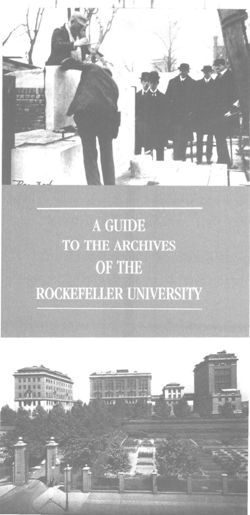
A GUIDE
TO THE ARCHIVES
OF THE
ROCKEFELLER UNIVERSITY
H+
THE ROCKEFELLER ARCHIVE CENTER
he Rocketeller I niversity Archives are
T
maintained at the Rockefeller Archive
Center a division of The Rocketeller
I niversity, located 25 miles north of Yes
York City in Pocantico Hills near Sleepy Hollow,
New York
The Archive Center was established in 19-1
to preserve and make available to researchers
the records of the l niversity the Rocketeller
Foundation the Rocketeller Brothers Fund.
members of the Rockefeller family and other
individuals and institutions associated with their
endeavors The Center's collections document
seminal developments and issues of the 20th
century Major subjects include African- American
history agriculture, the arts education inter-
national relations and economic development
labor. medicine and public health. nursing
philanthropy, politics. population religion
science the social sciences social welfare
and women's history
Scholars planning to conduct research using
the University Archives should contact Darwin
H. Stapleton Director of the Rockefeller Archive
Center. or Lee R. Hilizik | Iniversity Archivist
at the Rocketeller Archive Center
Campus Office
For the convenience of the | niversity community
the Archive Center also maintains an office on
the campus of the University in Room 118 at
Theobald Smith Hall (X8912) Staffed In
archivist Renée 1) Mastrocco the office is open
by appointment.
Additional information about the holdings
and programs of the Rockefeller Archive Center
is available online at
http://www.rockefeller.edu./archive.ctr/
THE ROCKEFELLER UNIVERSITY
The Rockefeller University, established in
1901 by John D. Rockefeller as The
Rockefeller Institute for Medical Research
(RIMR), was the first institution in the
United States devoted solely to biomedical
research. The earliest work was carried on
through grants-in-aid to researchers in
various American (and a few European)
laboratories, but that program was phased
out after the Institute's own laboratories
were opened on its New York City campus
in 1906. In 1954, the Institute became part
of the University of the State of New York
and acquired the right to confer graduate
degrees, awarding its first Ph.D. in 1959.
The Institute became The Rockefeller
University in 1965.
From the beginning the University's
research programs were aimed at develop-
ing fundamental knowledge of disease and
physiology. Research has been carried out
in interdisciplinary laboratories headed by
leading scientists, who were known for
more than fifty years as Members of the
Institute and subsequently as Professors.
A hospital was opened in 1910 and has
remained an integral part of the research
program.
The
University
1
THE UNIVERSITY ARCHIVES
The Rockefeller University Archives,
ca. 4,500 cu. ft. of documents, includes
correspondence and memoranda, reports,
laboratory notebooks, lectures and
addresses, administrative records, and
photographs and films. The material covers
all periods of the University's history,
and documents significant aspects of the
20th-century history of New York City,
of international currents in biomedical
research, and of educational and scientific
developments in the U.S.
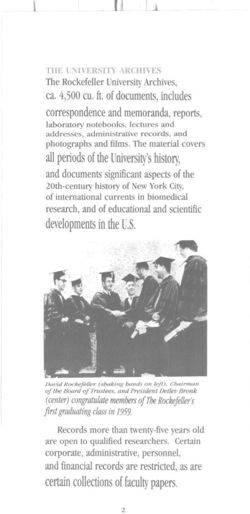
David Rockefeller (shaking bands on left), Chairman
of the Board of Trustees, and President Detlev Bronk
(center) congratulate members of The Rockefeller's
first graduating class in 1959.
Records more than twenty-five years old
are open to qualified researchers. Certain
corporate, administrative, personnel,
and financial records are restricted, as are
certain collections of faculty papers.
2
Researchers should note that additional
material related to the University and its
scientists may be located in the archives
of philanthropic foundations at the
Rockefeller Archive Center.
Descriptions of selected record groups
(RG) follow.
RG 105 REPORTS AND CORRESPONDENCE
OF THE SCIENTIFIC DIRECTORS, 1901-1937.
1 CU. FT.
RG 110 MINUTES OF THE SCIENTIFIC
DIRECTORS, 1901-1953. 10 VOLUMES.
The Board of Scientific Directors was
responsible for overseeing all research at
the Institute, including the hospital, until
merged with the Board of Trustees in 1953.
RG 130 MINUTES OF THE BOARD OF
TRUSTEES, 1910-1982. 21.8 CU. FT.
The trustees control the property and funds
of the University. In 1953 the Board of
Scientific Directors was merged with the
Board of Trustees.
RG 210 BUSINESS MANAGERS' FILES,
1906-1963. 46.4 CU. FT.
Organized by subject, these records provide
information on the day-to-day operations of
the University.
3
RG 301 SIMON FLEXNER PAPERS,
1903-1945. 3.6 CU. FT.
This collection
includes miscella-
neous administrative,
scientific, and
personal correspon-
dence of the first
director of the RIMR
(1903-1935).
Flexner (1863-
1946), a physician,
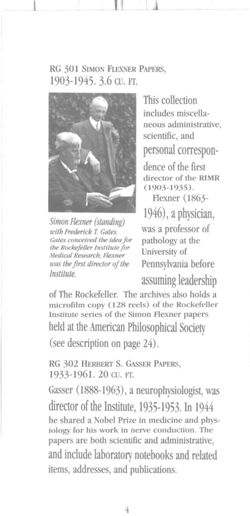
Simon Flexner (standing)
with Frederick T. Gates.
was a professor of
Gates conceived the idea for
pathology at the
the Rockefeller Institute for
Medical Research; Flexner
University of
was the first director of the
Pennsylvania before
Institute.
assuming leadership
of The Rockefeller. The archives also holds a
microfilm copy (128 reels) of the Rockefeller
Institute series of the Simon Flexner papers
held at the American Philosophical Society
(see description on page 24).
RG 302 HERBERT S. GASSER PAPERS,
1933-1961. 20 CU. FT.
Gasser (1888-1963), a neurophysiologist, was
director of the Institute, 1935-1953. In 1944
he shared a Nobel Prize in medicine and phys-
iology for his work in nerve conduction. The
papers are both scientific and administrative,
and include laboratory notebooks and related
items, addresses, and publications.
4
RG 303 DETLEV W. BRONK PAPERS,
1840-(1954-1975)-1978 115 CU. FT.
Bronk (1897-1975) was president during
the transition from Institute to University,
from 1954 to 1968. A leader in the study of
human physiology in aeronautics, he was
also a major figure in post-World War II
scientific and governmental organizations.
The collection includes significant
documentation of every phase of Bronk's
career, and major portions deal with
research, professional and government
activities, lectures and addresses, and
personal and professional correspondence.
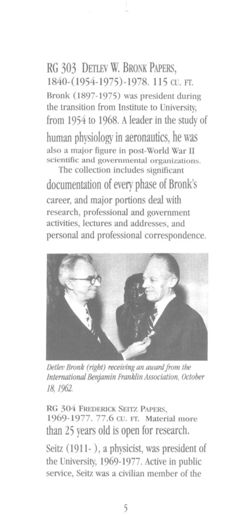
Detlev Bronk (right) receiving an award from the
International Benjamin Franklin Association, October
18, 1962.
RG 304 FREDERICK SEITZ PAPERS,
1969-1977. 77.6 CU. FT. Material more
than 25 years old is open for research.
Seitz (1911-), , a physicist, was president of
the University, 1969-1977. Active in public
service, Seitz was a civilian member of the
5
National Defense Research Committee and a
consultant to the secretary of war during World
War II. He was also a member of the President's
Science Advisory Committee, 1962-1969.
RG 341 THOMAS M. RIVERS PAPERS,
1917-1957. 2.4 CU. FT.
Rivers (1888-1962) joined the Institute in
1922 and specialized in virus research. From
1953 until his retirement in 1955 he was vice-
president of the Institute. The papers are largely
scientific and administrative, and include
documentation of Rivers' medical research in
the Pacific theater during World War II.
RG 439 SCIENTIFIC REPORTS OF THE
LABORATORIES TO THE BOARD OF SCIENTIFIC
DIRECTORS, 1901-1955. 42 VOLUMES.
Between 1901 and the reorganization of the
Institute in the mid 1950s, each laboratory,
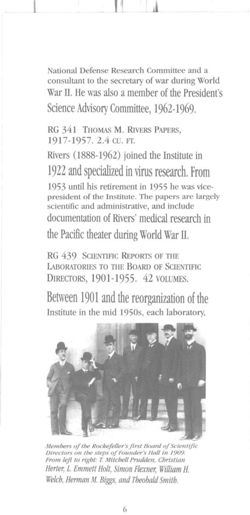
Members of the Rockefeller's first Board of Scientific
Directors on the steps of Founder's Hall in 1909.
From left to right: T. Mitchell Prudden, Christian
Herter, L. Emmett Holt, Simon Flexner, William H.
Welch, Herman M. Biggs, and Theobald Smith.
6
research group, and special program was
required to submit an annual report of its
research to the corporate body that over-
saw the Institute's scientific activities.
Together the scientific reports chronicle the
whole saga of research at the Institute and
provide a valuable snapshot of research
during any particular year. These reports
document the investigations of a number of
the early scientists whose papers have not
been preserved in the Rockefeller
University Archives or in other repositories.
RG 600-1 ANTI-VIVISECTION PAPERS,
1895-1957. 8.5 CU. FT.
The Institute's earliest leaders were con-
vinced of the usefulness of animal research
for understanding human disease and
physiology and were active in opposing
anti-vivisectionist legislation. The collection
includes correspondence and publications,
with a focus on anti-vivisection movements
during 1908-1920, but continuing to 1957.
RG 600-2 WAR DEMONSTRATION HOSPITAL
RECORDS, 1916-1920. 5 CU. FT.
During World War I, the Rockefeller
Foundation funded a military hospital
located on the Institute campus, headed
by Alexis Carrel and staffed by Institute
personnel. Research at the hospital focused
on preventing the infection of wounds, and
military physicians and nurses assigned to
the hospital received training in medical
7
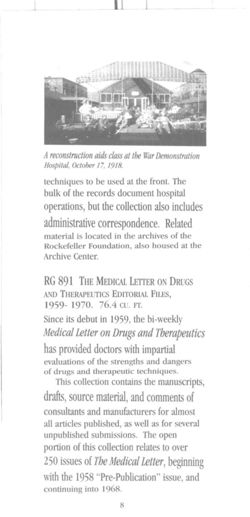
A reconstruction aids class at the War Demonstration
Hospital, October 17, 1918.
techniques to be used at the front. The
bulk of the records document hospital
operations, but the collection also includes
administrative correspondence. Related
material is located in the archives of the
Rockefeller Foundation, also housed at the
Archive Center.
RG 891 THE MEDICAL LETTER ON DRUGS
AND THERAPEUTICS EDITORIAL FILES,
1959-1970. 76.4 CU. FT.
Since its debut in 1959, the bi-weekly
Medical Letter on Drugs and Therapeutics
has provided doctors with impartial
evaluations of the strengths and dangers
of drugs and therapeutic techniques.
This collection contains the manuscripts,
drafts, source material, and comments of
consultants and manufacturers for almost
all articles published, as well as for several
unpublished submissions. The open
portion of this collection relates to over
250 issues of The Medical Letter, beginning
with the 1958 "Pre-Publication" issue, and
continuing into 1968.
8
PUPERS SELECT MEMBERS
PROFESSORS
RG 450 MEMBERS AND PROFESSORS.
The papers of members and professors are
organized alphabetically as subseries of
this record group. Laboratory heads were
designated Members of the Institute until
September 1957 and Professors thereafter.
Researchers should consult the archivists
regarding papers of members and
professors not included in this brochure.
An asterisk (*) denotes a Nobel prize recipient.
RG 450 Av37 OSWALD T. AVERY PAPERS,
1913-1983. 2.5 CU. FT.
This collection consists of articles about
Avery, awards, clippings, correspondence,
memorabilia, obituaries, photographs,
reports, reprints, and an inventory of the
Avery papers at the Tennessee State Library
and Archives.
A research physician and bacteriologist,
Avery (1877-1955) joined the RIMR as an
Assistant in 1913 and rose to the position
of Member in 1923. A ranking researcher
on pneumonia, Avery was one of the
founders of the science of immuno-
chemistry and discoverer of the
transforming nature of DNA. He retired
to Nashville, Tennessee in 1949.
9
RG 450 C232 *ALEXIS CARREL PAPERS,
1906-1983. 2 CU. FT.
This collection consists of biographical
articles, clippings, correspondence
(1906-1944), experimental notes (1909),
inquiries about Carrel (1936-1970),
photographs, and reprints.
Carrel (1873-1944), born and educated in
Lyons, France, was a physician who worked
in experimental surgery at the RIMR from
1906 until his retirement in 1939. He
perfected the technique of vascular surgery
and was awarded the Nobel prize in medicine
in 1912 for his work on the suture of blood
vessels and organ transplants. Carrel headed
the Rockefeller Foundation-sponsored War
Demonstration Hospital on the Institute's
grounds during World War I (see RG 600-2,
War Demonstration Hospital).
RG 450 C661 ALFRED E. COHN PAPERS,
1900-(1920-1954)-1980. 60 CU. FT.
The collection contains
administrative records,
clippings, correspon-
dence (both personal
and professional),
manuscripts of
Minerva's Progress
(1946) and Burden
of Disease (1950),
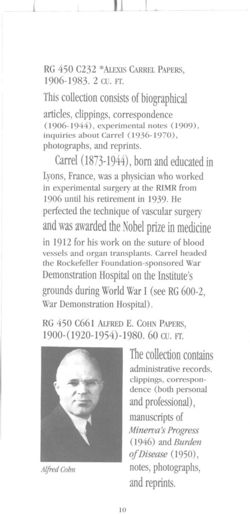
Alfred Cohn
notes, photographs,
and reprints.
10
Cohn (1879-1957), one of the first
cardiologists in the U.S., became an
associate and assistant physician at the
hospital of the RIMR in 1911. Within a
few years he became the leader of the
laboratory and clinical service devoted to
the study of heart disease, a position
he held until his retirement in 1944.
His laboratory made contributions to
knowledge in anatomy, embryology,
physiology and biochemistry, as well as
pathology and pharmacology.
Cohn took a leading role in the activities
of various organizations, and this collection
documents his activities in the New York
Heart Association, New York Academy of
Medicine, Veterans Administration, China
Medical Board, Asia Institute, Sydenham
Hospital, and the Committee for Displaced
Foreign Scholars and Displaced Foreign
Physicians.
RG 450 D851 RENÉ DUBOS PAPERS,
1900-(1927-1982)-1988. 60 CU. FT.
The collection consists of biographical
material; correspondence; drafts of
lectures, articles, and books; laboratory
notebooks; memorabilia; reprints;
photographs and slides; audio and video
cassettes; and films.
A microbiologist and experimental
pathologist, Dubos (1901-1982) joined the
RIMR as a fellow after receiving his Ph.D.
11
from Rutgers in 1927. His association with
The Rockefeller was interrupted only by
two years at Harvard (1942-1944).
He conducted research into pneumonia,
tuberculosis, and enzymes, and was instru-
mental in the development of gramicidin.
Dubos's interests extended to include
psychology, genetics, and the environment.
He was the author of numerous articles
and more than twenty books.
RG 450 H735 FRANCIS O. HOLMES PAPERS,
1923-1990. 18 CU. FT.
The first six cubic feet of correspondence
are processed and are available for use
by researchers.
Holmes (1899-1990) was a phyto-
pathologist who conducted research in
the Philippines, Puerto Rico, Hawaii, and
the Indian subcontinent. From 1923 until
1932, Holmes worked as a protozoologist
at the Boyce Thompson Institute for Plant
Research in Yonkers, New York. In 1932,
following Dr. Louis 0. Kunkel's move,
Holmes joined the faculty of the RIMR in
the Department of Plant Pathology at its
Princeton site in Hillsboro, New Jersey. In
Kunkel's laboratory, Holmes changed his
research concentration from plant protozoa
to plant viruses. His area of expertise
centered on mosaic virus diseases in
various commercial crops. He also was
a guest researcher at the Puerto Rico
Agricultural Experiment Station in Rio
Pedras, where he studied the causes of the
spread of "bunchy-top" disease in the
papaya plantations. When The Rockefeller
closed its Princeton site in 1950, Holmes
moved his research to the Institute's New
York City campus. He retired in 1965.
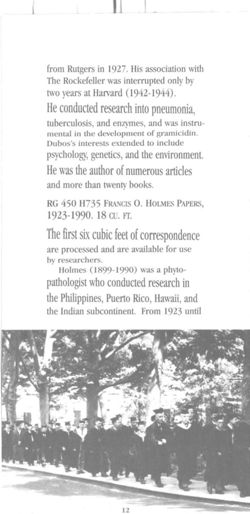
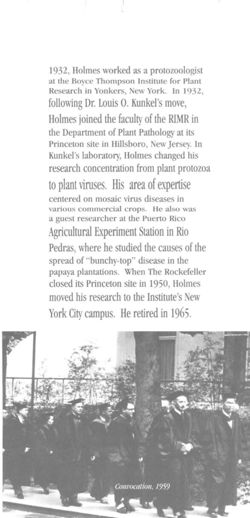
Convocation, 1959
RG 450 L221 REBECCA C. LANCEFIELD
PAPERS, 1917, (1922-1981). 12.2 CU. FT.
This collection includes biographical
material, correspondence (both personal
and professional), laboratory notebooks,
memorabilia, photographs, and reprints.
Lancefield (1895-1981), microbiologist,
was first associated with the RIMR in 1919
as a technical assistant. After beginning
graduate study at Columbia University,
she returned to The Rockefeller in 1922 as
an assistant and by 1958 had advanced to
the status of full member and professor
of microbiology. Lancefield's research
centered on immunochemical studies of
streptococcal bacteria. She developed a
classification system for hemolytic strepto-
cocci, known universally as the Lancefield
Grouping. Her classification work helped
provide the foundation for epidemiological
investigations for streptococcal disease
worldwide. During World War II,
Lancefield's laboratory supplied vast
quantities of Group A streptococcal sera
to the U.S. Armed Forces.
RG 450 L239 *KARL LANDSTEINER PAPERS,
1892-(1925-1943)-1984. 16.6 CU. FT.
The collection includes biographical
material, correspondence, subject files
and laboratory notes, manuscripts,
reprints, and lantern slides.
14
Landsteiner (1868-1943) was born in
Vienna, where he also began his medical
career in 1891 after earning an M.D from
the University of Vienna. A physician and
researcher in physiology, he demonstrated
the dependence of immunological
phenomena on chemical structure. In
1900 his studies on blood resulted in the
identification and classification of the
human blood groups A, B, AB and o, and
for this work he received the Nobel Prize in
1930. Landsteiner was affiliated with the
RIMR from 1922 until his death.
RG 450 L657 PHOEBUS A.T. LEVENE
PAPERS, 1905-1940. 7.2 CU. FT.
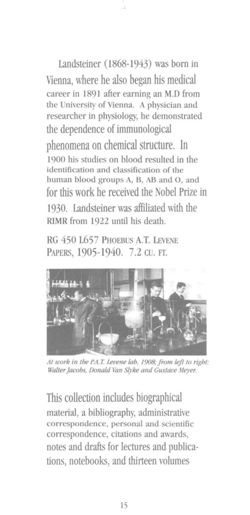
At work in the P.A.T. Levene lab, 1908; from left to right:
Walter Jacobs, Donald Van Slyke and Gustave Meyer.
This collection includes biographical
material, a bibliography, administrative
correspondence, personal and scientific
correspondence, citations and awards,
notes and drafts for lectures and publica-
tions, notebooks, and thirteen volumes
15
of reprints. A corresponding photographic
collection contains thirty items.
Levene (1869-1940), born and educated
in Russia, was a biochemist noted for his
extensive research on the chemistry of
nucleic acids, proteins, and amino acids.
Following graduation from a medical
academy in 1892, Levene joined his family in
the U.S. and practiced medicine on New
York's Lower East Side until 1896, when he
contracted tuberculosis and decided upon a
career in biochemical research. He served
as a Member of the RIMR from 1905 until
his retirement in 1939.
RG 450 L667 *FRITZ LIPMANN PAPERS,
1924-1986. 56.3 CU. FT.
The collection contains personal papers,
laboratory and lecture notes, and
manuscripts.
Lipmann (1899-1986) was born in
Germany and earned an M.D. (1924) and
Ph.D. in chemistry from the University of
Berlin. He came to the U.S. in 1939 and
worked at the Cornell
Medical School and
Massachusetts General
Hospital before
joining The Rockefeller
in 1957, four years after
receiving the Nobel
Prize for his discovery
of Coenzyme A and its
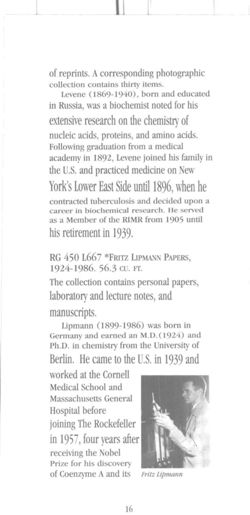
Fritz Lipmann
16
recognition as one of the most important
substances in body metabolism. At
Rockefeller, Lipmann worked with charged
tRNAs and moved into the field of elonga-
tion factors in ribosomal protein synthesis.
RG 450 L823 JACQUES LOEB PAPERS,
1906-1924. 0.6 CU. FT.
This collection includes biographical
material, a bibliography, correspondence
(1906-1924), memorials and tributes,
articles about Loeb, photographs, reprints,
and an inventory of the Jacques Loeb
papers at the Library of Congress.
Loeb (1859-1924), born and educated
in Germany, was a leading proponent of
the mechanistic conception of biology who
served as a Member of the RIMR from
1910 until his death. His scientific work
was stimulated by his philosophical
concern with the freedom of the will, and
his search for a mechanistic explanation
for animal conduct led to research on
animal tropisms and to applications of
physical chemistry theories to biology.
RG 450 M679 ALFRED MIRSKY PAPERS,
1915-(1936-1975)-1986. 29 CU. FT.
This collection includes administrative
records, biographical material, correspon-
dence (both personal and professional),
manuscripts of published papers and
17
lectures, laboratory notes, photographs and
slides, programs, and reports.
Mirsky (1900-1974) was a biochemist
and physiologist at The Rockefeller from
1927 until his death. His research interests
focused on the nature of proteins and prop-
erties of the cell nucleus. Mirsky was one of
the first scientists to isolate and characterize
the Messenger RNA as genetic material in
mammalian cells. As chairman of the
Faculty Committee on Educational Policies,
he helped shape policies in restructuring
the RIMR into a graduate university. Mirsky
was also active in furthering the publication
of scientific literature through book
publishing and as a consultant to Scientific
American.
RG 450 M786 *STANFORD MOORE PAPERS,
1930-1984.
This inventoried collection includes subject
files, laboratory notebooks, memorabilia,
degrees and awards, lecture notes, photos,
reprints, and correspondence. Partially
restricted while processing is in progress.
Moore (1913-1982), a biochemist who
joined The Rockefeller in 1939, investigated
the chemistry of proteins and carbohydrates
and analyzed the composition of amino
acids. Moore's research focused on the
relationship between protein's chemical
structure and its biological action.
18
RG 450 N689 HIDEYO NOGUCHI PAPERS,
(1900-1928)-1976. 2.4 CU. FT.
This collection includes biographical
material, a bibliography, correspondence
(1900-1928), condolences and memorials,
newspapers and magazine articles about
Noguchi, photographs, and four volumes
of reprints of his writings. Much of the
collection is posthumous material about
Noguchi.
Noguchi (1876-1928), born and
educated in Japan, gained great fame as a
scientist in America, where he joined the
RIMR (1904-1928). After early research
on snake venoms, Noguchi became the first
scientist to demonstrate that paralysis
resulted from syphilis; was the first to grow
pure cultures of spirochetes; and made
significant contributions toward the under-
standing of Carrion's disease. He worked
on yellow fever later in his career and
believed he had isolated its causative agent
Hideyo Noguchi in the laboratory, 1922
19
and developed a vaccine. When these
findings were challenged, Noguchi pursued
his research, only to contract the fatal
disease himself.
The Rockefeller Foundation provided
financial support for Noguchi's research,
and related material is located in its
archives, also located at the Rockefeller
Archive Center.
RG 450 P422 GERTRUDE E. PERLMANN
PAPERS, 1927, 1933, (1935-1974).
30 CU. FT.
This collection includes administrative
records, biographical material, conference
material, correspondence (both personal
and professional), glass slides, laboratory
notes, manuscripts and drafts of
manuscripts, memorabilia, photographs,
and reports.
Perlmann (1912-1974), an authority in
the field of protein chemistry, was affiliated
with The Rockefeller from 1947 until her
death. She was noted for her research
on the chemical structure of pepsin, an
enzyme that speeds food digestion, and for
demonstrating its ability to break down
food. Perlmann also took an interest in
scientific developments in Israel. In 1960,
she was visiting professor at the Weizmann
Institute in Rechovot at the laboratory of
Ephraim Katchalski (who was later the
president of Israel, Ephraim Katzir).
20
RG 450 ST34 *WILLIAM H. STEIN PAPERS,
1937-1980. 26.0 CU. FT.
The collection includes correspondence,
manuscripts, laboratory notes, lectures,
subject files, administrative records, and
audiovisual material.
Stein (1911-1980) was affiliated with
The Rockefeller throughout his profes-
sional career. He began as a volunteer in
Max Bergmann's laboratory in 1937, joined
the staff in 1938, and became a Member in
1952. His research focused on questions
in protein chemistry. He studied the rela-
tionships between the chemical structures
of proteins and their biological functions.
Stein collaborated extensively with his
Rockefeller colleague, Stanford Moore,
and in 1959 they succeeded for the first
time to decipher the complete chemical
structure of ribonuclease. Stein and
Moore were awarded the Nobel Prize in
Chemistry in 1972 for their investigations
on the structure and activity of ribonucle-
ase.
RG 450 T189 *EDWARD L. TATUM PAPERS,
1931-(1930-1975)-1979. 23 CU. FT.
This collection includes biographical
material, correspondence (both personal
and professional), film, laboratory notes,
manuscripts of published papers and
lectures, memorabilia, photographs and
slides, and reprints.
21
Tatum (1909-1975), a biochemical
geneticist, was a Member and Professor at
The Rockefeller from 1957 until his death.
He had earlier been associated with
Stanford University (1937-1945, 1948-
1957) and Yale University (1945-1948).
Tatum's field of research was the study of
the genetics and metabolism of bacteria,
yeast, and molds. Some of his most
significant research accomplishments
included the discovery of biochemical
mutations in Neurospora (with George W.
Beadle); biochemical mutation in bacteria;
and gene recombination in Escherichia
coli, both of the latter two research
projects in association with Joshua S.
Lederberg. In recognition of his work,
Tatum shared the 1958 Nobel Prize in
medicine and physiology with Beadle
and Lederberg for their contributions to
biochemical genetics.
RG 450 U600 GEORGE E. UHLENBECK
PAPERS, 1925-1988. 6.8 CU. FT.
The collection consists of reprints,
correspondence and general office files.
Uhlenbeck (1900-1988) was a
theoretical physicist best known for his
contributions to the study of atomic
structure, quantum and statistical
22
mechanics, the kinetic theory of matter,
and nuclear physics. Uhlenbeck joined
The Rockefeller in 1961 and contributed to
the development of its theoretical physics
faculty. He retired in 1974.
RG 450 W436 PAUL A. WEISS PAPERS,
1922-1980. 48 CU. FT.
The collection includes correspondence,
photographs and slides, course syllabi,
reprints, manuscripts, and lecture books.
Weiss (1898-1989) conducted impor-
tant research on the vertebrate nervous
system that contributed to the development
of neurobiology. After years of teaching and
research in his native Vienna and at Yale
University and the University of Chicago,
he joined The Rockefeller in 1954 and for
the next decade directed a laboratory of
developmental biology, specializing in
research in wound healing, cancer, and the
development and repair of the nervous
system. After 1964 he alternated research
at Rockefeller with visiting professorships
at other universities.
*Denotes Nobel prize recipient.
23
RAC SPECIAL COLLECTION
SIMON FLEXNER PAPERS, 1891-1946.
128 REELS OF MICROFILM.
This collection consists of microfilm of the
Rockefeller Institute series of the Flexner
Papers in the American Philosophical
Society collection. A register for the
complete collection is available at the
Archive Center.
Flexner (1863-1946) was a physician,
administrator, professor of pathology at the
University of Pennsylvania, first director of
the RIMR (1901-1935), a trustee of the
Rockefeller Foundation, and a friend and
advisor to John D. Rockefeller, Jr.
The papers reflect almost every
movement in the organization of medical
science in the first half of the 20th century
and are rich in social, cultural, and
educational history. The collection includes
correspondence, diaries, drafts of articles,
and speeches. Subjects covered include
epidemics in the U.S., immunology,
medical sciences, and poliomyelitis.
See also RG 301 above.
24
The Rockefeller Archive Center
A division of The Rockefeller University
15 Dayton Avenue
Sleepy Hollow, New York 10591-1598
Telephone (914) 631-4505
http://www.rockefeller.edu./archive.ctr/
e-mail: : archive@rockvax.rockefeller.edu
May 2000
MAJOR
ROCKEFELLER
ORGANIZATIONAL
ARCHIVE CENTER
COLLECTIONS
RECORDS
STAFF
ROCKEFELLER FAMILY ARCHIVES
ROCKEFELLER BROTHERS FUND ARCHIVES
Includes the following major record groups:
Established in 1940, the RBF has been interested in
In addition to its major collections, the Center's
DARWIN H. STAPLETON, Ph.D., Direc
cultural advancement, education, health, religion,
holdings include the papers of a number of individuals
John D. Rockefeller Papers, 1855-1942
welfare, international relations and understanding,
associated with Rockefeller philanthropy and the
MONICA S. BLANK, B.A., Archivist
conservation, population control, and racial equality.
records of the organizations listed below.
Office of the Messrs Rockefeller, General Files, 1890-
MINDY S. GORDON, M.S., Archivist
Includes correspondence, reports, grant files, and
1961
Special Studies Project files. Project files over 10 years
Agricultural Development Council
Includes the correspondence and project files of John
LEE R. HILTZIK, Ph.D., University Arch
old are open for research.
American International Association for Economic
D. Rockefeller, John D. Rockefeller, Jr., his sons,
and Social Development
MICHELE HILTZIK, M.L.A., Archivis
and associates. Also includes the personal papers of
COMMONWEALTH FUND ARCHIVES
Arts, Education and Americans Panel
John D. Rockefeller, Jr. and his wife, Abby Aldrich
Rockefeller.
Established in 1918 by Mrs. Stephen V. Harkness for
Asia Society
MILISSA B. KAFES, M.S., Archivist
"benevolent, religious, educational and like purposes."
Bureau of Social Hygiene
Abby R. Mauze Papers, 1903-1976
Includes General Directors' reports; division files for the
China Medical Board of New York
JOHN LeGLOAHEC, M.L.S., Archivis
child guidance/welfare, legal research, mental hygiene,
Council on Foundations
John D. Rockefeller 3rd Papers, 1906-1978
public health, and rural hospitals programs; grant files;
ERWIN LEVOLD, Ph.D., Archivist
Charles E. Culpeper Foundation
medical fellowship files; annual reports; and Harkness
Davison Fund
RENÉE MASTROCCO, M.A.,
Nelson A. Rockefeller Papers, 1930-1979
family papers.
General Education Board
Archivist at Rockefeller University
Processing in progress. 1,232 cu. ft. of papers,
photographs, films, and sound recording currently
Historic Hudson Valley
RUSSELL SAGE FOUNDATION RECORDS
HAROLD W. OAKHILL, M.A., Archivi
open to researchers.
Established in 1907 by Margaret Olivia Sage for the
International Basic Economy Corporation
"improvement of social and living conditions in the
International Education Board
MICHELLE M. POWERS, B.A.L.A.,
Winthrop Rockefeller Papers, 1911-1973
United States." Includes correspondence, reports,
JDR 3rd Fund
Assistant Archivist
On microfilm. Major portions restricted.
meeting agenda and minutes, annual reports, financial
Lucille P. Markey Charitable Trust
statements, clippings, pamphlets, brochures, and Mrs.
Laura Spelman Rockefeller Memorial
SHARON PULLEN, M.S.,
ROCKEFELLER UNIVERSITY ARCHIVES
Sage's personal office correspondence.
Martha Baird Rockefeller Fund for Music
Assistant Archivist
Established as The Rockefeller Institute for Medical
Memorial Sloan-Kettering Cancer Center
Research in 1901, it was the first American institu-
JOHN AND MARY MARKLE FOUNDATION ARCHIVES
CAROL RADOVICH, B.A., Archivist
Population Council
tion devoted solely to medical research. Includes the
Established in 1927 "to promote the general good of
Rockefeller Sanitary Commission for the
reports to the Board of Scientific Directors, administra-
KENNETH W. ROSE, Ph.D.,
mankind," its programs have focused on support for
Eradication of Hookworm Disease
Assistant to the Director
tive correspondence, business managers' files, and the
medical research (1936-1949), the Markle Scholar
personal and scientific papers of numerous former
Sealantic Fund
Program to promote medical research and teaching
faculty and administrators. Most corporate records over
(1947-1969), and mass communications.
Spelman Fund of New York
THOMAS E. ROSENBAUM, M.A., Arch
25 years old are open for research.
Union Tank Car Company
CHARLOTTE L. STURM, B.A.,
SOCIAL SCIENCE RESEARCH COUNCIL ARCHIVES
Woodrow Wilson National Fellowship Foundation
Assistant Project Archivist
ROCKEFELLER FOUNDATION ARCHIVES
Incorporated in 1924 to advance research in the social
Established in 1913, the RF has conducted a world-
sciences, the SSRC has conducted much of its work
Some material is restricted.
LARISSA D. WOO, M.S., Project Archi
wide program in agricultural development, education,
through committees, which set research priorities, award
the natural and social sciences, public health and the
fellowships and research grants, and sponsor confer-
arts and humanities. Includes programs and policy
ences and publications. The bulk of the collection
ADMINISTRATIVE STAFF
CUSTODIAL ST
consists of committee files.
files, grant files, general correspondence and
Pecolia Allston-Rieder
Elias Siguen
financial records. Project files over 20 years old are
Marie Callahan
Felix Yumar
open for research.
Camilla Harris
Roseann Variano
ROCKEFELLER
THE
T
HE ROCKEFELLER ARCHIVE CENTER,
RESEARCH SUPPORT PROGRAM
ARCHIVE CENTER
a division of The Rockefeller University,
ROCKEFELLER
The Center's Grant-in-Aid program offers support to
GOVERNING COUNCIL
was created in 1974 to assemble, process,
scholars in any discipline who are engaged in
ARCHIVE CENTER
and make available for scholarly research the
research that requires extensive use of the archival
archival collections of members of the Rockefeller
collections housed at the Center. Applications for
family and of various philanthropic and educational
this competitive program must include a budget
GEORGE C. BOND
institutions they have founded, including The
that details estimated expenses for travel, temporary
Professor, Program in Applied Anthropology
Rockefeller University, the Rockefeller Foundation,
lodging, meals, and research. Scholars from the
and the Rockefeller Brothers Fund. Seven non-
Teachers College, Columbia University
United States and Canada may apply for grants of
Rockefeller institutions have added their records to the
up to $2,500; because of the additional cost of
CRAIG CALHOUN
Center's collections since 1985.
travel, scholars from outside the U.S. and Canada
President, Social Science Research Ccouncil
may request up to $3,000. Special grants-in-aid
The Center's 66 million pages of documents,
and residences for targeted subject areas are
ELLEN F. FITZPATRICK
500,000 photographs, and 2,000 films provide
announced annually. The deadline for application
Associate Professor of History
unique insights into worldwide developments and
is November 30th, and recipients are announced in
University of New Hampshire
issues of the 19th and 20th centuries. More than
March.
3,000 scholars have conducted research at the Center,
EDIE HEDLIN
and many of them have produced books, articles,
CONFERENCES AND PUBLICATIONS
Director, Smithsonian Institution Archives
dissertations and films based on the Center's
The Center sponsors occasional seminars and
collections.
JULES HIRSCH
conferences on topics related to its holdings and
Professor and Senior Lab Physician
seeks to publish the proceedings. The Center has
Major subjects researched at the Center include
The Rockefeller University
published general guides to its manuscripts and
agriculture, the arts, African-American history,
records and to its photograph collections, as well as
education, international relations and economic
ROBERT E. KOHLER
surveys of its holdings related to specific subjects.
Professor of History and Sociology of Science
development, labor, medicine, philanthropy, politics,
The Center issues a Newsletter in the fall and
University of Pennsylvania
population, religion, science, the social sciences,
Research Reports from the Rockefeller Archive
social welfare and women's history.
Center each spring. Many of the publications are
ELLEN CONDLIFFE LAGEMANN
available online.
Professor of History and Education and Director,
Scholars interested in conducting research at the
Center for the Study of American Culture and Education
Center should write to the Director, describing their
ONLINE DESCRIPTION
New York University
projects in specific terms. The staff will respond with
The Center's collections are described in RLIN and
a description of the scope and content of relevant
ALICE LUSTIG
materials in the collections.
on the Center's home page on the World Wide
Executive Vice President and Chief Operating Officer
Web, which contains information about archival
15 Dayton Avenue
The Rockefeller University
and manuscript holdings, research services, the
LOCATION AND ACCESS
Sleepy Hollow, New York 10591-1598
grant program, and publications.
The Rockefeller Archive Center is located 25 miles
(914) 631-4505
BRUCE MAZLISH
See http://www.rockefeller.edu/archive.ctr/
north of New York City in Sleepy Hollow, New York.
Professor of History, Massachusetts Institute of Technology
Metro North Hudson Line trains from Grand Central
Rockefeller Family Representative
w:http://www.rockefeller.edu/archive.ct
INTERLIBRARY LOAN
Station to Tarrytown (40 minutes) and major highways
JOYCE L. MOOCK
provide access to the Center. The Reading Room is
Microfilm editions of selected collections are
email: archive@rockvax.rockefeller.edu
open to researchers on weekdays from 9:00 A.M. until
available through interlibrary loan. Contact the
Associate Vice President, The Rockefeller Foundation
4:45 P.M., and on one Saturday each month. An
Center for details.
BENJAMIN R. SHUTE, Jr., Council Chair
information packet, which includes a map, a listing of
The
Secretary and Treasurer
holiday closings and Saturday openings, and local
Rockefeller
Rockefeller Brothers Fund
housing accommodations, is available upon request and
University
online.
Rev. 3/2000
STEVEN C. WHEATLEY
Director of Programs
American Council of Learned Societies
ROCKEFELLER
THE
T
HE ROCKEFELLER ARCHIVE CENTER,
RESEARCH SUPPORT PROGRAM
ARCHIVE CENTER
a division of The Rockefeller University,
ROCKEFELLER
The Center's Grant-in-Aid program offers support to
GOVERNING COUNCIL
was created in 1974 to assemble, process,
scholars in any discipline who are engaged in
ARCHIVE CENTER
and make available for scholarly research the
research that requires extensive use of the archival
archival collections of members of the Rockefeller
collections housed at the Center. Applications for
family and of various philanthropic and educational
this competitive program must include a budget
institutions they have founded, including The
GEORGE C. BOND
that details estimated expenses for travel, temporary
Professor, Program in Applied Anthropology
Rockefeller University, the Rockefeller Foundation,
lodging, meals, and research. Scholars from the
and the Rockefeller Brothers Fund. Seven non-
Teachers College, Columbia University
United States and Canada may apply for grants of
Rockefeller institutions have added their records to the
up to $2,500; because of the additional cost of
CRAIG CALHOUN
Center's collections since 1985.
travel, scholars from outside the U.S. and Canada
President, Social Science Research Ccouncil
may request up to $3,000. Special grants-in-aid
The Center's 66 million pages of documents,
and residences for targeted subject areas are
ELLEN FITZPATRICK
500,000 photographs, and 2,000 films provide
announced annually. The deadline for application
Associate Professor of History
unique insights into worldwide developments and
is November 30th, and recipients are announced in
University of New Hampshire
issues of the 19th and 20th centuries. More than
March.
3,000 scholars have conducted research at the Center,
EDIE HEDLIN
and many of them have produced books, articles,
CONFERENCES AND PUBLICATIONS
Director, Smithsonian Institution Archives
dissertations and films based on the Center's
The Center sponsors occasional seminars and
collections.
JULES HIRSCH
conferences on topics related to its holdings and
Professor and Senior Lab Physician
seeks to publish the proceedings. The Center has
Major subjects researched at the Center include
The Rockefeller University
published general guides to its manuscripts and
agriculture, the arts, African-American history,
records and to its photograph collections, as well as
education, international relations and economic
ROBERT E. KOHLER
surveys of its holdings related to specific subjects.
Professor of History and Sociology of Science
development, labor, medicine, philanthropy, politics,
The Center issues a Newsletter in the fall and
University of Pennsylvania
population, religion, science, the social sciences,
Research Reports from the Rockefeller Archive
social welfare and women's history.
Center each spring. Many of the publications are
ELLEN CONDLIFFE LAGEMANN
available online.
Professor of History and Education and Director,
Scholars interested in conducting research at the
Center for the Study of American Culture and Education
Center should write to the Director, describing their
ONLINE DESCRIPTION
New York University
projects in specific terms. The staff will respond with
The Center's collections are described in RLIN and
a description of the scope and content of relevant
ALICE LUSTIG
materials in the collections.
on the Center's home page on the World Wide
Web, which contains information about archival
Executive Vice President and Chief Operating Officer
15 Dayton Avenue
The Rockefeller University
and manuscript holdings, research services, the
LOCATION AND ACCESS
Sleepy Hollow, New York 10591-1598
grant program, and publications.
The Rockefeller Archive Center is located 25 miles
(914) 631-4505
BRUCE MAZLISH
See http://www.rockefeller.edu/archive.ctr/
north of New York City in Sleepy Hollow, New York.
Professor of History, Massachusetts Institute of Technology
Metro North Hudson Line trains from Grand Central
Rockefeller Family Representative
ww:http://www.rockefeller.edu/archive.
INTERLIBRARY LOAN
Station to Tarrytown (40 minutes) and major highways
:archive@rockvax.rockefeller.edu
provide access to the Center. The Reading Room is
Microfilm editions of selected collections are
JOYCE L. MOOCK
open to researchers on weekdays from 9:00 A.M. until
available through interlibrary loan. Contact the
Associate Vice President, The Rockefeller Foundation
Center for details.
4:45 P.M., and on one Saturday each month. An
BENJAMIN R. SHUTE, Jr., Council Chair
information packet, which includes a map, a listing of
The
Secretary and Treasurer
holiday closings and Saturday openings, and local
Rockefeller
Rockefeller Brothers Fund
housing accommodations, is available upon request and
University
1901
online.
Rev. 3/2000
STEVEN C. WHEATLEY
Director of Programs
American Council of Learned Societies
MAJOR
ROCKEFELLER
ORGANIZATIONAL
COLLECTIONS
ARCHIVE CENTER
RECORDS
STAFF
ROCKEFELLER FAMILY ARCHIVES
ROCKEFELLER BROTHERS FUND ARCHIVES
Includes the following major record groups:
Established in 1940, the RBF has been interested in
In addition to its major collections, the Center's
DARWIN H. STAPLETON, Ph.D., Directo
cultural advancement, education, health, religion,
holdings include the papers of a number of individuals
John D. Rockefeller Papers, 1855-1942
welfare, international relations and understanding,
associated with Rockefeller philanthropy and the
MONICA S. BLANK, B.A., Archivist
conservation, population control, and racial equality.
records of the organizations listed below.
Office of the Messrs Rockefeller, General Files, 1890-
MINDY S. GORDON, M.S., Archivist
Includes correspondence, reports, grant files, and
1961
Special Studies Project files. Project files over 10 years
Agricultural Development Council
Includes the correspondence and project files of John
American International Association for Economic
LEE R. HILTZIK, Ph.D., University Archiv
old are open for research.
D. Rockefeller, John D. Rockefeller, Jr., his sons,
and Social Development
and associates. Also includes the personal papers of
MICHELE HILTZIK, M.L.A., Archivist
COMMONWEALTH FUND ARCHIVES
Arts, Education and Americans Panel
John D. Rockefeller, Jr. and his wife, Abby Aldrich
Rockefeller.
Established in 1918 by Mrs. Stephen V. Harkness for
Asia Society
MILISSA B. KAFES, M.S., Archivist
"benevolent, religious, educational and like purposes."
Bureau of Social Hygiene
Abby R. Mauze Papers, 1903-1976
Includes General Directors' reports; division files for the
China Medical Board of New York
JOHN LeGLOAHEC, M.L.S., Archivist
child guidance/welfare, legal research, mental hygiene,
Council on Foundations
John D. Rockefeller 3rd Papers, 1906-1978
public health, and rural hospitals programs; grant files;
ERWIN LEVOLD, Ph.D., Archivist
Charles E. Culpeper Foundation
medical fellowship files; annual reports; and Harkness
Davison Fund
Nelson A. Rockefeller Papers, 1930-1979
family papers.
RENÉE MASTROCCO, M.A.,
Processing in progress. 1,232 cu. ft. of papers,
General Education Board
Archivist at Rockefeller University
photographs, films, and sound recording currently
RUSSELL SAGE FOUNDATION RECORDS
Historic Hudson Valley
open to researchers.
Established in 1907 by Margaret Olivia Sage for the
International Basic Economy Corporation
HAROLD W. OAKHILL, M.A., Archivist
"improvement of social and living conditions in the
International Education Board
MICHELLE M. POWERS, B.A.L.A.,
Winthrop Rockefeller Papers, 1911-1973
United States." Includes correspondence, reports,
JDR 3rd Fund
Assistant Archivist
On microfilm. Major portions restricted.
meeting agenda and minutes, annual reports, financial
Lucille P. Markey Charitable Trust
statements, clippings, pamphlets, brochures, and Mrs.
Laura Spelman Rockefeller Memorial
SHARON PULLEN, M.S.,
ROCKEFELLER UNIVERSITY ARCHIVES
Sage's personal office correspondence.
Martha Baird Rockefeller Fund for Music
Assistant Archivist
Established as The Rockefeller Institute for Medical
Memorial Sloan-Kettering Cancer Center
Research in 1901, it was the first American institu-
JOHN AND MARY MARKLE FOUNDATION ARCHIVES
CAROL RADOVICH, B.A., Archivist
tion devoted solely to medical research. Includes the
Population Council
Established in 1927 "to promote the general good of
reports to the Board of Scientific Directors, administra-
Rockefeller Sanitary Commission for the
mankind," its programs have focused on support for
KENNETH W. ROSE, Ph.D.,
tive correspondence, business managers' files, and the
Eradication of Hookworm Disease
Assistant to the Director
medical research (1936-1949), the Markle Scholar
personal and scientific papers of numerous former
Program to promote medical research and teaching
Sealantic Fund
faculty and administrators. Most corporate records over
(1947-1969), and mass communications.
Spelman Fund of New York
THOMAS E. ROSENBAUM, M.A., Archivi
25 years old are open for research.
Union Tank Car Company
CHARLOTTE L. STURM, B.A.,
SOCIAL SCIENCE RESEARCH COUNCIL ARCHIVES
Woodrow Wilson National Fellowship Foundation
Assistant Project Archivist
ROCKEFELLER FOUNDATION ARCHIVES
Incorporated in 1924 to advance research in the social
Established in 1913, the RF has conducted a world-
sciences, the SSRC has conducted much of its work
Some material is restricted.
LARISSA D. WOO, M.S., Project Archivis
wide program in agricultural development, education,
through committees, which set research priorities, award
the natural and social sciences, public health and the
fellowships and research grants, and sponsor confer-
arts and humanities. Includes programs and policy
ences and publications. The bulk of the collection
ADMINISTRATIVE STAFF
CUSTODIAL STAFF
files, grant files, general correspondence and
consists of committee files.
Pecolia Allston-Rieder
financial records. Project files over 20 years old are
Elias Siguenza
Marie Callahan
Felix Yumart
open for research.
Camilla Harris
Roseann Variano
MAJOR
ROCKEFELLER
ORGANIZATIONAL
COLLECTIONS
ARCHIVE CENTER
RECORDS
STAFF
ROCKEFELLER FAMILY ARCHIVES
ROCKEFELLER BROTHERS FUND ARCHIVES
Includes the following major record groups:
Established in 1940, the RBF has been interested in
In addition to its major collections, the Center's
DARWIN H. STAPLETON, Ph.D., Directo
cultural advancement, education, health, religion,
holdings include the papers of a number of individuals
John D. Rockefeller Papers, 1855-1942
welfare, international relations and understanding,
associated with Rockefeller philanthropy and the
MONICA S. BLANK, B.A., Archivist
conservation, population control, and racial equality.
records of the organizations listed below.
Office of the Messrs Rockefeller, General Files, 1890-
MINDY S. GORDON, M.S., Archivist
Includes correspondence, reports, grant files, and
1961
Special Studies Project files. Project files over 10 years
Agricultural Development Council
Includes the correspondence and project files of John
American International Association for Economic
LEE R. HILTZIK, Ph.D., University Archiv
old are open for research.
D. Rockefeller, John D. Rockefeller, Jr., his sons,
and Social Development
and associates. Also includes the personal papers of
MICHELE HILTZIK, M.L.A., Archivist
COMMONWEALTH FUND ARCHIVES
Arts, Education and Americans Panel
John D. Rockefeller, Jr. and his wife, Abby Aldrich
Rockefeller.
Established in 1918 by Mrs. Stephen V. Harkness for
Asia Society
MILISSA B. KAFES, M.S., Archivist
"benevolent, religious, educational and like purposes."
Bureau of Social Hygiene
Abby R. Mauze Papers, 1903-1976
Includes General Directors' reports; division files for the
China Medical Board of New York
JOHN LeGLOAHEC, M.L.S., Archivist
child guidance/welfare, legal research, mental hygiene,
Council on Foundations
John D. Rockefeller 3rd Papers, 1906-1978
public health, and rural hospitals programs; grant files;
ERWIN LEVOLD, Ph.D., Archivist
Charles E. Culpeper Foundation
medical fellowship files; annual reports; and Harkness
Davison Fund
Nelson A. Rockefeller Papers, 1930-1979
family papers.
RENÉE MASTROCCO, M.A.,
General Education Board
Processing in progress. 1,232 cu. ft. of papers,
Archivist at Rockefeller University
photographs, films, and sound recording currently
RUSSELL SAGE FOUNDATION RECORDS
Historic Hudson Valley
open to researchers.
Established in 1907 by Margaret Olivia Sage for the
International Basic Economy Corporation
HAROLD W. OAKHILL, M.A., Archivist
"improvement of social and living conditions in the
International Education Board
MICHELLE M. POWERS, B.A.L.A.,
Winthrop Rockefeller Papers, 1911-1973
United States." Includes correspondence, reports,
JDR 3rd Fund
Assistant Archivist
On microfilm. Major portions restricted.
meeting agenda and minutes, annual reports, financial
Lucille P. Markey Charitable Trust
statements, clippings, pamphlets, brochures, and Mrs.
Laura Spelman Rockefeller Memorial
SHARON PULLEN, M.S.,
ROCKEFELLER UNIVERSITY ARCHIVES
Sage's personal office correspondence.
Martha Baird Rockefeller Fund for Music
Assistant Archivist
Established as The Rockefeller Institute for Medical
Memorial Sloan-Kettering Cancer Center
Research in 1901, it was the first American institu-
JOHN AND MARY MARKLE FOUNDATION ARCHIVES
CAROL RADOVICH, B.A., Archivist
Population Council
tion devoted solely to medical research. Includes the
Established in 1927 "to promote the general good of
reports to the Board of Scientific Directors, administra-
Rockefeller Sanitary Commission for the
mankind," its programs have focused on support for
KENNETH W. ROSE, Ph.D.,
tive correspondence, business managers' files, and the
Eradication of Hookworm Disease
Assistant to the Director
medical research (1936-1949), the Markle Scholar
personal and scientific papers of numerous former
Sealantic Fund
Program to promote medical research and teaching
faculty and administrators. Most corporate records over
(1947-1969), and mass communications.
Spelman Fund of New York
THOMAS E. ROSENBAUM, M.A., Archivi
25 years old are open for research.
Union Tank Car Company
CHARLOTTE L. STURM, B.A.,
SOCIAL SCIENCE RESEARCH COUNCIL ARCHIVES
Woodrow Wilson National Fellowship Foundation
Assistant Project Archivist
ROCKEFELLER FOUNDATION ARCHIVES
Incorporated in 1924 to advance research in the social
Established in 1913, the RF has conducted a world-
sciences, the SSRC has conducted much of its work
Some material is restricted.
LARISSA D. WOO, M.S., Project Archivis
wide program in agricultural development, education,
through committees, which set research priorities, award
the natural and social sciences, public health and the
fellowships and research grants, and sponsor confer-
arts and humanities. Includes programs and policy
ences and publications. The bulk of the collection
ADMINISTRATIVE STAFF
CUSTODIAL STAFF
files, grant files, general correspondence and
consists of committee files.
Pecolia Allston-Rieder
financial records. Project files over 20 years old are
Elias Siguenza
Marie Callahan
Felix Yumart
open for research.
Camilla Harris
Roseann Variano
ROCKEFELLER
THE
T
ROCKEFELLER ARCHIVE CENTER,
RESEARCH SUPPORT PROGRAM
ARCHIVE CENTER
a division of The Rockefeller University,
ROCKEFELLER
The Center's Grant-in-Aid program offers support to
GOVERNING COUNCIL
was created in 1974 to assemble, process,
scholars in any discipline who are engaged in
ARCHIVE CENTER
and make available for scholarly research the
research that requires extensive use of the archival
archival collections of members of the Rockefeller
collections housed at the Center. Applications for
family and of various philanthropic and educational
this competitive program must include a budget
institutions they have founded, including The
GEORGE C. BOND
that details estimated expenses for travel, temporary
Rockefeller University, the Rockefeller Foundation,
Professor, Program in Applied Anthropology
lodging, meals, and research. Scholars from the
and the Rockefeller Brothers Fund. Seven non-
Teachers College, Columbia University
United States and Canada may apply for grants of
Rockefeller institutions have added their records to the
up to $2,500; because of the additional cost of
CRAIG CALHOUN
Center's collections since 1985.
travel, scholars from outside the U.S. and Canada
President, Social Science Research Cooncil
may request up to $3,000. Special grants-in-aid
The Center's 66 million pages of documents,
and residences for targeted subject areas are
ELLEN F. FITZPATRICK
500,000 photographs, and 2,000 films provide
announced annually. The deadline for application
Associate Professor of History
unique insights into worldwide developments and
is November 30th, and recipients are announced in
University of New Hampshire
issues of the 19th and 20th centuries. More than
March.
3,000 scholars have conducted research at the Center,
EDIE HEDLIN
and many of them have produced books, articles,
CONFERENCES AND PUBLICATIONS
Director, Smithsonian Institution Archives
dissertations and films based on the Center's
The Center sponsors occasional seminars and
collections.
JULES HIRSCH
conferences on topics related to its holdings and
Professor and Senior Lab Physician
seeks to publish the proceedings. The Center has
Major subjects researched at the Center include
The Rockefeller University
published general guides to its manuscripts and
agriculture, the arts, African-American history,
records and to its photograph collections, as well as
education, international relations and economic
ROBERT E. KOHLER
surveys of its holdings related to specific subjects.
Professor of History and Sociology of Science
development, labor, medicine, philanthropy, politics,
The Center issues a Newsletter in the fall and
University of Pennsylvania
population, religion, science, the social sciences,
Research Reports from the Rockefeller Archive
social welfare and women's history.
Center each spring. Many of the publications are
ELLEN CONDLIFFE LAGEMANN
available online.
Professor of History and Education and Director,
Scholars interested in conducting research at the
Center for the Study of American Culture and Education
Center should write to the Director, describing their
ONLINE DESCRIPTION
New York University
projects in specific terms. The staff will respond with
The Center's collections are described in RLIN and
a description of the scope and content of relevant
ALICE LUSTIG
materials in the collections.
on the Center's home page on the World Wide
Web, which contains information about archival
Executive Vice President and Chief Operating Officer
15 Dayton Avenue
The Rockefeller University
and manuscript holdings, research services, the
LOCATION AND ACCESS
Sleepy Hollow, New York 10591-1598
grant program, and publications.
The Rockefeller Archive Center is located 25 miles
(914) 631-4505
BRUCE MAZLISH
See http://www.rockefeller.edu/archive.ctr/
north of New York City in Sleepy Hollow, New York.
Professor of History, Massachusetts Institute of Technology
Metro North Hudson Line trains from Grand Central
w:http://www.rockefeller.edu/archive.c
Rockefeller Family Representative
INTERLIBRARY LOAN
Station to Tarrytown (40 minutes) and major highways
email: archive@rockvax.rockefeller.edu
Microfilm editions of selected collections are
JOYCE L. MOOCK
provide access to the Center. The Reading Room is
open to researchers on weekdays from 9:00 A.M. until
available through interlibrary loan. Contact the
Associate Vice President, The Rockefeller Foundation
Center for details.
4:45 P.M., and on one Saturday each month. An
BENJAMIN R. SHUTE, Jr., Council Chair
information packet, which includes a map, a listing of
The
Secretary and Treasurer
holiday closings and Saturday openings, and local
Rockefeller
Rockefeller Brothers Fund
housing accommodations, is available upon request and
University
1901
online.
Rev. 3/2000
STEVEN C. WHEATLEY
Director of Programs
American Council of Learned Societies
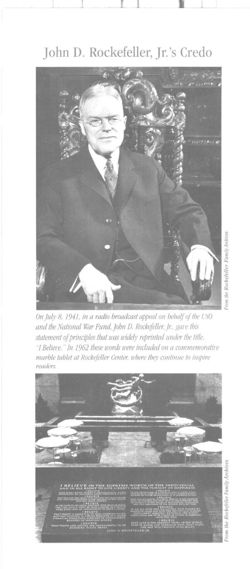
John D. Rockefeller, Jr.'s Credo
On July 8, 1941. in a radio broadcast appeal on behalf of the USO
and the National War Fund, John D. Rockefeller. Jr., gave this
statement of principles that was widely reprinted under the title.
"I Believe. "In 1962 these words were included on a commemorative
marble tablet at Rockefeller Center, where they continue to inspire
readers.
I BELIEVE IN THE SUPREME WORTH OF THE INDIVIDUAL
PURSUIT HAPPINESS
AVERY
THAT TRUTH
AN
WORLD,
RIGHT
ROCKE
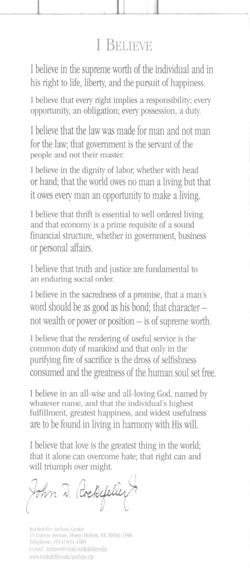
I BELIEVE
I believe in the supreme worth of the individual and in
his right to life, liberty, and the pursuit of happiness.
I believe that every right implies a responsibility; every
opportunity, an obligation; every possession, a duty.
I believe that the law was made for man and not man
for the law; that government is the servant of the
people and not their master.
I believe in the dignity of labor, whether with head
or hand; that the world owes no man a living but that
it owes every man an opportunity to make a living.
I believe that thrift is essential to well ordered living
and that economy is a prime requisite of a sound
financial structure, whether in government, business
or personal affairs.
I believe that truth and justice are fundamental to
an enduring social order.
I believe in the sacredness of a promise, that a man's
word should be as good as his bond; that character -
not wealth or power or position - is of supreme worth.
I believe that the rendering of useful service is the
common duty of mankind and that only in the
purifying fire of sacrifice is the dross of selfishness
consumed and the greatness of the human soul set free.
I believe in an all-wise and all-loving God, named by
whatever name, and that the individual's highest
fulfillment, greatest happiness, and widest usefulness
are to be found in living in harmony with His will.
I believe that love is the greatest thing in the world;
that it alone can overcome hate; that right can and
will triumph over might.
John D.
Rockefeller Archive Center
15 Dayton Avenue, Sleepy Hollow NY 10591-1598
Telephone (914) 631-4505
e-mail: archive@mail.rockefeller.edu
www.rockefellen.edu/archive.ctr
Rockefeller
Fall 2000
Archive
Newsletter
Center
The Rockefeller University
Three Targeted
Turns 100 Years Old
Grant Programs
for 2001
By Elizabeth Hanson, Ph.D.
Society will designate the campus
For the year 2001, the
Executive Editor, The Rockefeller
a National Historic Chemical
Rockefeller Archive Center
University Public Affairs Office
Landmark in honor of achievements
again will award grants-in-aid of
ohn D. Rockefeller never
at Rockefeller in protein and
research in three targeted areas
J
realized his wish to live to be
nucleic acid chemistry. Five Nobel
in addition to its regular pro-
100 years old, but the first
laureates in chemistry have done
gram of grants. Two areas
institution created solely with
their Prize-winning work at the
the history of the Rockefeller
Rockefeller money will reach
University. During the October 20
University and the history
that milestone in 2001. The
program, Professor Emeritus and
of basic medical research -
Nobel laureate R. Bruce Merrifield
Rockefeller University, founded in
continue from previous years,
1901 as the Rockefeller Institute
will join others in paying tribute
and a new area for 2001 offers
for Medical Research, was the first
to the history of chemistry at the
support for research in the his-
institution in the U.S. devoted
University.
tory of the Cold War era. All
completely to studying the under-
The following month, on
three targeted grant areas are
November 13 and 14, 2000, the
lying causes of disease and the
described below. The applica-
Rockefeller Archive Center will
fundamental processes of life.
tion deadline for all programs
Today its areas of research
sponsor a conference titled
is November 30, 2000; grant
include chemistry and structural
"Creating a Tradition of Biomedical
recipients will be announced
Research" to be held at the
biology, cell and developmental
in March 2001.
biology, neuroscience, immu-
University's campus. Public events
nology, and physics and mathe-
during the conference include
The History of the Cold War Era
noontime lectures by Rogers
The Rockefeller Archive Center
matical biology.
Throughout the 2000-2001
Hollingsworth of the University
announces a special program
of Wisconsin on "The Model of
academic year, the University will
of grants-in-aid for the year
celebrate its centennial with
a Modern Biological Research
2001 in the History of the Cold
special events, exhibits, and publi-
Institution: A Century of The
War Era. In addition to its other
cations that have been developed
Rockefeller" and Robert Olby of
grants, the Center will award
by a planning committee repre-
the University of Pittsburgh on
grants of up to $2,500 for resi-
"Rockefeller University and the
dents of the U.S. and Canada,
senting all areas of the University.
Centennial projects include a
Molecular Revolution in Biology,"
and up to $3,000 for residents
University video, public lectures
and an evening symposium on
of other nations, for travel to
November 13, "At the Crossroads of
the Center to conduct research
and scientific symposia organized
Science: The Future of Research at
in its collections in this field.
around the research areas of
the 68th Street Corner," which will
the University, and a series of
Scholarly researchers may
feature Antonio Gotto, dean of the
newsletters describing current
apply; students preparing doc-
research. A calendar of events is
Weill Medical College of Cornell
toral dissertations are particu-
available from the Public Affairs
University, Arnold J. Levine, presi-
larly urged to consider this pro-
Office and on the University
dent of the Rockefeller University,
gram. Prospective applicants
website.
Herbert Pardes, president of the
should contact one of the
Additional centennial events
New York-Presbyterian Hospital, and
Center's archivists prior to
and exhibits explore the
Harold Varmus, president of
applying in order to identify
University's history. On October
Memorial Sloan-Kettering Cancer
(continued on page 15)
20, 2000, the American Chemical
(continued on page 14)
Director's Comment
Institutional History and Personal Biography
CONTRACTING
Productive research at the
vidual applying for a grant probably
1901-2001
THE
Rockefeller Archive Center can be
will recite elements of biography,
ROCKEFELLER
accomplished not only on virtually
which may include not only profes-
UNIVERSITY
every subject of historical
sional accomplishments, but may
importance over the last 125
refer to personal experiences.
years, but on a great many individ-
Not only is such information likely
uals and institutions of importance
to be unique historical data but,
The Rockefeller Archive Center,
in that era. Researchers should
because grant applications often
a division of The Rockefeller
keep in mind that approximately
occur in conjunction with turning
University, was established in
67 million pages of documents
points in institutional or individual
1974 to preserve and make avail-
at the Rockefeller Archive Center
development, the information
able to researchers the records
often hold substantial amounts of
can be critical to understanding
of the University, the Rockefeller
Foundation, the Rockefeller
information about key points in
development and change.
Brothers Fund, members of the
institutional history or in personal
The Center also holds the per-
Rockefeller family, and other
biography.
sonal papers of nearly a hundred
individuals and institutions
Grant files open one of the
individuals, mostly presidents
associated with their endeavors.
most important windows on
and professors at The Rockefeller
Since 1986, the Center has
individuals and institutions An
University or officers of the
received the records of several
applicant to a funding organiza-
Rockefeller Foundation, that in
non-Rockefeller philanthropies.
tion, such as one of the founda-
many cases document their involve-
The Center's collections
tions represented in the Center's
ment in other institutions. Their
document seminal developments
collections, typically includes in
service on boards of directors and
and issues of the 20th century.
the application both background
other involvements often resulted
Major subjects include African-
information and a statement about
American history, agriculture,
in their collecting considerable
the arts, education, international
plans and goals. For an institution
bodies of records for institutions
relations and economic develop-
that may mean a recapitulation of
that no longer exist or, if they do
ment, labor, medicine and public
organizational history, an account-
exist, may not have been careful
health, nursing, philanthropy,
ing of assets and expenditures, and
conservers of their own history.
politics, population, religion,
an outline of what the funding is
science, the social sciences,
expected to accomplish. An indi-
(continued on page 19)
social welfare, and women's
history.
Scholars planning to conduct
research at the Center should
Rockefeller Archive Center Governing Council
write to the Center's director,
describing their project in
Benjamin R. Shute, Jr.
Robert E. Kohler
specific terms An archivist will
Council Chairman
Professor, Department of History and Sociology
Secretary
of Science, University of Pennsylvania
respond with a description of
Rockefeller Brothers Fund
the scope and contents of
Ellen Condliffe Lagemann
relevant materials.
George Bond
President, The Spencer Foundation
The Archive Center is located
Professor, Program in Applied Anthropology
Alice Lustig
and Anthropology and Education
25 miles north of New York City
Executive Vice President and Chief Operating
Teachers College, Columbia University
Officer, The Rockefeller University
in Pocantico Hills near Sleepy
Craig Calhoun
Hollow, New York. An informa-
Bruce Mazlish
President
tion packet for researchers,
Professor of History,
Social Science Research Council
Massachusetts Institute of Technology
containing a map and listing
Ellen F. Fitzpatrick
Rockefeller Family Representative
local lodging accommodations,
Associate Professor of History
is available upon request.
Joyce L. Moock
University of New Hampshire
Associate Vice President
Information about the Center's
Edie Hedlin
The Rockefeller Foundation
holdings and programs is
Director, Smithsonian Institution Archives
Steven C. Wheatley
available online at
www.rockefeller.edu/archive.ctr
Jules Hirsch
Vice President
Professor and Senior Lab Physician
American Council of Learned Societies
The Rockefeller University
2
The
Rockefeller
University
Research Report
Second Graders in the Archives:
Using Primary Sources and the Web to Teach History
By Terry Hongell & Patty Taverna,
community to learn about its
Archive Center to illustrate the
Pocantico Hills School
history, especially the life of such
text. We now had a 40-page book,
the Rockefeller Archive
an important figure as John D.
complete with timeline, map,
T
Center is just a few short
Rockefeller. In preparation for our
glossary, and family tree. Each child
blocks from Pocantico Hills
work with the children, we read
received a copy to use during our
School. The students and staff at
about John Davison Rockefeller
study. The creation of the book for
Pocantico have been fortunate to
and his family and visited Kykuit,
the children was our first hurdle.
use the facilities at the Archive
the Rockefeller family estate, and
During another visit to the
Center for research on several
the Rockefeller Archive Center.
Center, Dr. Levold arranged for us
occasions. In the spring of 2000
We then decided to focus the
to examine many primary sources
our second grade students began
children's study on the life of
and made copies of those we
a study of the life of John Davison
John D. Rockefeller, Sr.
selected to use with the children.
Rockefeller, Sr. (JDR). We were
Ron Chernow's biography of
We brought back to the classroom
privileged, once again, to have
JDR, Titan, and Rockefeller's
many photographs, pieces of
access to the wonderful materials
autobiography, Random
personal correspondence, receipts,
at the Archive Center. Through
Reminiscences, proved to be
and political cartoons relating to
our collaboration with archivist
invaluable as sources of informa-
JDR. The children knew that we
Dr. Erwin Levold the students
tion about JDR and insight into his
were doing "research" and upon
were able to examine first-hand
character. Unfortunately, we were
our return from the Center they all
documents and artifacts relating
unable to find a book about JDR
wanted to know, "How was it?"
to JDR.
suitable for our young students.
We talked at length with them
Each year we study a topic in
We did manage to find one copy
about what we had seen and done
depth with our second grade
of an out-of-print book written for
as "researchers."
students. Our final goal is to
middle school students, John D.
In order to share the extraordi-
create a student-centered web
Rockefeller by Ellen Greenman
nary collection of primary sources
site. It provides the children with
Coffey in the American Dream
that we now had, we created a
an authentic opportunity to share
Series At this point we realized
scrapbook and photo display for
their knowledge and to teach
that if this project were to be
the children to investigate. Being
others what they have learned.
viable, we would have to create
able to examine and analyze these
In the past several years we have
our own book. We were mindful
historical documents helped make
created Internet resources on
of the enormous responsibility of
JDR come alive for them. After
Harriet Tubman, Charlotte's Web,
creating something that accurately
reading about JDR's careful
and Vietnam. Our project for the
reflected the complexity of JDR
accounting from the age of 16, we
1999-2000 school year actually
while also being appropriate for
used copies of several pages from
began in the summer of 1999.
young readers. This was a challeng-
Ledger A, his first account book,
Our interest in the Rockefeller
ing task. Without the help of the
and created a mini ledger for each
family as a topic of study was
Rockefeller Archive Center it
child to scrutinize. Some of the
sparked by Pocantico Hills
would not have been possible. We
children actually used magnifying
School's involvement in the Stone
spent months reading, examining,
glasses to read JDR's small but very
Barns project, an effort to estab-
critiquing and editing the massive
precise penmanship. We created
lish an education center about
amounts of information we had
blank ledgers for each child to
farming and life in the Hudson
gathered from the Archive Center
use to keep track of his/her own
Valley in a facility on David
and other sources. We then careful-
spending habits. Finally, the
Rockefeller's property. We also
ly adapted the text of the Coffey
children used journals, as JDR did,
strongly believed that it was
book and used a photo journal for-
to make notes and record their
important for the children of this
mat for our version. We were able
ideas. With the development of
to choose photographs from the
these and many other lessons,
3
The
Rockefeller
University
1901
Research Report
materials and document-based
examine. She also gave each child
man, business giant and influential
tasks we felt we had passed our
a dime, reminiscent of the way
member of the Pocantico commu-
next hurdle.
her great great grandfather hand-
nity. They were very proud of all
Second graders are not the nor-
ed out dimes. They were oh SO
of their work, especially their
mal clientele for the Rockefeller
proud of their "Rockefeller dime."
web site, which can be found at
Archive Center, but again the
Our visit to Kykuit was also by
www2.lhric.org/pocantico/
Archive Center and Dr. Levold
special arrangement. Historic
rockefeller/jdr.htm. The creation
were most generous and arranged
Hudson Valley designed a tour
of the web site was the culmina-
a special visit. We believe our
just for us that allowed the
tion of our classroom study and
children are the youngest to be
children a glimpse into the home
our last hurdle, but hopefully it
treated to a tour of the Center.
life of JDR in his later years. It was
will serve as a beginning for oth-
The huge portrait of JDR in the
wonderful because once again
ers wanting to learn about the life
lobby captivated them. Dr. Levold
the children got a better sense of
of John Davison Rockefeller, Sr.
had set out original maps, ledgers,
what his life was like. Our visits
The use of primary sources is
receipts and various other
to the Archive Center and Kykuit
an important focus in education
documents that he explained
were exciting culminating
today. We believe it is one of the
and allowed the children to view.
activities, another hurdle passed.
most effective ways for children
The children were thrilled to see
The product of our study is an
to learn about history, people and
JDR's desk from 26 Broadway and
extensive student-centered web
events. We are committed to the
his golf clubs. They wondered if
site. It provided the opportunity
concept that even the youngest
these were the same clubs that
for our second graders to
of students can begin to learn
he had used for his secret golf
demonstrate and share what they
how to examine records of the
lessons to impress his wife Laura.
had learned about John Davison
past. In doing SO we feel they
In the ladies' powder room,
Rockefeller. The children used
develop skills that will serve them
the children noticed the elegant
computer software to create an
as learners for years to come.
furnishings and the painting of
illustrated time-line of JDR's life.
We have watched our students
Queen Victoria done in 1839, the
They drew detailed pictures of
become excited about history as
same year JDR was born. (The
artifacts that we had discussed
they studied sources from the
painting technique on the walls
while we were learning about
Rockefeller Archive Center. For
inspired our choice of back-
John. They generated questions
example, one line in Ledger A
ground for our JDR web site.)
and answers relating to John's life
referring to the cost of JDR's
They were fascinated by the
and then created a quiz, a cross-
toothbrush generated a very lively
storage facilities on the ground
word puzzle and a word search.
classroom conversation. We
floor. The fact that there were
They drew portraits of John to
discussed and debated what a
SO many documents relating to
accompany the character sketches
toothbrush looked like in 1855,
the Rockefeller family was very
they wrote about him. We also
whether JDR used toothpaste,
impressive to them. Finally, they
used the pictures from the
how much a toothbrush cost then
were excited to have a peek at
Rockefeller Archive Center and
VS. now and where JDR might
the rooms on the second floor
other museums to create an
have bought a toothbrush.
where researchers from around
on-line photo album. Several of
Discussions like this are fueled
the world work. We proudly
the items from our book also
by inspiring materials that entice
pointed out the room where we
appear on the web site, including
students to read and think in
had worked!
a family tree, a map of the places
a way that more traditional
As part of our study, we also
where John lived, and a glossary.
materials often do not. We are
enjoyed a visit from Mrs. Rachel
Also included are pictures of the
extremely grateful to the
Gumina, granddaughter of Nelson
JDR game boards that the children
Rockefeller Archive Center and
Rockefeller. She came to our class-
created in art class. The children
to Dr. Erwin Levold for enabling
room and shared many wonderful
learned an impressive amount
us to provide a richer learning
stories about her family and
of information about JDR. More
experience for our students
her visits to Kykuit. She brought
importantly, we feel they gained a
through the use of their
several of JDR's golf tees for us to
sense of who he was as a family
resources.
4
University
Archival Notes
Survey of Photo Collections Sparks Interest in H.T. Koshiba's Work
he Rockefeller Archive
400,000 and 500,000 images and
entered into a Microsoft Access
T
Center is currently
negatives.
Database. The database is used to
conducting a survey of its
The survey records two types
producec individual collection
photographic collections. The
of information: description and
reports, condition reports, inven-
survey, begun in 1999, has two
condition. Descriptive data
tories, shelf lists, and a complete
objectives: to improve access to
includes the collection titles,
survey report.
these materials through updated
series numbers, catalog numbers,
Assessing the condition of the
written collection guides, and to
folder titles, subject notes, item
photographic collections to
initiate a long-term strategy for
counts, format, and physical loca-
develop a strategy for preserving
the preservation of the collec-
tion. Condition data is collected
these materials is an integral part
tions. At present over 84,000
in four ways: a count of damaged
of the survey. The data collected
items have been surveyed. It is
materials, a comparative condition
is used to evaluate current and
estimated that the completed
rating, action plan, and comments.
future preservation needs and to
survey will include between
The collected information is
create schedules for carrying out
preservation- related tasks, such
as negative duplication, rehous-
ing, and mounting images.
One of the highlights of the
Rockefeller family photographs
that have been surveyed is a col-
lection of gelatin dry plate nega-
tives and corresponding prints by
the photographer H.T. Koshiba.
Born in August 1873, Koshiba
died in New York in 1966, and
between 1904 and 1950 he
worked for the Rockefeller family
as a portrait photographer on
numerous occasions. Little is
known about how Koshiba was
first commissioned by the
Rockefellers or where he learned
his craft. Correspondence from
John D. Rockefeller, Jr. indicates
that Koshiba had a studio on Fifth
Avenue, as well as a summer stu-
dio in Bar Harbor, Maine. He was
a skilled photographer, adept at
incorporating artistic rendering
into his photographic portraiture.
The accompanying group
portrait, taken by Koshiba in
September of 1913, shows (from
left to right) John D. Rockefeller
3rd, Nelson, and Abby, children of
John D. Rockefeller, Jr. and Abby
Aldrich Rockefeller. The original
5
The
Rockefeller
University
Archival Notes
carbon print shows little deterio-
Rockefeller to Become a "Great Floridian"
ration and only minor surface
abrasion. The print was generated
Ormond Beach and The Casements
from an 8 x10 gelatin dry plate
negative. Examination of the neg-
ative shows that the photographer
exposed the plate, then coated the
non-emulsion side of the glass
negative with a fixative. He used
this coated surface to draw the
background elements of the image
in a combination of charcoal and
graphite. In this photograph the
background elements seen behind
the children - the drapery that
obscures the flooring behind
Abby's chair leg, the column,
wainscoting, and landscape -
have been drawn on the negative.
This is somewhat akin to the
The Casements, John D. Rockefeller's Ormond Beach, Florida, home, 1932.
modern practice of using a paint-
ed backdrop to frame the setting
ohn D. Rockefeller will
of a portrait photograph. The
significant difference, however, is
J
1912 for the Reverend Harwood
become a "Great Floridian"
Huntington and named for its large
that the background is unique to
in a ceremony to be held on
hand-cut casement windows.
the image. In the group portrait
November 18, 2000, in Ormond
Local legend maintains that when
shown here, the background does
Beach, his home during the
Rockefeller learned he was paying
not appear as a prop but as part
winter months for several years.
more than other guests at the
of the picture. There is no
This designation by the State
Hotel Ormond, he went across the
defining line or flattening of the
of Florida will acknowledge
street to purchase the Casements.
Rockefeller's contributions to
space directly behind Abby. The
Upon purchasing the
the history of Florida.
Casements in October 1918,
edges of background elements are
softened, giving the impression
As John D. Rockefeller grew
Rockefeller began to expand on
older, the harsh winters at his
the core of the house and to devel-
of being slightly out of focus,
yet highlights carefully placed on
homes in Ohio, New York, and
op the gardens bordering the
New Jersey began to affect him.
Halifax River. Rockefeller arrived
the column and the wainscoting
In 1911, Rockefeller began to
at the Casements in December
give the perception of depth
and dimension.
spend winters golfing in Augusta,
1918, along with his niece, Fannie
Although not all of Koshiba's
Georgia. Periodically he would
Evans, and several servants.
visit his friend and co-founder of
photographs at the Archive Center
Although he used the Casements
show this same amount of render-
Standard Oil, Henry Flagler, who
primarily as a winter residence,
lived in Ormond Beach, Florida,
Rockefeller was an active member
ing of the background, all show
a keen awareness of detail in
a town that was recommended
of the Ormond Beach community.
to Rockefeller as the "finest in
composition and a high level of
He attended the Ormond Village
competence in the manipulation
which to live." During these visits
Improvement Association's annual
of photographic technology.
Rockefeller stayed at the Hotel
street fairs, where he sang with
Research on Koshiba, his technical
Ormond, where he and his
residents and passed out dimes to
training, and his work for the
entourage occupied an entire
children. According to one resi-
floor. The hotel was located on
Rockefeller family is continuing.
dent, Rockefeller would appear in
the Halifax River on Granada
a long coat, with a white silk scarf
Larissa Woo
Boulevard. Across the street sat
and top hat. He also golfed, rode
Project Archivist
the Casements, a home built in
through the countryside in his
6
The
Rockefeller
University
Archival Notes
chauffeured car, and attended
folk art and the largest display of
corporation that aims to enhance
Sunday night concerts at the
Boy Scout memorabilia in the
community life by preserving
Hotel Ormond. Rockefeller also
southeast, which may still be seen
and protecting important local
entertained at the Casements,
on the third floor of the home.
historical, cultural, and natural
hosting Will Rogers, Henry Ford,
Assisting the city in the opera-
resources, are working to identify
and Harvey Firestone, among
tion of the Casements is a
and preserve remaining historic
others. The highlights of
volunteer organization, the
sites within the city limits.
Rockefeller's time in Ormond
Casements Guild, which was
The city plans to highlight the
Beach were the Christmas parties
organized in 1979 to support
Casement's association with the
that he held at the Casements.
and promote the welfare of the
Rockefeller family in an effort to
After Rockefeller's death in
Casements. Guild members
raise awareness of the property
1937, the house was put up for
provide guided tours of the
and the city of Ormond Beach.
sale. It was purchased in 1941 by
Casements, operate the Case-
Through a newly established rela-
Maude Van Woy for use as a girls'
ments Gift Shoppe, and hold an
tionship with the Rockefeller
preparatory school. She oversaw
annual spring fund-raiser. In the
Archive Center, Michael Sanden,
changes to the house, including
tradition of Rockefeller's annual
Cultural Center Coordinator at
the addition of a dormitory on
Christmas party, the Guild
the Casements, hopes to learn
the south side of the property.
sponsors a Christmas walk in
more about Rockefeller's time at
After the school closed in 1951,
early November. While the City
the Casements and his influence
the property was sold to the
of Ormond Beach owns and main-
on the City of Ormond Beach. Mr.
Fellowship Foundation, Inc. to
tains the Casements, the Guild
Sanden has been a central force
be used as a home for the elderly.
enriches the building with arti-
in efforts to renew the Rocke-
In 1959, the property was sold to
facts and enhancements in keep-
feller presence in Ormond Beach
the Ormond Hotel Corporation,
ing with its history and tradition.
and to designate Rockefeller as a
whose development plans for the
Rockefeller's presence at the
"Great Floridian."
Casements were never realized.
Casements has been reduced to
John LeGloabec
The home sat empty for many
one room, the Rockefeller Room,
Archivist
years, a victim of two fires, hurri-
located on the west side of the
canes, and extensive vandalism.
house on the second floor. The
The Rockefellers
The Casements was placed on
room has been restored to the
the National Register of Historic
period in which Rockefeller lived
on PBS
Places in 1972, and the next year
in the house. Seven items in the
was purchased by the City of
room have been authenticated as
"The Rockefellers," a two-part
Ormond Beach for $500,000.
being present during Rockefeller's
documentary on the
Rockefeller family, will be
In 1976, the City received a feder-
residency: a desk, two sideboards,
al public works grant of $449,000
broadcast this fall as part of
a pie crust table, a gilt mirror,
to assist in restoring the home.
and two sets of china. In addition,
The American Experience
series on the Public
After renovations to the site, the
the Rockefeller Archive Center
Casements was opened to the
provided the Casements with
Broadcasting System. The
Rockefeller Archive Center
public on October 1, 1979.
several photographs for display in
this room.
provided 295 images for the
A city-owned property, the
Casements now functions as a
31/2 hour production and
In recent years, the City of
cultural and civic center, sponsor-
copied footage from 31 films.
Ormond Beach has begun to
ing a variety of events. The
address the preservation of its
The two segments of "The
Rockefellers" are scheduled for
programs include classes in visual
historic properties. The Hotel
broadcast on October 16 and
and literary arts, lectures and
Ormond already has been lost:
October 23. An extensive
workshops, and exhibits by
after years of neglect, the hotel
web site about the program
national artists, schools, and
was demolished and replaced by
special audiences. Installed short-
and the family is available at
a condominium development.
ly after the Casement's reopening
The city and the Ormond Beach
www.pbs.org/wgbh/amex/
rockefellers/index.html
were exhibitions of Hungarian
Historical Trust, a non-profit
7
University
Collection News
Additions to the Nelson A. Rockefeller Papers
n additional 92.3 cu. ft. of
Subseries 4, Polls, 1958-1970. A
4, Memos, 1959-1970. This sub-
A
Nelson A. Rockefeller's
selection of polls and public opin-
series contains memos Hinman
papers have been donated
ion surveys conducted primarily
sent to NAR briefing him on his
to the Rockefeller Archive Center
in New York at NAR's request.
political status, the activities of
and are now open for research.
Some polls are accompanied by
political rivals, and strategies that
These records deal with the
analysis.
could be implemented in future
political career and gubernatorial
campaigns.
service of Nelson A. Rockefeller
Subseries 5, Office of the
(NAR). Located in two different
Governor, 1958-1970. Subject
Series P, Ann C. Whitman, Politics,
record groups, the following six
files primarily covering the first
1958-1973, 10.0 cu. ft.
records series are now available
two administrations (1959-1966).
This series contains a portion of
to researchers:
Few files offer complete docu-
NAR's political correspondence
mentation of a particular issue.
on state and national issues as
Record Group 4, Nelson A.
Series J.2, George L Hinman Files,
maintained by Whitman, his
Rockefeller - Personal
1959-1970, 38.0 cu. ft.
executive secretary.
Series J.1, Politics, 1935-1970,
Divided into five subseries, this
Record Group 15, Nelson A.
37.0 cu. ft.
material offers partial documenta-
Rockefeller - Gubernatorial
tion of Hinman's role as one of
This series contains material
NAR's chief political strategists
Series 10.2, Counsel, S. Neil
pertaining to NAR's long standing
and Republican National
Corbin, 1958-1965, 1.8 cu. ft.
as a politician, statesman, and
Committeeman from New York.
This subseries contains a small
public servant. Much of the
material is related to his tenure as
Of particular interest is Subseries
portion of the files of Sol Neil
governor of New York. The series
is divided into five subseries:
Subseries 1, Politics, General,
1935-1970. Offers partial docu-
mentation of NAR's evolution as
a political force in New York and
the nation.
Subseries 2, National Political
Campaigns, 1956-1968. Offers
limited perspective on the dynam-
ics of NAR's three presidential
campaigns (1960, 1964, and 1968)
and documents his involvement
in President Eisenhower's 1956
campaign.
Subseries 3, New York State
Gubernatorial Campaigns,
1958-1970. Partial documenta-
tion of NAR's four gubernatorial
campaigns (1958, 1962, 1966, and
New York State Governor Nelson A. Rockefeller waves to his constituents as
1970). Most of the material
be and fellow honorary parade chairman Richard J. Hughes, governor of
pertains to the 1958 campaign.
New Jersey, are driven along Fifth Avenue during the Steuben Day parade,
September 17, 1966.
8
The
Rockefeller
University
1901
Collection News
Corbin, who served as Assistant
"Commissioner's statement,"
Series 38, New York Republican
Counsel (January 14, 1959-June 1,
the status of major programs,
State Fund Raising Reports,
1961) and then Counsel (July 1,
emergency situations and other
1967-1973, 1.0 cu. ft.
1962- September 1, 1965) to
unusual developments, and brief
This series consists of copies of
Governor Nelson A. Rockefeller.
summaries of recent research,
the financial reports that New
The principal topics are housing
publications, and management
York Republican fund raising
and urban renewal. Major issues
improvement plans. Many of the
committees filed with the New
include the creation of the New
reports include charts, tables,
York State Secretary of State in
York State Housing Finance
other graphics, and appendices of
accordance with New York State
Agency (folders 7-8), and the
departmental publications. NAR's
election laws at the time. There
consolidation, clarification and
hand written comments are found
are ten reports from the New York
simplification of urban renewal
on a few of these reports. The
Republican State Dinner
and housing laws (folders 19-20).
reports begin with the first
Committee and nineteen reports
quarter of 1963. Most agencies
from the Governor's Club. The
Series 28, Departmental Reports,
reported through the first quarter
reports consist of "Schedule A,"
1960-1973, 4.5 cu. ft.
of 1966. Further information on
receipts, and "Schedule B," dis-
This series consists of periodic
the guidelines for these reports
bursements. Schedule A is an
reports prepared by New York
can be found in folder 102,
itemized list of contributions that
State departments and agencies
"Reporting Format."
includes the name and address
for NAR. The reports are of four
of each contributor and the date
different types, from four different
Agency Appraisal Reports,
and amount of the contribution.
periods representing each of
1970. These reports represent a
Contributions are listed in the
NAR's four administrations
self-analysis by each agency
In general the reports offer an
defining the agency's purpose,
order in which they were
the status of its current programs,
received; thus, finding a particular
assessment of each department's
responsibilities, goals, perfor-
and its future plans and needs.
name is time consuming.
Schedule B is a short list of
mance, problems, and needs.
Monthly Reports, 1971-1973.
expenses and contributions.
The reports are arranged
Actually issued every four weeks,
With three exceptions all the
alphabetically by department,
these reports are short narratives
contributions from both organiza-
chronologically thereunder.
written in memo form by each
tions were to the New York
Each of the four different report
agency head. The average length
Republican State Committee.
types is found for most, but not
is three pages, with no graphics
However, the Dinner Committee
all, of the departments. The four
and few appendices. The focus
made contributions to the
types of reports are as follows:
is on immediate issues and
New York Republican County
Program Meeting Report,
activities. Up to a dozen reports
Committee in 1968, to the United
1960. These were the result of
were sent to NAR at a time with
Service Organization in 1969, and
meetings by representatives of
a one-page summary covering all
to Friends of the Rockefeller Team
each department with the
the reports. These summaries
in 1971. Other than a covering
Secretary to the Governor and
are filed separately in folders
letter these reports contain no
the Counsel to the Governor.
105-107, "Forwarding Memos and
correspondence, charter, or pro-
The purpose of the meeting was
Summaries." Many of the sum-
motional literature or any other
to identify the major issues each
maries bear NAR's hand written
evidence of the nature of these
department would face in the
comments. These reports begin
organizations or who ran them.
coming year and to define any leg-
in March 1971 and the last ones
Members of the Rockefeller family
islative and budgetary support
are dated late November or early
are found among the contributors
necessary to meet the issues.
December 1973, just before NAR's
in each of these reports. Since
resignation on December 18.
Quarterly Reports, 1963-1966.
these are copies of reports filed
with the state, this information is
The reports include a one-page
considered public.
Harold W. Oakhill
Archivist
9
The
Rocketeller
University
1901
Collection News
Fritz Lipmann, Nobel Laureate and RU Scientist
T
he papers of Fritz/
with Vincent du Vigneaud at the
In 1953 in recognition of his
Lipmann (1899-1986), a
Cornell Medical School. He was
work on Coenzyme A, Lipmann
collection in the Rockefeller
later affiliated with both
was awarded the Nobel Prize in
University Archives, have recently
Massachusetts General Hospital
Physiology or Medicine (together
been processed and are available
and the Harvard Medical School.
with Hans Krebs). Lipmann came
for research. The Lipmann
The latter appointed him
to the Rockefeller Institute for
Collection (Record Group 450
professor of biological chemistry
Medical Research in 1957 and
L667) consists of 56.3 cubic feet
in 1949. In a review article,
worked with charged tRNA and
of material and spans the years
"Metabolic Generation and the
also conducted research in the
1924 through 1986. It includes
Utilization of Phosphate Bond
field of elongation factors in
Lipmann's correspondence, labo-
ribosomal protein synthesis.
ratory files, manuscripts, Nobel
EFTs and EFTU were discovered
Prize files, and photographs.
during his years at RU.
A finding aid is available for
Lipmann was a member of
researchers, a copy of which is
numerous scientific organizations,
available at the Rockefeller
including the National Academy
Archive Center's website.
of Sciences, the Royal Danish
Additional Lipmann material can
Academy of Sciences, and the
be found in other record groups
Royal Society in London. In 1966
of the Rockefeller University
President Lyndon Johnson
Archives as well as in the archives
presented Lipmann with the
of the Rockefeller Foundation.
National Medal of Science, the
Born in Koenigsberg, Germany
nation's highest award for
(now Kaliningrad, Russia) on June
scientific achievement. Lipmann
12, 1899, Fritz Albert Lipmann
was also the recipient of
earned an M.D. in 1924 and Ph.D.
numerous other awards and
in 1927 in chemistry from the
medals. In 1974, on the occasion
University of Berlin. Forsaking
of his 75th birthday, Lipmann's
a medical career for one in
colleagues and former students
research, he joined Otto
honored him with a symposium
Meyerhof's group at the Kaiser
Fritz Lipmann in 1973
at the Max-Planck-Institut in
Wilhelm Institute first in Dahlem
Energy" published in Advances in
Berlin, where an annual Fritz
and then in Heidelberg. In 1930,
Enzymology (1941), Lipmann
Lipmann Lecture was subse-
Lipmann continued his work in
proposed the concept of a
quently established.
biochemistry with Albert Fischer,
metabolic dynamo by which
Up until his death in 1986,
whom he later followed to
energy-rich phosphate bonds
Fritz Lipmann continued to teach,
the Biological Institute of the
continuously supply the energy
research and publish. His later
Carlsberg Foundation in
needed for the work of building
research was focused on the
Copenhagen, Denmark. In 1931
and repairing cells. Lipmann
mechanism of protein synthesis.
1932, Lipmann was a Rockefeller
isolated Coenzyme A in 1945 and
Dr. Lipmann's scientific achieve-
Foundation Fellow with P.A.T.
identified it as a key substance in
ments have been credited with
Levene's laboratory at the
the biosynthesis of a great variety
greatly increasing our understand-
Rockefeller Institute for Medical
of cell constituents, including
ing of the energy dynamics of
Research (now the Rockefeller
fatty acids, steroids, amino acids,
living cells on the molecular level.
University).
hemoglobin and others. He found
Fritz Lipmann immigrated to
that it contained one of the B
Lee R. Hiltzik
the United States in 1939 to work
vitamins, pantothenic acid.
University Archivist
10
Rockefeller
University
Collection News
Abby Aldrich Rockefeller Ledger
newly processed ledger
of Modern Art and served on
the National American Women's
A
labeled "Contributions and
several committees of its Board of
Suffrage Association; the Vassar
Donations" has been added
Trustees, generously contributing
Club; the Greek War Relief
to the Abby Aldrich Rockefeller
her administrative talents as well
Association; the Committee to
Papers. The collection, arranged
as her personal collection of
Defend America by Aiding the
in seven series, documents the
modern art.
Allies; the Women's Trade Union
life and philanthropic activities
Entries in the ledger are
League; Bellevue Hospital; Henry
of Abby Aldrich Rockefeller
handwritten or typed on ruled
Street Settlement; the Netherland
(1874-1948), the wife of John D.
paper and record contributions to
American Foundation; the Soldiers
Rockefeller, Jr. These papers
both institutions and individuals
and Sailors Club; Daughters of
include extensive personal and
from 1936 to 1948. The docu-
the American Revolution; Gifts for
professional correspondence that
ment is located in Series IV,
Guam; and the Gramercy Boys
reveal the range of her philan-
Philanthropy Files, of the Abby
Club, among many others. Also
thropic activities.
Aldrich Rockefeller Papers, which
included in the ledger are dona-
Abby Aldrich Rockefeller held a
constitute a series within Record
tions to individuals as well as gifts
number of positions in voluntary
Group 2 in the Rockefeller Family
to members of the Rockefeller
organizations, serving as the head
Archives. Ledger entries illustrate
family. In keeping with Archive
of Auxiliary 356 of the American
her wide range of charitable con-
Center policy, information in the
Red Cross and as chairman of the
cerns, which included Riverside
ledger about living members of
Housing Committee of the War
Church; the Children's Village at
the Rockefeller family is closed to
Work Council of the National
Dobbs Ferry, New York; Colonial
research.
Board of the Young Women's
Williamsburg; the New York Plant
Mindy Gordon
Christian Association (YWCA).
and Flower Guild; the Police
Archivist
She was a founder of the Museum
Athletic League of New York City;
Rockefeller Foundation
Project Files for Italy
on Microfilm
The files in the Rockefeller
Foundation Archives, Record
Group 1.1, Series 751, document-
ing the foundation's projects in
Italy, 1912-1962, have been micro-
filmed. The seven reels of film are
available for use at the Archive
Center and on interlibrary loan.
Italy was the focus of the founda-
tion's anti-malaria program, 1924-
1938, which is documented in the
files, as are grants for projects in
the medical sciences, nursing, the
natural sciences and agriculture,
schools of hygiene and public
health, the social sciences, the
Abby Aldrich Rockefeller holds the hammer that she used to drive a bolt
Vatican Library, and the library at
during construction of the "Albatross" in Portland, Maine, in mid August 1918.
the International Institute of
Photograph by Underwood & Underwood, New York City.
Agriculture.
11
The
Rockefeller
University
1901
Collection News
Jackson Davis' GEB Diaries on Microfilm
Rockefeller philanthropies but also
documents other aspects of his
he eleven volumes of offi-
T
academics, school officials, and
career, such as his work as chair-
cer's diaries (1937-1947)
local leaders. An index facilitates
man of the Commission on
maintained by Jackson
access to each volume of the
Training Camp Activities during
Davis as part of his duties for the
diaries.
World War I, his experience at the
General Education Board (General
Additional material on Davis'
Paris peace conference, and his
Education Board Archives, Series
career is located in the archives
work for the League of Nations.
12) have been microfilmed and
of the General Education Board
A set of the microfilm is available
are available for use at the
and in a small (40 item) collection
for use at the Rockefeller Archive
Rockefeller Archive Center and on
of Jackson Davis Papers at the
Center and on interlibrary loan.
interlibrary loan. A set of the
Archive Center.
Lucille P. Markey
Charitable Trust Records
on Microfilm
he records of the Lucille P.
T
Markey Charitable Trust,
1981-(1983-1996)-1998, were
accessioned by the Rockefeller
Archive Center in 1997 and have
been completely processed and
microfilmed according to preser-
vation standards. The entire
collection, originally 84 cubic feet,
has been converted onto 155 reels
Jackson Davis (third from the left) and Raymond B. Fosdick (far right) on a
of 100 ft., 35mm polyester micro-
tour of the South with other officers of the Generai Education Board, includ
film. Three generations of film
ing John D. Rockefeller 3rd (center), in 1939. Gift of John Marshall.
have been produced: the Master
Negative, which is stored off-site;
microfilm also is available for use
the Print Master, stored in a secure
at the Special Collections
Raymond B. Fosdick
Department at the University of
Correspondence on
location at the Archive Center;
and, a Service Copy, which will be
Virginia Library. Davis (1882-
Microfilm
available for research use.
1947), a Virginia native, joined the
Preservation microfilm offers the
GEB in 1915 and for the next thir-
joint project between the
ty years worked on its education-
A
Seeley G. Mudd Manuscript
benefits of providing extended
al programs for both blacks and
Library at Princeton
longevity beyond the lifetime of
whites in the segregated South.
University and the Rockefeller
paper; facilitates copy production
Archive Center has preserved on
using a reader/printer or redupli-
He also was a trustee of the
microfilm the Mudd Library's col-
cation of a reel; and preservation
Phelps-Stokes Fund and became
an influential voice in matters
lection of the Raymond B. Fosdick
of the original reel in a monitored
environment.
pertaining to Southern education
Papers, 1910-1971 (11.75 cu. ft.).
and race relations. He was an
Fosdick (1883-1972) was an
The Lucille P. Markey Charitable
early advocate of the develop-
advisor to John D. Rockefeller, Jr.
Trust, established as a limited
term trust in the will of Lucille P.
ment of regional centers of edu-
and a trustee of many and
cation in the South. The diaries
president of several Rockefeller
Markey in 1975, began operation
philanthropies, including the
in 1983 and terminated in 1997.
contain his notes during trips
Rockefeller Foundation (1936-
Lucille P. Markey, née Lucille
throughout the South to visit vari-
1948). The collection reflects not
Parker, was born December 14,
ous schools and his notes follow-
only his work for Rockefeller and
1896, the youngest of seven
ing meetings with a wide range of
children and the daughter of a
12
Collection News
tobacco farmer who fought for the
to research centers and programs
Trust Administrator and
Confederacy in the Civil War. In
conducting advanced research,
the Trustees; and Scrapbook,
1918, she married Warren Wright,
and General Organizational Grants
Photographs and Miscellany, with
who inherited the Calumet Baking
toward the training and education
newspaper clippings pertaining to
Powder Company, as well as a horse
of Ph.D.'s and M.D.'s pursuing
the milestones of the Trust's life-
farm near Lexington, Kentucky. The
careers in biomedical research.
time as well as photographs taken
Wrights built this small inheritance
The collection is organized into
at the Annual Scholars
into one of the most successful
six series: Scholars and Visiting
Conferences. The subseries
thoroughbred horse breeding and
Fellows, documenting individual
"Miscellany" also contains photo-
racing stables, Calumet Farm.
awardees and applicants, the notes
graphs of the Markeys and articles
Calumet Farm produced eight
of the Selection Committee and
about Calumet Farm. Material in
Kentucky Derby winners and three
Scholars' Annual Conference
the collection that has not been
Triple Crown winners, including
abstracts; Institutional Grants and
filmed includes books and video-
Citation in 1948, horse racing's first
Proposals, including all institution-
tapes that resulted from grant-
thoroughbred millionaire. In 1952,
al and organizational applications
sponsored research. These items
Lucille Wright married Admiral
for grant support; Governance,
are available in the Archive
Gene Markey and continued to pur-
including Minutes of the
Center's library.
sue her passion in horse breeding
Committees, records of the
Although the collection will not
and horse racing. The bulk of Mrs.
Chairman, Board of Trustees, the
be open until 2007, limited access
Markey's estate, however, derived
Director for Medical Sciences,
may be granted by the Director of
from a large interest in oil and gas
and Annual Reports; Program
the Archive Center prior to the
leases in Texas inherited from her
Development, chronicling the
material becoming available for
first husband, Warren Wright.
conception of the grant awarding
research.
Mrs. Markey's charitable
structure; Correspondence, includ-
Mindy Gordon
devotion during her lifetime began
ing letters and memoranda of the
Archivist
locally with generous support of
Kentucky's Blue Grass Boy's
Ranch, and significantly, the estab-
lishment of a Cancer Center at the
University of Kentucky. She also
ealth is not just luck!
supported research on arthritis at
Rockefeller University. This chari-
table legacy continued after her
death through the trust estab-
lished in her name. In an effort to
ensure that the distribution of her
assets were monitored by those
who understood the nature of her
interests, Mrs. Markey designated
that her fortune be dedicated to
"human health," an idea which
took shape as support for "basic
medical research." The Trust
distributed over $500 million in
three broad categories: Individual
During the 1940s the Rockefeller Foundation, its International Health
Grants, which consisted of scholar-
Division, and the General Education Board provided funding to the State
ships and fellowships to younger
Departments of Health and Education in Mississippi to establish a public
researchers; and two types of
health education and school health program. In these photographs from 1947,
Institutional Grants, including
students at the Dentville school learn the steps to good health (left) and a
Research Program Grants, awarded
student in an unidentified school takes an eye examination.
13
The
Rockefeller
University
1901
Collection News
W.G. Van Schmus and Radio City Music Hall
The Rockefeller University
Turns 100 Years Old
M
argaret Teel of Blue Hill,
Schmus died in January 1942,
(continued from page 1)
Maine, recently donated to
Martin Quigley, the publisher of
Center. Conference proceedings
the Rockefeller Archive
several theatrical papers, wrote
will be published by The
Center an album of press clippings
that "the history of the industry
Rockefeller University Press.
about W.G. Van Schmus, the manag-
discloses the name of no person
Contact the Rockefeller Archive
ing director of Radio City Music
who more quickly and thoroughly
Center for further details.
Hall, 1934-1942, the glamorous
established for himself and
Two exhibits on campus
theater at Rockefeller Center. Also
during the Centennial year inter-
included in the gift were six photo-
pret the history of the University
graphs of John D. Rockefeller, Jr.
and the life of its founder, John
and the Rockettes.
D. Rockefeller. Breaking New
William George Van Schmus
Ground, on display in the Abby
(1875-1942) had no experience in
Aldrich Rockefeller Hall, show-
the theatrical business in 1934
cases photographs from the
when he took on the job at the
Rockefeller University Archives.
Radio City Music Hall, which was
These images date from the
billed as the "Show Place of the
Institute's first quarter-century and
Nation" and boasted of "the
are organized around the themes
world's largest stage." The
of founding the Institute, clinical
Chicago-area native had worked
research, and laboratory research.
in publishing, as a department
This exhibit also can be viewed at
store executive, as the manager
the University's web site,
of the George L. Dyer Advertising
www.rockefeller.edu, with a
Agency, and as a management
narration by television talk show
consultant who did some work for
host Charlie Rose.
the Rockefeller interests in the
The exhibit John D. Rockefeller:
early 1930s. The Music Hall was
The Art of Getting and the Art of
developed by the legendary
Giving opens in the lobby of
showman Samuel L. "Roxy"
W.G. Van Schmus (left) and John D.
Founder's Hall at the University on
Rothafel, but Van Schmus became
Rockefeller, Jr. with the Rockettes,
September 21, 2000. This exhibit is
the theater's manager after
December 30 1937.
derived from Rockefeller
financial problems and Roxy's
Rediscovered, which was curated
poor health threw the operation
his enterprise a reputation for
by Rockefeller biographer Ron
into turmoil. The album includes
respect and admiration." Under
Chernow and displayed at the
clippings from industry publi-
Van Schmus' direction, Quigley
Museum of American Financial
cations as well as the daily papers
noted, Radio City Music Hall
History in New York City in 1999.
that record his efforts to stabilize
"developed into an example of
Both exhibits have been created in
the theater's business, his meetings
quiet, orderly and sensible opera-
collaboration with the Rockefeller
and press photo sessions with
tion which set for itself a remark-
Archive Center. The exhibit at the
popular stars at the beginning of a
able ideal of public service."
University describes John D.
movie's run at the theater, and the
Additional material about Van
Rockefeller's life, his accumulation
programmatic changes in the the-
Schmus and his work is located in
of wealth through the Standard Oil
later's operations during his tenure.
the Rockefeller Family Archives,
Trust, and his philanthropy. Objects
Eliminating the usual breathless
Record Group 2 Office of the
on display include personal items
hype from his theater's publicity,
Messrs Rockefeller, Business
that belonged to Rockefeller, such
"Mr. Van" brought a new attitude to
Interests series, which contains
as a coin purse and golf scorekeep-
theatrical management. When Van
material on Rockefeller Center.
ing books on loan from the Archive
14
The
Rockefeller
University
1901
Grant Programs
Center, memorabilia from Standard
written by its second director,
donations, and a page from one
Oil on loan from the Museum of
Herbert Gasser, in 1946. It was
of Rollin Hotchkiss's laboratory
American Financial History, and
composed at the request of John
notebooks, which diagrams the
a microscope that belonged to
D. Rockefeller, Jr., then president
steps in purifying the first system-
Simon Flexner, the Rockefeller
of the Board of Trustees, as the
atically discovered antibiotic.
Institute's first director, which
Institute entered a period of self-
In many ways, the history of
belongs to the University's collec-
examination and planning for the
The Rockefeller University
tion of scientific instruments.
future. By mid-century many of the
parallels the development of the
To commemorate the centen-
Institute's founding goals -
biomedical sciences in the United
nial and to introduce the Univer-
expanding medical knowledge,
States. The Rockefeller Institute
sity's history and its work to a lay
setting high research standards for
was a model for many other
audience, a book entitled
others to follow, and training
research institutions, and funds
Achievements: A Century of
young researchers - had been
from Rockefeller philanthropies
Science for the Benefit of
achieved. David Rockefeller, who
fueled the growth of the biomed-
Humankind, 1901-2001, by
succeeded his father as president
ical sciences. Although financial
Elizabeth Hanson, was published by
of the board in 1950, oversaw the
support for science and its scope
The Rockefeller University Press in
process that led to the transforma-
and practice have changed over
September 2000. The book details
tion of the Institute into a Univer-
the course of a century, the
the founding of the institution and
sity. This included consulting
University remains dedicated to
its growth up to the present day,
dozens of the leading scientific
its founding commitment to
and discusses the many accomplish-
administrators and educators of
basic research. As records in the
ments of scientists who have
the day. Special permission was
archives show, other, more
worked there - twenty Nobel lau-
obtained from David Rockefeller's
mundane aspects of academic life
reates among them. The narrative of
office to review the transcripts
also remain the same. A telegram
this coffee-table book is augmented
of the interviews with scientific
from Rufus Cole, the first director
by 120 richly reproduced pho-
leaders undertaken at this time.
of the Institute's hospital, reveals
tographs from the Archive Center
Records in the Rockefeller
that bidding wars for star faculty
and elsewhere.
University Archives provide insight
date from the beginning of the
Achievements relies on many
into world events as well as the
century. The message reads: "Have
archival sources - as background
internal history of the institution.
refused Ann Arbor will be glad to
material, quoted material, and illus-
In the papers of chemist Max
accept Rockefeller place.
trations - to tell the University's
Bergmann, for example, one
story. Documents written by Simon
scientist's story during the 1930s
Three Targeted Grant
Flexner, the Institute's first director,
intellectual migration comes to
offer insight into his vision for orga-
light. Bergmann had been forced
Programs for 2001
nizing the Institute and guiding
to "retire" from his directorship of
(continued from page 1)
its growth. In a 1902 letter, for
the Kaiser Wilhelm Institute in
the extent of documentation
example, Flexner first outlined the
Dresden. Correspondence in the
related to their topics.
unique structure of the Rockefeller
archives shows how Simon
Applications are invited for
Institute as a group of laboratories
Flexner and others at the Institute
research on the background of
headed by independent investiga-
facilitated Bergmann's emigration
the Cold War, the development of
tors and undivided by disciplinary
to the United States and his
Cold War policy and strategy,
boundaries. In another document,
appointment as a member of the
and the cultural and intellectual
written twenty-five years later,
Institute in 1934.
context of the Cold War, as
he reflected on the Institute's
One of the letters pertaining
documented in the records
successes, the growth of medical
to Bergmann's emigration is repro-
maintained at the Archive Center.
science since its founding, and
duced in the Centennial book.
Relevant collections include
its role in setting high standards for
Other documents used as illustra-
the archives of the Rockefeller
medical research.
tions include pages from John D.
Foundation, the Population
Another assessment of the
Rockefeller's "Ledger A," in which
Institute's accomplishments was
he recorded his early charitable
(continued on next page)
15
The
Rockefeller
University
Grant Programs
Council, the Social Science
and Karl Landsteiner), photo-
basic medical research. The field
Research Council, and the
graphs, and films.
will be defined broadly to
Rockefeller Brothers Fund,
The archives document the
include most aspects of the histo-
especially the files of the Fund's
leading currents of biomedical
ry of The Rockefeller University;
Special Studies Project. The
research in the 20th century, and
much of the history of the
archives of the Rockefeller family
include significant materials on
international medical, public
are also pertinent, including
such topics as the design and use
health, and scientific research
especially the papers of Nelson A.
of scientific instruments, pharma-
programs of the Rockefeller
Rockefeller, the papers of John D.
cology, the development of scien-
Foundation; and major elements
Rockefeller 3rd, and the records
tific and educational institutions
of the histories of the Common-
of the Office of the Messrs
in the U.S., and many aspects of
wealth Fund, Charles E. Culpeper
Rockefeller, which document
the social history of New York
Foundation, Lucille P. Markey
the philanthropy of John D.
City.
Trust, and John and Mary R.
Rockefeller, Jr.
Records in the Rockefeller
Markle Foundation. Certain
Potential subjects include, but
University archives are in many
segments of the Rockefeller
are not limited to, the funding of
cases closely related to other
family archives also document
communications studies; promo-
archival collections at the Archive
the history of basic medical
tion of studies of the strategic
Center, such as the archives of
research, such as the founding
position of the United States at
the Rockefeller Foundation, the
and support of research
the mid-twentieth century; the
Rockefeller family, and the
institutions. As a group, the
development of the Foreign Policy
Commonwealth Fund. It is antici-
archives of these institutions
Association; a variety of specific
pated that although applications
constitute one of the outstanding
grants made in the post-World War
for these special grants-in-aid will
resources for the study of the
II period for studies of American
focus on the University archives,
history of basic medical research
foreign policy and civil society; the
they will in many cases propose
in the 20th century.
end of colonialism; and Nelson
research that also draws on these
Scholars conducting substan-
Rockefeller's and John D. Rocke-
other collections.
tial research in any aspect of the
feller 3rd's governmental and
This program will award two
history of basic medical research
personal activities in Latin America
(2) one-month residencies at the
are urged to apply. Prospective
and Asia.
Center with stipends of $5,000.
researchers may apply for resi-
History of The Rockefeller
Applications will also be received
dencies of one month, one
University
for special grants-in-aid (outside
semester, or an academic year.
of the Center's regular grant-in-aid
Stipends at the rate of $5,000 per
The Rockefeller Archive Center has
program) to support research of
month will be awarded to cover
extended for a year its program
shorter duration. For these,
all travel, food and lodging, and
of grants to support research in
applicants from within the U.S.
research expenses associated
the history of The Rockefeller
and Canada may request support
with the residency.
University. Founded in 1901 as the
of up to $2,500; because of
Applications will be reviewed
Rockefeller Institute for Medical
the additional cost of travel,
in a competitive process.
Research, the University's laborato-
applicants from other nations may
Applicants will be asked to com-
ries have focused on developing
request up to $3,000.
plete a special form (available
fundamental knowledge of disease
and physiology. The Rockefeller
Residencies in the History of
from the Center), to describe the
University archives include admin-
Basic Medical Research
research to be undertaken, and to
submit three letters of reference.
istrative records (including the
The Archive Center also invites
Prospective applicants are urged
papers of Herbert Gasser and
applications for the third year of
to contact the Center to deter-
Detlev Bronk), papers of individual
its five-year program of residen-
mine the type and extent of
scientists (such as Alfred E. Cohn,
cies for research at the Center on
records that will be useful for
Rene Dubos, Rebecca Lancefield,
topics related to the history of
their research.
16
The
Rockefeller
University
1901
Grant Programs
Grant-in-Aid
Grants to Support
targeted grant programs have
awarded grants to two scholars for
Program for 2001
Ehrlich Research
research in the history of interna-
tional relations and economic
the Rockefeller Archive
(he Rockefeller Archive Center
T
Center's annual Grant-in-Aid
T
is pleased to announce that a
development, to three scholars
Program offers support to
generous gift has made avail-
for research in the history of The
scholars in any discipline who are
able funds to support short-term
Rockefeller University, and to four
engaged in research that requires
research in the Paul Ehrlich
scholars for residencies to study the
extensive use of the archival
Collection. The Ehrlich Collection is
history of basic medical research.
collections housed at the Center.
the largest and most important body
All recipients, their institutions and
Thirty-seven scholars from
of original and facsimile materials
research topics follow.
around the world received fund-
documenting the life and scientific-
General Grants, 2000
ing from this program in 2000.
medical research program of Nobel
Thomas Andrews
Scholars from within the United
Laureate Paul Ehrlich (1854-1915).
Ph.D. Candidate.
States and Canada may apply for
Certain documents are available in
Department of History,
grants of up to $2,500; because
English translations.
University of Wisconsin, Madison.
of the additional cost of travel,
Prospective applicants are urged
"The Road to Ludlow: Work, Environment,
scholars from other nations may
to contact the director of the
and the Industrialization of Southern
request up to $3,000.
Archive Center with an initial
Colorado, 1870-1915."
Applications for this competitive
description of the applicant's
Judith Arcana
program must include a budget
research, SO that Archive Center staff
Core Faculty. School of Interdisciplinary
that details estimated expenses
can help determine the extent of
Arts & Sciences of The Graduate College
for travel, temporary lodging,
related materials.
of the Union Institute, Portland, Oregon.
meals, and research. The deadline
Applicants will use the forms,
"Abortion and Related Subjects in Terms
for applications for grants is
adhere to funding limits, and
of Medical Practice and Regulation, Law
November 30, 2000 and the grant
follow the procedures of the
and Policy, Realization and Manifestation,
Community and Family Health, etc."
recipients will be announced in
Center's general grant-in-aid
March 2001.
program. However, applications may
Cornelius Borck
Inquiries about the Center's
be made at any time and,
Postdoctoral Fellow. Max-Planck-Institut
grant programs and requests for
if judged worthy, awards will be
for the History of Science,
applications should be addressed
Berlin, Germany.
made within a month of the receipt
"The Emergence of the Electric Brain"
to Darwin H. Stapleton, Director,
of applications. Contact Darwin H.
and "History of Neuroscience in Germany,
Rockefeller Archive Center,
Stapleton, Director, Rockefeller
1930-1950."
15 Dayton Avenue, Sleepy Hollow,
Archive Center, 15 Dayton Avenue,
Henriette Buus
New York 10591-1598;
Sleepy Hollow, NY 10591-1598;
telephone (914) 631-4505;
Telephone: (914) 631-4505;
Research Fellow. Department of
Archaeology and Ethnology,
fax (914) 631-6017; e-mail
Fax: (914) 631-6017;
University of Copenhagen, Denmark.
archive@mail.rockefeller.edu,
E-mail: stapled@mail.rockefeller.edu.
"The Health Visitor in the Welfare State."
The grant application and guides
to the Center's collections are
Jamie Cohen-Cole
accessible from the Center's
2000 Grant
Ph.D. Candidate. Program in the History
of Science, Princeton University.
home page on the World Wide
Web at
Recipients
"Thinking about Thinking in Cold War
America."
www.rockefeller.edu/archive.ctr/
n March the Rockefeller Archive
Applications must be submitted
I
Center announced that 37
Jennifer DeVoe
scholars have received grants
Ph.D. Candidate. Social History of
by regular mail.
under its general research grant
Medicine, Nuffield College,
Oxford University, England.
program for 2000, and that its
"Community Health Center Development
in the U.S., Australia, and South Africa:
A Comparative Study."
17
The
Rockefeller
University
Grant Programs
Zeljko Dugac
John Kayser
Catha Paquette
Research Assistant. Division for the
Associate Professor. Graduate School of
Ph.D. Candidate. Department of History
History of Medicine, Institute for History
Social Work, University of Denver.
of Art and Architecture,
and Philosophy of Science, Croatian
"Exclusionary Practices in Social Work:
University of California, Santa Barbara.
Academy of Sciences and Art, Croatia.
An Oral History Project."
"U.S. Reception of Mexican Art, 1935-
"Basis of Health Education in Croatia."
1954: New York's Museum of Modern
Peter Kraemer
Art."
David Ekbladh
Ph.D. Candidate. Department of History,
Ph.D. Candidate. Department of History,
Indiana University.
Biswamoy Pati
Columbia University.
"Germany Is Whose Problem?
Associate Professor. Department of
"Engineering the Asia-Pacific,
American Efforts to Democratize
History, Sri Venkateswara College,
1898-1970."
Germany, 1943-1963."
Delhi University, India.
"Health Policies in Eastern India, 1930-
Brian Finnegan
Tong Lam
Ph.D. Candidate and Fulbright Fellow.
Ph.D. Candidate. Department of History,
1960: Social and Institutional History."
American Studies,
University of Chicago.
Rajeswari S. Raina
George Washington University and
"Investigating and Representing
Scientist. Technological and Social
Universidad Católica de Chile.
"Society" in Modern China, 1890-1949."
Change Group, National Institute of
"Secular Pilgrimages': Academic
Sarah Lawrence
Science, Technology, and Development,
Exchange in Business Education and the
New Delhi.
Ph.D. Candidate.
Building of a Chilean Managerial Class
Department of History,
"Institutional and Organizational
since 1955."
The Pennsylvania State University.
Change in Agricultural Research:
The Rockefeller Foundation in India,
Jay Garcia
"On Their Own Terms: Birth Control
1950-1975."
Ph.D. Candidate. American Studies
Education Among African Americans
Program, Yale University.
in 1930s Rural Virginia."
Edmund Ramsden
"Psychological Expertise, Political
Maria Mesner
Ph.D. Candidate. Department of
Culture and Race in the Mid-Twentieth
Lecturer. Institute for Contemporary
Political and Social Science, European
Century United States."
History, University of Vienna, Austria.
University Institute, Florence, Italy.
Courtney Gilbert
"Asserting Control Over Reproduction:
"Between Quality and Quantity: The
Politics of "Science-Making' in Eugenics
Ph.D. Candidate. Department of Art
Discourses, Attitudes, and Policies
History, University of Chicago.
in Austria and the United States,
and Demography in Britain and the
United States, 1925-1965."
"Visions of Indigenous Mexico: European
1920-1970."
Surrealists and Their Mexican
Heather Munro Prescott
Jerome Segal
Contemporaries."
Postdoctoral Fellow. Max-Planck-Institut
Associate Professor and Chair.
Ruth Haug
Department of History, Central
for the History of Science,
Research Scientist. Social Science
Berlin, Germany.
Connecticut State University.
Research Center,
"The Rockefeller Foundation and the
"An Interdisciplinary Approach
Mississippi State University.
Social Construction of 'Normal'
to the Concept of Complexity in the
Post-World War II Era: Warren Weaver's
"Impact of Rockefeller Support of Two
Adolescence in 20th-Century America."
Mississippi Institutions: Public Health
Legacy."
Eduardo L. Ortiz
Administration and the Social Science
Eve. P. Smith
Senior Research Fellow. Imperial
Research Center."
Independent Scholar.
College of Science, Technology and
"Foundation Influence on
K. Walter Hickel
Medicine, London, United Kingdom.
Historian. Digital Manuscripts Program,
"Refugee Scientists and the Expansion
New York City Child Welfare."
History of Medicine Division, National
of the International Scientific Network
Sona Strbanova
Library of Medicine.
to Latin America."
Associate Professor. Faculty of Science,
"The Child Development Movement and
Gabor Pallo
Department of Philosophy and History
the Politics of Disability, 1890-1945."
Director of Research. The Institute of
of Science, Charles University, Prague,
Ana Maria Kapelusz-Poppi
Philosophy of the Hungarian Academy
Czech Republic.
"Public Health Activities of the
Ph.D. Candidate.
of Sciences.
Rockefeller Foundation in
Department of History,
"The Rockefeller Foundation Hungarian
University of Illinois, Chicago.
Project: Decision Making."
Czechoslovakia, 1918-1948."
"The Formation of a Public Health
Discourse in Western Mexico, 1930-1960."
18
The
Rockefeller
University
1901
Grant Programs
Sarah Thuesen
Targeted Grants for Research in the
Steffani Pfeiffer
Ph.D. Candidate. Department of History,
History of International Relations and
Ph.D. Candidate. Department of History,
University of North Carolina, Chapel Hill.
Economic Development, 2000
Rutgers University.
"Fighting for the Child's Own Soul: The
Eve Buckley
"Science and Social Negotiation:
Culture and Politics of Black Segregated
Chinese Patients and the Culture of
Ph.D. Candidate. Department of History
Schools in the South, 1930-1954."
& Sociology of Science,
Biomedicine at Peking Union Medical
Christian Topalov
University of Pennsylvania.
College, 1921-1951."
Director of Studies, Ecole Des Hautes Études
"From Crop Production to Food
Emilio Quevedo
En Sciences Sociales and Director of
Consumption: Rockefeller Studies
Associate Professor, Universidad
Research, Centre National De La Recherche
Agriculture, Nutrition and Population in
National de Colombia, Bogota, and
Scientifique, Paris, France.
Colombia, 1948-1973."
Director, Centro Historia de la Medicina
"The Neighborhood of the Social Sciences."
"Andres Soriano Leras." "The Rockefeller
Karin Matchett
Foundation and the Transition from
Wendy Wall
Ph.D. Candidate. Program in History
Visiting Assistant Professor, Department of
of Science and Technology,
Hygiene to Public Health in Colombia,
History, Duke University and Research
1919-1953."
University of Minnesota.
Associate, Institute on Race and Social
"Scientific Agriculture Across Borders:
Aya Takahashi
Division, Boston University.
Mexico/U.S. Collaboration in Corn
Ph.D. Candidate. Department of History,
"The Idea of America': Nationalism,
Breeding."
Royal Holloway, University of London.
Pluralism, and the Quest for Consensus
"Rockefeller Intercession in Western
from the New Deal through the Civil Rights
Targeted Grants for Research in the
Innovation and the Development of
Movement."
History of The Rockefeller University,
Medicine in Japan, 1900-1940."
2000
Anahi Walton-Schafer
Ph.D. Candidate. Department of History,
Samuel Haber
Director's Comments
State University of New York,
Professor Emeritus.
Stony Brook.
Department of History,
(continued from page 2)
"Scholars between Paradigms
University of California, Berkeley.
Researchers should also be
and Politics: Social Sciences, Modernization
"The Composite Legitimation of
aware that, because of the
and Democracy in Argentina, 1955-1989."
American Universities and the
eminence, generosity, and broad
Amy E. Wells
Exclusion of Jews from Their Faculty,
range of activities of the
1920-1945."
Ph.D. Candidate. Educational Policy Studies
Rockefeller family, many
and Evaluation, College of Education,
Abigail O'Sullivan
individuals and institutions are
University of Kentucky.
Ph.D. Candidate. Oxford University,
represented in the Rockefeller
"From Ideas to Institutions: Southern
United Kingdom.
family papers. Appeals for fund-
Scholars and Emerging Universities in the
"Nobel Laureates in Medicine and
ing, requests for advice, and
South, 1920-1950."
Physiology: Social Analysis of
simple intersections of interest,
Achievement."
Carolyn Wilson
frequently led to letters, memo-
Ph.D. Candidate. Department of History,
Robert Olby
randa, and copies of documents
Emory University.
Research Professor. Department of
accumulating in the family
"The Search for Direction: African-American
History & Philosophy of Science,
archives. In certain subject
Higher Education after Segregation,
University of Pittsburgh.
treas-African-American
1954-1975."
"Hyden's Research into the
education would be an example-
Michael Worboys
Biochemistry of Memory."
one can find a range of contacts
Director. Cultural Research Institute,
Residency in the History of Basic
that allows for a virtual survey of
Sheffield, England.
Medical Research, 2000
the subject area at certain points
"The History of the Colonial Hospital:
Sabine Brauckmann
in time.
Bombay Presidency, 1900-1950."
Independent Research Scholar
Likewise, the General
Adriana Zavala
and Research Associate.
Correspondence (Record Group
Ph.D. Candidate. History of Art,
University of Munster, Germany.
2) of the Rockefeller Foundation
Brown University.
I. "The Involvement of Biology and
provides a view of developments
"Dressing and Undressing the Indigenous
Medicine in the 20th Century Life
far beyond the foundation's
Fe/Male Body in Mexico: Fine Art, Popular
Sciences." II. "Neurobiology, 1944-1954."
Visual Culture and Performativity, ca. 1910-
central activities. Any researcher
III. "Bronk's Building Program."
1950."
(continued on next page)
19
The
Rockefeller
University
Recent Publications
interested in the story of the
Articles
Gemelli, Giuliana. "Enciclopedie ed
demise of colonialism in the
Abir-Am, Pnina G. "The Rockefeller
enciclopedisti d'oltre Oceano tra l'età
1950s and 1960s would do well to
di Hoover e la guerra fredda." In
Foundation and Refugee Biologists:
consult those files, which
Enciclopedie e Scienze Sociali nel XX
European and American Careers of
document the extensive contacts
Leading RF Grantees from England,
Secolo, edited by Giuliana Gemelli.
of the foundation's officers in
France, Germany, and Italy."
Milan, Italy: FrancoAngeli, 1999,
In The "Unacceptables": American
pp. 135-186.
Africa and south Asia, in particular.
Finally, it is perhaps valuable to
Foundations and Refugee Scholars
Gemelli, Giuliana. "Introduction:
relate one of my research
between the Two Wars and after, ed. by
Scholars in Adversity and Science
Giuliana Gemelli. Brussels: P.I.E.-Peter
experiences in the records.
Policies (1933-1945)." In The
Lang, 2000, pp. 217-240.
"Unacceptables":
In the pursuit of the Rockefeller
Foundations and Refugee Scholars
Foundation's involvement in
Dosso, Diane. "The Rescue of French
anti-typhus and anti-malaria
Scientists: Respective Roles of the
between the Two Wars and after, ed. by
Giuliana Gemelli. Brussels: P.I.E.-Peter
programs, 1940-1945, I have been
Rockefeller Foundation and the
continually impressed by the num-
Biochemist Louis Rapkine (1904-1948)."
Lang, 2000, pp. 13-34.
In The "Unacceptables": American
Gemelli, Giuliana. "Permanent
ber and range of agencies that are
Foundations and Refugee Scholars
Connections: Paul Lazarsfeld, American
in evidence in the records. In the
between the Two Wars and after, ed. by
Foundations and Europe (1930s-
United States the foundation col-
Giuliana Gemelli. Brussels: P.I.E.-Peter
1960s)." In The "Unacceptables":
laborated with the Departments
Lang, 2000, pp. 195-215.
American Foundations and Refugee
of Agriculture, Army, Navy, and
Scholars between the Two Wars and
Dror, Otniel E. "The Affect of
State; with wartime agencies such
after, ed. by Giuliana Gemelli. Brussels:
Experiment: The Turn to Emotions in
as the Office of Scientific
Anglo-American Physiology, 1900-
P.I.E.-Peter Lang, 2000, pp. 241-271.
Research and Development and
1940." Isis 90 (June 1999), pp. 205-237.
Hall, Peter Dobkin. "The Work of Many
the U.S.A. Typhus Commission;
Fisher, Donald. "Harold Innis and the
Hands:A Response to Stanley N. Katz
several corporations that manufac-
Canadian Social Science Research
on the Origins of the 'Serious Study' of
tured insecticides and equipment;
Council: An Experiment in Boundary
Philanthropy." Nonprofit and Voluntary
and private organizations such as
Work." In Harold Innis in the New
Sector Quarterly 28: 4 (December
the American Friends Service
1999), pp. 522-534.
Century: Reflections and Refractions,
Committee and the Red Cross.
ed. by Charles R. Acland and William J.
Hess,J.] and P.J. Schmidt. "The First
Abroad in Mexico, North Africa
Buxton. Montreal and Kingston:
Blood Banker: Oswald Hope
and Italy, the foundation's officers
McGill-Queen's University Press, 1999,
Robertson." Transfusion 40 (January
worked with a branch of the
pp. 135-158.
2000), pp. 110-113.
Pasteur Institute, many local and
Fleck, Christian. "Long-Term
Hull, Terence H. "Roots of Primary
national government units, the
Consequences of Short-Term
Health Care in Institutions in
Allied Military Government, and
Fellowships." In The "Unacceptables":
Indonesia." In What We Know about
the United Nations Relief and
American Foundations and Refugee
Health Transition: The Cultural, Social
Reconstruction Administration.
Scholars between the Two Wars and
and Behavioural Determinants of
Evidence from these collabora-
after, ed. by Giuliana Gemelli. Brussels:
Health, ed. by John Caldwell, et al.
tions might well be useful in
P.I.E.-Peter Lang, 2000, pp. 51-81.
The Proceedings of an International
reconstructing elements of their
Workshop, Canberra, May 1989, Volume
Franks, Angela. "The Connection
II. Canberra: Health Transition Centre,
histories.
Between Birth Control and Eugenics:
The Rockefeller Archive Center
Archival Resources." The Mendel
The Australian National University,
is centrally an archive of the
Newsletter, New Series No. 9 (January
1990, pp. 500-508.
Rockefeller family and its philan-
2000), pp. 2-6.
Kalling, Ken. "Eesti teadus Rockefelleri
thropies; but this simple statement
Gariepy, Thomas P. "John Farquhar
fondi pilgu läbi" [Estonian sciences
Fulton and the History of Science
viewed from America] Ajalooline
only hints at the richness
of the documentation within
Society." Isis 90 (1999), pp. S7-S27.
Ajakiri, 105 (1999), pp. 103-121.
these collections.
Darwin H. Stapleton
Director
20
The
Rockefeller
University
Recent Publications
Krohn, Claus-Dieter. "American
Ortiz, Eduardo L."A Convergence of
Siegmund-Schultze, Reinhard.
Foundations and Refugee Scholars
Interests: Einstein's Visit to Argentina in
"Rockefeller Support for
between the Wars." In The
1925." Ibero- Amerikanisches Archiv,
Mathematicians Fleeing from the Nazi
"Unacceptables": American
21: 1-2 (1995), pp. 67-126.
Purge." In The "Unacceptables":
Foundations and Refugee Scholars
Ortoll, Servando. "Daniel Cosío Villegas
American Foundations and Refugee
between the Two Wars and after, ed. by
Scholars between the Two Wars and
Giuliana Gemelli. Brussels: P.I.E.-Peter
y la Fundación Rockefeller," Claridades
[Colima, Mexico], May 12, 2000,
after, ed. by Giuliana Gemelli. Brussels:
Lang, 2000, pp. 35-50.
pp. 21-22.
P.I.E.-Peter Lang, 2000, pp. 83-106.
Kotlowski, Dean. "Black Power-Nixon
Silverstein, Arthur "Auf der Suche
Ortoll, Servando. "Sin preámbulos." In
Style: The Nixon Administration and
nach dem Leitstern in Paul Ehrlichs
Comala,: Memorias de un Encuentro,
Minority Business Enterprise." Business
edited by Servando Ortoll. Colima,
Immunologie." [Looking for the
History Review 72 (Autumn 1998),
México: Instituto Colimense de
Keynote in Paul Ehrlich's Immunology.]
pp. 409-445.
Cultura/Sericolor Diseñadores e
Chemotherapie Journal 8: 2 (1999),
LeGloahec, John. "The Politics of Art
Impresores, 1994, pp. 1-12.
pp. 65-68.
Collecting: Nelson A. Rockefeller."
Silverstein, Arthur M. "The End Is Near':
Parmar, Inderjeet. "The Carnegie
Museum Archivist 12:1 (February
The Phenomenon of the Declaration
Corporation and the Mobilisation of
1999), pp. 22-27.
Opinion in the United States' Rise to
of Closure in a Discipline." History of
Lindee, M. Susan. "The Repatriation of
Globalism, 1939-1945." Minerva 37
Science 37 (1999), pp. 409-425.
Atomic Bomb Victim Body Parts to
(1999), pp. 355-378.
Stapleton, Darwin H. "The Short-Lived
Japan: Natural Objects and Diplomacy."
Miracle of DDT." Invention and
Rodríguez Ocaña, Esteban, "La
Osiris 13 (1998), pp. 376-409.
Intervención de la Fundación
Technology 15:3 (Winter 2000),
Löwy, Ilana and Patrick Zylberman.
Rockefeller en la Creación de la
pp. 34-41.
"Medicine as a Social Instrument:
Sanidad Contemporánea en España."
Tone, Andrea. "Black Market Birth
Rockefeller Foundation, 1913-45."
Revista Española de Salud Pública, 74
Control: Contraceptive Entrepreneur-
Introduction to the Special Issue,
(monographic issue), (2000), pp. 27-34;
ship and Criminality in the Gilded Age."
"The Rockefeller Foundation and the
online at www.msc.es/revistas/resp/
Journal of American History 87
Biomedical Sciences." Studies in
monographico/ocana.htm
(September 2000), pp. 435-459.
History and Philosophy of Biology
Rodríguez Ocaña, Esteban, "Foreign
Tosiello, Rosario J. "Max Ascoli:
and Biomedical Sciences, 31C:
Expertise, Political Pragmatism and
A Lifetime of Rockefeller Connections."
(2000), pp. 365-379.
Professional Elite: The Rockefeller
In The "Unacceptables": American
Mesters, Han. "J.L. Hydrick in the
Foundation in Spain, 1919-39." Studies
Foundations and Refugee Scholars
Netherlands Indies: An American View
in History and Philosophy of Biology
between the Two Wars and after, ed. by
on Dutch Public Health Policy." In
and Biomedical Science, 31:3 (2000),
Giuliana Gemelli. Brussels: P.I.E.-Peter
Health Care in Java: Past and Present,
pp. 447-461.
Lang, 2000, pp. 107-140.
edited by Peter Boomgaard, Rosalia
Rodríguez Ocaña, E., J. Bernabeu
Weindling, Paul. "An Overloaded Ark?
Sciortino and Ines Smyth. Leiden, The
Mestre, and J.L. Barona. "La Fundación
The Rockefeller Foundation and
Netherlands: KITLV, 1996, pp. 51-62.
Rockefeller y España, 1914-1939.
Refugee Medical Scientists, 1933-45."
Moffatt, Frederick C. "Re-Membering
Un acuerdo para la modernización
Studies in History and Philosophy of
Adam: George Gray Barnard, the John
científica y sanitaria" [The Rockefeller
Biology and Biomedical Sciences,
D. Rockefellers, and the Gender of
Foundation and Spain, 1914-1939:
31C:3 (2000), pp. 477-489.
Patronage." Winterthur Portfolio 35: 1
An agreement for scientific and sanitary
Witkop, Bernhard. "Paul Ehrlich and His
(2000), pp. 53-80.
modernization]. In Estudios de Historia
Magic Bullets-Revisited." Proceedings
Murard, Lion and Patrick Zylberman.
de las Técnicas, la Arqueología
of the American Philosophical Society
"Seeds for French Health Care: Did the
Industrial y las Ciencias, edited by
143: 4 (December 1999), pp. 540-557.
Rockefeller Foundation Plant the Seeds
J.L. García Horucade, J. M. Moreno, and
between the Two World Wars?" Studies
G. Ruiz. Salamanca: Junta de Castilla y
Woods, Lawrence T. "Canada and the
León, 1998, vol. 2, pp. 531-539.
Institute of Pacific Relations: Lessons
in History and Philosophy of Biology
from an Earlier Voyage." Canadian
and Biomedical Sciences, 31C: 3
Rose, Kenneth W. "John D. Rockefeller's
Foreign Policy 6: 2 (Winter 1999),
(2000), pp. 463-475.
Philanthropy and Problems in
pp. 119-138.
Nelson, Philip J."Community Dreaming
Fundraising at Cleveland's Floating
in the Rural Northwest: The Montana
Bethel Mission and the Home for Aged
Study, 1944-47." Great Plains Quarterly
Colored People." Ohio History 108
19 (Fall 1999), pp. 257-275.
(Summer-Autumn 1999), pp. 145-161.
21
Rockefeller
University
1901
Recent Publications
Zambelli, Paola. "Refugee Philosophers:
Cooper, Jill E. 'Of Microbes and Men:
Ikeda, Misako. "Sociopolitical Debates in
'An Emigré's Career': Koyré at the
A Scientific Biography of Rene Jules
Late Parliamentary Egypt, 1944-1952."
New School for Social Research."
Dubos." Ph.D. dissertation, Rutgers
Ph.D. dissertation, Harvard University,
In The "Unacceptables": American
University, New Brunswick, 1998.
1998.
Foundations and Refugee Scholars
Daugherty, John. A Place Called
Ingebrigtsen, Erik. "Ungarsk
between the Two Wars and after, ed. by
Jackson Hole: The Historic Resource
Giuliana Gemelli. Brussels: P.I.E.-Peter
Nasjonalisme og Amerikansk Filantropi:
Study of Grand Teton National Park.
Rockefeller Foundations Stotte til
Lang, 2000, pp.
Moose, Wyoming: Grand Teton National
Modernisering av Ungarsk Vitenskap
Zambelli, Paola. "Refugee Philosophers.
Park, 1999.
og Helsevesen 1920-1941"
'The Gulf between Continental and
Dickason, John H. and Duncan
[Hungarian Nationalism and American
Analytical Philosophy' as Registered
Neuhauser. Closing a Foundation:
Philanthropy: The Rockefeller
in H. Spiegelberg's Interviews."
The Lucille P.Markey Charitable Trust.
Foundation's Support towards the
In The "Unacceptables". American
Washington, D.C.: Council on
Modernization of Hungarian Science
Foundations and Refugee Scholars
Foundations, 2000.
and Public Health, 1920-1941]. Ph.D.
between the Two Wars and after, ed. by
dissertation, Norwegian University of
Giuliana Gemelli. Brussels: P.I.E.-Peter
Domhoff, G. William. State Autonomy
Science and Technology, 2000.
Lang, 2000, pp. 173-194.
Or Class Dominance? Case Studies on
Policy Making in America. Hawthorne,
Kavadi, Shirish N. The Rockefeller
Foundation and Public Health in
BOOKS AND DISSERTATIONS
New York: Walter de Gruyter, Inc., 1996.
Colonial India, 1916-1945:A Narrative
Acland, Charles R. and William J. Buxton,
Dror, Otniel. "Modernity and the
History. Pune/Mumbai, India:
eds. Harold Innis in the New Century:
Scientific Study of Emotions, 1880-
Foundation for Research in Community
Reflections and Refractions. McGill-
1950." Ph.D. dissertation, Program in
Health, 1999.
Queen's University Press, 1999.
the History of Science, Princeton
University, 1998.
Keehn, Martha McKee. India Ink: Letters
Anderson, Eric and Alfred A. Moss, Jr.
from India 1953-1961 by Martha
Dangerous Donations: Northern
Foulkes, Julia L. "Dancing America:
McKee Keehn and the Keehn Collection
Philanthropy and Southern Black
Modern Dance and Cultural
of Modern Indian Art. Produced by the
Education, 1902-1930. Columbia:
Nationalism, 1925-1950." Ph.D.
Thomas B. Keehn family. New Delhi:
University of Missouri Press, 1999.
dissertation, University of Massachusetts
Vadehra Art Gallery, 2000.
at Amherst, 1997.
Baick, John S. "Reorienting Culture: New
Lederer, Susan E. Subjected to Science:
York Elites and the Turn Toward East
Gary, Brett. The Nervous Liberals:
Human Experimentation in America
Asia." Ph.D. dissertation, New York
Propaganda Anxieties from World War
before the Second World War.
University, 1998.
I to the Cold War. New York: Columbia
Baltimore: The Johns Hopkins University
University Press, 1999.
Balas, Glenda R. "The Recovery of
Press, 1995.
Institutional Vision for U.S. Public Media:
Gasman, Marybeth. "A Renaissance in
McNicholas, Joseph. "Corporate Culture
Three Moments of Purpose and Failed
Nashville: Charles S. Johnson's Use of
and the American Novel: Producers,
Resolve." Ph.D. dissertation, University
Philanthropy to Build Fisk University in
Persuaders and Communicators."
of Iowa, 1999.
the Post-War Period." Ph.D. dissertation,
Ph.D. dissertation, English Department,
Indiana University, 2000.
Bell, Heather. Frontiers of Medicine in
University of Texas at Austin, 1999.
the Anglo-Egyptian Sudan, 1899-1940.
Gemelli, Giuliana, ed. "The
Mitman, Gregg. Reel Nature: America's
Oxford and New York: Oxford University
Unacceptables": American
Romance with Wildlife on Film.
Press, 1999.
Foundations and Refugee Scholars
Cambridge, Massachusetts: Harvard
Between the Two Wars and after.
Blomert, Reinhard. Intellektuelle im
University Press, 1999.
Berne, New York and Brussels: P.I.E.-
Aufbruch: Karl Mannheim, Alfred Weber,
Peter Lang, 2000.
Mitnick, Barbara J. Geraldine Rockefeller
Norbert Elias und die Heidelberger
Dodge. Morristown, New Jersey:
Sozialwissenschaften
Gonzalez, Lorenzo. "Modernity and
Geraldine R. Dodge Foundation, 2000.
der Zwischenkriegszeit. München,
the City: Caracas 1935-1958." Ph.D.
dissertation, Cornell University, 1996.
Mizrachi, Nissim. "The Institutional
Germany: Carl Hanser Verlag, 1999.
Management of Mind-Body Dualism:
Boschma, Geertje. "Creating Nursing
Hartigan, Francis. Bill W.: A Biography
The Battle over Psychosomatic
Care for the Mentally Ill: Mental Health
of Alcoholics Anonymous Cofounder
Medicine." Ph.D. dissertation,
Nursing in Dutch Asylums, 1890-1920."
Bill Wilson. New York: St. Martin's
University of Michigan, 1998.
Ph.D. dissertation, Nursing, University
Press, 2000.
of Pennsylvania, 1997.
22
The
Rockefeller
University
1901
Recent Publications
Moran, Jeffrey P. "Wholesome Fear':
Reagan, Patrick D. Designing a New
Strahorn, Eric A. "Land Use in the
The Evolution of Sex Education in
America: The Origins of New Deal
Indian Tarai, 1947-1975:
the United States, 1905-1995." Ph.D.
Planning, 1890-1943. Amherst: University
Representations of a Rapidly
dissertation, Harvard University, 1996.
of Massachusetts Press, 2000.
Transforming Landscape." Ph.D.
Murphy, Elizabeth A. "Initiative Help:
Rees, Jonathan. "Managing the Mills: Labor
dissertation, University of Iowa, 1997.
U.S.-Czechoslovak Relations from
Policy in the American Steel Industry, 1892-
Taylor, Leslie A. "Veritable Hotbeds:
Versailles to Munich." Ph.D. dissertation,
1937." Ph.D. dissertation, University of
Lesbian Scandals in the United States,
Cornell University, 1999.
Wisconsin-Madison, 1997.
1926-1936." Ph.D. dissertation,
Ogilvie, Marilyn Bailey and Clifford J.
Santesmases, María Jesús. Antibióticos en
University of Iowa, 1998.
Choquette. A Dame Full of Vim and
la Autarquía: Banco Privada, Industria
Walker, Melissa. All We Knew Was to
Vigor: A Biography of Alice Middleton
Farmaacéutica, Investigación Científica y
Farm: Rural Women in the Upcountry
Boring, Biologist in China.
Cultura Liberal en España, 1940-1960.
South, 1919-1941. Baltimore: The
Amsterdam: Harwood Academic
Documento de Trabajo 9906. Programa de
Johns Hopkins University Press, 2000.
Publishers, 1999.
Historia Económica. Madrid: Fundación
Watkins, Elizabeth. "On the Pill: A
Empresa Publica, 1999.
Ohmer, Susan. "Measuring Desire:
Social History of Oral Contraceptives in
George Gallup and the Origins of
Smith, McKelden and Lorraine H. Barstow.
America, 1950-1970." Ph.D. dissertation,
Market Research in Hollywood." Ph.D.
Matisse & Chagall at the Union Church
Harvard University, 1996.
Dissertation, Department of Cinema
of Pocantico Hills. With an Introduction
Watkins, Elizabeth. On the Pill:
Studies, New York University, 1997.
by David Rockefeller. Tarrytown, New
A Social History of Oral
Pierson, Mary Louise. The Rockefeller
York: Historic Hudson Valley Press, 1999.
Contraceptives, 1950-1970. Baltimore:
Family Home, Kykuit. Photographs
Stevens, Marianne P. "Dollars and Change:
Johns Hopkins University Press, 1998.
by Mary Louise Pierson; text by Ann
The Influence of Rockefeller Foundation
Williams, Adriana. Covarrubias.
Rockefeller Roberts; captions and
Funding on Medical Education at the
Austin: University of Texas Press, 1994
additional text by Cynthia Altman.
University of Toronto, McGill and
New York: Abbeville Press, 1998.
Dalhousie." Ph.D. dissertation, University of
Toronto, 1999.
Pols, Johannes C. "Managing the Mind:
The Culture of American Mental Hygiene,
1910-1950." Ph.D. dissertation, 1997.
Selected RAC Publications
The staff of the Rockefeller Archive
*A Bibliography of Scholarship
To order, please put a check beside any
Center has prepared a number of
at the Rockefeller Archive Center
guides and surveys you would like to order
descriptive guides and subject surveys as
(1999).
and return a copy of this form, along with
introductions to the Center's holdings.
Subject surveys of sources at the
your address, to the Rockefeller Archive
The guides provide a general description
Rockefeller Archive Center include the
Center, 15 Dayton Avenue, Sleepy Hollow,
of each collection, and the surveys list
New York 10591. Checks should be made
following:
by box and folder headings materials
payable to The Rockefeller University, and
related to specific subjects. The follow-
*Africa (1996), 57 pp.
must be drawn on an American bank.
ing publications are available (+ denotes
African-American History and
There is a $3.00 charge for each publication
also available from the Center's home-
Race Relations (1993).
ordered, and a $2.00 postage and handling fee.
page on the World Wide Web at
www.rockefeller.edu/archive.ctr):
*Child Studies (1988), 86 pp.
*Labor and Industrial
Quantity
X $3.00=
*A Guide to Archives and Manu-
scripts at the Rockefeller Archive Center
Relations 2nd edition (1989), 47 pp.
Postage and Handling
+2.00
(1989), 77 pp., indexed.
*Nursing (1987; revised 1990),
Total enclosed
$
60 pp.
*A Guide to the Social Science
*Psychiatry and Related Areas
Research Council Archives (1999),
(1985), 107 pp.
34 pp.
*The Transfer of Western
Photograph Collections in the
Science, Medicine, and Technology to
Rockefeller Archive Center (1986),
China During the Republican Period
37 pp., indexed.
(1989), 34 pp.
23
The
Rockefeller
University
1901
The Rockefeller Foundation supported numerous area studies programs in the aftermath of World War II. Here Indiana
University East European studies director Dr. Thomas A. Sebeok looks on as (seated from left to right) Lita L. Hancock,
Gloria Michener, and Barbara Levitan take down Finnish text as Lennart Von Sweygberg (standing at right), professor
emeritus at the Indiana University School of Music and a native of Finland, makes a recording ca. 1947. Programs to
promote understanding between the East and the West will be one of many subjects scholars can seek support to study
under this year's targeted grants-in-aid for the history of the Cold War. (See page 1)
Rockefeller Archive Center
Non-Profit
15 Dayton Avenue
Organization
Sleepy Hollow, NY 10591-1598
U.S. Postage
PAID
Telephone: (914) 631-4505
Permit 91006
e-mail: archive@mail. rockefeller.edu
White Plains, NY
www.rockefeller.edu/archive.ctr
The Rockefeller Archive Center Newsletter is an
annual fall publication of the Rockefeller Archive
Center. It is intended to highlight the diverse
range of subjects covered in the collections at the
Center and to promote scholarship in the history
of philanthropy.
If you wish to be added to the mailing list to
receive free of charge the print version of future
RAC Newsletters, as well as Research Reports from
the Rockefeller Archive Center each spring, please
notify the Rockefeller Archive Center. Both
publications also are available online from the
Center's homepage on the World Wide Web at
http://www.rockefeller.edu/archive.ctr/
Both the Newsletter and Research Reports
are edited by Erwin Levold and Ken Rose,
and designed by Mitelman & Associates Ltd.,
Tarrytown, NY.
Rockefeller
1995
Archive
Center
Newsletter
Twenty Years of Service
New Deadline for
Grant-in-Aid Program
to Scholarship
Beginning this year, applica-
tions for the Rockefeller
Archive Center's Grant-in-Aid
n August 18, 1995, the
The Center's tradition of scholar-
Program will be due on Novem-
O
Rockefeller Archive Center
ship and publication has continued
ber 30, a month earlier than
celebrated twenty years of
and expanded under the Center's
the previous deadline. This
service to researchers. Between its
second and current director, Darwin
change will facilitate the Cen-
opening to researchers on August
H. Stapleton (Ph.D., Delaware).
ter's processing of applications.
18, 1975 and the end of June 1995,
The Center's grant program
2,063 researchers examined materi-
offers support to scholars in any
als in the Archive Center's Reading
discipline who are engaged in
Room under the watchful gaze of
research that requires extensive
a portrait of Laura Spelman Rocke-
use of the archival collections
feller, a former schoolteacher.
housed at the Center. Applica-
Records maintained by the Archive
tions for this competitive pro-
Center indicate that these scholars
gram must include a budget
have produced 348 articles, 231
that details estimated expenses
books, and 60 dissertations that cite
for travel, temporary lodging,
the Center's collections.
meals, and research. Scholars
Under the leadership of profes-
from within the United States
sionally trained historians, the staff
and Canada may apply for
of the Rockefeller Archive Center
grants of up to $1,500; because
always has been conscious of its
of the additional cost of travel,
scholarly mission as well as its archi-
scholars from other nations may
val responsibilities. The first leaders
A portrait of Laura Spelman Rockefeller (Mrs.
request up to $2,000. The
of the Archive Center, founding
John D. Rockefeller) overlooks the Reading Room
deadline for applications for
director Joseph W. Ernst (archivist
at the Rockefeller Archive Center, which
grants is November 30, and
for the Rockefeller family; Ph.D.,
celebrated its twentieth anniversary in August.
the grant recipients will be
Columbia) and associate director
announced the following March.
J. William Hess (archivist for the
The continuation of this tradition
Requests for application
Rockefeller Foundation; Ph.D.,
is evident in the expansion of the
forms and any of the Center's
Harvard) firmly established the tradi-
Center's publication program. In
guides and surveys (see p. 24)
tion that the Center's staff contrib-
the spring of 1990 the Center initi-
should be addressed to Darwin
ute toward scholarship through
ated a second annual publication,
H. Stapleton, Director. Appli-
conferences and publications, as well
Research Reports from the Rockefeller
cants will soon be able to down-
as by promoting the collections
Archive Center, which includes se-
load the application form from
and making them accessible through
lected reports from the Center's
the Archive Center's homepage
the preparation of guides, subject
scholars and a list of research grant-
on the World Wide Web at
surveys, and the Center's Newsletter,
in-aid recipients and the topics
http://www.rockefeller.edu./
which began publication in 1982.
of their research. The Newsletter
arc_cent/arc_cent.html, but
(For a list of guides and surveys avail-
appears in the fall; Research Reports
applications must be submitted
able from the Center, see p. 24.)
(continued on page 17)
by mail.
Director's Comment
Vision to Reality in Twenty Years
The
In August 1975 the first scholars
mented events in every region of the
Rockefeller
walked through the door of the newly-
world. Because new files and entire
opened Rockefeller Archive Center, a
collections are being opened every
University
repository for the records of the Rocke-
year (for example, portions of the
1901
feller family and its philanthropies. In
Nelson A. Rockefeller Papers are
1995 it is likely that the 2,200th re-
now being opened at regular inter-
searcher will arrive. In the intervening
vals), future scholarship based on the
The Rockefeller Archive Center,
twenty years the Center has become a
Center's collections will influence
a division of The Rockefeller Univer-
repository for nearly 60 million pages
new areas of knowledge.
sity, was established in 1974 to
of records that touch on virtually every
Few research institutions on the
preserve and make available to
important aspect of global history in
scale of the Archive Center can claim
researchers the records of the Univer-
the last 125 years.
its level of scholarly productivity.
sity, the Rockefeller Foundation, the
Rockefeller Brothers Fund, members
The average researcher who comes
This remarkable record is a tribute to
to the Center reviews its rich files to
of the Rockefeller family, and other
the planners who began in the mid-
individuals and institutions associ-
understand significant episodes in the
1960s to envision a research center,
ated with their endeavors. Since
life of a person or institution in order
and is the culmination of continuing
1986, the Center has received the
to discuss them in a scholarly publica-
commitments to deposit and open
records of several non-Rockefeller
tion. This newsletter publishes a list of
institutional records for research. The
philanthropies.
the most recent publications based on
two-decade-old vision of founders of
The Center's collections document
Archive Center documents, a list that
the Center - the Rockefeller family,
seminal developments and issues of
this year includes more than 90 entries
the Rockefeller Foundation, the
the 20th century. Major subjects
(see pp. 19-23).
Rockefeller University, and the
include African-American history,
The considerable body of scholar-
Rockefeller Brothers Fund - has
agriculture, the arts, education, inter-
ship coming out of research at the
become reality.
national relations and economic
Archive Center has fed a broad range
development, labor, medicine and
Darwin H. Stapleton
of fields of knowledge, and has docu-
Director
public health, nursing, philanthropy,
politics, population, religion, science,
the social sciences, social welfare,
and women's history.
Rockefeller Archive Center Governing Council
Scholars planning to conduct
research at the Center should write
Benjamin R. Shute, Jr.
Larry J. Hackman
to the Center's director, describing
Council Chairman
Director, Harry S. Truman Library
their project in specific terms. An
Secretary and Treasurer,
Robert E. Kohler
Rockefeller Brothers Fund
archivist will respond with a descrip-
Professor, Department of History and Sociology
tion of the scope and contents of
Alexander G. Bearn
of Science, University of Pennsylvania
relevant materials.
Trustee and Adjunct Professor, Medicine
Kathleen D. McCarthy
The Archive Center is located
and Genetics, The Rockefeller University
Director, Center for the Study of
25 miles north of New York City in
John E. Craig, Jr.
Philanthropy, City University of New York
Pocantico Hills, North Tarrytown,
Executive Vice President and Treasurer,
Joyce L. Moock
New York. An information packet
The Commonwealth Fund
Associate Vice President,
for researchers, containing a map
The Rockefeller Foundation
Harvey P. Dale
and listing local lodging accommoda-
Professor and Director, School of Law Program
Barbara B. Rockefeller
tions, is available upon request.
on Philanthropy and the Law,
Associate Professor of History,
Additional information about the
New York University
Middlebury College
Center's holdings and programs is
Vanessa Northington Gamble
Torsten Wiesel
available online at http://www.
Associate Professor, Family Medicine
President, The Rockefeller University
rockefeller.edu./arc_cent/
& Practice and History of Medicine &
Beth Zolkind
arc_cent.html
Preventive Medicine, School of Medicine,
Controller, Russell Sage Foundation
University of Wisconsin-Madison
2
Rockefeller
University
Research Reports
Yellow Fever in the Anglo-Egyptian Sudan
by Heather Bell
o one had any idea that
century that U.S. Army scientists
archives document the RF's strug-
N
yellow fever occurred in the
confirmed that yellow fever was
gle in the mid-1920s to establish
Anglo-Egyptian Sudan until
transmitted from human to human
whether American yellow fever
1933, when its previous biological
by Aedes aegypti mosquitoes, and
and West African yellow fever
existence was discovered as part of
established that the disease could be
were in fact the "same" disease. In
an Africa-wide immunity survey
eliminated by targeting mosquito
the context of the new laboratory
conducted by the International
larvae. While yellow fever was
medical science, this meant show-
Health Division (IHD) of the
viewed as a disease of the Americas,
ing that American and West
Rockefeller Foundation (RF). The
African yellow fevers were caused
IHD immunity test results baffled
by the same organism. The first
scientists and laymen alike: while
strain of yellow fever virus was
the tests revealed pockets of high
isolated by RF scientists at Accra,
immunity to yellow fever in south-
Gold Coast in 1927; cross-immu-
ern Sudan, the disease was clinically
nity experiments in South America
unknown in that area, indeed in all
soon confirmed that yellow fever
of East Africa, and no doctor could
was a single disease.
recall ever having seen a case. The
If yellow fever was a well-
discovery caused widespread con-
known disease, the interwar pre-
sternation in the international politi-
occupation with it was born of
cal community, which feared that
entirely new conditions: the dawn
newly developing commercial air
of commercial air travel. By reduc-
travel would spread the disease
ing travel time, air travel removed
from East Africa to the virgin soil of
age-old barriers to the spread of
Asia. For IHD it was an exciting, if
infectious disease. This resulted in
medically puzzling, find. The Brit-
an unprecedented internationaliza-
ish-run Sudan government was less
tion of health concern. New inter-
enthused: only just climbing out of
national health bodies formulated
the Depression, it was compelled to
A "mosquito squad" in Ife, Nigeria ca. 1931
the International Sanitary Conven-
assume the costs of compliance with
"receiving instruction in the method of catching
tion on Aerial Navigation (ISC),
international regulations designed
adult insects for use in laboratory studies of
which attempted to protect "unin-
to contain the spread of a disease
yellow fever" conducted by the RF's International
fected" countries from diseases
Health Division.
which its doctors claimed did not
such as yellow fever, without sti-
exist in Sudan.
its etiology was held to be universal,
fling the nascent airplane industry.
Little of a critical nature has been
leading the RF to commit itself to
In order for quarantine and disin-
written about the history of yellow
the disease's worldwide eradication.
fection regulations to work, how-
fever research in Africa, as scholars
The application of medical knowl-
ever, the extent of the disease had
have focused on the more famous
edge acquired in one region to the
to be known. Accordingly, the
American experience of the disease.
situation in another was not
Office international d'hygiène
This is no accident: it was in
straightforward, however, as the
publique approached the IHD in
Central America at the turn of the
RF discovered in West Africa. The
1930 for help in mapping areas
3
Rockefeller
University
Research Reports
endemic for yellow fever. The appeal
search in Uganda, Sudan, and the
C. Smithburn isolated two strains of
was fortuitously timed, for RF scien-
Belgian Congo in the late 1930s,
yellow fever virus from the Nuba
tists in New York had just developed
which failed to yield the virus. The
Mountains. This proved the valid-
a test for yellow fever immunity in
frustration and concern of IHD sci-
ity of the protection test and
white mice-the mouse protection
entists grew. They remained con-
confirmed that many cases of East
test- which would allow them to
vinced that where yellow fever
African yellow fever were mild,
analyze a larger number of human
could occur endemically, as indi-
even sub-clinical. Among colonial
sera samples.
cated by their protection test, it
doctors in Africa, everyone was a
At complete odds with the clinical
could also flare up into a significant
convert, requesting large supplies of
evidence, the test results from Sudan
epidemic.
the RF's 17D yellow fever vaccine.
indicated endemicity and were
When the outbreak that the
I arrived at the Archive Center
greeted with a variety of responses.
IHD had been waiting for finally
thinking that Sudan's rather strange
Many European doctors, serving
came, it nearly passed everyone by.
experience of yellow fever was pe-
the colonial and commercial interests
Although it had been claiming lives
ripheral to the history of the disease
of their states, quite reasonably
since May, the Nuba Mountains
in Africa, but the documentation
challenged the scientific validity of
epidemic of 1940 only came to the
completely overturned my precon-
the mouse protection test. Officials
attention of the Sudan government
ception. In addition to enlighten-
in vulnerable countries, such as India
in October. The area in question
ing me, this story also illuminates
and Indonesia, declared bans on
was remote and had been cut off
wider themes in the history of
flights arriving from endemic areas,
from outside contact during the
medicine and empire, to the point
such as Sudan. The Sudan govern-
summer rains. Moreover, the gov-
of challenging the usefulness of the
ment, while skeptical that yellow
ernment's attention was elsewhere
term "colonial medicine." Colonial
fever could occur in its territory with-
that summer, preoccupied with the
relationships, both between coloniz-
out detection, chose to comply cau-
threat of Italian army invasion from
ers and colonized, and between
tiously with the ISC in maintaining
Abyssinia. When government
European capitals and their repre-
mosquito-free aerodromes. In addi-
doctors finally confirmed yellow
sentatives within the colonies, are
tion, mosquito larvae were diligently
fever in November, officials moved
not the decisive ones in this story.
collected and killed in most southern
quickly to further isolate the Nuba
What mattered was not whether a
Sudanese towns, and all suspicious
Mountains from the surrounding
country was a colony, but whether
deaths due to fever were investigated.
area, and thereby protect the
it was infected by yellow fever.
The Sudan government was not
British, Sudanese, and Indian troops
Indeed, this story revolves around a
willing, however, to let the yellow
moving through northern Sudan.
globalization of health concern,
fever virus enter Sudan for experimen-
The 15,000 reported deaths
triggered by the start of air travel,
tal purposes, and therefore refused
among the Nuba made this the
which made colonial boundaries
an IHD request to establish a yellow
largest known yellow fever epi-
seem obsolete at the same time as
fever laboratory in southern Sudan.
demic in Africa. In the eyes of the
it created new relationships. Un-
The Uganda government gave the
Sudan Medical Service (SMS) and
infected countries such as India sud-
IHD a better reception; with the
IHD researchers, however, the epi-
denly found themselves dependent
opening of the Yellow Fever Re-
demic was less an episode of human
on precautions taken in distant, in-
search Institute at Entebbe in 1936,
suffering than an exciting scientific
fected countries, like Sudan. From
IHD scientists started the search for
event. Exulted Dr. Robert Kirk of
a country without African colonies,
East African yellow fever virus in
the SMS, in his Scottish lilt, "If it
the RF provided the international
order to vindicate their immunity
were no' for the war, this epidemic
personnel, outlook, and funds that
test results. Field diaries and semi-
wad be juist grrrand!" IHD doctors
annual reports record painstaking re-
Alexander F. Mahaffy and Kenneth
(continued on page 16)
4
The
Rockefeller
University
1901
SERVICE
RAC News
New Index to John D. Rockefeller Material Available
R-21277
INSTITUTION OR INDIVIDUAL
n the last two years researchers have shown a
#1
I
renewed interest in the papers of John D. Rocke-
Merry Kind
feller, and the Rockefeller Archive Center is
FOR WHAT SPECIAL PURPOSE.
pleased to announce the availability of a new index
that will help researchers gain better access to this
series of correspondence. This new tool is available
Date.
To Whom Paid.
Amount
for use at the Archive Center.
1894
Using a set of Rockefeller's charities index cards
Dept.25 Mrs Florence Chamber
350.00
that record his contributions from about 1864
through 1903, volunteer Kyle Larson and several
7ib 28
350.00
staff members have compiled a database that enables
"
600.00
researchers to determine more easily which organiza-
tions and individuals received gifts from Rockefeller
"
600.00
during this period. Rockefeller apparently began to
any
Rubh have
7.38
keep this alphabetical card index of his charitable
gifts sometime in the 1880s, and he went back
Sep In of Complaine
900.00
through his ledgers to add selected earlier gifts.
1897
900.00
These cards are now stored in eight boxes in the
do
Rockefeller Family archives, Record Group 1, John
900.00
D. Rockefeller Papers, Financial Materials series,
the
Pum
30.00
Charities Index Cards.
afe28 hrs 6 g Coffee
Goo.
At the top of each card, Rockefeller listed the
name of the organization or individual for which the
Oct this In E Raws
900.00
1899
gift was intended; below it, he recorded the date and
7ma23 illi Home
500.00
amount of each gift to that beneficiary, along with
the name of the individual to whom it was sent. The
ape Company- them
900.00
database is intended to facilitate access to the corre-
11 10
alta Homan
2000.00
spondence and does not include the specific date or
amount of these gifts. Since incoming letters to
May 15
"
3000.00
Rockefeller are filed alphabetically by correspondent,
your
"
"
5000.00
this database will make it easier for researchers inter-
ested in particular institutions to identify and locate
July 25 Lunned miss Smith
200.00
relevant correspondence. Used in conjunction with
11 31 alta House
5000.00
the Index to the John D. Rockefeller Letterbooks 1877-
Self."
"
"
5000.00
1918 (1987), this new tool will permit researchers to
use Rockefeller's correspondence with greater ease.
han 2
140.00
A second set of cards which record Rockefeller's
FORWARD.
28177.38
gifts beginning in 1904 has not been included in the
database as of yet.
The first of two cards that record Rockefeller's gifts to the
Cleveland Day Nursery and Kindergarten Association from
September 1894 to January 1901, this shows that Rocke-
feller gave the association general support as well as gifts for
very specific purposes, such as a piano in September 1897.
5
The
University
Archival Notes
Nelson A. Rockefeller, 3:00 PM, Tuesday, October 10, 1950:
Portrait of a Man and a Career in Progress
dinator of Inter-American Affairs
for President Franklin D. Roosevelt,
and then as a private businessman
and philanthropist, Rockefeller
launched a constant stream of pro-
grams to improve Latin America's
economies and to strengthen its
cultural ties with the U.S. On a
pragmatic level he also was con-
cerned with maintaining U.S. access
to resources and markets which
were threatened initially by the
Axis Powers and subsequently by
communism.
By the late 1940s Rockefeller
had definite ideas about the kind of
economic foreign policy the U.S.
should pursue and the ways in
which government and business
could cooperate in that field. He
his photograph was initially
verge of accepting another presiden-
was thrilled when President Harry
T
selected to accompany the
tial appointment, the third of six
S. Truman, in his inaugural address
announcement of the newly
such positions that eventually led
in January 1949, announced a
opened portions of the Nelson
him into elective politics. Haacker's
"bold new program" to channel
A. Rockefeller papers on page 9.
photos from this session offer a
America's technical know-how and
A posed "PR" portrait of the 42-
portrait of Rockefeller at a junction
capital investment into the under-
year-old businessman in his office at
in his career.
developed areas of the world.
Rockefeller Center on October 10,
During the previous thirteen
Throughout 1949 and 1950 Rocke-
1950, the photo neatly illustrates
years, Rockefeller had devoted
feller promoted Truman's Point
the concepts of "Nelson A. Rocke-
nearly all of his energy to improving
Four concept to private and govern-
feller" and "papers." However,
the economies and living standards
ment groups. At the hearings of
curiosity about what he was writing
of Latin America. In the 1930s he
the House Committee on Foreign
led to closer examination of the
had become fascinated with the
Affairs, which was developing legis-
photo (with a magnifying glass at
people and culture of the region,
lation for the Point Four program,
one point), which in turn led to
but was distressed at the wretched
Rockefeller shared his insights
some research in his papers. This
living conditions he found. He
and conclusions on international
revealed that there was more going
believed these conditions were due
economic development. He urged
on with Rockefeller on this day
primarily to the national economies
Congress to go beyond merely
besides photographer Charles
of the continent, which were
providing technical assistance and
Haacker's three o'clock appoint-
depressed at worst, lopsided at best.
called for the establishment of a
ment. After five years as a private
First as a director of the Creole
broad independent program free
citizen, Rockefeller was on the
Petroleum Company, later as Coor-
from State Department control.
6
Rockefeller
University
Archival Notes
When the government seemed
ing the project indefinitely.
nessmen, who as a group were not
slow to act, Rockefeller grew impa-
When Haacker arrived for his
interested in foreign investment.
tient and sought greater support for
afternoon appointment on October
American industry, still busy meet-
his views through their publication.
10, 1950, Rockefeller was in the
ing the pent-up demand for con-
In the fall of 1949 he hired two
process of shelving another related
sumer goods following the end of
ghost writers and began working
project. On the paper before him in
World War II, was now swamped
on "The U.S. and the World," a
the photograph, Rockefeller had
with orders as a result of another
monograph that summarized his
written "Summary of NAR's conclu-
military build-up prompted by the
experiences in foreign economic
sions on ECOR." ECOR was Eco-
outbreak of war in Korea. With
development and outlined his ideas
nomic Research, Inc., which had
money to be made at home, busi-
for a large program of U.S. foreign
been established five months earlier
nessmen found little incentive to
aid and economic growth. The
as an association of business leaders
assume the risks of foreign invest-
program was geared toward both
from Europe, Latin America, and
ment. On October 4, Rockefeller
improving living conditions in
the U.S. Essentially a study group
wrote a memo on ECOR's future
underdeveloped countries and sup-
to determine if and how the private
and two days later met with some
porting the growth of democracy,
sector could establish a Point Four-
of the group's leaders to discuss the
both of which Rockefeller believed
type program on its own, ECOR
issue. His conclusions on ECOR
were key to thwarting the spread of
was especially interested in projects
were to stop the development of
communism. Furthermore, he
which would be mutually bene-
new programs and, once its current
believed that improving living
ficial in developing Latin America,
programs were finished, suspend its
conditions in poorer nations was a
rebuilding Europe, and providing
activities. Nonetheless, Rockefeller
moral obligation of the world's
markets and investment opportuni-
thought ECOR might have a role to
wealthiest nation. The book had
ties for America. International
play in about a year.
reached its third draft when, eight
events and economic realities over-
Rockefeller's tabling of both his
days before this photo, Rockefeller
took ECOR, however. The weak
book project and ECOR did not
told his writers that he was suspend-
link proved to be American busi-
represent any discouragement on
NAR Notes
AIA, IBEC, and ECOR are in
The notes he is writing were evi-
Documentation for these events
the AIA-IBEC Series. His files
dently not retained. However, a
comes from several records series
on Creole Petroleum and the
transcript of them, based on this
in Record Group 4, Nelson A.
manuscript for Rockefeller's un-
and two other photographs
Rockefeller, Personal, in the
published book are in the Activi-
taken that afternoon, has been
Rockefeller Family archives.
ties Series. The book he is
placed in the ECOR file.
Rockefeller's files on his work as
examining in the photo is Basic
Finally, note the unorthodox
Coordinator of Inter-American
Data on the Other American Repub-
manner in which the left-handed
Affairs, as Assistant Secretary of
lics, an OCIAA publication
Rockefeller holds his pencil.
State, and as chairman of the In-
which is now filed in the Wash-
Left-handedness was socially un-
ternational Development Advi-
ington, D.C. Series. The appoint-
acceptable when he was a child,
sory Board can be found in the
ment book on Rockefeller's
and he was forced to write with
Washington, D.C. Series. His
right, which dates the photo and
his right hand, producing this un-
Congressional testimony and gen-
notes the photographer's ap-
usual style.
eral support for Point Four are in
pointment at three o'clock, is
the Projects Series. His files on
found in the Activities Series.
Harold W. Oakhill
7
Rockefeller
University
Archival Notes
his part, for recent developments
October 1950, Rockefeller was
ing more than a little bitter.
had made these efforts redundant.
president and chairman of the
Now Truman was calling him
On September 8, President Tru-
board of Rockefeller Center, Inc.;
back. In suspending the work on
man had established the Interna-
he was president of both his own
his book and ECOR, Rockefeller
tional Development Advisory
economic development agency, the
appears to have made up his mind
Board (IDAB) and shortly thereaf-
International Basic Economy Corpo-
by October 10 to accept the offer,
ter offered Rockefeller the chair-
ration (IBEC) and his own interna-
but earlier that day, Rockefeller
manship of the new board, which
tional philanthropy, the American
had drawn up a list of "Things to
was to devise plans for implement-
International Association for
Discuss with the President," which
ing the broad program originally
Economic and Social Development
revealed his concerns. Rockefeller
envisioned in his inaugural address.
(AIA); and he was president and
wanted concessions from Truman
Truman's offer was the chance
chairman of the Museum of Modern
before he accepted the appointment.
Rockefeller had been waiting for:
Art. From real estate development
He wanted direct access to Truman;
the opportunity to plan, within the
in Manhattan to the improvement
he wanted to maintain his own
sanctity of a presidential appoint-
of corn production in Venezuela,
private activities in the field of inter-
ment, a comprehensive program
Rockefeller directed his own large-
national economic development;
of foreign economic development.
scale programs; now he was being
he wanted Truman to know that
Rockefeller had been down this
asked to chair a government
he would remain non-partisan and
road before. In 1940 he had
committee which would have no
would stay out of politics (though
presented President Roosevelt with
authority to implement any of its
he felt compelled to remind the
his proposal for a "Hemisphere
proposals.
President that he and his family
Economic Policy." Not only had
Furthermore, this offer came
were Republicans); and he wanted
Roosevelt accepted the proposal, he
from the same president who, five
the appointment to be on a six-
had asked Rockefeller to implement
years earlier, had asked Rockefeller
month basis with the understanding
it as head of the new Office of the
to resign from his position as Assis-
that if he did not live up to
Coordinator of Inter-American
tant Secretary of State for American
Truman's expectations he would
Affairs. The thought, indeed the
Republic Affairs. President
step down. These were the mix of
hope, that this might happen again
Roosevelt had promoted Rocke-
thoughts and emotions that filled
must surely have been on Rocke-
feller to the post in December 1944
him that afternoon as he posed
feller's mind.
in recognition of the rapport that
for this photograph.
But Rockefeller's elation at the
Rockefeller had developed with the
In a meeting at the White House
new opportunity was no doubt
Latin American people. Rockefeller
on November 1, 1950, President
tempered by the memories of his
tried to continue Roosevelt's policies
Truman agreed to Rockefeller's
previous experiences in government
after his death in 1945. He
conditions and assured him that he
service. He clearly remembered the
argued that inter-American unity
thought Rockefeller was capable of
constant compromising and endless
should be a priority in the U.S.
doing the job. Rockefeller accepted
cajoling members of Congress and
foreign policy agenda, but he found
the appointment. The board con-
the administration to get a fraction
himself increasingly out of step with
sisted of twelve other members
of the funds and authority he felt he
the majority of those in the State
representing business, labor, and
needed to carry out his responsibili-
Department who felt that Europe
academia, and was supported by
ties. He also remembered the pub-
should be the center of U.S. foreign
seventeen consultants and a staff of
lic scrutiny and criticism that came
policy interests. By August 1945
fourteen. The board met for the
with government service. In his
the situation had become
first time on November 29 and
past five years as a private citizen,
intolerable for all concerned and
issued its final report, titled Partners
Rockefeller once again had gotten
Rockefeller was essentially fired.
in Progress, on March 7, 1951.
used to being his own man. By
The whole affair had left him feel-
Predictably, the IDAB's recom-
8
Rockefeller
University
Collection News
mendations drew heavily on Rocke-
Additional Portions of the Nelson A. Rockefeller
feller's experiences and closely
matched his vision of a large pro-
Papers Open for Scholarly Research
gram of foreign aid and investment.
n January 1, 1995 an addi-
Activities Series, 1930-1979,
The recommendations reflected
O
tional 472 cubic feet of
64.8 cu. ft. The series provides a
Rockefeller's own convictions that
Nelson A. Rockefeller's
partial view of Rockefeller's busi-
the nations of the world were de-
pendent upon each other for their
papers were made available for use
ness, civic, governmental, philan-
by scholars. Over 900 cubic feet of
thropic, cultural, and social
own military security and economic
Rockefeller's papers, dating from
activities. It includes Rockefeller's
stability, and that economic growth
1930 to 1979, are now open for
speeches and statements (1932-
and its attendant rise in living stan-
dards were essential to the growth
research. This material documents
1965), appointment books record-
of democracy. Just as predictably,
portions of his public service career
ing his daily professional activities
as well as many of his personal phil-
(1932-1968), itineraries of his do-
the proposal was shot to pieces by
mestic and foreign travels (1930-
Congressional conservatives and
anthropic, business, and civic activi-
1971), philanthropic and political
turf-conscious bureaucrats in the
ties. Reflecting Rockefeller's widely
contributions (1937-1971), and
administration. Truman did little
varying interests, his papers offer
preparations for social events he
to support the IDAB's recommen-
rich sources on a number of broad
hosted (1935-1971).
dations, and the resulting program
themes, including the arts, the Cold
Files on his interests in Latin
fell far short of the vast, indepen-
War, environmental policy, interna-
America include those on the
dent one called for in Partners in
tional economic development,
American-Colombian Corporation;
Progress.
Latin America, New York City,
Compania Anonima Hotelera
Rockefeller resigned from the
New York State government and
Venezolana; Compania de Fomento
board in November 1951, once
politics, philanthropy, public policy,
Venezolana; Creole Petroleum;
again intrigued by the vast poten-
the U.S. federal government, U.S.
Hemisphere Films; Speeches and
tial for action he saw in govern-
foreign policy, and World War II.
Statements (especially for 1940-
ment, but simultaneously
The newly opened material in-
1945); and Trips. Of particular
disappointed by its political reali-
cludes four series from three differ-
interest are the notes, drafts and
ties. It was another in a series of
ent record groups of the Rockefeller
reference files assembled for his
experiences for Rockefeller which
Family archives. They are described
unpublished manuscript "The U.S.
drove home the same two points:
below:
and the World" (1949-1950). The
only government offered the means
manuscript represents Rockefeller's
to carry out the broad programs of
Record Group 4, Nelson A.
summation of his role in Latin
economic and social improvement
Rockefeller-Personal
America and his ideas for future
that he envisioned; and real power
This record group consists of
American foreign economic policy.
and authority in government was to
Nelson A. Rockefeller's correspon-
Included are transcripts of Rocke-
be had not through appointments,
dence files as maintained by his staff
feller's tape-recorded narration of
but through the ballot box. On
at the Rockefeller family offices in
his experiences as Coordinator of
October 10, 1950, photographer
New York City. For the most part
Inter-American Affairs and as
Charles Haacker caught Rockefeller
they document his personal activi-
President of the International Basic
passing a junction on the road
ties but also include files from his
Economy Corporation.
that was leading him into electoral
work with the federal government
Other significant files include the
politics.
in the 1940s and 1950s. The
Mayor's Business Advisory Commit-
Harold W. Oakhill
following two series from this
tee (New York City, 1940-1947);
Archivist
record group are now available:
the Government Affairs Foundation
(1953-1969); the Temporary State
9
The
Rockefeller
University
1901
Collection News
Commission on the Constitutional
Record Group 15, Nelson A.
1974 to January 20, 1977. The
Convention (New York, 1956-
Rockefeller-Gubernatorial
following series from this record
1958); the Rockefeller Brothers
Rockefeller, a Republican, served as
group is now available:
Fund (1941-1971) and its Special
governor of New York from Janu-
Central Files Series, 1974-
Studies Project, chaired by Henry
ary 1, 1959 to December 18, 1973.
1977, 200 cu. ft. The series
Kissinger, (1956-1967); and the
He was the first person elected to
contains the general correspondence
Saudi Arabian-American Corpora-
four consecutive four-year terms as
of the Office of the Vice President
tion (1977).
a state governor. The following
from Nelson A. Rockefeller's tenure
Projects Series, 1930-1971, 110
series from this record group is now
in that office. The series offers par-
cu. ft. This series is a general corre-
available:
tial documentation of Rockefeller's
spondence file offering further docu-
Press Office Series, 1958-
role in the development of national
mentation of Rockefeller's business,
1974, 90 cu. ft. The series includes
policy; his duties as President of the
civic, governmental, philanthropic,
press releases documenting Rocke-
U.S. Senate; his information-gather-
feller's governmental and political
ing activities on behalf of the White
cultural, and social activities. Major
activities. Also included are tran-
House and executive agencies; and
files include Dartmouth College
(1930-1971); Committee for
scripts of Rockefeller's speeches;
his support of the President's poli-
Economic Development (1946-
travel itineraries and schedules;
cies. There are also reports and
1971); Council for Inter-American
and some background material.
position papers on national issues
Cooperation (1945-1952); Council
Topics include his "Town Meet-
submitted to the Vice President by
ings" (1967, 1969, 1972); his Presi-
individuals both in and outside
on Foreign Relations (1947-1971);
Institute for International Social
dential Mission to Latin America
government. Also documented are
(1969); and his campaigns for the
Rockefeller's campaign activities on
Research (1942-1971); Metropoli-
tan Museum of Art (1932-1971);
Republican presidential nomination
behalf of President Ford and Senator
Museum of Modern Art (1931-
(1960, 1964 and 1968). The series
Robert Dole in the 1976 presidential
1971); Museum of Primitive Art
continues to October 16, 1974
campaign.
(1954-1971); Whitney Museum
and includes his Critical Choices
The bulk of the correspondence
of American Art (1948-1971);
Commission, Watergate, and his
consists of letters from U.S. citizens
National Conference of Christians
appointment as Vice President.
expressing their opinions on issues,
and Jews (1948-1961); Pan Ameri-
The series also contains 371
inviting the Vice President to speak
can Union (Organization of the
reports issued by New York State
at events, or asking for assistance
American States, 1945-1971);
agencies and commissions; position
with personal problems. The re-
Rockefeller Center (1930-1971);
papers for Rockefeller and other
sponses to such correspondence were
United Jewish Appeal (1946-
candidates in the 1964 and 1968
written by the Vice President's staff.
1971); United Nations (1946-
presidential campaigns; analysis of
A brief description of all the open
1971); United States Council on
public opinion surveys on various
portions of Nelson Rockefeller's
International Economic Policy
issues (1966-1971); and back-
papers is available upon request.
(1945-1947); United States Govern-
ground information on local issues
Scholars seeking specific information
ment (1940-1969); University of
in each county of New York (1962).
should submit a letter of inquiry.
The letter should include a brief
the Andes Foundation (1958-
1971); Victory Clothing Drive For
Record Group 26, Nelson A.
outline of the research project with
Overseas Relief (1946); and
Rockefeller - Vice Presidential
the names of relevant individuals
Westchester County Board of
President Gerald R Ford appointed
and institutions, and should indicate
Health (1939-1959).
Rockefeller to fill the vacant vice
clearly what information is being
presidency. Rockefeller served as
sought.
Vice President from December 19,
Harold W. Oakhill
Archivist
10
Rockefeller
University
Collection News
John Z. Bowers Papers
the New England Deaconess
Radiology Laboratory, he launched
Hospital under Dr. Shields Warren,
a significant research project for the
he Rockefeller Archive Center
T
a noted pathologist and a specialist
Atomic Bomb Casualty Commis-
has acquired an additional
in radiobiology. From 1947 to
sion to study the effects of radio-
six cubic feet of the personal
1950, Bowers served as Deputy
active substances. In 1955 he was
and professional papers of John Z.
Director of the Biology and Medi-
chosen as the Dean of the Univer-
Bowers (1913-1993), a distin-
cine Division of the Atomic Energy
sity of Wisconsin School of Medi-
guished educator and scientist, a
Commission, and in this capacity
cine. From 1958 to 1961 Bowers
renowned expert on medical educa-
witnessed the nuclear weapons tests
served as a member of President
tion and history, and a respected
at Eniwetok.
Dwight Eisenhower's Health and
foundation officer.
In August 1949, Bowers was sent
Resources Advisory Committee,
to Japan to monitor the long-term
which made recommendations on
biological effects of atomic
national problems in medicine and
radiation on the survivors of the
health care.
attacks on Hiroshima and Nagasaki.
When the China Medical Board
He collaborated with Warren on
awarded him an Alan Gregg fellow-
studies of acute radiation syndrome
ship to study in the Far East,
and investigated changes in electro-
Bowers selected Japan, for he
lytes produced by exposure to radia-
wished to study medical education
tion. He served as director of the
in a country which shifted from a
Radioactive Isotope Laboratory in
traditional system to a modern sys-
Baltimore, and, in 1950, as a
tem and developed strong research.
director and research fellow at the
He subsequently chose Kyoto as the
Crocker Radiation Laboratory of the
base of his studies because of the
University of California at Berkeley.
quality of its university and its his-
His broad experience with the
toric significance. He served as a
effects of radiation led to his ap-
visiting professor at both the Kyoto
pointment in 1981 to the Advisory
University School of Medicine and
Committee to the Radiation Effects
the University of the Philippines
Research Foundation of the
during 1962-1964. His keen inter-
John Z. Bowers
National Academy of Sciences. He
est in ancient and modern Japanese
John Zimmerman Bowers was
wrote The History of the U.S. Atomic
medicine and his extensive research
born in Cantonsville, Maryland on
Bomb Casualty Commission for the
were reflected in his many scholarly
August 27, 1913. He received his
National Academy of Sciences in
papers and books, and earned him
B.S. from Gettysburg College
1983 and Radiation Effects Research
acclaim as one of the foremost
(1933) and his M.D. from the Uni-
Foundation - Its Origins and Growth,
authorities in the U.S. on Japanese
versity of Maryland (1938). During
published in 1985.
and Chinese medical education and
World War II, he saw active duty
Bowers served as Assistant Profes-
history.
in the Naval Medical Corps and was
sor of Preventive Medicine at The
Bowers joined the Rockefeller
wounded at the battle of Guadalca-
Johns Hopkins University School of
Foundation in 1964 and the next
nal. He was awarded the Legion of
Medicine, and in 1950, at age thirty-
year became president of the Josiah
Merit for Combat and the Purple
seven, he became the youngest medi-
Macy, Jr., Foundation, a position he
Heart. Before his discharge as a
cal dean ever chosen when he was
held from 1965 until 1980. Under
commander in 1945, Bowers was
appointed Dean and Professor at the
his innovative and effective guid-
sent to Harvard University for six
University of Utah College of Medi-
ance, the Macy Foundation insti-
months of training in pathology at
cine. As director of the University's
tuted programs designed to bring
11
The
Rockefeller
University
Collection News
more women and minority students
Rockefeller Foundation as a consul-
role of philanthropy in American
into medical careers, and the foun-
tant and in 1983 wrote The Health
society and in international eco-
dation won international recogni-
of Mankind, a history of its health
nomic and social development
tion for fostering education in the
and natural science programs.
during the 1950s, at the height of
health sciences. Bowers also organ-
The John Z. Bowers Papers at
the Cold War. As befitting a former
ized and presided over a series of
the Rockefeller Archive Center
State Department official and a
highly successful international
comprise 25 cubic feet of material
future Secretary of State, foreign
conferences on various aspects of
consisting of his books and
policy is the theme of much of this
medical care and education, and the
manuscripts, journal articles, book
material. The speeches and articles
proceedings of many of these Macy
reviews, and reprints; material on
cover issues relating to the process
Conferences were published.
Japan and China, and on the
of policy development; relations
As president (1968-1978) of
Atomic Bomb Casualty Commis-
with the Soviet Union; the politics
Alpha Omega Alpha, the National
sion; three volumes of annual
of the Korean War; the operation
Medical Honor Society, Bowers
reports of the Radiation Effects
of the United Nations; and the
continued to be outspoken in his
Research Foundation, 1975-1980;
economic and social significance of
insistence on excellence in scholar-
and the published proceedings of
ship as well as personal distinction.
the Macy Conferences. Also in-
He guided the society in initiating
cluded are Shields Warren's photo-
its Leaders in American Medicine
graphs of Nagasaki in 1947 and
program, which published the auto-
diaries of observations he made
biographical memoirs of contempo-
during tests of the atomic and
rary distinguished men and women
hydrogen bombs at Eniwetok in
in medicine.
1948. Although the collection is
In 1980, Huang Chiassu,
unprocessed, the inventoried papers
president of the Chinese Academy
are available to researchers.
of Medical Sciences (formerly the
Peking Union Medical College),
Dean Rusk's RF Papers,
personally invited Bowers to visit
1952-1962
China. The invitation was Chiassu's
compliment to Bowers' book,
ean Rusk, a steward of
Western Medicine in a Chinese Palace:
D
American domestic and for-
Dean Rusk (right), president of the Rockefeller
Peking Union Medical College, 1917-
eign policy during the Cold
Foundation, and former RF president Raymond
1951 (1972), which was based on
War, has left a small collection of
B. Fosdick at the RF Christmas party, December
twenty-three years of research.
papers now open for research at the
21, 1960.
This invitation was one of many
Rockefeller Archive Center. The
honors that Bowers received for his
collection offers insight into Rusk's
tax exemption accorded to philan-
accomplishments. Others include
work as president of the Rockefeller
thropic foundations. A few items
the Legion of Honor of France, the
Foundation (RF) from 1952-1960.
are dated as late as 1962, document-
Order of the Rising Sun of Japan,
He left the foundation to become
ing writings on foreign policy and
and numerous fellowships, honorary
Secretary of State in the John F.
reactions to those writings.
degrees, and other awards.
Kennedy Administration.
The highlight of this collection is
After his retirement from the
The papers consist of three series:
the rough text of a statement that
Macy Foundation in 1980, Bowers
Correspondence, Speeches, and
Rusk made to RF staff in December
maintained his affiliation with the
Published Articles. The speeches
1954, in which he addressed the
and articles are concerned with the
subject of the Reece Committee
12
University
1901
Collection News
investigation of foundations. Rusk
The Commonwealth Fund
welcomed the expected statement in
the Reece Committee report that no
Harkness Fellowships
new legislation would be sought to
change the law affecting foundations.
He took note of principal objections
to the work of the philanthropic
community, including the Rockefeller
Foundation: that philanthropy
supported something of a left-wing
influence in American society, and
that the Foundation's support of
empirical research constituted a poten-
tial or actual subversion of established
American values.
The correspondence files and some
of the speech files consist of letters
that document either arrangements
for specific occasions, most notably
speeches, or Rusk's contacts with a
range of leaders in the academic and
governmental foreign policy estab-
lishment. The collection includes an
index to the Speech files; for some
The second annual Commonwealth Fund Fellowship dinner, July 5, 1927 at the Hotel Victoria in London,
of Rusk's appearances, there are notes
for newly appointed fellows prior to their departure for the U.S. The fellows were received by the Prince of
rather than full text, and for some
Wales the following day.
appearances, neither notes nor text
appears.
he Rockefeller Archive Center
This small collection complements
T
the administrative files will be pro-
acquired a major portion of
cessed at a later date, they can be
the Rusk material that is maintained
the Commonwealth Fund
made available for research when
as part of the archives of the Rocke-
archives in 1986. This initial
the Center is given advance notice
feller Foundation. The Foundation
deposit included fifty-five cubic feet
of a researcher's interest.
archives contain a relatively brief
of administrative records and fellow-
The Harkness Fellowship pro-
officer's diary kept by Rusk, and corre-
ship files from the Fund's Harkness
gram followed the philanthropic
spondence by and to him. The most
Fellowship offices in New York and
aims of Edward S. Harkness, his
substantive correspondence appears
London. These files comprise Series
mother Anna M. Harkness, and his
in numerous grant administration
20 of the Commonwealth Fund
wife Mary. When the Common-
(Record Group 1) and program and
archives. Subsequent transfers of
wealth Fund was established in
policy (Record Group 3) files. This
records, primarily fellowship files,
1918 in New York, its mandate
documentation shows the founda-
added another seventy cubic feet of
was simply "to do something for the
tion's president in many respects
documents. Processing of the indi-
welfare of mankind." Edward
functioning as a first among equals,
vidual fellowship files (Series 20.2)
Harkness' fondness for the British
often actively exchanging views with
has been completed, and they are
people and his desire to promote
division officers and then making a
open to researchers. The files are
closer relationships between the
final decision.
arranged alphabetically by fellow
U.S. and Great Britain stemmed
Tom Rosenbaum
and total 104 cubic feet. Although
from his personal love of England's
Archivist
13
The
Rockefeller
Collection News
traditions, particularly the treasures
personal relationship the Fund insti-
Abby Aldrich Rockefeller
of the independent colleges at
tuted with over 1,800 fellows. A
Papers Rearranged
Oxford and Cambridge. The fellow-
typical file in Series 20.2 contains a
ship program began in 1925 with
fellow's application, his curriculum
twenty fellowships for British gradu-
A
bby Aldrich Rockefeller
vitae and letters of recommenda-
(1874-1948), an important
ate students to study in the United
tion, his fellowship report, and
philanthropist and art collec-
States. According to the Fund's
photographs. It was not unusual
tor and a member of two prominent
annual report for that year, the
for fellows and officials at the
American families, has been a
program stemmed from the
Commonwealth Fund to maintain
central figure in a number of recent
trustees' belief that "international
correspondence for more than
books, from Kathleen McCarthy's
understanding can be provided in
twenty years, and files often contain
Women's Culture: American Philan-
no more practicable way than
family photographs, professional
thropy and Art, 1830-1930 (1991)
through the provision of interna-
writings, and newspaper clippings
to Bernice Kert's biography, Abby
tional opportunities for education
from fellows who succeeded in a
Aldrich Rockefeller (1993) and Clarice
and travel to young men and
wide variety of fields. Such files
Stasz's recent study of The Rockefeller
women of outstanding character
clearly demonstrate that close
Women (1995).
and ability." By helping potential
and personal relationships were
To facilitate the work of future
British leaders become "familiar
maintained by the Fund and the
scholars, the Rockefeller Archive
with the institutions, customs, and
Harkness fellows.
Center has recently reprocessed the
ways of thinking" in the U.S., the
The program guidelines required
Abby Aldrich Rockefeller Papers,
program would create "a force for
that every fellow spend a significant
1858-1957 (16.4 cu. ft.), a sub-
mutual understanding and good
portion of the fellowship in travel,
series of Record Group 2 in the
feeling" which would in turn pro-
an "obligation" highly prized by the
Rockefeller Family archives. The
mote "unity of thought and purpose
fellows. Their travel experiences
collection has been arranged into
on the part of the two great English
were an important educational
seven series: Series I, Abby Aldrich
speaking nations of the world."
factor and lasting benefit, and were
Rockefeller Correspondence; Series
Over the years, a number of
often praised in the reports the
II, Personal Papers; Series III, Art
changes in the original guidelines of
fellows were required to submit
Collections; Series IV, Philanthropy
the program broadened the scope
after their return home.
Files; Series V, Aldrich/Greene Fam-
of the fellowships. In 1929, the
These fellowship reports, written
ily Papers; Series VI, Death of Abby
program also provided civil service
from the viewpoint of a foreigner,
Aldrich Rockefeller; and Series VII,
fellowships to British subjects hold-
provide tremendous insight into
Chase Biography Files.
ing posts in various overseas depart-
American culture. Indeed, one
The bulk of Abby Aldrich Rocke-
ments of the British government.
Harkness fellow based a career on
feller's personal and professional
This broadened eligibility to include
such insights. "It changed my life,"
correspondence (1882-1957) is
candidates from government service
Alistair Cooke wrote of his fellow-
located in Series I, Abby Aldrich
in Australia and New Zealand.
ship in literature shortly after
Rockefeller Correspondence (boxes
Eligibility was expanded again in
completing it in 1932. Cooke's
1-9). Letters have been filed alpha-
1959 to include non-civil servants
fellowship file consists of reports
betically by correspondent. Major
in New Zealand and Australia, and
and correspondence (1932-1989)
correspondents include Abby's
eventually in 1960, applicants from
that document his stay in the U.S.
sister, Lucy Truman Aldrich, with
Italy, France, Holland, Germany,
and his eventual rise to fame with
whom Abby corresponded at length
Switzerland, and Norway were also
the British Broadcasting Company.
for thirty years; siblings Nelson,
considered.
Edward, Stuart, William, Richard,
The records of the Harkness
Susan Riviezzo
Winthrop, and Elsie; and her six
Fellowships reflect the close
Project Archivist
children. Abby's letters to her
14
University
Collection News
husband, John D. Rockefeller, Jr.,
ers Henri Matisse (two letters,
are located in the John D. Rocke-
1932, 1933), Georgia O'Keefe,
feller, Jr. Series in Record Group 2
Walter Pach, and Peter Blume.
of the Rockefeller Family archives.
Letters (1929-1937) from Eustache
Abby's correspondence with her
de Lorey of the Institut Francais
brothers (Elsie Aldrich is not a pri-
D'Archeologie et d'Art Musulmans
mary correspondent) fills six folders.
discuss recent exhibitions, various
Letters reveal the friendly rapport
pieces of Persian and Indian art,
and mutual respect between the
and modern pictures de Lorey envi-
Aldrich siblings. They also provide
sioned for the Museum of Modern
information on Abby's occasional
Art (MoMA)
anonymous donations to projects in
Also housed in Series I are
Boston and Providence for which
twenty-four folders of MoMA
her brothers sought her support.
correspondence (1929-1945, 1947).
William, who was an architect in
This is largely Abby's incoming
Boston, shared Abby's aesthetic
correspondence from museum staff
interests and often recommended to
relating to exhibitions and loans,
her the purchase of paintings and
personnel and financial matters, art
furniture.
therapy for World War II veterans,
Among her children, Abby wrote
and the modern art movement.
most frequently to Winthrop
Major correspondents include
Rockefeller, especially during the
Abby's financial adviser Arthur W.
years of his army service (1941-
Packard, MoMA Director Alfred
1945) in World War II. Letters
Barr, MOMA president A. Conger
(1916-1948) from her daughter
Goodyear, Monroe Wheeler (Direc-
Babs include passionate appeals
tor of Exhibitions and Publications),
to return home from summer camp
Stephen C. Clark (Chairman of the
and accounts of sightseeing in
Board), Frances Hawkins (Secre-
Europe with her aunt, Lucy
tary), James T. Soby (Director of
Truman Aldrich, in 1920-1921.
Paintings and Sculpture), and
The collection contains thirteen
Abby Aldrich Rockefeller.
John E. Abbott (Executive Vice
letters (1887-1909, n.d.) to Abby
President). Stephen Clark's moving
from her mother, Abby Pearce
impending changes: "Your letter
tribute to Abby's moral leadership
Chapman Aldrich. In a letter dated
reminds me that very soon I shall
of the museum during the war years
March 8, 1897, her mother advises
not be able to deal with you as a
is housed in Series VII, Chase Biog-
Abby against a visit to New York.
little girl to be disposed of without
raphy Files.
"I do not wish Mamma Rockafeller
consultation but that you will have
Correspondence documenting
[sic] to think you are chasing her
to be treated with as a young lady,
Abby's other philanthropies, espe-
son," she wrote. Abby's letters to
with wants and demands."
cially the Bayway Community
her mother are located in Series V.
Other correspondents include
Center project and the Y.M.C.A.
There are thirteen letters (1887-
Italianist Bernard Berenson, writing
Housing Committee work, is
1914, n.d.) to Abby from her
in 1927 from I Tatti; archaeologist
located in Series IV, Philanthropy
father, Nelson W. Aldrich. Some
James Henry Breasted (1923, 1925-
Files, together with annual benevo-
are brief notes enclosed with checks;
1928, 1933), describing the newly
lence reports (1917-1924, 1935-
others display a rare sensitivity. In
unearthed tomb of King Tutan-
1943). The General Office File
an undated letter to his growing
khamen; landscape architect
(1909-1955), a correspondence file
daughter, the Senator acknowledges
Beatrice Farrand (1937), and paint-
maintained by John D. Rockefeller,
15
Rockefeller
University
Collection News
Jr.'s office staff, also contains infor-
Art Institute of Chicago, and the
Yellow Fever in the
mation on Mrs. Rockefeller's chari-
Cleveland Museum of Art.
Anglo-Egyptian Sudan
table activities. This correspon-
Series V, housed in Box 27,
dence is housed in Series I.
contains the Aldrich and Greene
(continued from page 4)
Series II, Personal Papers, brings
Family Papers (1858-1949).
made for truly global medical
together an assortment of personal
Records are alphabetically arranged
philanthropy.
effects which were previously
by type of material. The series
The story of yellow fever in
dispersed throughout the collection.
consists largely of the correspon-
Sudan also reminds us of the "imper-
Files are alphabetically arranged by
dence (1860-1913, n.d.) received
ialism" of ambitious medical scien-
type of material. There are two
by Abby's mother, Abby Pearce
tists, who ignored international
volumes of diaries kept by Abby as
Chapman Aldrich, who, though
frontiers in their eagerness to follow
a young student and debutante in
born in Preston, Connecticut, was
disease mysteries wherever they led.
Providence (1892, 1893-1894);
raised by the Duty Greene family of
The increasingly sophisticated tech-
seven thick tablets recording social
Providence. Most of the correspon-
nology at their disposal advanced
engagements for the years 1894-
dence is from the Greene and Pierce
their scientific understanding, but
1898, 1900, and 1901; itineraries,
families, Providence friends, and
in its emphasis on laboratory tests,
passports, and passenger lists for
four of Abby Aldrich's children,
also served to marginalize the
European trips; invitations; wed-
Lucy (1885, 1887-1902), Stuart
patient's experience, or non-experi-
ding books; and clippings relating
(1885, 1887), William (1885,
ence, of disease. The mouse protec-
to Abby's marriage in 1901, the
1887, 1900), and Abby (1885-
tion test could tell a doctor whether
activities of her six children, and her
1913). There is one folder of
a person had ever been infected by
anti-war and prohibition work.
correspondence from John D.
the yellow fever virus. With the
Series III, Art Collections,
Rockefeller, Jr. (1901-1911) and
dominance of medical science, what
contains photograph inventories of
two letters from Laura Spelman
patients remembered about their
the works of art donated, loaned, or
Rockefeller (1901, 1903).
medical history no longer mattered.
sold by Abby Rockefeller. Files are
Series VI, Death of Abby Aldrich
alphabetically arranged by subject.
Rockefeller, contains clippings,
Information pertaining to the origi-
condolences, and publicity files,
Heather Bell is Rhodes Research Fellow
nal purchase or acquisition of Abby
alphabetically arranged by type of
at St. Hilda's College, Oxford. She is
Rockefeller's paintings, sculpture,
material. Series VII, Chase Biogra-
currently completing her doctoral thesis,
decorative arts, Japanese and Chi-
phy Files, includes John D. Rocke-
"Medicine and Medical Science in the
nese prints, and American folk art is
feller, Jr.'s correspondence with
Ango-Egyptian Sudan, 1899-1940,"
available in these albums, including
Mary Ellen Chase, Abby's biogra-
which explores the role that medicine
provenance, dealer name, purchase
pher, and with his office staff con-
played within empire by examining colo-
price, and date of sale or gift. The
cerning the publication and distri-
nial initiatives that ranged from the
verso often holds commentary by
bution of Abby Aldrich Rockefeller
founding of modern research laboratories
the dealer. Major gifts represented
(1950). Chase's research materials
to the retraining of traditional, illiterate
in Series III include those to the
include typed excerpts of Abby's
midwives. She also is starting work on a
Metropolitan Museum of Art, the
correspondence and the original
comparative history of yellow fever in
Museum of Modern Art, the Rhode
annotated typescript of the biog-
Africa from 1880 to 1960, contrasting
Island School of Design, Colonial
raphy.
French, British, and Belgian approaches
Williamsburg, and other major
to colonialism and disease. Address
museums, such as the Fogg Art
Valerie S. Komor
inquiries to St. Hilda's College, Oxford,
Museum at Harvard University, the
Archivist
UK 0X4 1DY, or to
blbell@vax.ox.ac.uk.
16
Rockefeller
University
1901
RAC News
Twenty Years
TABLE 1. MICROFORM COLLECTIONS
of Service to
Throughout its history, the Center
Papers of John D. Rockefeller, Sr. Part 1
has sought to expand the use of
Business Correspondence; Part 2:
Scholarship
its materials by making certain por-
Business Investment Correspon-
(continued from page 1)
tions of the records commercially
dence; Part 3: Office Correspon-
available in microform to libraries
dence; and Part 4: Index to the
in the spring. The Center also has
and research institutions. Scholarly
John D. Rockefeller Letterbooks at
joined with Fordham University
Resources Inc. will begin work soon
the Rockefeller Archive Center.
Press to publish two collections of
on new microfilm editions of an-
Bethesda, Maryland: Univerisity
letters from the Rockefeller Family
other portion of General Education
Publications of America, 1992.
archives, edited by Dr. Ernst: "Dear
Board records and a portion of the
Father"/"D Correspondence
The Russell Sage Foundation: Social
Laura Spelman Rockefeller Memo-
of John D. Rockefeller and John D.
Research and Social Action in America,
rial records. Interested researchers
Rockefeller, Jr. (1994), and Worth-
1907-1947 (UPA Academic
should contact the publisher about
while Places: Correspondence of John D.
Editions, an imprint of Congressional
the availability of the following:
Information Service, Inc., 1988).
Rockefeller, Jr. and Horace M. Albright
(1991).
The General Education Board: The
The William O. Inglis Interview with
To promote and enhance schol-
Early Southern Programs (Scholarly
John D. Rockefeller, 1917-1920.
arly use of the Center's collections,
Resources, Inc., 1994).
(Meckler Publishing, microfiche
the staff has produced a number of
The Rockefeller Foundation Archives,
edition, 1984; two-volume book
in-house publications that are made
edition, 1989).
Record Group 1.1 (Projects): Series
available to researchers, such as the
600 (Asia) and Series 601 (China)
The Bureau of Social Hygiene Project and
subject surveys and the Index to the
(Scholarly Resources, Inc., 1994).
Research Files (Scholarly Resources
John D. Rockefeller Letterbooks, 1877-
Inc., 1980).
1918 (North Tarrytown, New
York: The Rockefeller Archive
Center, 1987), compiled by former
TABLE 2. CONFERENCES AND PROCEEDINGS
archivists Emily J. Oakhill and
Since 1975, the Archive Center has
Archive Center conferences include,
Claire Collier. Most recently,
sponsored or co-sponsored eighteen
in reverse chronological order:
volunteer Kyle Larson has helped
major conferences on topics related
the staff compile a new tool that
"Critical Issues in American
to its holdings, as well as smaller
will enhance access to the correspon-
conferences on archival practice.
Nursing: Perspectives and Case
dence in the John D. Rockefeller
Studies," May 20-21, 1993.
The most recent conference,
Papers (see p. 5).
Co-sponsor: The Foundation of
"Philanthropy and Cultural
The Center also facilitates schol-
New York State Nurses Associa-
Context: Western Philanthropy in
arship by making portions of the
tion, Inc. Funders: The Common-
South, East and Southeast Asia in
collections available in microform
wealth Fund and the Charles E.
the Twentieth Century," was held
(see Table 1). It also has a strong
Culpeper Foundation. Proceed-
at the Archive Center on November
tradition of bringing scholars to-
ings: Critical Issues in American
3-4, 1994. This conference was or-
gether to share their work at confer-
Nursing in the Twentieth Century:
ganized by Soma Hewa of Mount
Perspectives and Case Studies, edited
ences (see Table 2). As they
Royal College and co-sponsored by
by Darwin H. Stapleton and
celebrate the Center's twenty years
the Indiana University Center on
Cathryne A. Welch (Guilderland,
of service and its contributions to
Philanthropy, with major funding
New York: The Foundation of New
scholarship, the Center's staff looks
from the Ford Foundation. Dr.
York State Nurses Association Inc.,
forward to continuing these tradi-
Hewa is editing the proceedings
1994).
tions.
from this meeting. Other major
(continued on page 18)
17
The
Rockefeller
University
RAC News
Table 2. CONFERENCES AND
"Research and Education in Twenti-
ence on American Economic Enter-
PROCEEDINGS (continued from page 17)
eth-Century China," May 21-23,
prise, October 5-6, 1979. Proceed-
1984. Proceedings: John Z.
ings: Joseph R. Frese and Jacob
"Philanthropy in the African-Ameri-
Bowers, J. William Hess, and
Judd, eds. An Emerging Independent
can Experience," September 24-26,
Nathan Sivin, eds. Science and
American Economy, 1815-1875.
1992. Organizer: Dr. Adrienne
Medicine in Twentieth-Century China:
(Tarrytown, New York: The Sleepy
Lash Jones. Funder: The Rockefeller
Research and Education (Ann Arbor:
Hollow Press and the Rockefeller
Foundation.
The Center for Chinese Studies, the
Archive Center, 1980).
"Science, Philanthropy, and Latin
University of Michigan, 1988).
"Private Philanthropy and Public
America: Cross-Cultural Encounters
"Academic Medicine: Present and
Elementary and Secondary Educa-
in the Twentieth Century," Novem-
Future," May 25-27, 1982. Pro-
tion," June 8, 1979. Proceedings:
ber 15, 1991. Co-sponsor: The
ceedings: John Z. Bowers and Edith
Gerald Benjamin, ed. Private Philan-
Indiana University Center on Philan-
E. King, eds. Academic Medicine:
thropy and Public Elementary and Sec-
thropy. Organizer: Dr. Marcos
Present and Future (North Tarry-
ondary Education. (North Tarrytown,
Cueto. Proceedings: Missionaries of
town, New York: The Rockefeller
New York: The Rockefeller Archive
Science: The Rockefeller Foundation and
Archive Center, 1983).
Center, 1980).
Latin America (Bloomington:
Indiana University Press, 1994).
"Business and Government in the
"Business Enterprise in Early New
Twentieth Century," October 9-10,
"Foundation Archives: Information,
York: Its Beginnings, 1624-1812,"
1981, Fourth Conference on Ameri-
Conference on American Economic
Access, and Research," January 9,
can Economic Enterprise. Proceed-
Enterprise, October 6-7, 1978. Pro-
1990. Co-sponsor: The Council on
ings: Joseph R. Frese and Jacob
ceedings: Joseph R. Frese and Jacob
Foundations. Proceedings: Darwin
Judd, eds. Business and Government:
Judd, eds. Business Enterprise in Early
H. Stapleton and Kenneth W. Rose,
Essays in Twentieth-Century Coopera-
New York. (Tarrytown, New York:
eds. Establishing Foundation Archives:
tion and Confrontation. (Tarrytown,
The Sleepy Hollow Press and the
A Reader and Guide to First Steps
New York: The Sleepy Hollow
Rockefeller Archive Center, 1979).
(Washington, D.C.: Council on
Press and the Rockefeller Archive
Foundations, 1991), containing
Center, 1985).
"The Art of Giving," October 14,
papers presented at the conference
1977. Proceedings: The Art of
and additional essays by the Center's
"Conference on the History of Nurs-
Giving: Four Views on American
archivists offering advice on begin-
ing," May 22-23, 1981. Proceed-
Philanthropy. (North Tarrytown,
ning archival practice.
ings: Ellen Condliffe Lagemann, ed.
New York: The Rockefeller Archive
Nursing History: New Perspectives,
Center, 1979).
"Children at Risk in America,"
New Possibilities (New York:
May 25-27, 1988. Organizer:
Teacher's College Press, 1983).
"Trends in Biomedical Research,
Dr. Roberta Wollons. Funders: The
1901-1976," December 10, 1976.
Edward W. Hazen Foundation, the
"Industrialization, Expansion and
Proceedings: Trends in Biomedical
Rockefeller Brothers Fund, and the
the Law, 1870-1914," Third
Research, 1901-1976. (North Tarry-
Rockefeller Family Fund. Proceed-
Conference on American Economic
town, New York: The Rockefeller
ings: Roberta Wollons, ed. Children
Enterprise, October 10-11, 1980.
Archive Center, 1977).
at Risk in America. (Albany: State
Proceedings: Joseph R. Frese and
University of New York Press, 1992).
Jacob Judd, eds. American Industri-
"The Scholar's Right to Know
"International Conference on
alization, Economic Expansion, and the
Versus the Individual's Right to
Law. (Tarrytown, New York: The
Privacy," December 5, 1975. Pro-
Documentary Editing in the
Sleepy Hollow Press and the Rocke-
ceedings: The Scholar's Right to Know
History of Science and Technology,"
feller Archive Center, 1981).
versus the Individual's Right to Privacy.
April 11-14, 1985. Proceedings pub-
(North Tarrytown, New York: The
lished in The British Journal for the His-
"Establishing an Independent Econ-
Rockefeller Archive Center, 1976).
tory of Science. Vol. 20, part 1, no. 64
omy, 1815-1870," Second Confer-
(January 1987).
18
The
Rockefeller
University
Recent Articles and Books
I
n the past year the staff of the
Buettler, Fred W. "Morals and
Bynum, W.F. "Sir George New-
Rockefeller Archive Center has
Ethics in the Education of a Trustee:
man and the American Way." In
learned that the following pub-
Chester I. Barnard at the Rockefeller
Clio Medica: The History of Medical
lished works make use of materials
Foundation." In Richard C. Turner,
Education in Britain. Ed. by Vivian
located in the Center's holdings:
ed., Taking Trusteeship Seriously:
Nutton and Roy Porter. (1995),
Articles
Essays on the History, Dynamics and
pp. 37-50.
Practice of Trusteeship. Indianapolis:
Abel, Christopher. "External Phi-
Cahan, Emily D. "Science, Practice,
Indiana University Center on Philan-
lanthropy and Domestic Change in
and Gender Roles in Early Ameri-
thropy, 1995, pp. 9-21.
Colombian Health Care: The Role
can Child Psychology." In Contempo-
of the Rockefeller Foundation, ca.
Buxton, William J. "From Radio
rary Constructions of the Child: Essays
Research to Communications Intelli-
1920-1950." Hispanic American His-
in Honor of William Kessen, ed. by
torical Review 75: 3 (August 1995),
gence: Rockefeller Philanthropy,
Frank K. Kessel, Marc H. Bornstein
pp. 339-376.
Communications Specialists, and the
and Arnold Sameroff. Hillsdale,
American Intelligence Community."
New Jersey: Lawrence Erlbaum
Acland, Charles R. and William J.
In The Political Influence of Ideas: Pol-
Associates, 1991, pp. 225-249.
Buxton. "Continentalism and
icy Communities and the Social Sciences,
Philanthropy: A Rockefeller Offi-
Cotter, Joseph. "The Origins of the
edited by Alain-G. Gagnon and
cer's Impressions of the Humanities
Green Revolution in Mexico: Conti-
Stephen Brooks. Westport, Con-
in the Maritimes, 1942." Acadiensis
nuity or Change?" In David Ruk,
necticut, 1994, pp. 187-209.
23: 2 (Spring 1994), pp. 72-93.
ed., Latin America in the 1940s: War
Buxton, William J. "The Political
and Postwar Transitions. Berkeley:
Ahrens, Edward H. Jr. "The Birth
Economy of Communications Re-
University of California Press, 1994,
of Patient-Oriented Research as a
search." With commentary by
pp. 224-247.
Science (1911)," Perspectives in
Gertrude J. Robinson. In Informa-
Biology and Medicine 38:4 (Summer
Cotter, Joseph. "Salinas de
tion and Communication in Economics,
1995), pp. 548-553.
Gortari's Agricultural Policy and
edited by Robert E. Babe. Boston/
Scientific Exchange: Some Lessons
Akami, Tomoko. "The Rise and
Dordrecht/London: Kluwer, 1994,
from Before and During the Green
Fall of a 'Pacific Sense': The Experi-
pp. 147-175.
Revolution." In David Levey and
ment of the Institute of Pacific
Buxton, William J. "Private Wealth
Enrique Ochoa, eds. Estado y
Relations, 1925-1930." Journal of
and Public Health: Rockefeller
Agricultura en Mexico: Antecedentes e
Shibusawa Studies, No. 7 (October
Philanthropy and the Massachusetts-
Implicaciones de las Reformas Salinistas.
1994), pp. 2-37.
Halifax Relief Committee/Health
Mexico, D.F.: UAM Azcapotzalco,
Akami, Tomoko. "The Rise and
Commission." In Ground Zero: A
1994, pp. 39-55.
Fall of a 'Pacific Sense': The Experi-
Reassessment of the 1917 Explosion in
Doona, Mary Ellen. "Gertrude
ment of the Institute of Pacific Rela-
Halifax Harbour, ed. by Alan
tions, 1925-1930." In Rediscovering
Ruffman and Colin D. Howell.
Weld Peabody: Unsung Patron of
Public Health Nursing Education."
the IPR: Proceedings of the First
Halifax, Nova Scotia: Nimbus
Nursing and Health Care 15: 2
International Research Conference on the
Publishing Ltd. and Gorsebrook Re-
Institute of Pacific Relations, edited
search Institute for Atlantic Canada
(February 1994), pp. 88-94.
with an introduction by Paul F.
Studies at Saint Mary's University,
Doona, Mary Ellen et al. "Nursing
Harper. Center for Arts & Humani-
1994, pp. 183-194.
in Massachusetts during the Roar-
ties Occasional Paper No. 2.
ing Twenties." Historical Journal of
Manoa, Hawaii: University of
Massachusetts 23 (Summer 1995),
Hawaii, 1994, pp. 10-32.
pp. 133-165.
19
The
Rockefeller
University
Recent Articles and Books
Fantini, Bernardino. "Anophelism
Hine, Darlene Clark. "The Intersec-
Komor, Valerie. "The Rockefeller
without Malaria: An Ecological and
tion of Race, Class and Gender in
Archive Center." [In Russian]
Epidemiological Puzzle." Parassitolo-
the Nursing Profession. "In Critical
Otechtestvennie Archivi (No. 1, 1995),
gia, 36, nos. 1-2 (August 1994)
Issues in American Nursing in the
pp. 108-109.
[Special Issue: "Malaria and Eco-
Twentieth Century: Perspectives and
Macrakis, Kristie. "Exodus der
systems: Historical Aspects"],
Case Studies, edited by Darwin H.
Wissenshaftler aus der Kaiser-
pp. 83-106.
Stapleton and Cathryne A. Welch.
Wilhelm-Gesellschaft." In Exodus
Guilderland, New York: The
Farley, John. "Mosquitoes or
Foundation of the New York State
von Wissenschaften aus Berlin:
Malaria? Rockefeller Campaigns in
Fragestellungen-Ergebnisse-Desiderate
Nurses Association Inc., 1994,
the American South and Sardinia."
Entwicklungen vor und nach 1933.
pp. 59-68.
Parassitologia 36, nos. 1-2 (August
Edited by Wolfram Fischer, Klaus
1994) [Special Issue: "Malaria and
Hoffschwelle, Mary S. "Organizing
Hierholzer, Michael Hubenstorf,
Ecosystems: Historical Aspects"],
Rural Communities for Change:
Peter Th. Walther and Rolf Winau.
pp. 165-173.
The Commonwealth Fund Child
Berlin: Walter de Gruyter, 1994,
Health Demonstration in Ruther-
pp. 267-283.
Farley, John. "To Degree or Not to
ford County, 1923-1927." Tennessee
Degree: The International Health
Division and the Toronto School of
Historical Quarterly 53 (Fall 1994),
Meldrum, Marcia L. "Christopher
Tietze and the Statistical Evaluation
pp. 154-165.
Nursing." In Critical Issues in Ameri-
of Fertility Control, 1959-1968,"
can Nursing in the Twentieth Century:
James, Ellen. "In the Heart of the
Bulletin of the History of Medicine 70:2
Perspectives and Case Studies, edited
Asmat: Michael Rockefeller's
(Summer 1996).
by Darwin H. Stapleton and
New Guinea Journals.' Destination
Moberg, Carol L. "The Electron
Cathryne A. Welch. Guilderland,
Discovery, July 1995, pp. 12-19.
New York: The Foundation of the
Microscope Enters the Realm of the
Katz, Frank F. "Theobald Smith
New York State Nurses Association
Intact Cell." Journal of Experimental
and Animal Parasitology: High-
Inc., 1994, pp. 91-108.
Medicine 181 (March 1995), pp.
lights on an Anniversary." Veterinary
829-837.
Greenspan, Anders. "How Philan-
Heritage: Bulletin of the American
thropy Can Alter Our View of the
Veterinary History Society 17:2
Murard, Lion and Patrick Zylber-
man. "Les Rockefeller Medicine
Past: A Look at Colonial Williams-
(December 1994), pp. 63-71.
Men en France (1917-1923)." In
burg." Voluntas 5: 2 (August
King, Bruce. "West Indian Drama
Americanisme et Modernité: L'idéal
1994), pp. 193-203.
and the Rockefeller Foundation,
américain dans l'architecture, ed. by
Hagan, Jeff. "Rockefeller's Legacy:
1957-70: Derek Walcott, the Little
J.-L. Cohen and H. Damisch. Paris:
John D.'s riches helped build Cleve-
Carib and the University of the
EHESS and Flammarion, 1993,
land industrially, charitably and
West Indies." The Massachusetts Re-
pp. 267-282.
recreationally." Cleveland Plain
view 35 nos. 3-4 (Autumn-Winter
Dealer Sunday Magazine, December
1994), pp. 493-508.
Murard, Lion and Patrick Zylber-
man. "La Mission Rockefeller en
25, 1994, pp. 12-15.
Kingsley, Sidney. "Why I Didn't
France et la Création du Comité
Hall, Peter Dobkin. "Theories
Write This Play: Sidney Kingsley
National de Défense contre la
and Institutions." Nonprofit and
on J. Robert Oppenheimer." The
Tuberculose (1917-1923)." [The
Voluntary Sector Quarterly 24: 1
New Theater Review No. 11 (Fall
Rockefeller Mission in France and
(Spring 1995), pp. 5-13.
1994), pp. 17-21. [Transcript of a
the Creation of the National Com-
lecture delivered at The Rockefeller
mittee for Defense Against Tuberu-
University, December 1, 1972, and
losis] Revue d'Histoire Moderne et
preserved on tape in the Rockefeller
Contemporaine 34 (April-June 1987),
University Archives.)
pp. 257-281
20
The
Rockefeller
University
Recent Articles and Books
Murard, Lion and Patrick Zylber-
man. "L'autre Guerre (1914-1918):
International Health Organizations
Moulin, Anne Marie. "The
La Santé Publique en France sous
and Movements, 1918-1939,
Pasteur Institutes between the
l'oeil de l'Amerique." [The Other
edited by Paul Weindling
Two World Wars: The Transfor-
War: Public Health in France
(New York and Cambridge:
mation of the International
Under the Eye of America] Revue
Cambridge University Press,
Sanitary Order," pp. 244-265.
Historique No. 560 (October-
1995) contains ten essays that
December 1986), pp. 367-397.
cite collections at the RAC.
Rafferty, Anne Marie. "Interna-
These include:
tionalising Nursing Education
Nunn, G. Raymond. "Institute of
during the Interwar Period,"
Pacific Relations: U.S. and Canadian
Balinska, Marta Aleksandra.
pp. 266-282.
Resource Guide." In Rediscovering the
"Assistance and Not Mere Relief:
IPR: Proceedings of the First Interna-
Thomson, Mathew. "Mental
The Epidemic Commission of the
tional Research Conference on the Insti-
Hygiene as an International
League of Nations, 1920-1923,"
tute of Pacific Relations, edited with
Movement," pp. 283-304.
pp. 81-108.
an introduction by Paul F. Harper.
Towers, Bridget. "Red Cross Or-
Center for Arts & Humanities
Cueto, Marcos. "The Cycles of
Eradication: The Rockefeller
ganisational Politics, 1918-1922:
Occasional Paper No. 2. Manoa,
Relations of Dominance and the
Hawaii: University of Hawaii, 1994,
Foundation and Latin American
Influence of the United States,"
pp. 106-109.
Public Health, 1918-1940,"
pp. 36-55.
pp. 222-243.
Ortoll, Servando. "Isabel Kelly a
Weindling, Paul. "Introduction:
Su Paso por Colima." In Transforma-
Dubin, Martin David. "The
Constructing International Health
ciones Mayores en el Occidente de Mexico,
League of Nations Health
Between the Wars," pp. 1-16.
ed. by Ricardo Avila Palafox.
Organisation," pp. 56-80.
Guadalajara, Mexico: Universidad
Weindling, Paul. "Social Medicine
Farley, John. "The International
de Guadalajara, 1994, pp. 235-252.
Health Division of the Rocke-
at the League of Nations Health
Packard, R.M. and P. Gadelha. "A
feller Foundation: The Russell
Organisation and the Interna-
tional Labour Office Compared,"
Land Filled with Mosquitoes: Fred
Years, 1920-1934," pp. 203-221.
pp. 134-153.
L. Soper, the Rockefeller Founda-
tion, and the Anopheles Gambiae
Invasion of Brazil." Parassitologia 36,
nos. 1-2 (August 1994) [Special
Business Curriculum." Journal of Busi-
Ryan, Lori Verstegen and William
Issue: "Malaria and Ecosystems:
ness Ethics 14 (1995), pp. 769-779.
G. Scott. "Ethics and Organiza-
tional Reflection: The Rockefeller
Historical Aspects"], pp. 197-213.
Reingold, Nathan. "Choosing the
Foundation and Postwar 'Moral
Parsons, Kermit C. "Collaborative
Future: The U.S. Research Commu-
Deficits, 1942-1954." Academy of
Genius: The Regional Planning
nity, 1944-1946." Historical Studies
Management Review 20: 2 (1995),
Association of America." Journal of
in the Physical and Biological Sciences
pp. 438-461.
the American Planning Association 60
25:2 (1995), pp. 301-328.
(Autumn 1994), pp. 462-482.
Siegmund-Schultze, Reinhard.
Rosen, Lawrence. "The Creation of
"Scientific Control' in Mathemati-
Paul, Karen and Peter Dobkin Hall.
the Uniform Crime Report: The
Role of Social Science." Social Science
cal Reviewing and German-U.S.-
"The Influence of the JDR 3rd Fund
American Relations between the
on Business and Society: Incorporating
History 19:2 (Summer 1995), pp.
Two World Wars." Historia Mathe-
Corporate Social Responsibility in the
215-238.
matica 21 (1994), pp. 306-329.
21
The
Rockefeller
University
1901
Recent Articles and Books
Soloway, Richard A. "The 'Perfect
chusetts: The Architectural History
John D. Rockefeller and John D. Rocke-
Contraception': Eugenics and Birth
Foundation and the MIT Press,
feller, Jr. New York: Fordham Uni-
Control Research in Britain and
1994.
versity Press in cooperation with the
America in the Interwar Years."
Rockefeller Archive Center, 1994.
Bland, Sidney R. Preserving
Journal of Contemporary History 30:4
Charleston's Past, Shaping Its Future:
Gamble, Vanessa Northington.
(October 1995), pp. 637-664.
The Life and Times of Susan Pringle
Making a Place for Ourselves: The
Stapleton, Darwin H. "Archival
Frost. Contributions in American
Black Hospital Movement, 1920-
Sources and the Study of American
Studies, Number 105. Westport,
1945. New York: Oxford Univer-
Philanthropy." Nonprofit Manage-
Connecticut: Greenwood Press,
sity Press, 1995.
ment and Leadership 5 (Winter
1994.
Grant, H. Roger. Erie Lackawanna:
1994), pp. 221-224.
Castro-Santos, Luiz A. and Lina
Death of an American Railroad, 1938-
Stapleton, Darwin H. "A Success
Rodrigues de Faria. Arquivo Rocke-
1992. Stanford, California:
for Science or Technology? The
feller: Banco de Dados. Rio de Janeiro:
Stanford University Press, 1994.
Rockefeller Foundation's Role in
Instituto de Medicina Social,
Universidade do Estado do Rio de
Greene, John Robert. The Presidency
Malaria Eradication in Italy, 1924-
of Gerald R. Ford. Lawrence: Univer-
1935." Medicine Nei Secoli: Arte
Janeiro, 1995.
sity Press of Kansas, 1995.
Scienza 6 (1994), pp. 213-228.
Chauncey, George. Gay New York:
Gender, Urban Culture, and the
Grob, Gerald. The Mad Among Us:
Vessuri, Hebe M.C. "Foreign Scien-
tists, the Rockefeller Foundation
Making of the Gay Male World, 1890-
A History of the Care of America's
Mentally Ill. New York: The Free
and the Origins of Agricultural
1940. New York: Basic Books,
Press, 1994.
Science in Venezuela." Minerva 32
1994.
(Autumn 1994), pp. 267-296.
Hammack, David C. and Stanton
Colby, Gerard with Charlotte
Wheeler. Social Science in the Mak-
Dennet. Thy Will Be Done: The Con-
Books and Dissertations
ing: Essays on the Russell Sage Founda-
quest of the Amazon: Nelson Rockefeller
tion, 1907-1972. New York
Agoratus, Steven. "The Core of
and Evangelism in the Age of Oil.
Russell Sage Foundation, 1994.
New York: HarperCollins, 1995.
Progressivism: Research Institutions
and Social Policy, 1907-1940."
Cotter, Joseph. "Before the Green
Heckscher, August. The Harbor
Ph.D. dissertation, Carnegie-Mellon
Club: A History. Seal Harbor, Maine:
Revolution: Mexican Agricultural
The Harbor Club, 1995.
University, 1994.
Policy, 1920-1949." Ph.D. disserta-
Balinska, Marta Aleksandra. Une
tion, University of California, Santa
Herman, Ellen. The Romance of
Vie Pour l'Humanitaire: Ludwik
Barbara, 1993.
American Psychology: Political Culture
Rajchman, 1881-1965. [The Life of
Craig, Lois. The Image of Boston: Per-
in the Age of Experts. Berkeley: Uni-
a Humanitarian]. Paris: Décou-
ception and Change in the Modern City.
versity of California Press, 1995.
verte, 1995.
Cambridge: The Massachusetts
Hershberg, James G. James B.
Institute of Technology, 1995.
Conant: Harvard to Hiroshima and
Berkowitz, Edward D. Mr. Social
Security: The Life of Wilbur J. Cohen.
Dahrendorf, Ralf. LSE: A History of
the Making of the Nuclear Age.
Lawrence: University Press of
the London School of Economics and
New York: Knopf, 1993.
Kansas, 1995.
Political Science, 1895-1995. New
Hewa, Soma. Colonialism, Tropical
Betsky, Aaron. James Gamble Rogers
York: Oxford University, 1995.
Disease and Imperial Medicine: Rocke-
and the Architecture of Pragmatism.
Ernst, Joseph W., editor. "Dear
feller Philanthropy in Sri Lanka.
New York and Cambridge, Massa-
Father"/"Dear Son": Correspondence of
Lanham, Maryland: University
Press of America, Inc., 1995.
22
University
Recent Articles and Books
Horowitz, Helen Lefkowitz. The
1946-1969." Ph.D. dissertation,
Rockefeller (1915-1930)." [A Pio-
Power and Passion of M. Carey
SUNY Stony Brook, 1994.
neering Phase of Sanitary Reform in
Thomas. New York: Alfred A.
Brazil: The Performance of the
Monnier, Victor. William E.
Knopf, 1994.
Rappard: Défenseur des libertés, serviteur
Rockefeller Foundation]. Ph.D. dis-
King, Bruce. Derek Walcott and
de son pays et de la communauté interna-
sertation, Rio de Janeiro, Instituto
de Medicina Social, 1994.
West Indian Drama. New York:
tionale. [William E. Rappard: De-
Oxford University Press, 1995.
fender of Liberty, Servant of
Rossiter, Margaret W. Women Scien-
His Country and the International
Kletke, Daniel. Der Kreuzgang aus
tists in America Before Affirmative
St.-Guilbem-le-Désert in The Cloisters
Community] Paris: Edition
Action, 1940-1972. Baltimore and
Champion, 1995.
in New York. [The Altar of St.-
London: Johns Hopkins University
Press, 1995.
Guilhem-le-Désert]. Berlin: Verlag
Neushul, Peter. "Science, Technol-
Dr. Köster, 1995. (Ph.D. disserta-
ogy and the Arsenal of Democracy:
Schenkel, Albert F. The Rich Man
tion, Technische Universität Berlin,
Production Research and Develop-
and the Kingdom: John D. Rockefeller,
1994.)
ment during World War II." Ph.D.
Jr. and the Protestant Establishment.
Minneapolis, Minnesota: Fortress
Press, 1995.
Seitz, Frederick. On the Frontier: My
Life in Science. New York: American
Institute of Physics Press, 1994.
Sellers, Christopher. "Manufactur-
ing Disease: Experts and the Ailing
American Worker," Ph.D. disserta-
tion, Yale University, 1992.
Sinha, Jagdish N. "Science Policy
of the British in India during the
Second World War," Ph.D. disser-
tation, University of Delhi, 1994.
Two scenes of life in China in the 1920s from the rich collection of more than 1,400 photographic images
recorded by Conrad W. Anner (1899-1960), who supervised architectural work on the Peking Union
Stasz, Clarice. The Rockefeller
Medical College for the Rockefeller Foundation from 1919 until 1930.
Women: Dynasty of Piety, Privacy, and
Service. New York: St. Martin's
Mark, Joan. The King of the World in
dissertation, University of California,
Press, 1995.
the Land of the Pygmies. Lincoln and
Santa Barbara, 1993.
Thiriez, Régine. "Les Photographes
London: University of Nebraska
Prescott, Heather M. "A Doctor
Occidentaux des Palais Europeens
Press, 1995.
of Their Own': The Emergence of
du Yuanmingyuan, 1860-1925"
Mazumdar, Pauline M.H. Species
Adolescent Medicine as a Clinical
[Western Photographers of
and Specificity: An Interpretation of the
Sub-specialty, 1904-1980." Ph.D.
the European Palaces of the Yuan-
History of Immunology. New York:
dissertation, Cornell University,
mingyuan, 1860-1925]. Ph.D.
Cambridge University Press, 1994.
1992.
dissertation, Etudes Historiques et
Philologiques, Ecole Pratique des
Meldrum, Marcia L. "Departures
Rodrigues de Faria, Lina. "A Fase
Hautes Etudes, at the Sorbonne,
from the Design': The Randomized
Pioneira da Reforma Sanitária no
1994.
Clinical Trial in Historical Context,
Brasil: A Atuacao da Fundacao
23
Rockefeller
University
Selected RAC Publications
Guides and Surveys
Subject surveys of sources at the
Please put a check beside any guides and
The staff of the Rockefeller Archive
Rockefeller Archive Center include:
surveys you would like to order and return
Center has prepared a number
a copy of this page, along with your address,
Child Studies (1988), 86 pp.
of descriptive guides and subject
to the Rockefeller Archive Center.
surveys as introductions to the
Labor and Industrial Relations
There is a $3.00 charge for each
Center's holdings. The guides
2nd edition (1989), 47 pp.
publication ordered, and a $2.00
provide a general description of
Nursing (1987; revised 1990),
postage and handling fee.
each collection, and the surveys list
60 pp.
by box and folder headings materi-
Checks should be made payable to:
als in the Center's holdings related
Psychiatry and Related Areas (1985),
The Rockefeller University.
to specific subjects. The following
107 pp.
publications are available:
Quantity
X $3.00
$
The Transfer of Western Science,
Medicine, and Technology to China
Postage and Handling
+
2.00
A Guide to Archives and
During the Republican Period
Total enclosed
$
Manuscripts at the Rockefeller
(1989), 34 pp.
Archive Center (1989), 77 pp.,
indexed.
Laurence A. Schneider,
"Using the Rockefeller Archives
Note: The Rockefeller Archive Center also has published
A Survey of Sources at the Rockefeller Archive Center for
Photograph Collections in the
for Research on Modern Chinese
the Study of African-American History and Race Rela-
Rockefeller Archive Center (1986), 37
Natural Science," Chinese Science 7
tions (1993), which is available for $12.00 from the Indiana
pp., indexed.
University Center on Philanthropy, 550 West North Street,
(December 1986), pp. 25-31.
Suite 301, Indianaplolis, Indiana 46202-3162
Rockefeller Archive Center
Non-Profit
Organization
15 Dayton Avenue
U.S. Postage
PAID
Pocantico Hills
Permit 6
North Tarrytown, New York 10591-1598
Tarrytown, NY
Telephone: (914) 631-4505
The Rockefeller Archive Center Newsletter is
an annual fall publication of the Rockefeller
Archive Center. Edited by Erwin Levold and
Ken Rose, it is intended to highlight the
diverse range of subjects covered in the
collections at the Center and to promote
scholarship in the history of philanthropy.
If you wish to receive future RAC newsletters
and an "R" does not appear to the right of
your name, please return your mailing label
to the RAC.
We have tried to eliminate duplicate labels
from the various mailing lists we use. Should
you receive more than one copy of the RAC
Newsletter, please pass one along to an inter-
ested colleague.
8 This newsletter is printed on acid-free paper 8
Design: Mitelman & Associates Ltd., Tarrytown, NY
THE NEW YORK TIMES, SUNDAY, FEBRUARY 25, 2001
MB
RE
7
Streetscapes/Rockefeller University, 62nd to 68th Streets Along the East River
From a Child's Death Came a Medical Institute's Birth
tered toward the East River side of the
The university, in its
campus until the 1950's, when Wallace Har-
rison of Harrison & Abramovitz designed
centennial year,
several new buildings for staff apartments,
offices and private house for the president.
continues to expand.
Harrison also designed the distinctive Ca-
spary Auditorium, the domed meeting hall
close to York Avenue, which was originally
covered in blue mosaic tile.
By CHRISTOPHER GRAY
In 1963 the institute's president, Detlev
N 1901 John D. Rockefeller's first grand-
Bronk, threatened to leave all the new build-
child, John Rockefeller McCormick, died
ings behind. The New York City Transit
of scarlet fever at age 3. Four months
Authority had planned to build a new sub-
later, Rockefeller decided to found an insti-
way tunnel to Queens under 64th Street, and
tute devoted to research in medicine. With
Bronk said the tunnel would disturb sensi-
Rockefeller University in its centennial
tive testing equipment. A year later the city
year, its campus near the East River from
rerouted the tunnel to 63rd Street.
62nd to 68th Streets shows evidence of three
In 1965 the institute changed its name to
building campaigns, and it continues to
Rockefeller University.
grow. The 15-acre site is visible to passersby
through its high iron fence, but it is open to
HE third period of building began in
the public only once a year, for a single day
the 1970's, when Rockefeller Universi-
in May.
ty got permission to roof over the
Although factories overran much of the
F.D.R. Drive. So far, only two structures
East River shoreline in the late 19th centu-
have been built over the Drive, the Scholars
ry, the clifftop stretch from 64th to 67th
Residence (1987), south of 63rd Street, and
Street offered poor water access and was
the Rockefeller Research Building (1992),
north of 64th.
not developed. Period photographs show
open, uneven ground, used by an athletic
Although New York Hospital and the Hos-
club, with a few frame houses and an old
Rockefeller University Archives
pital for Special Surgery have completely
chapel.
covered over their frontage above 68th
Looking east along 66th Street,
Rockefeller left his position as active
Street - what had been a sunny, open
head of the Standard Oil empire in the
above, in 1916 toward Rockefeller
boulevard of city views - Rockefeller Uni-
1890's to devote his life to philanthropy. His
Institute, showing original build-
versity's portion is still generally open.
adviser, Frederick T. Gates, had been urg-
Now the architects Hellmuth, Obata &
ing, center, and hospital, to the
ing him to create something in the medical
Kassabaum are renovating and expanding
field and, after the death of his grandson,
right. The old hospital building is
the Rockefeller University hospital building.
Rockefeller pledged $200,000 for what was
being renovated and expanded.
The construction scaffolding is visible from
initially known as the Rockefeller Institute
far west on 65th Street. The plans call for
of Medical Research His son, John D.
restoring the peculiar metal and glass mar-
Rockefeller Jr., guided much of the plan-
craggy retaining wall is still a familiar
quee of 1910, and also adding two floors on
feature on the Franklin D. Roosevelt Drive.
ning.
an adjacent wing, for laboratory and me-
At the time, American medical research
Flexner's staff included Hideyo Noguchi,
chanical spaces.
was a sometime thing. One institute trustee
a Japanese-born bacteriologist, and the
Kenneth Drucker, the designer director
was Dr. Christian Herter, a leading medical
Frenchman Alexis Carrel, who became the
for the project, says the firm is modeling the
researcher; Herter worked out of a labora-
institute's first Nobel Prize winner, for
expanded portions after the older building,
tory he had built in his home at 819 Madison
transplant research, in 1912. (Over the
not stone for stone, but by keeping the
Avenue, near 68th Street. (His nephew, also
years, the institute's Nobel laureates have
materials in the same palette the buff of
Christian Herter, was appointed Secretary
included Gunter Blobel in 1999 for research
the older limestone, the light orange-brown
of State by President Dwight D. Eisenhower
on protein signals, and Paul Greengard in
of the brick and the distinctive dark red of
in 1959.)
2000 for research on the brain and the
the metal roofs.
At first the institute gave away grants
nervous system.)
The architects have also prepared a lat-
and conducted research in makeshift quar-
Flexner also hired the bacteriological re-
eral expansion plan for the hospital, bring-
Halebian for The New York Times
ters at 50th Street and Lexington Avenue
searcher Paul de Kruif in 1920, but Flexner
ing it up to the line of the F.D.R. Drive. Jim
An outbreak of meningitis in the winter of
dismissed him in 1922 - de Kruif's 1922
64th to 67th Streets. (Over the years, the
balconies so patients could be wheeled out
Stallard, a spokesman for the university,
1904-05 led the institute's first director, Dr.
spoof, "Our Medicine Men," satirized
institution expanded north and south.)
even in beds for fresh air.
said that at the moment there are no plans
Simon Flexner, to develop a serum to fight
Rockefeller Institute personnel too closely.
to build out farther over the Drive.
the disease.
The first building opened in 1906, at the
The first buildings were set well back
De Kruif later assisted Sinclair Lewis on
The Rockefeller University grounds are
The trustees, headed by Gates, soon be-
head of a long drive at the foot of 66th Street,
from the city proper, behind a tall fence and
Lewis's 1925 novel, "Arrowsmith," itself
open to the public only once a year, on what
gan looking at building sites. After consider-
followed in 1910 by a hospital and other
large planted grounds from what is now
based loosely on the institute. De Kruif's
the university calls Spring Neighborhood
small block from 57th to 58th Streets
buildings, variously designed by York &
York Avenue. Perched high above the East
own 1926 book about medical research, "Mi-
Day. This year the day is Saturday, May 19,
fronting on the East River, Rockefeller gave
Sawyer and Shepley, Rutan Coolidge. Ear-
River, the buildings had panoramic views
crobe Hunters," is still in print.
when anyone can stroll around the cam-
money to buy the riverfront parcel from
ly photographs show the hospital with open
over the water and to Queens. The massive,
The institute's buildings remained clus-
pus.
8
RE MB
THE NEW YORK TIMES, SUNDAY, FEBRUARY 25, 2001
The Rental Season for Summer Is Staying Hot
Continued From Page 1
center hall colonial with pool and sunken
tennis court in Sagaponack, which he has
listed at $135,000 for the season.
"He has bought two other lots with the
same intention," Mr. Flagg said. "He will
have spent $1.6 million per house by the
time he's finished and will get $125,000 to
$150,00 each per season, so as an investment
he is making 10 percent. He exemplifies
confidence in the rental market."
How long rentals will continue to be im-
pervious to the gyrations of the stock mar-
ket, the demise of many dot-coms and the
spreading wave of layoffs remains to be
seen. But, for now at least, three months
before Memorial Day, brokers up and down
the East Coast from Kennebunkport, Me., to
Kiawah Island, S.C., say they have sensed no
surge in the number of owners seeking to
recover from economic setbacks by renting
out their houses nor any resistance among
tenants to asking prices. In fact, demand
Chris Ramirez for The New York Times
Maxine Hicks for The New
has risen since last summer in many com-
munities, and houses are being snapped up
Garrison, N.Y.: 4-bedroom, 2-bath guesthouse on 2.25 acres;
pool,
North Haven, Long Island: 5-bedroom, 51/2-bath new house on 1.8 acres;
faster.
fireplace, river view; $25,000 for the season.
conservatory, library, pool, 3 fireplaces; $200,000 for season.
"What is happening defies logic," said
Jeff Akers, the general manager of Kiawah
Island Villa Resorts, which handles rentals
But, she continued: "If someone came to
ings and have rented the majority of those.
short rentals then," Mr. Keeshan said.
opting to rent them in the opposite season."
of 550 homes and condominiums on the
me now and said they wanted to spend
Now I have a few things that are within six
People who prefer inland countryside set-
There are a number of programs that
barrier beach island off the coast of South
$50,000 for a four-bedroom house with air-
blocks of the beach but not much else. And
tings to the beach may find more meager
draw tourists to the White Mountains who
Carolina near Charleston. "Last year was
conditioning, a heated pool and tennis court,
the few seasonal rentals we get, maybe 15 a
choices.
subsequently become regular renters, Mr.
flat or maybe just a little bit up, but this
I would say the few houses like that are
summer, were gone by the first week in
"We do rentals on a limited basis because
Collier said.
year the forecast is terrific. Right now rent-
already gone. For $50,000 we could probably
January. Normally that is not true until
there are not a lot of them available," Mr.
Among the events he cited: the Inside Out
als are running 20 to 25 percent ahead of last
get them a tennis court and three bedrooms
February."
Battistoni said about northern Dutchess and
Soul Festival, which is a Christian rock
year, and when you read the papers, you
or no tennis court and four bedrooms. Of
By contrast, it is still early in the hunting
southern Columbia Counties. "People who
music festival; a Chevrolet Corvette rally;
wonder why.'
course, there would be a pool at both.'
season in areas like Dutchess and Columbia
own properties here own them to use them
a trained bear show; and the New Hamp-
On Nantucket, Craig Hawkins, a broker
On Long Beach Island off the New Jersey
Counties in New York.
during the summer. At the moment, there is
shire Highland Games, which bring some
with Maury People, a Resort Quest compa-
shore, John Franzoni, owner of Oceanside
Kevin Battistoni, principal broker with
SO little rental inventory that it is scary."
60,000 people of Scottish ancestry for cultur-
ny and a Sotheby's affiliate, which has more
Realty, which has offices in Harvey Cedars
Leigh Ponvert Real Estate, a Christie's
When houses are available, he said, they
and Surf City, offered much the same as-
al and athletic events, including the tossing
than 1,000 rental houses on its roster, said
affiliate, which has offices in Millbrook and
tend to run from a low of $15,000 for the
sessment.
of the caber, a large log.
the gross value of rentals had already out-
Rhinebeck, N.Y., did not get many inquiries
season to as much as $50,000, but the larger
stripped those of last year by $100,000.
"It's not true that everything is gone," he
"Every time you get a new feature like
until about two weeks ago.
properties with acres of rolling grounds are
said. "I might not be able to get you the
that, you bring people to the area who have
"Last year at this time we were at
"The weather was an inhibition to people
rarely put up for rent.
$1,831,245," he said. "This year we are at
oceanfront you want for the price you want
not been here before, and then they tend to
who want to come north and not a lot of
Farther south on the Hudson River, Nora
$1,935,120.'
in the first week in August, but the good
return," he said.
people look in the dead of winter," he said.
Preusser, president of A. D. Preusser Real
see no indication whatsoever of a slow-
houses are not all gone and we continue to
Estate in Garrison, Putnam County, said:
Noting that the average stay in his corner
Of course, a good number of renters forgo
down and if we have a recession, rentals will
get new authorizations as the season goes
"We have very few summer rentals, and
of New Hampshire is six days, Mr. Collier
looking altogether, in particular those who
continue to chug along full speed," he said.
on."
rerent houses they have already occupied or
many of what we have are repeat custom-
said the most expensive accommodation
"They carried this and other companies
In a typical year, Mr. Franzoni said: "We
who rely on the Internet for photographs
ers. If people don't buy, they just continue to
would be a four-bedroom house with sleep-
through the last recession. People still go on
do about 2,500 leases, with the average lease
and description.
rent. There are less than a dozen houses
ing space for 10 to 12 people at $1,469 a week.
vacation."
for two weeks. We have an enormous range
available, and people are looking at them
The least expensive would be a town house
in rentals, from a two-bedroom duplex in a
N fact, brokers agree that the uncertain
two-family home on the bay side of Surf City
R
EPEAT business is thriving in Mon-
right now."
with a master bedroom and sleeping loft for
tauk at the eastern tip of Long Island,
Nor is there much to buy. "You have to
$729 a week.
economy is helping to fuel the rental
for $1,000 a week to a six-bedroom house
where John Keeshan who has been in
wait for someone to die, divorce or change
"We limit reservations to no more than a
market as prospective buyers wait to see
with a pool on the beach in Loveladies for
business for 30 years said: "Almost every
houses," she said. Rentals in Garrison
year ahead, and people start booking then,"
what will happen to their portfolios or de-
$30,000 a week."
rental that has been taken by one family for
range from $4,000 a month for what Ms.
he said. "We probably have about 40 percent
cide that renting offers a good holding pat-
On Long Island's North Fork, Ms. Hahn
the last two years has been rerented by the
Preusser described as "an average Ameri-
of the 240 homes we list booked SO far, so
tern until sales prices decline.
had a varied selection of houses to show a
same family. All we have to do is call the
can home" - three bedrooms on two acres
there is still space left."
"If the sales market takes a downturn,
visitor recently as she drove around the
tenant from last year, who says, 'Yes, send
with no pool - to $75,000 to $90,000 a season
that means more people will be renting,"
nautical environs of Orient and Greenport
me the lease and I'll send you the check.'
for four bedrooms with pool, tennis court
N Manchester, Vt., Chester Kasnowski,
said Andrew Hart, managing broker in the
and the farmlands and vineyards of Cutch-
But, he went on, "Fifty percent of the
and river view.
owner of CondoHome Rentals, who has
East Hampton office of Cook Pony Farm,
ogue.
rentals for the season are still available at
Farther north, as ski areas are increas-
listings for 80 southern Vermont houses
which has 11 offices spread over the Hamp-
"The summer rental market is different
prices ranging from $18,500 to $25,000. There
ingly transformed into year-round destina-
from restored farmhouses to cabins in the
tons. "Judging by the leases I've seen com-
every year, and you can't make predictions
ing through, we're probably doing the same
are also a few houses with pools on the
until March," said Ms. Hahn, who owns
tions, more houses and condos for up for
woods, said the pace of inquiries he was
Hahn Realty in Greenport and Marion R.
ocean available by the month, starting at
rent.
volume of work as last year at this time and
getting for summer rentals was stepping up.
$100,000."
have done more high-end rentals early.
King Realty in Cutchogue. "With Presi-
"No more than 15 percent of the homes
"In February and March we get calls
Mr. Beqaj said he had few properties on
dent's
weekend
Procrastinators might find something as
are used regularly by the owners," said Jim
from retirees from Florida, who make a
we
are
now
start-
late
Fire Island to show clients.
those
ing
the
seeking
Collier, of Loon Reservation Service
straight track up here for July August and
Viewer Controls
Toggle Page Navigator
P
Toggle Hotspots
H
Toggle Readerview
V
Toggle Search Bar
S
Toggle Viewer Info
I
Toggle Metadata
M
Zoom-In
+
Zoom-Out
-
Re-Center Document
Previous Page
←
Next Page
→
[Series II] Rockefeller Archives Center Newsletters, Property, Services
| Page | Type | Title | Date | Source | Other notes |
| 1 | File Folder | Rockefeller Archive Center Newsletters/property/services | - | Ronald Epp | - |
| 2-27 | Pamphlet | Copy of the pamphlet, "A Guide to the Archives of the Rockefeller University" | 2000 | The Rockefeller Archive Center. www.rockefeller.edu/archive.ctr | - |
| 28-36 | Pamphlet | The Rockefeller Archive Center pamphlet includes information on collection, organizational records, staff and governing council; John D. Rockefeller Jr's credo, "I Believe" | Revised March 2000 | The Rockefeller Archive Center. www.rockefeller.edu/archive.ctr | - |
| 37-60 | Newsletter | The Rockefeller Archive Center Newsletter: "The Rockefeller University Turns 100 Years Old" (cover story) | Fall 2000 | Available online at www.rockefeller.edu/archive.ctr | - |
| 61-84 | Newsletter | The Rockefeller Archive Center Newsletter: "Twenty Years of Service to Scholarship" (cover story) | Fall 1995 | Available online at www.rockefeller.edu/archive.ctr | - |
| 85 | Newspaper Article | "From a Child's Death Came a Medical Institute's Birth" | 02/25/2001 | New York Times | - |
| 86 | Newspaper Article | "The Rental Season for Summer is Staying Hot," continued from page 1 | 02/25/2001 | New York Times | Note: Article has no connection to article in Item #6 of same NYT issue - Delete? [MF] |
Details
Series 2