From collection Great Cranberry Island Historical Society Collection

Page 1
Page 2
Search
results in pages
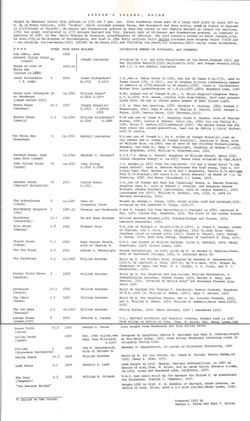
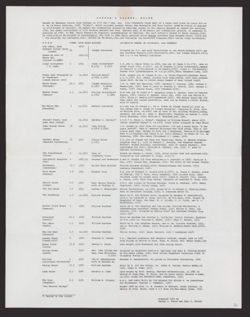
Sutton Island houses information
SUTTON'S ISLAND MAINE
Bought by Ebenezer Sutton from Indians in 1755 for 2 qts. run, Five Cranberry Isles part of a large land grant by Louis XIV to
M. de la Motte Cadillac, 1688. "Acadie", which included present Maine, New Brunswick and Nova Scotia, ceded by France to England
in
1713(Treaty
of
Utrecht).
Mt.
Desert
and
Cranberries
granted
by
Mass.
Bay
colony
to
Gov.
Francis
Bernard
as
reward
for
services,
1762; but grant confiscated in 1776 because Bernard was Tory. Eastern half of Mt.Desert and Cranberries granted, in response to
petition of 1787, to Mere. Maria Theresa de Gregoire, granddaughter of Cadillac. She sold Sutton's Island to Henry Jackson,1792
he sold,1796. to n.Bingham of Philadelphia, who died in 1804 Early settlers built before purchase from Bingham heirs: 65A(W end
+
ctr.strip)by Jos.Lancaster,1835; 39A(NE) by Wm.Moore, 1837, and 42A(SE)by Jos.Moore, his stepsons; 38A(s ctr.)by Isaac Richardson
N M E
ACRES DATE BUILT BUILDER
SUCCESSIVE OWNERS OR OCCUPANTS, and COMMENTS
Log cabin, near
1806
present Gilley house
65
(razed)
Joseph Lancaster
Occupied by J.L. and wife Nancy(widow of Jos Moore, drowned 1805) and
her children Nancy(b.1799),william*(b.1801) and Joseph Moore(b.1803),
House on site of
1810-20
and J.L.'s son Haskell Lancaster
White Hen
(burned ca.1850)
Isaac Richardson
2
1821
Isaac Richardson*
I.R. who m. Nancy Moore in 1820, was son of James R. (b.1730, came to
( R. Lamb)
b.1791 d.1874
Somes Sound 1761, d.1807), son of Stephen R. (from Londonderry, Ireland
to America in 1738: settled in Mt.Desert,1762 Clara A. (Richardson)
Bunker Rice (granddaughter of I.R.;d.1923),1874; Rosamond Lamb, 1922
House near Afterglow 39
ca.1825
William Moore*
W.Mr. oldest son of Joseph M.,Sr., m. Eliza Higgins*; daughter Nancy
or Farmhouse
b.1801 d.1874
L.*, b.1828. W.M. owned, jointly with step-father, dock near present
(razed before 1900)
Lyman dock, He was in latter years keeper of Bear Island Light.
Moore House
25.5
1827
Joseph Moore(jr)
J.M. B. Mary Ann Spurling, 1828. Abraham c. Stanley, 1862; Andrew c.
(Wornser)
b.1803 d.after
Wheelright, 1895; Mary ,wife of Charles B. Church, 1909; George L.
1862
Paine, 1932: Carola Paine, 1949 (Wormser, 1953)
Bunker House
2.3
ca.1845
William Richardson
W.RN was son of Isaac R.*. Daughter Clara A. Bunker, wife of Charles
(Hawtin)
b.1822
d.1864
Bunker, 1864: Lealie R. Bunker, their son, 1892; his son Philip B.,
1924; Elise F. Hawtin,1957(remodeled 1962) The Bunker house was for
many years the island postoffice, last run by Mattie L. (Rice) Bunker,
wife of Lealie.
The White Hen
9
ca.1850
Haskell Lancaster
H.L.was son of Joseph L. he m. widow of Joseph Moore(jr),just as
(Boardman)
his father had m. widow of Joseph Moore(sr). Caroline M. Rice, wife
of William Rice, ca.1866; one or more of her children Wilbert,Loring
Herbert, and Seth H. Mary c. Wheelright, daughter of Andrew c.,1919;
Anita Boardman, 1959: William H. Boardman, son, 1961.
Pernald house, near
ca.1852
Abraham C. Fernald*
A.C.F.* n. Nancy L. Moore*, daughter of William Moore*, about 1853.
town dock (razed)
Infant daughter Nancy* d. ca.1853. House later occupied by Capt.Black
John Gilley house
28
ca.1852
John Gilley
J.G. bought, in 1853 from Jos.Lancaster 53A and a house built "a few
(Lyman)
b.1822 d.1896
years before", then m. Harriet Wilkinson who died young, then m. her
sister Mary Jane. Estate to wife and 3 daughters, Hattie M. (m.Springs)
Mary E. (n.Stanley) and Laura A. (m. Orrin Donnell) on death of J.G. by
drowning, 1896. Mrs.Henry (Elizabeth c.) Lynan, 1924
Kendall House
25
1854
Albion Moore
A.M., son of Joseph and Mary Ann (Sperling) Moore, m. Hannah Stanley.
(Harvard University)
b.1830
Daughter
Mary
E.
wife
of
Edward
J.
Stanley:
2nd
daughter
Hannah
Boulger: Phoebe Mitchell (astronomer, wife of Joshua Kendall), 1885
(purchased for $500): William M. Kendall, son, 1931: K. gave to
Harvard University, 1941.
The Schoolhouse
8
ca.1887
Town of
Bought by George L. Paine, 1929: moved across road and enlarged,1931;
(Paine)
Cranberry Isles
occupied by the Landreth H. Kings, 1932-57.
Bunchberry Bungalow
1
1887-93
Freeman
and Woodworth F. and W. bought 51A from Nancy(Mrs.A.C.) Fernald in 1887; Caroline B.
(Fry)
Fry, 1922: Louise Fry, daughter, 1941 The first of the summer houses.
Windemere
13.5
1889
Wn. and Emma Burnham
William Burnham Stimson, 1928; Ochaenschlager and Turner, 1953:
(Rosenthal)
Lawrence Rosenthal, 1960.
Rice House
1.8
1891
Wilbert Rice
W.R.,son of Wilbert A. Rice(b.1791,d.1874), m. Clara A. Bunker, widow
(Manley)
of Charles, Ida C. Rice their daughter, 1902 (m.Seth Rice; their
children lived on island until 1921): Clara M. Paine*, 1911; George
L. Paine, 1948; Ruth King Manley, daughter of Landreth H. King, 1951.
Church House
6.5
1895
Mary Warren Church,
M.W.C. was sister of William Burnham, Allen R. Memhard, 1925; Henry
(Lange)
wife of Charles B.
Chatfield, 1948; Victor Lange, 1962.
The Tea House
1.5
1895
Andrew C. Wheelright
Nelson Rockefeller, ca.1930: given by R. to Ernest M. Hopkins, Presi-
dent of Dartmouth College, 1935: R. retained about 8A
The Parmhouse
1.3
ca.1898
William Burnham
Built by B. for Wilbert Rice; occupied by Hermann M. Hessenbruch,
1903-4, by Landreth H. King, 1907-30, by A.Gano, 1931. Bought by
daughters of Gano, the Mmes. W. S. Silsby, C. M. Closz, and T. J.
Nussdorfer, 1948.
Rachel Field House
1
1898
William Burnham
Built by B. for daughter and son-in-law, Willian Worchester, a
(Kenniel)
Swedenborgian minister: Rachel Field, 1924: Walter B. Kahn, now
Kenniel, 1941. Occupied by Wyncie King* and Hortense Flexner King
until 1960
Afterglow
10.5
1899
William Burnham
Built by Burnham for Charles A. Gilchrist; Persis Furbush, daughter
(Hottel)
of 7.8.2902 (m. William H. Eades, 1925); Hoyt c. Hottel, 1955
The Cabin
0.5
1900
William Burnham
Built by B. for daughter Persis, who m. Dr. Lincoln Furbush, 1902,
(Eades)
and m. William H. Eades, 1925; William H. Eades(m.Honor Gano, 1948),
1948.
The Cow Barn
1.5
ca.1900
William Burnham
Philip Bunker, 1924 Mason Fernald, 1954 ( remodeled 1956)
(Pernald)
Lanman House
8
1902
Charles R. Lanman
C.L., Harvard professor and Sanskrit scholar, bought land in 1887
(razed, 1952)
from Gilley on advice of Pres. Chas. W. Eliot; Mrs. Henry Lynan, 1915
Buena Vista
53.8
1902
George L. Paine
Lots bought from Woodworth and from Gilley heirs.
(Paine)
Gilley house
1904
Mrs. John Gilley, nee
Occupied by daughters Hattie M. Springer and Mary E. Stanley bought
(Lyman)
Mary Jane Wilkinson
by Mrs Henry Lyman, 1924, with Gilley daughters retaining right of
d.1918
occupancy during life.
Fir-Lea
1
1904
Ida M. Hessenbruch,
Hernann M. Hessenbruch, Jr.igiven to Princeton University, 1961
(Princeton University
wife of Hermann M.
Talley House
10.5
1908
William Burnham
Built by B. for his doctor, Dr. James E. Talley; Persis Eades,ca.
1925; James H. Shaw, 1955.
Lamb House
9.5
1924
Horatio A. Lamb
Land bought by Prof. Byerly, Harvard mathematician, in 1884 on
advice of Pres.Chas. W. Eliot, but he never built; Horatio A.Lamb,
ca.1923; Aimee and Rosamond Lamb, daughters, 1950.
The Dory
2.3
1931
William B. Stimson
W.B.S. had cabin built by Jin Sprague for Eloise s. as guesthouse
(Campbell)
for Windemere; Charles I. Campbell, 1957.
"The Natural Bridge
Bought 1886 by Prof. P. B. Goodwin of Harvard, Greek scholar, on
advice of Pres. Eliot, with a 3.2 acre lot;Mrs.Henry lyman, 1932.
. Buried on the island.
Prepared 1963 by
George L. Paine and Hoyt c. Hottel
Viewer Controls
Toggle Page Navigator
P
Toggle Hotspots
H
Toggle Readerview
V
Toggle Search Bar
S
Toggle Viewer Info
I
Toggle Metadata
M
Zoom-In
+
Zoom-Out
-
Re-Center Document
Previous Page
←
Next Page
→
Sutton Island houses information
Document, Sutton Island Houses, by George L. Paine & Hoyt Hottel, 1963. (See also item #834)
Details
No Copyright - Non-Commercial Use Only
1000.112.834